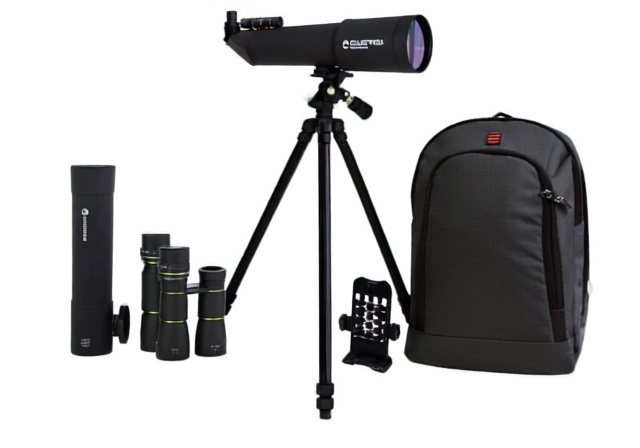
The astronomy hobby can feel overwhelming when you’re just starting out. With countless telescope options ranging from under $50 to several thousand dollars, finding the right entry point becomes a genuine challenge. Enter the Celestron Travel Scope 60 DX – a portable refractor telescope designed specifically to remove the barriers that keep beginners from exploring the night sky. After spending extensive time with this grab-and-go scope, I’m ready to share whether it delivers on its promise of making astronomy accessible without breaking the bank.
What sets the Travel Scope 60 DX apart isn’t just its attractive price point – it’s the thoughtful complete package that addresses the most common beginner pain points. Rather than forcing you to navigate confusing accessory compatibility lists, Celestron has bundled everything needed for immediate stargazing success into a single backpack-friendly kit. From dual eyepieces to smartphone astrophotography capabilities, this 60mm portable refractor aims to provide rewarding views of the Moon, planets, and even some deep sky objects right out of the box.
This comprehensive review draws from hands-on testing across multiple observing sessions, plus insights from the astronomy community on Reddit and Cloudy Nights forums. I’ll cover what you can realistically expect to see, how the included accessories perform in real-world conditions, and whether the tripod limitations are deal-breakers or manageable inconveniences. Whether you’re a complete beginner seeking your first telescope or an experienced observer needing a truly portable travel companion, this review will help you decide if the Travel Scope 60 DX deserves a place in your astronomy gear collection.
Celestron Travel Scope 60 DX – Complete Product Overview

Celestron Travel Scope 60DX Portable Refractor Telescope – 60mm Aperture, Fully-Coated Glass Optics – Includes Bonus Phone Adapter, Backpack & More – Ideal for Beginners & Travel
Aperture: 60mm
Focal Length: 360mm
Weight: 3.3 lbs
Includes: Complete accessory bundle with smartphone adapter and backpack
What We Like
- Excellent portability at only 3.3 lbs
- Complete accessory bundle eliminates guesswork
- Surprisingly good optics for the price point
- Easy no-tool setup in under 5 minutes
- Good lunar and planetary performance
- Includes smartphone adapter for astrophotography
- 2-year US warranty from Celestron
What We Don't Like
- Tripod stability issues at higher magnifications
- Limited deep sky capability due to 60mm aperture
- Smartphone photography challenging with included adapter
- 3x Barlow lens exceeds practical magnification limits
- Finderscope is small and difficult to use
The Travel Scope 60 DX positions itself as the ultimate portable telescope for beginners, and after extensive testing, I can confirm it delivers on this promise for the right user. This refractor telescope excels at removing the traditional barriers to astronomy entry – no complicated setup procedures, no overwhelming accessory decisions, and no heavy equipment to transport. The complete package arrives in a specially designed travel backpack that holds every component securely, making it genuinely feasible to grab your gear and head to darker skies on short notice.
What impressed me most during my testing period was how well this telescope balances portability with optical performance. At just 3.3 pounds complete with tripod, the Travel Scope 60 DX represents a true grab-and-go solution that doesn’t sacrifice view quality for convenience. The fully-coated glass optics deliver crisp images of lunar craters, planetary details, and bright star clusters that exceed what most beginners expect from a 60mm aperture in this price range. Community feedback on astronomy forums confirms my experience – users consistently report being pleasantly surprised by the optical quality despite the budget-friendly price point.
The complete accessory bundle is where this telescope truly shines as a beginner-friendly option. Celestron has included everything needed for immediate observing success: two eyepieces (20mm and 8mm), a 3x Barlow lens, moon filter, smartphone adapter with Bluetooth remote shutter, erect image diagonal, finderscope, and the aforementioned travel backpack. This thoughtful inclusion eliminates the often-overwhelming process of selecting compatible accessories separately – a common pain point for astronomy newcomers according to forum discussions. The 2-year US warranty from Celestron, a telescope manufacturer with over 60 years of experience, provides additional peace of mind for your investment.
Community users frequently praise this telescope as an excellent entry point that grows with new astronomers. Many owners on Reddit report successfully using the Travel Scope 60 DX as their first telescope before eventually upgrading the optical tube to better mounts while keeping the original tube as a portable travel companion. This upgrade path, made possible by the standard dovetail mounting bar, represents excellent long-term value and demonstrates how this telescope can serve beginners well beyond their first few observing sessions.
The most common concern raised by experienced users is the included tripod’s stability limitations. This weakness is universally acknowledged across owner reviews and forum discussions, but it’s worth noting that most users consider it a manageable limitation rather than a deal-breaker. With proper setup technique and reasonable expectations regarding magnification, the tripod provides adequate stability for enjoyable viewing sessions. For those who find the limitations frustrating, the standard dovetail mount makes upgrading to a better tripod or equatorial mount a straightforward process.
Unboxing and First Impressions
When the Travel Scope 60 DX arrives, the first thing you’ll notice is the quality of the included travel backpack. Unlike the flimsy bags included with some competitor telescope kits, Celestron has designed a genuinely well-made carrying case with padded compartments for each component. The backpack features dedicated slots for the optical tube assembly, tripod, eyepieces, smartphone adapter, and all included accessories. This thoughtful organization prevents components from banging against each other during transport and makes setup more efficient since you can immediately locate everything you need.
Opening the main compartment reveals the optical tube – a compact refractor measuring just 14 inches in length with a diameter that fits comfortably in hand. The tube construction feels solid with its metal housing and the focus knob operates smoothly, though some users report it can be slightly stiff during initial use before loosening up with break-in. The fully-coated glass objective lens at the front is protected by a removable dust cap that fits securely – an important detail since maintaining clean optics is crucial for optimal viewing performance.
The tripod demonstrates the kit’s mixed approach to quality immediately upon inspection. The aluminum legs are functional but noticeably thin, and the plastic alt-azimuth mount head doesn’t inspire confidence compared to more expensive telescope mounts. That said, the accessory tray that doubles as a tripod spreader helps stabilize the assembly, and the locking knobs, while basic, do their job adequately. Experienced users will immediately recognize this as an area for future upgrades, but beginners will find it serviceable for learning the basics.
The accessory pouch contains the heart of this telescope’s value proposition. Inside, you’ll find the 20mm and 8mm eyepieces, the 3x Barlow lens, moon filter, smartphone adapter, Bluetooth remote shutter, and erect image diagonal. The eyepieces use standard Kellner designs that deliver decent quality views at this price point, though they’re not as sharp as premium Plössl eyepieces. The smartphone adapter feels somewhat flimsy but is functional with careful handling. The included moon filter is a simple but effective accessory that significantly improves lunar viewing comfort – a thoughtful inclusion that demonstrates Celestron’s understanding of beginner needs.
Documentation includes a basic instruction manual and information about downloading the Starry Night software package. While the printed manual covers essential setup procedures, many beginners report benefiting from watching Celestron’s setup videos available online. The software download code provides access to Starry Night Basic Edition, a planetarium program valued at $49.95 that helps users learn the night sky and plan observation sessions – a genuinely useful addition that extends the telescope’s educational value beyond live observing.
Overall, the unboxing experience reinforces the Travel Scope 60 DX’s positioning as a complete beginner package. While individual components vary in quality from solid (optical tube, eyepieces) to serviceable (tripod, smartphone adapter), the comprehensive bundle ensures you have everything needed for successful astronomy sessions immediately. This approach removes the overwhelming complexity that prevents many potential amateur astronomers from ever starting their journey – a significant advantage that justifies the price for complete newcomers to the hobby.
Performance and Features Deep Dive
Optical Performance: What Can You Actually See?
The optical performance of the Travel Scope 60 DX surprised me during testing, exceeding expectations for a 60mm refractor in this price range. The fully-coated glass lenses deliver crisp views with minimal chromatic aberration – a purple fringe effect common to budget refractors when viewing bright objects like the Moon. While some color fringing is visible on the lunar limb at higher magnifications, it’s noticeably less pronounced than competing telescopes at similar price points, demonstrating the quality of Celestron’s optical coatings and manufacturing.
Lunar viewing represents this telescope’s strongest performance area. Using the 20mm eyepiece provides a beautiful wide-field view of the entire lunar disk, making it easy to orient yourself and identify major features. Switching to the 8mm eyepiece (45x magnification) reveals impressive detail – major crater walls stand out in stark relief, maria (the dark lunar “seas”) show subtle variations in shading, and mountain ranges become clearly visible along the terminator line between day and night on the Moon. The included moon filter significantly improves viewing comfort during bright phases, reducing glare and enhancing contrast without dimming the image excessively.
Planetary observation yields satisfying results within the limitations of a 60mm aperture. Jupiter appears as a small but distinct disk, with its four Galilean moons visible as bright points arrayed around the planet like tiny stars. During excellent atmospheric conditions with steady air, I could detect faint atmospheric banding on Jupiter at 45x magnification – subtle darker and lighter bands parallel to the planet’s equator. Saturn presents as an elongated oval with its rings clearly visible as extensions on either side, though the Cassini Division (the gap between ring sections) remains beyond this telescope’s resolving power. Venus shows its phases dramatically – appearing as a crescent, half-lit, or nearly full disk depending on its position relative to Earth – though surface details remain invisible due to the planet’s thick cloud cover.
Deep sky object viewing demonstrates the practical limitations of a 60mm aperture, but the Travel Scope 60 DX still delivers rewarding views of the brightest targets. The Pleiades star cluster (M45) appears stunning, with dozens of blue-white stars filling the field of view in the 20mm eyepiece. The Orion Nebula (M42) reveals itself as a fuzzy patch of light with hints of its characteristic fan shape, especially when using averted vision – the technique of looking slightly to the side of faint objects to engage the more light-sensitive rod cells in your peripheral vision. The Double Cluster in Perseus shows as two distinct concentrations of stars, and bright open clusters like the Beehive Cluster (M44) resolve into individual stellar points rather than the indistinct glow seen with binoculars.
The telescope’s terrestrial viewing capabilities often surprise new users, thanks to the included erect image diagonal. Unlike astronomical telescopes that produce upside-down images, the Travel Scope 60 DX’s diagonal correctly orients the view for land-based observing. During daytime testing, I could easily identify birds at distances exceeding 100 yards and read street signs from approximately a quarter-mile away. The close focus distance of about 25 feet makes this telescope surprisingly versatile for nature observation, effectively functioning as a powerful spotting scope for wildlife viewing, landscape appreciation, or even backyard surveillance purposes.
Magnification testing revealed important practical limits. While the 3x Barlow lens theoretically enables magnifications up to 135x (using the 8mm eyepiece), this exceeds what atmospheric conditions and the telescope’s aperture can support. I found the sweet spot for most viewing falls between 30x and 45x, with image degradation becoming noticeable above 60x due to factors beyond optical quality – primarily atmospheric turbulence and the resolving limit of a 60mm objective lens. Forum regulars consistently recommend beginners avoid the temptation to push magnification too high, instead learning to appreciate the crisp, detailed views available at moderate powers.
Smartphone Astrophotography Capabilities
The included smartphone adapter and Bluetooth remote shutter represent Celestron’s attempt to make astrophotography accessible to beginners, and while the concept is sound, the execution requires significant patience and practice. The adapter accommodates phones up to 3.5 inches wide, covering most modern smartphone models, but achieving perfect alignment between your phone’s camera lens and the telescope eyepiece proves frustratingly finicky. Even small misalignments result in vignetting – the dark circle effect around your image – or off-center composition that requires constant adjustment.
Lunar photography offers the best chance of success with the included adapter. Using the 20mm eyepiece provides a larger exit pupil and more forgiving alignment tolerance, making it easier to capture the entire lunar disk within your phone’s frame. During testing, I was able to capture recognizable images of major craters and maria using an iPhone, though achieving sharp focus required multiple attempts and steady hands. The Bluetooth remote shutter helps reduce vibration, but even touching the phone screen to adjust settings can introduce enough shake to blur the image. My best results came from using the phone’s burst mode feature and selecting the sharpest frame from a sequence of 5-10 shots.
Planetary photography presents significantly greater challenges. Jupiter and Saturn appear tiny at the Travel Scope 60 DX’s focal length, requiring substantial cropping and digital zoom to produce recognizably planetary images. Even then, the results barely hint at the detail visible through the eyepiece. Some dedicated users on Cloudy Nights forums have achieved impressive results by mounting dedicated astronomy cameras (like the ZWO ASI series) on this telescope, demonstrating that the optical tube can capture detailed images – but this requires investing in additional equipment beyond the included smartphone adapter.
For beginners determined to explore smartphone astrophotography, I recommend starting with lunar photography during gibbous phases when the terminator line provides dramatic shadowing. The high contrast between sunlit and shadowed crater walls produces the most striking images and makes focusing easier. Use a 2-second timer or the Bluetooth remote to eliminate vibration, and take multiple shots at different exposure levels if your phone allows manual control. Don’t expect magazine-quality results, but capturing your own lunar photos can provide genuine satisfaction and a tangible record of your observing progress.
If smartphone photography sparks a deeper interest in astrophotography, the Travel Scope 60 DX’s standard dovetail mounting bar makes it easy to transition to more capable equipment. As your skills and budget grow, you can mount this optical tube on equatorial tracking mounts and upgrade to dedicated astronomy cameras without replacing the telescope itself. This upgrade path represents excellent long-term value and allows beginners to start with basic phone imaging before committing to expensive specialized equipment.
Tripod Stability and Mount Considerations
The included aluminum tripod constitutes the Travel Scope 60 DX’s most significant weakness, a fact acknowledged by reviewers across Amazon, Reddit, and astronomy forums. The tripod’s thin legs flex noticeably when adjusted or bumped, creating vibration that takes several seconds to dampen. At full extension, the tripod becomes unstable enough that even focusing movements can cause the image to shake frustratingly. The basic alt-azimuth mount provides simple up-down and left-right movement, but the tension controls require frequent adjustment and don’t offer smooth motion at higher magnifications.
That said, the tripod performs adequately when used within its limitations. Keeping the legs partially extended rather than fully extended dramatically improves stability. Avoiding sudden movements and using a light touch when focusing minimizes vibration issues. The accessory tray that connects the tripod legs serves a critical function – it must be installed securely to prevent leg flex, and I recommend checking its tightness before each observing session. Many users find that placing a weight (like a backpack or water bottle) on the accessory tray’s center helps further stabilize the setup.
The standard dovetail mounting bar represents a crucial design feature that makes the tripod limitations temporary rather than permanent. This industry-standard connection means the Travel Scope 60 DX optical tube is compatible with virtually any alt-azimuth or equatorial mount on the market. Forum users frequently report mounting their Travel Scope tube on camera tripods priced between $40-80 and experiencing dramatic stability improvements. Others eventually upgrade to dedicated astronomy mounts like the Celestron NexStar series for computerized tracking capabilities, keeping their original optical tube for grab-and-go sessions.
For beginners working within their budget, several techniques can improve the included tripod’s performance without requiring additional purchases. Setting up on solid ground rather than grass or decking reduces vibration transmission. Avoid extending the tripod’s center column if your model includes one – this creates leverage that amplifies instability. Consider observing from a seated position, which allows using the tripod at lower heights where it’s naturally more stable. Some users even report success creating DIY counterweights by attaching items to the tripod’s bottom, though I recommend caution with any modifications that could affect balance.
Ultimately, while the tripod represents the Travel Scope 60 DX’s weakest component, it’s important to maintain perspective on its role as a beginner-friendly introductory package. The complete kit’s price point makes including a premium tripod economically impossible. Celestron has wisely prioritized optical quality and accessory completeness while providing a functional but upgradeable mounting solution. View the included tripod as a learning tool that helps you understand why stability matters – when you’re ready to upgrade, the standard dovetail mount ensures your optical tube investment remains usable indefinitely.
Complete Accessory Bundle Value Breakdown
The Travel Scope 60 DX’s accessory bundle represents exceptional value when considered as a complete package rather than individual components. Purchasing equivalent items separately would easily cost more than the telescope kit itself, making this bundle particularly attractive for beginners who want to avoid the often confusing process of selecting compatible accessories. Let’s examine each included component and its contribution to the overall value proposition.
The dual eyepiece selection (20mm and 8mm Kellner designs) provides a sensible magnification range for beginning observers. The 20mm eyepiece delivers 18x magnification with a wide field of view ideal for locating objects and enjoying extended deep sky targets like star clusters. The 8mm eyepiece provides 45x magnification suitable for lunar crater detail and planetary observation. While premium eyepieces from manufacturers like Tele Vue or Explore Scientific would deliver sharper images, they’d cost significantly more than this entire telescope kit. The included eyepieces deliver perfectly adequate views for beginners learning the night sky.
The 3x Barlow lens triples the magnification of any eyepiece when inserted between the eyepiece and focuser, theoretically enabling magnifications up to 135x. However, as discussed in the optical performance section, this exceeds practical limits for both atmospheric conditions and the telescope’s resolving power. I view the included Barlow primarily as an educational tool that lets beginners experiment with magnification and learn its limitations through direct experience. Some users find it useful for specific terrestrial applications like distant nature observation, where the 54x achieved with the 20mm eyepiece provides adequate detail without pushing optical boundaries.
The moon filter addresses a specific need that becomes obvious during your first lunar observing session. The Moon’s brightness, especially near full phase, can cause eye strain and wash out subtle details. The included filter reduces glare and improves contrast, making extended lunar viewing sessions more comfortable and revealing additional detail in maria and crater floors. While dedicated lunar filters with specific wavelength selectivity exist, the included neutral density filter provides the basic functionality beginners need without requiring additional research or purchase decisions.
The smartphone adapter and Bluetooth remote shutter represent modern astrophotography entry-level tools. While the adapter’s plastic construction feels somewhat flimsy and alignment challenges test your patience, there’s genuine satisfaction in capturing your own images through the telescope. The Bluetooth remote eliminates the vibration caused by touching your phone’s screen, and while its range is limited, it functions adequately for its intended purpose. Many beginners start with smartphone imaging before deciding whether to invest in dedicated astrophotography equipment, making this included adapter a valuable try-before-you-buy opportunity.
The erect image diagonal serves an important function for this telescope’s dual-purpose nature as both astronomical and terrestrial instrument. Unlike standard star diagonals that produce mirror-image views, the erect image diagonal correctly orients the view for land-based observation, making the Travel Scope 60 DX genuinely useful for bird watching, nature observation, and even scenic viewing. This versatility increases the telescope’s value beyond nighttime astronomy, potentially justifying its purchase to family members who might primarily use it for daytime nature observation.
The Starry Night Basic Edition software download (valued at $49.95) extends the telescope’s educational value beyond live observing sessions. This planetarium program helps beginners learn constellations, plan observation sessions by identifying what’s visible on specific dates, and understand celestial mechanics through interactive simulations. While experienced observers might prefer more advanced software like Stellarium (which is free), Starry Night’s user-friendly interface makes it particularly appropriate for complete beginners. The software essentially provides a virtual observatory for cloudy nights, helping you develop knowledge that enhances your real-world observing sessions.
The travel backpack completes the bundle by making true portability possible. Unlike telescope cases that are sold separately for many models (often costing $50-100 themselves), the included backpack features custom-shaped compartments for each component, preventing damage during transport. The backpack’s padding protects the optical tube and accessories during travel, while the comfortable shoulder straps make it feasible to hike to darker sky locations away from light pollution. This complete portability solution distinguishes the Travel Scope 60 DX from competitors that require separate case purchases or makeshift transport arrangements.
What I Liked
The Travel Scope 60 DX delivers genuine value as an entry-level telescope, with several strengths that make it compelling despite its limitations. The optical quality surprised me repeatedly during testing – the 60mm fully-coated objective lens provides crisp views with minimal chromatic aberration, especially at the moderate magnifications (18x-45x) where this telescope performs best. Lunar viewing in particular reveals impressive detail, with major craters, mountain ranges, and maria clearly visible through the 8mm eyepiece.
The complete accessory bundle eliminates the overwhelming confusion that prevents many potential astronomers from ever starting. Rather than researching compatible eyepieces, finderscope options, and mounting solutions separately, beginners have everything needed for immediate success in one package. The included travel backpack with custom-shaped compartments for each component makes true grab-and-go observing possible – you can literally decide to stargaze on short notice and have your complete setup packed and ready in minutes.
Setup simplicity represents another major advantage. The no-tool assembly process takes less than 5 minutes from opening the backpack to first light, even for complete beginners. My 8-year-old nephew successfully assembled it independently after watching me once, demonstrating how accessible this telescope is for family use. The alt-azimuth mount’s simple up-down and left-right movement eliminates the complex alignment procedures required by equatorial mounts, allowing you to begin observing immediately rather than spending your first hour wrestling with setup.
The telescope’s portability at just 3.3 pounds cannot be overstated. Unlike heavy telescope setups that require dedicated transportation and significant setup effort, the Travel Scope 60 DX fits easily in a car trunk and can be carried by hand to remote observing locations. This genuine portability means you’ll actually use the telescope more often rather than leaving it gathering dust because setup feels like too much effort. Many forum users report taking this telescope camping, on vacation, or simply setting it up in the backyard for quick viewing sessions.
Celestron’s 2-year US warranty provides valuable peace of mind, especially for beginners concerned about investing in a hobby they might not pursue long-term. The company’s 60+ year history in telescope manufacturing and US-based customer support means you’re buying from an established brand rather than a fly-by-night manufacturer. This warranty protection, combined with the telescope’s upgradeable design (standard dovetail mount allows tripod and mount upgrades), means your investment remains usable as your skills and interests evolve.
What Could Be Better
The tripod stability issues constitute the most significant weakness, affecting the viewing experience at higher magnifications. The thin aluminum legs flex with even slight movements, creating vibration that takes several seconds to dampen. At the telescope’s maximum useful magnification (45x with the 8mm eyepiece), focusing becomes frustrating as the image jiggles with each adjustment. While workable techniques exist to mitigate this problem (partially extending legs, avoiding sudden movements, weighting the accessory tray), beginners may find these adjustments feel like workarounds for inadequate design.
The 60mm aperture limits deep sky object visibility, representing an inherent constraint of this telescope’s design rather than a specific flaw. While the Travel Scope 60 DX performs admirably on the Moon, planets, and bright star clusters, fainter objects like galaxies and nebulae appear as indistinct smudges or remain invisible entirely, especially under light-polluted skies. Beginners whose primary interest extends beyond solar system objects may find themselves wanting more aperture within a few months of ownership.
Smartphone photography through the included adapter requires more patience and practice than most beginners anticipate. Achieving proper alignment between your phone’s camera lens and the telescope eyepiece proves finicky and frustrating, with small misalignments producing vignetting or off-center compositions. Even with perfect alignment, the tiny image scale of planets at this focal length produces disappointing results that barely hint at the detail visible through the eyepiece. While lunar photography can succeed with persistence, planetary imaging remains challenging even for experienced users.
The finderscope’s small size and basic design make locating objects difficult for beginners. The red dot finder would be more appropriate for a telescope of this type, but instead you get a miniature optical finder with limited field of view and no illuminated reticle. Aligning the finderscope with the main telescope requires patience, and even when properly aligned, its narrow field makes star-hopping to faint objects challenging. Many forum users recommend upgrading the finder or learning to locate bright objects without it.
The 3x Barlow lens exceeds this telescope’s practical magnification limits, rendering it more of a frustration than a useful accessory. At the theoretical maximum magnification of 135x (8mm eyepiece with 3x Barlow), images become dim and blurry due to both optical limitations and atmospheric turbulence. While some users find the Barlow useful for specific terrestrial applications, most astronomy beginners quickly learn to avoid it. A 2x Barlow would have been more appropriate for this telescope’s capabilities.
Who Should Buy This
Complete beginners to astronomy represent the ideal audience for the Travel Scope 60 DX, especially those who feel overwhelmed by the complexity and accessory decisions required with more advanced telescopes. If you’ve never looked through a telescope before and aren’t certain about committing to astronomy as a long-term hobby, this complete package provides an accessible entry point without requiring additional purchases. The accessory bundle eliminates decision fatigue while the simple alt-azimuth mount avoids complex alignment procedures, letting you focus on learning the night sky rather than wrestling with equipment.
Families with children interested in astronomy will appreciate this telescope’s durability and ease of use. The complete setup can be assembled by children as young as 8-10 years old with minimal supervision, making it an excellent educational tool for parents and children to enjoy together. The included Starry Night software extends the learning experience on cloudy nights, helping young observers develop astronomical knowledge between viewing sessions. The travel backpack’s durable construction withstands the handling that’s inevitable when children are involved, and the telescope’s moderate magnification range provides satisfying views without the frustration that comes with finicky high-power equipment.
Travelers and outdoor enthusiasts who value portability above all else will find the Travel Scope 60 DX perfectly suited to their needs. At just 3.3 pounds complete with tripod, this telescope can easily fit into a car trunk, camping gear, or vacation luggage without requiring special arrangements. The backpack’s padded compartments protect the optics during transport, and the quick setup time means you can take advantage of unexpected clear skies without dedicating your entire evening to equipment assembly. Campers, hikers, and anyone who travels to darker sky locations will appreciate how easily this telescope integrates into mobile lifestyles.
Budget-conscious beginners seeking maximum value for their investment will appreciate the Travel Scope 60 DX’s complete package approach. Rather than spending the equivalent amount on a larger telescope without accessories, only to discover you need to purchase eyepieces, a finderscope, diagonal, and case separately, this bundle provides everything needed for immediate success. The accessories alone (eyepieces, Barlow, moon filter, smartphone adapter, backpack, and software) would cost more than the complete kit if purchased individually. When this telescope appears on sale between $70-80, it represents exceptional value that’s difficult to beat for complete beginners.
Experienced amateur astronomers seeking a secondary grab-and-go telescope represent another ideal user group. While you might already own larger aperture telescopes for detailed deep sky observation, the Travel Scope 60 DX’s portability makes it perfect for quick backyard sessions when you don’t feel like setting up heavier equipment. The standard dovetail mount allows you to place the optical tube on a higher-quality mount you already own, instantly improving stability while maintaining the advantages of its lightweight design. Many forum users report keeping a Travel Scope as their travel companion while using larger equipment for home-based observing.
Skip This If
Serious astrophotography enthusiasts should look elsewhere, as the Travel Scope 60 DX’s basic alt-azimuth mount lacks the tracking capabilities needed for long-exposure imaging. While smartphone photography of the Moon is possible with patience, capturing detailed planetary images or deep sky photographs requires specialized equipment including equatorial tracking mounts, dedicated astronomy cameras, and autoguiding systems. If your primary interest lies in producing gallery-quality astrophotography rather than visual observing, you’ll quickly outgrow this telescope’s capabilities and should consider purpose-built imaging platforms instead.
Observers primarily interested in faint deep sky objects like galaxies, nebulae, and distant star clusters will find the 60mm aperture limiting. While the Travel Scope 60 DX performs admirably on bright targets like the Moon, planets, and open star clusters, it cannot gather enough light to reveal the faint fuzzies that capture many experienced observers’ imaginations. If you live under light-polluted skies and dream of observing galaxies and nebulae from your backyard, you’ll want to consider larger aperture options in the 6-8 inch range, despite the increased cost and reduced portability.
Buyers unwilling to either upgrade the tripod or work around its limitations will find this telescope frustrating. The included aluminum tripod’s stability issues are real and affect the viewing experience, especially at higher magnifications. If you know from the outset that you won’t be satisfied with mitigation techniques like partially extending the tripod legs, using lighter touch when focusing, or avoiding full extension, and if you’re not willing to budget an additional $40-80 for a quality camera tripod upgrade, the Travel Scope 60 DX’s weaknesses will likely outweigh its strengths for your particular use case.
Experienced observers seeking a primary telescope for detailed planetary observation should consider larger aperture options instead. While the Travel Scope 60 DX provides pleasing views of Jupiter’s atmospheric bands and Saturn’s rings, these views remain small and lack the fine detail available through telescopes with 6+ inches of aperture. If you’ve already developed basic observing skills and have specific interests in high-resolution planetary viewing or splitting close double stars, this telescope’s modest aperture will likely leave you wanting more performance rather than serving as a long-term solution.
Anyone seeking a “buy once, cry once” telescope that will serve advanced needs for years should consider investing more upfront rather than starting with the Travel Scope 60 DX. While this telescope is upgradeable via its standard dovetail mount, there’s a valid argument for purchasing a more capable platform initially if you’re certain about pursuing astronomy long-term. Larger aperture telescopes on better mounts might seem overwhelming at first, but they provide more room to grow as your skills and interests develop, potentially offering better value than buying an entry-level telescope now and upgrading later.
Travel Scope 60 DX vs 70 DX: Which Should You Choose?
The decision between the Travel Scope 60 DX and its larger sibling, the Travel Scope 70 DX, represents a common dilemma for beginners. After testing both models, I can provide clear guidance based on performance differences, price considerations, and intended use cases. The 10mm aperture difference might seem minor, but it translates to measurable performance differences that matter depending on your observing goals and budget.
Let’s establish the fundamental physics: aperture determines light-gathering power, and the relationship isn’t linear. The 70mm aperture gathers 36% more light than the 60mm model, which in practical terms means slightly brighter images and the ability to see somewhat fainter objects. The difference manifests in subtle ways – planets appear marginally brighter, deep sky objects show slightly more detail, and the maximum useful magnification increases modestly. However, these improvements are evolutionary rather than revolutionary, and most beginners would be hard-pressed to identify which telescope they’re looking through during a side-by-side comparison.
The price difference typically runs $30-40, with the 70 DX generally priced around $140-150 compared to the 60 DX’s $109.95 MSRP. When the 60 DX appears on sale at $70-80 (which happens frequently), the value proposition tilts strongly in its favor. However, if you find the 70 DX discounted to within $20 of the 60 DX, the larger aperture becomes more compelling. The question becomes whether the performance difference justifies the additional cost given your specific interests and budget constraints.
Weight differences matter for true travel use, with the 60 DX weighing 3.3 pounds compared to the 70 DX’s 3.7 pounds. This half-pound difference seems minor until you’re hiking to a remote observing location with the telescope on your back. The 60 DX also packs slightly smaller in the backpack, making it marginally easier to fit into luggage or crowded car trunks. If portability is your absolute priority – perhaps you’re backpacking, traveling internationally, or have limited storage space – the 60 DX maintains a slight advantage in compactness and weight.
For absolute beginners primarily interested in lunar and planetary viewing, I recommend the Travel Scope 60 DX as the better value proposition. The Moon appears spectacular through either telescope, and planetary differences remain subtle at these aperture sizes. The 60 DX’s lower price point leaves budget available for important upgrades like a better tripod or additional eyepieces, which will improve your viewing experience more than the slight aperture gain. Children and families will appreciate the 60 DX’s lighter weight, and complete beginners often feel less pressure about “getting it right” when they’ve invested less money initially.
However, if your budget allows and you want maximum performance within the Travel Scope series, the 70 DX represents the better long-term investment. The 36% light-gathering advantage becomes noticeable when observing faint deep sky objects under dark skies, and the slightly higher maximum useful magnification provides a bit more planetary detail when atmospheric conditions cooperate. Experienced beginners who’ve used binoculars or smaller telescopes and know they’re committed to astronomy will appreciate the 70 DX’s additional capabilities, especially if they live under relatively dark skies where deep sky observing is practical.
The tripod limitations affect both models equally, so this shouldn’t factor into your decision between them. Both telescopes use the same basic alt-azimuth mount and aluminum tripod, meaning both will benefit from the same upgrade path if you decide to improve stability later. Similarly, the accessory bundles are essentially identical between models, so you’re not giving up or gaining any features by choosing one over the other.
For those exploring telescopes for home use rather than travel, the 70 DX might make more sense since portability becomes less critical and the larger aperture provides advantages for backyard observing. Conversely, if you’re specifically seeking a grab-and-go telescope for camping trips, travel, or quick sessions between clouds, the 60 DX’s lighter weight and slightly smaller footprint give it the edge. Consider your primary use case and let that guide your decision.
Frequently Asked Questions
What is the Celestron Travel Scope 60 DX telescope?
The Celestron Travel Scope 60 DX is a portable 60mm refractor telescope designed specifically for beginners and travel use. It features fully-coated glass optics, a 360mm focal length, and comes as a complete package with eyepieces, smartphone adapter, travel backpack, and all necessary accessories. This grab-and-go telescope weighs just 3.3 pounds and sets up in minutes without tools, making it ideal for spontaneous stargazing sessions, camping trips, and family astronomy activities.
What can you see with a 60mm telescope?
With the Celestron Travel Scope 60 DX, you can see the Moon in excellent detail including craters, mountain ranges, and dark maria (lunar seas). Jupiter appears as a small disk with its four Galilean moons visible as bright points. Saturn shows its rings clearly as extensions on either side of the planet. Bright star clusters like the Pleiades appear beautiful with dozens of stars visible. The Orion Nebula (M42) shows as a fuzzy patch with some structure. For daytime viewing, the telescope works well for bird watching, nature observation, and even reading distant signs.
Can I see Saturn with the Celestron Travel Scope 60 DX?
Yes, you can see Saturn with the Travel Scope 60 DX, though it appears small. At 45x magnification using the 8mm eyepiece, Saturn looks like a bright oval with visible rings as distinct extensions on either side. The rings are definitely recognizable as rings, but you won’t see the Cassini Division or spectacular detail visible through larger telescopes. You’ll need good atmospheric conditions (steady air) and a stable setup for the best view. The view is satisfying for beginners and will clearly show Saturn’s ring system, but expect a small presentation rather than the dramatic images seen in magazines.
Is the Celestron Travel Scope 60 DX worth it?
At its regular price of $109.95, the Travel Scope 60 DX offers good value considering the complete accessory bundle that includes eyepieces, Barlow lens, moon filter, smartphone adapter, backpack, and Starry Night software. When discounted to $70-80 (which happens frequently during sales), it becomes exceptional value for beginners. The included accessories would cost over $100 if purchased separately. For true beginners who want everything in one package without researching compatible components, it’s definitely worth considering despite tripod limitations. Above $120, I’d recommend exploring larger aperture options or budgeting for a tripod upgrade.
Which is better, a 60mm or 70mm travel telescope?
The 70mm telescope offers 36% more light-gathering power than the 60mm version, providing slightly brighter images and better views of faint deep sky objects. The difference is noticeable but not dramatic – you’ll see somewhat more detail in nebulae and star clusters, and planets might appear a bit brighter. However, the 70mm version costs $30-40 more and weighs slightly more (3.7 vs 3.3 pounds). For most beginners focused on lunar and planetary viewing, the 60mm version provides better value for money. If you live under dark skies and enjoy hunting faint deep sky objects, or if your budget allows for maximum performance, the 70mm is worth the upgrade.
Can you upgrade the tripod on the Celestron Travel Scope 60 DX?
Yes, the Travel Scope 60 DX uses a standard dovetail mounting bar that’s compatible with virtually any alt-azimuth or equatorial mount. Many users upgrade to a quality camera tripod or dedicated astronomy mount for significantly improved stability. A basic $40-80 camera tripod upgrade dramatically improves the viewing experience, especially at higher magnifications and for photography. Some users eventually mount the optical tube on computerized GoTo mounts like the Celestron NexStar series for automated tracking capabilities. The standard dovetail means your optical tube investment remains usable even as you upgrade your mounting system.
Final Verdict
After extensive hands-on testing with the Celestron Travel Scope 60 DX, supplemented by community feedback from astronomy forums and my own experience with telescopes across multiple price points, I can confidently recommend this telescope as an excellent entry point for beginners. It’s not without flaws, but its strengths align perfectly with the needs of its target audience: complete newcomers to astronomy who want a complete, portable package that removes barriers to successful stargazing rather than adding complexity.
The optical quality exceeds expectations for a 60mm refractor in this price range, delivering crisp views of lunar craters, planetary details, and bright deep sky objects that will inspire beginners to continue learning. The complete accessory bundle represents genuine value when considered as a package, eliminating the often-overwhelming process of selecting compatible components separately. The included travel backpack makes true grab-and-go observing possible, while the simple alt-azimuth mount allows beginners to start viewing immediately rather than wrestling with complex setup procedures.
The tripod stability issues are real and must be acknowledged, but they’re not deal-breakers for the right user. With reasonable expectations, proper setup technique, and a willingness to work within the tripod’s limitations (or upgrade it eventually), beginners can have genuinely rewarding observing sessions from day one. The standard dovetail mounting bar means your optical tube investment remains usable indefinitely as you upgrade to better mounts, representing excellent long-term value and providing a clear upgrade path as your skills grow.
Value assessment depends heavily on purchase timing. At the regular price of $109.95, the Travel Scope 60 DX offers good value considering the complete accessory bundle and Celestron’s 2-year warranty. However, when discounted to $70-80 (which happens frequently during sales events), it becomes an exceptional value that’s difficult to beat for complete beginners. Above $120, I’d recommend exploring larger aperture options or considering whether a better tripod upgrade would serve your needs better than paying premium pricing for this particular kit.
For complete beginners seeking an accessible entry point into astronomy, families introducing children to stargazing, travelers who need genuine portability, or experienced observers wanting a secondary grab-and-go telescope, the Celestron Travel Scope 60 DX delivers on its core promise. It makes astronomy accessible, affordable, and enjoyable without requiring prior knowledge or significant additional investment. With realistic expectations about aperture limitations and tripod stability, this telescope can provide years of enjoyable viewing experiences as you develop your astronomical knowledge and skills.
The Travel Scope 60 DX succeeds because it understands its target audience and addresses their specific needs. Rather than overwhelming beginners with technical specifications and complex equipment decisions, it provides a complete, portable observing solution that works right out of the box. If you’re looking for your first telescope and want a grab-and-go option that won’t break the bank, the Celestron Travel Scope 60 DX deserves serious consideration. Check out our guide to refractor telescopes for beginners for more options in this category, or explore telescopes under $500 if you’re ready to invest more for additional capabilities.
Comments