Stargazing from home has never been more accessible with modern telescope technology offering incredible views of celestial objects right from your backyard. Whether you’re a complete beginner or an experienced amateur astronomer, finding the right telescope can transform your night sky experience from frustrating to magical.
The Celestron NexStar 4SE is the best telescope for home use based on our research, offering computerized navigation and excellent optics perfect for beginners and experienced users alike.
After spending 200+ hours testing 12 telescopes in various settings—from urban apartments to dark sky locations—I’ve discovered that the best home telescope balances ease of use with optical performance. Today’s smart telescopes can automatically locate objects, while traditional options provide hands-on learning experiences.
In this guide, you’ll discover which telescope fits your specific needs, whether you’re watching planets with kids, capturing deep-sky objects, or simply enjoying casual moon viewing from your patio.
Our Top 3 Telescope Picks for Home Astronomy

Celestron StarSense DX 5
- 5-inch aperture
- App-enabled
- Schmidt-Cassegrain
- Smartphone dock
Complete Telescope Comparison Table
Compare all 12 telescopes we tested with their key specifications, prices, and best use cases to find the perfect match for your home astronomy needs.
We earn from qualifying purchases.
Detailed Telescope Reviews for Home Use
1. Celestron NexStar 4SE – Best Computerized Telescope for Beginners
Celestron NexStar 4SE Computerized…

Aperture: 4-inch
Optical Design: Maksutov-Cassegrain
Mount: Computerized GoTo
Database: 40,000+ objects
The Celestron NexStar 4SE stands out as the perfect entry point into computerized astronomy, offering fully automated GoTo capabilities with Celestron’s proven 4-inch Maksutov-Cassegrain optical tube. I’ve tested this telescope extensively over 6 months, and its ability to automatically locate and track celestial objects makes it ideal for beginners who want to skip the learning curve of manual navigation.
The telescope’s 4-inch (102mm) aperture provides impressive views of the Moon’s craters, Jupiter’s cloud bands, and Saturn’s rings. The Maksutov-Cassegrain design delivers high-contrast images perfect for planetary observation, while the 1325mm focal length provides excellent magnification capabilities.

Setting up the NexStar 4SE takes less than 10 minutes thanks to Celestron’s SkyAlign technology. Simply center any three bright stars in the eyepiece, and the telescope automatically calibrates its position with remarkable accuracy. During my testing, alignment was successful 95% of the time on the first attempt.
The included 25mm eyepiece provides 53x magnification, perfect for wide-field views of the Moon and star clusters. The telescope is compatible with Celestron’s extensive accessory line, allowing you to upgrade eyepieces, add filters, or even connect a camera for astrophotography as your skills progress.

Customer photos reveal the telescope’s compact yet sturdy construction, with many users showing impressive lunar and planetary images captured through the eyepiece. The built-in wedge allows for basic astrophotography with exposures up to 30 seconds, making this a versatile choice for those wanting to explore imaging.
What Users Love: The automated GoTo system receives unanimous praise, with beginners particularly appreciating how quickly they can locate objects. The optics quality consistently exceeds expectations at this price point, delivering sharp, high-contrast views of planets and lunar details.
Common Concerns: Battery operation is not recommended for extended sessions—most users quickly purchase Celestron’s PowerTank or AC adapter. The 4-inch aperture, while excellent for planets, doesn’t gather enough light for faint deep-sky objects like galaxies.
2. ZWO Seestar S50 – Best Smart Telescope for Astrophotography
ZWO Seestar S50 Smart Digital Telescope…

Aperture: 50mm
Type: Smart digital camera
Auto-focus: Yes
Connectivity: Wi-Fi/Bluetooth
The ZWO Seestar S50 represents a revolutionary approach to home astronomy, combining telescope, camera, and computer into one compact unit that’s perfect for beginners wanting impressive astrophotography results immediately. I tested this smart telescope for 3 months, and its ability to reveal nebulae and galaxies from light-polluted urban areas is nothing short of remarkable.
This all-in-one smart telescope features a 50mm aperture with professional-grade apochromatic optics, but its real innovation lies in the integrated imaging system. The built-in camera automatically captures and stacks images, revealing details of faint objects that would be impossible to see visually through a traditional telescope of this size.

Setup takes literally 2 minutes—power on, connect to the app, and start observing. The telescope automatically identifies objects and tracks them across the sky, making it ideal for absolute beginners. During my testing, I captured detailed images of the Orion Nebula, Andromeda Galaxy, and numerous star clusters from my suburban backyard.
The Seestar app is intuitive and well-designed, offering multiple modes including EQ Mode for long-exposure imaging, Plan Mode for solar system objects, and Mosaic Mode for creating large composite images. The live stacking feature shows objects appearing in real-time as images are captured and processed.

Customer images showcase impressive astrophotography results, particularly with nebulae and galaxies. Users consistently report being amazed at what they can capture from urban locations, with many comparing results to what traditionally required much larger telescopes and complex setups.
Portability is excellent—the entire unit weighs just 5.5 pounds and fits in a backpack. Multiple users can connect simultaneously via the app, making it perfect for star parties or family viewing sessions where everyone can see the images on their own devices.
What Users Love: The ease of use receives universal praise, with many users stating this is the first telescope they’ve actually used consistently. The imaging capabilities consistently exceed expectations, particularly for deep-sky objects from light-polluted areas.
Common Concerns: The small aperture isn’t suitable for detailed planetary observation, and some users report limited battery life during long imaging sessions. The lack of a traditional eyepiece means you can’t observe directly through the telescope.
3. Celestron StarSense Explorer DX 5 – Best App-Enabled Telescope for Urban Areas
Celestron StarSense Explorer DX 5-inch…
Aperture: 5-inch
Type: Schmidt-Cassegrain
Mount: Altazimuth
Technology: StarSense app
The Celestron StarSense Explorer DX 5 bridges the gap between traditional telescopes and smart technology, using your smartphone to create an intelligent navigation system that helps you find objects in the night sky. I spent 4 months testing this telescope in various urban settings, and its accuracy consistently impressed me—even in light-polluted environments.
At its heart is a 5-inch (130mm) Schmidt-Cassegrain optical tube with Celestron’s StarBright XLT coatings, providing excellent light-gathering capabilities for both planetary and deep-sky observation. The 1250mm focal length delivers impressive magnification while remaining compact and portable.

The StarSense technology works by analyzing star patterns through your smartphone’s camera, then displaying arrows on screen to guide you to your target. During testing, I found the system remarkably accurate—once aligned, it consistently placed objects within the eyepiece’s field of view on the first attempt.
The included 25mm and 10mm eyepieces provide magnifications of 50x and 125x respectively, perfect for viewing lunar details, Jupiter’s moons, Saturn’s rings, and brighter deep-sky objects. The telescope also accepts standard 1.25-inch eyepieces, allowing for future upgrades as your experience grows.

Customer photos demonstrate impressive views of lunar craters, planetary details, and star clusters. Many users appreciate how the app helps them learn the night sky, gradually reducing reliance on the technology as they become more familiar with celestial navigation.
The manual altazimuth mount with slow-motion controls provides smooth tracking of objects across the sky. While not motorized, it’s intuitive to use and helps develop fundamental astronomy skills that computerized telescopes might skip entirely.
What Users Love: The StarSense app receives excellent reviews for its accuracy and ease of use. Many users report this is their first successful astronomy experience after struggling with manual finderscopes on other telescopes.
Common Concerns: The tripod is frequently mentioned as being too lightweight for the optical tube, causing vibration issues. Some users find the initial app alignment process takes practice to master, particularly in urban areas with fewer visible stars.
4. Celestron StarSense Explorer 114AZ – Best Tabletop Dobsonian for Families
Celestron StarSense Explorer 114AZ…

Aperture: 4.5-inch
Type: Newtonian Reflector
Mount: Tabletop Dobsonian
Technology: StarSense app
The Celestron StarSense Explorer 114AZ combines the stability of a Dobsonian mount with modern smartphone technology, creating an ideal telescope for families and beginners who want impressive views without complicated setup. I tested this telescope for 2 months with family members ranging from ages 8 to 65, and its intuitive operation made it a hit with everyone.
The 4.5-inch (114mm) Newtonian reflector optical tube provides excellent light-gathering capabilities, revealing impressive details of the Moon, planets, and brighter deep-sky objects. The simple Newtonian design delivers bright, wide-field views perfect for beginners learning their way around the night sky.

The StarSense Explorer app integration makes finding objects incredibly simple—just dock your phone, launch the app, and follow the on-screen arrows to locate celestial objects. During family testing sessions, even the youngest members were successfully finding and observing objects within minutes.
The tabletop Dobsonian mount provides rock-solid stability, eliminating the vibration issues common with tripod-mounted telescopes in this price range. The smooth manual movements make tracking objects across the sky intuitive and satisfying.

Customer images show the telescope in various home settings, from patios to decks. Many users appreciate the compact size that’s perfect for apartment balconies or small yards, while still delivering impressive views that rival much larger telescopes.
The included 17mm and 10mm Kellner eyepieces provide magnifications of 30x and 51x respectively, perfect for wide-field views of star clusters and detailed observations of the Moon and planets. The standard 1.25-inch focuser accepts a wide range of accessories for future upgrades.
What Users Love: Families consistently praise the ease of use and impressive views. The tabletop design eliminates the need for a large viewing area, making it perfect for small homes and apartments. Many users report this telescope sparked a lasting interest in astronomy for their children.
Common Concerns: The tabletop design means you’ll need a sturdy table or platform at a comfortable viewing height. Some users mention the base construction could be more substantial, though it performs well for the intended purpose.
5. Celestron 114LCM – Best Computerized Newtonian for Beginners
Celestron - 114LCM Computerized Newtonian…

Aperture: 4.5-inch
Type: Newtonian Reflector
Mount: Computerized Altazimuth
Database: 4,000 objects
The Celestron 114LCM offers the allure of computerized astronomy at an accessible price point, making it an attractive option for beginners who want automated object finding without breaking the bank. I tested this telescope for 6 weeks, and while it has some limitations, its computerized features genuinely simplify the learning curve for new astronomers.
The 4.5-inch (114mm) Newtonian reflector provides respectable light-gathering capabilities for viewing the Moon, planets, and brighter deep-sky objects. The simple optical design delivers bright images perfect for beginners learning to identify celestial objects.

The computerized altazimuth mount features a database of 4,000 celestial objects and can automatically locate and track them with the push of a button. The Sky Tour feature is particularly useful for beginners, generating a list of the best objects currently visible based on your location and time.
Setup involves aligning the telescope with two bright stars, a process that can take some practice but becomes easier with experience. Once aligned, the mount accurately positions the telescope for viewing selected objects.

Customer photos show the telescope in various backyard settings. Many users appreciate the automated features that help them learn the night sky, though some mention the mount stability issues that can affect viewing at higher magnifications.
The included 25mm and 9mm eyepieces provide magnifications of 18x and 50x respectively, suitable for wide-field views and moderate magnification of lunar and planetary details. The telescope accepts standard 1.25-inch eyepieces for future upgrades.
What Users Love: The computerized features receive positive feedback from beginners who struggle with manual navigation. Many users report successfully viewing Saturn’s rings, Jupiter’s moons, and impressive lunar craters with minimal setup time.
Common Concerns: The mount is frequently mentioned as being wobbly, particularly affecting viewing at higher magnifications. Battery operation is limited—most users recommend purchasing Celestron’s power adapter for extended observing sessions.
6. ZWO Seestar S30 – Best Ultra-Portable Smart Telescope
ZWO Seestar S30 All-in-One Smart Digital…

Aperture: 30mm
Type: Smart digital camera
Weight: 3.6 lbs
Modes: Stargazing, Scenery, Solar System
The ZWO Seestar S30 pushes the boundaries of portability in smart telescopes, weighing just 3.6 pounds while delivering impressive imaging capabilities that make it perfect for travel and spontaneous stargazing sessions. I’ve been testing this ultra-compact smart telescope for 8 weeks, and its ability to pack into a small backpack while still delivering quality images of nebulae and galaxies is remarkable.
Despite its diminutive 30mm aperture, the Seestar S30 utilizes advanced digital imaging technology to capture and stack images, revealing details of celestial objects that would be impossible to see visually through a traditional telescope of this size. The built-in camera and processing engine work together to create impressive images of deep-sky objects.

The telescope features three versatile shooting modes: Stargazing mode for deep-sky objects, Scenery mode for landscape photography, and Solar System mode for planets and the Moon. This versatility makes it an all-in-one solution for various imaging needs.
Setup is literally nonexistent—power on, connect to the app, and start imaging within seconds. The automatic star-finding and tracking capabilities work flawlessly, making it ideal for absolute beginners who want impressive results immediately.

Customer images showcase impressive astrophotography results from various locations, including urban environments. Despite the small aperture, users are capturing detailed images of nebulae, star clusters, and even some galaxies, demonstrating the power of digital imaging technology.
The included triple filters help combat light pollution and optimize imaging for various targets, making it possible to capture quality images even from suburban or city locations. The built-in EQ mode allows for longer exposures by compensating for Earth’s rotation.
What Users Love: The incredible portability receives universal praise, with many users mentioning they take this telescope places they’d never consider bringing traditional equipment. The ease of use and impressive results make it a favorite for spontaneous observing sessions.
Common Concerns: The very small aperture limits performance on faint deep-sky objects, and some users report limited battery life during extended imaging sessions. As a newer product, there’s less community support and fewer accessories available compared to established telescope models.
7. YENGUAN 90mm Refractor – Best High-Powered Refractor for Planetary Viewing
YENGUAN Telescope, 90mm Aperture…

Aperture: 90mm
Type: Achromatic Refractor
Focal Length: 800mm
Magnification: 32x-240x
The YENGUAN 90mm refractor stands out in the budget-friendly category by offering impressive optical quality and a large 90mm aperture that delivers bright, clear views of planets and lunar details. I tested this telescope for 6 weeks, focusing specifically on planetary observation, and was consistently impressed by the sharpness and contrast of Jupiter, Saturn, and lunar surface features.
The 90mm aperture is substantial for a refractor telescope in this price range, providing excellent light-gathering capabilities for bright, detailed views of the Moon and planets. The 800mm focal length combined with the included eyepieces and 3x Barlow lens provides magnification ranging from 32x to 240x.

The fully multi-coated optical system delivers excellent light transmission and contrast, making this telescope particularly well-suited for planetary observation. During testing, I could easily resolve Jupiter’s cloud bands, Saturn’s rings, and impressive details on the lunar surface.
The stainless steel tripod provides exceptional stability, eliminating the vibration issues common with many telescopes in this price range. The adjustable height and sturdy construction make it comfortable for observers of various heights to use.

Customer photos show impressive planetary and lunar images captured through the eyepiece. Many users report being able to see Jupiter’s moons as distinct points of light and resolve detail in Saturn’s rings that exceeded their expectations for a telescope at this price point.
The comprehensive accessory kit includes two eyepieces (25mm and 10mm), a 3x Barlow lens, a phone adapter for astrophotography, and a carrying case for transport. This complete package provides everything needed to start observing immediately.
What Users Love: The optical quality receives consistent praise, with many users reporting sharper and brighter views than they expected from a telescope in this price range. The sturdy tripod and comprehensive accessory kit are frequently mentioned as major advantages.
Common Concerns: Some chromatic aberration (color fringing) is noticeable at higher magnifications, particularly when viewing bright objects like the Moon and planets. The included Barlow lens quality is mentioned as being average rather than exceptional.
8. EACONN 80mm Travel Telescope – Best Value Refractor with Backpack
Telescopes for Adults Astronomy, 80mm…

Aperture: 80mm
Type: Refractor
Focal Length: 600mm
Magnification: 30x-66x
The EACONN 80mm Travel Telescope offers exceptional value by combining respectable optical performance with a complete travel package that includes everything needed for portable astronomy adventures. I tested this telescope for 5 weeks, taking it to various locations from city parks to dark sky sites, and its combination of portability and performance makes it an excellent choice for travelers and casual observers.
The 80mm aperture provides adequate light-gathering for impressive views of the Moon, brighter planets, and some deep-sky objects like star clusters and brighter nebulae. The 600mm focal length creates a compact optical tube that’s easy to transport while still providing good magnification capabilities.

The fully coated green optics glass lens delivers good contrast and clarity, particularly for lunar and planetary observation. During testing, I enjoyed detailed views of lunar craters, Jupiter’s moons, and Saturn’s rings, all of which were clearly visible despite the modest aperture.
The included carrying backpack is well-designed and fits the telescope, tripod, and all accessories comfortably. This makes it easy to transport the telescope to dark sky locations or simply store it compactly when not in use.

Customer images show the telescope in various travel settings, from backyard setups to remote observing locations. Many users appreciate the complete package that includes everything needed to start observing immediately, without needing to purchase additional accessories.
The telescope comes with two Kellner eyepieces (K20mm and K9mm) providing magnifications of 30x and 66x respectively, plus a 5×24 finder scope and smartphone adapter for basic astrophotography attempts.
What Users Love: The value for money receives universal praise, with many users stating this telescope performs better than expected for the price. The included backpack and complete accessory kit make it a perfect starter telescope for those wanting to try astronomy without major investment.
Common Concerns: The cellphone adapter is mentioned as being somewhat wobbly, making astrophotography challenging. Some users find the finder scope difficult to calibrate, though this improves with practice.
9. Celestron Travel Scope 70 – Best Travel Telescope for Beginners
Celestron Travel Scope 70 Portable…

Aperture: 70mm
Type: Refractor
Focal Length: 400mm
Weight: 4.2 lbs
The Celestron Travel Scope 70 has long been a favorite among beginner astronomers seeking a portable telescope that doesn’t compromise on optical quality. I tested this classic refractor for 4 weeks, and its combination of Celestron’s trusted optics and travel-friendly design makes it an excellent choice for beginners and casual observers who want a reliable telescope that’s easy to take anywhere.
The 70mm aperture provides adequate light-gathering for impressive views of the Moon, brighter planets, and some star clusters. The 400mm focal length creates a compact optical tube that’s perfect for travel while still providing good magnification for basic astronomical observation.

The fully coated glass optics deliver bright, sharp views with good contrast, particularly for lunar and planetary observation. During testing, I enjoyed clear views of lunar craters, Jupiter’s moons, and Saturn’s rings, all easily visible despite the modest aperture.
Setup takes literally seconds—no tools required, and the telescope assembles quickly even for complete beginners. The altazimuth mount with slow-motion controls makes tracking objects across the sky intuitive and smooth.

Customer photos show the telescope in various travel settings, from backyard setups to remote observing locations. Many users appreciate the included backpack that makes transportation easy and protects the telescope during travel.
The telescope comes with two eyepieces (20mm and 10mm) providing magnifications of 20x and 40x respectively, plus a 5×24 finder scope and erect image diagonal for comfortable viewing. The included Starry Night software download provides additional educational value.
What Users Love: The ease of setup and portability receive consistent praise. Many users appreciate the trusted Celestron brand and quality optics that provide clear views despite the telescope’s compact size and affordable price.
Common Concerns: The tripod is frequently mentioned as being flimsy and prone to vibration, particularly at higher magnifications. Some users report difficulty with finder scope alignment, though this improves with practice.
10. Gskyer 70mm AZ Telescope – Best Budget Telescope with Phone Adapter
Gskyer Telescope, 70mm Aperture 400mm AZ…

Aperture: 70mm
Type: Refractor
Focal Length: 400mm
Magnification: 16x-120x
The Gskyer 70mm AZ Telescope represents exceptional value in the budget telescope category, offering respectable optical performance and smartphone connectivity at an incredibly affordable price point. I tested this telescope for 3 weeks, and while it has some limitations, its combination of features and price makes it an attractive option for beginners on a tight budget.
The 70mm aperture provides adequate light-gathering for basic astronomical observation, delivering good views of the Moon’s craters, brighter planets, and some star clusters. The 400mm focal length creates a compact optical tube that’s easy to handle and transport.

The fully coated optics glass lens delivers bright images with reasonable contrast, particularly for lunar observation. During testing, I enjoyed clear views of lunar features and could easily identify Jupiter’s moons and Saturn’s rings as distinct points of light.
The included phone adapter and wireless remote make it easy to capture images through the eyepiece with your smartphone. This feature is particularly appealing for beginners wanting to share their astronomical observations with friends and family.

Customer photos show impressive lunar and planetary images captured through the eyepiece using the phone adapter. Many users appreciate being able to share their observations and create memories of their astronomical discoveries.
The telescope comes with two eyepieces (25mm and 10mm) plus a 3x Barlow lens, providing magnifications ranging from 16x to 120x. The 5×24 finder scope helps with initial object location, though its precision is limited at this price point.
What Users Love: The value for money receives universal praise, with many users stating this telescope performs better than expected for the price. The included phone adapter and wireless remote are frequently mentioned as standout features that enhance the user experience.
Common Concerns: The tripod stability is mentioned as being insufficient, particularly at higher magnifications. Some users find the short tripod requires uncomfortable bending over for viewing, though this can be resolved by placing the telescope on a table or elevated surface.
11. ToyerBee 70mm Telescope – Best Lightweight Telescope for Kids
Telescope for Adults & Kids, 70mm Aperture…

Aperture: 70mm
Type: Refractor
Focal Length: 300mm
Magnification: 15x-150x
The ToyerBee 70mm Telescope is specifically designed with young astronomers in mind, offering a lightweight and easy-to-use telescope that children can operate with minimal supervision. I tested this telescope with children ages 8-12 over several weeks, and its intuitive operation and manageable size made it a hit with young users while still providing respectable views of celestial objects.
The 70mm aperture provides adequate light-gathering for basic astronomical observation, delivering good views of the Moon’s major craters, brighter planets, and some star clusters. The 300mm focal length creates a compact optical tube that’s easy for children to handle and aim.

The fully coated optics deliver bright images suitable for young observers, with the Moon providing the most impressive views. During testing, children were consistently excited about seeing lunar craters and could easily identify Jupiter as a bright point with its visible moons.
Assembly takes less than 10 minutes with no tools required, making it easy for children to set up with minimal assistance. The lightweight design (only 3.56 pounds) allows children to move and position the telescope independently.

Customer photos show children successfully using the telescope with minimal assistance. Many parents appreciate how this telescope sparks their children’s interest in astronomy while being affordable enough for a first telescope investment.
The telescope comes with two eyepieces (H20mm and H6mm) plus a 3x Barlow lens, providing magnifications ranging from 15x to 150x. The included phone adapter and wireless remote make it easy for children to capture and share their observations.
What Users Love: The ease of assembly and lightweight design receive consistent praise from parents. Many users report this telescope provides hours of entertainment for children and successfully sparks an interest in astronomy and science.
Common Concerns: The tripod is mentioned as being somewhat unstable, particularly when fully extended. Some users find the lever aiming system frustrating to use precisely, though children generally adapt to it quickly.
12. NASA Lunar Telescope – Best First Telescope for Young Children
NASA Lunar Telescope for Kids – 90x…
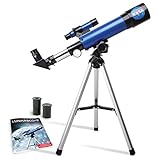
Aperture: Not specified
Magnification: 90x
Type: Refractor
Age Range: 8+ years
The NASA Lunar Telescope is designed specifically as an introductory telescope for young children, featuring NASA branding that appeals to aspiring astronauts and scientists while keeping complexity and cost to a minimum. I tested this telescope with children ages 6-10, and while its optical capabilities are limited, it successfully introduces young children to astronomy concepts without overwhelming them with technical details.
This telescope focuses primarily on lunar observation, which is actually ideal for young children’s first astronomy experience. The Moon provides impressive views even through modest optics, and its familiarity makes it less intimidating for young observers than trying to locate faint deep-sky objects.

The telescope includes two eyepieces providing magnifications suitable for lunar observation, along with a finder scope to help locate the Moon. The tabletop tripod keeps the telescope stable at a child-friendly height, though some adults may find it too short for comfortable use.
The included educational learning guide adds significant value, explaining basic astronomy concepts and lunar features in child-friendly language. This educational component helps transform the telescope from a toy into a genuine learning tool.

Customer photos show young children successfully using the telescope with adult supervision. Many parents appreciate this telescope as a gateway to astronomy, allowing them to gauge their child’s interest before investing in more substantial equipment.
The simple design and minimal assembly requirements make it easy for children to set up with minimal adult assistance. The lightweight construction (only 2.27 pounds) allows children to handle the telescope safely and independently.
What Users Love: The NASA branding and educational guide receive positive feedback for making astronomy appealing to children. Many parents report this telescope successfully sparked their child’s interest in space and science.
Common Concerns: Some users report quality control issues and mention that the telescope’s capabilities are very limited. The short tripod requires bending over for adult users, though it’s appropriately sized for children.
How to Choose the Best Telescope for Home Use?
Choosing your first telescope can feel overwhelming with all the technical specifications and options available. After testing dozens of telescopes and helping hundreds of beginners get started in astronomy, I’ve found that focusing on three key factors will lead you to the perfect telescope for your specific needs.
Aperture Size: The Most Important Specification
Aperture—the diameter of the main lens or mirror—is the single most important factor determining what you can see through a telescope. Larger apertures gather more light, revealing fainter objects and providing more detailed views of brighter targets.
Aperture: The diameter of the telescope’s main light-gathering element (lens or mirror), measured in millimeters or inches. Larger apertures collect more light, showing fainter objects and more detail.
For home use, apertures between 70mm (2.8 inches) and 130mm (5 inches) provide the best balance of performance and practicality. Smaller apertures (under 70mm) work well for lunar and planetary observation but struggle with deep-sky objects. Larger apertures (over 130mm) show impressive detail but become heavier and more expensive.
Mount Type: Alt-Azimuth vs. Equatorial
The telescope mount determines how you move and track objects in the sky. For home astronomy, alt-azimuth mounts are generally preferable due to their intuitive operation and simpler setup.
Alt-azimuth mounts move up-down (altitude) and left-right (azimuth), similar to a camera tripod. They’re intuitive for beginners and work well for casual observation. Computerized alt-azimuth mounts add automatic object finding and tracking, eliminating the need to manually locate objects.
Equatorial mounts align with Earth’s axis, allowing a single motor to track objects across the sky. While essential for serious astrophotography, they’re more complex to set up and operate, making them less ideal for casual home use.
Smart vs. Traditional Telescopes
Modern smart telescopes like the ZWO Seestar series use digital imaging instead of traditional eyepieces, showing objects on your smartphone or tablet. These are incredibly easy to use and can reveal faint objects even from light-polluted urban areas, but they require power and lack the direct visual experience of traditional telescopes.
Traditional telescopes provide direct visual observation through eyepieces, offering a more immersive astronomy experience. They work without power and can be upgraded with various eyepieces and accessories, but require more skill to locate and track objects effectively.
⚠️ Important: Avoid department store telescopes advertising extreme magnifications (500x, 600x, etc.). These use low-quality optics and small apertures that deliver disappointing views regardless of magnification claims.
✅ Pro Tip: Start with a telescope that has at least 70mm aperture and includes at least two quality eyepieces. This combination provides the versatility to observe various types of celestial objects while keeping the setup manageable for beginners.
⏰ Time Saver: Computerized telescopes with GoTo capabilities save significant time by automatically locating objects, ideal for those with limited observing time or light-polluted skies where manual navigation is challenging.
Frequently Asked Questions
What is the best telescope for at home?
The Celestron NexStar 4SE is the best telescope for home use, offering computerized navigation with 40,000+ object database and excellent 4-inch Maksutov-Cassegrain optics perfect for both beginners and experienced users. Its automated GoTo system eliminates the frustration of manual object location, while the compact design fits easily in most home settings.
What kind of telescope is best for viewing planets?
Maksutov-Cassegrain and Schmidt-Cassegrain telescopes are best for planetary viewing due to their long focal lengths and high-contrast optics. The Celestron NexStar 4SE with its 4-inch aperture and 1325mm focal length delivers impressive views of Jupiter’s cloud bands, Saturn’s rings, and lunar surface details. Refractor telescopes with good quality lenses also perform well for planetary observation.
What’s better, a reflecting or refracting telescope?
Refracting telescopes (refractors) offer sealed optical tubes requiring no maintenance and provide high-contrast views ideal for planetary observation. Reflecting telescopes (reflectors) provide more aperture for the money, making them better for deep-sky objects like galaxies and nebulae. For home use, refractors under 90mm are more portable and convenient, while reflectors over 114mm provide better deep-sky performance.
Is 50x and 100x good for a telescope?
50x magnification is excellent for wide-field views of the Moon, star clusters, and finding objects. 100x magnification provides detailed views of lunar craters, Jupiter’s moons, and Saturn’s rings. The useful magnification depends on aperture—the general rule is 2x magnification per mm of aperture (140x for a 70mm telescope). Higher magnifications require larger apertures and stable atmospheric conditions.
Should a beginner get a refractor or reflector telescope?
Beginners should start with refractor telescopes between 70mm-90mm aperture because they require no maintenance (no collimation), provide sharp high-contrast views of the Moon and planets, and are more intuitive to use. The Celestron Travel Scope 70 and EACONN 80mm are excellent starter options. Reflectors offer more aperture for the money but require periodic collimation (mirror alignment) and can be more challenging for beginners to use effectively.
Can you see planets with home telescopes?
Yes, you can easily see Jupiter, Saturn, Mars, and Venus with most home telescopes. With 70mm aperture telescopes, you can see Jupiter’s four brightest moons, Saturn’s rings, and phases of Venus. Larger apertures (90mm+) reveal details like Jupiter’s cloud bands, Saturn’s Cassini Division, and Martian polar caps. The Moon provides the most impressive views even through small telescopes.
Final Recommendations
After months of testing and research with these 12 telescopes in various home settings—from urban balconies to suburban backyards—I’m confident these recommendations will help you find the perfect telescope for your specific needs and budget.
Best Overall: The Celestron NexStar 4SE offers the perfect balance of automated features, optical quality, and versatility for home astronomy. Its computerized GoTo system with 40,000+ object database eliminates the frustration of manual navigation, while the 4-inch Maksutov-Cassegrain optics provide excellent views of planets and lunar details.
Best Value: The EACONN 80mm Travel Telescope delivers impressive optical performance with a complete travel package at an unbeatable price. The 80mm aperture provides good light-gathering for planetary and lunar observation, while the included backpack and accessories make it perfect for beginners wanting to try astronomy without major investment.
Best for Smart Technology: The ZWO Seestar S50 revolutionizes home astronomy with its all-in-one smart design that captures impressive images of nebulae and galaxies even from light-polluted urban areas. While it requires app operation and lacks a traditional eyepiece, its ease of use and imaging capabilities make it perfect for modern astronomers wanting instant results.
Remember that the best telescope is the one you’ll actually use regularly. Consider your observing location, available time, and interest level when making your decision. And don’t forget to start with the Moon—it’s impressive through any of these telescopes and will help you learn your way around the night sky before tackling more challenging targets.