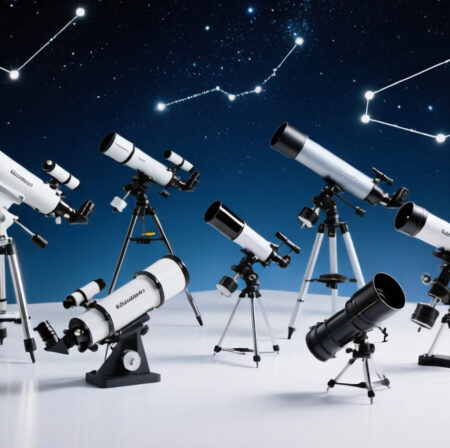
Since humanity first gazed at the stars, we’ve wondered what lies beyond our reach. The invention of the telescope transformed that wonder into discovery, opening windows to the universe that were previously invisible to us. These remarkable instruments have reshaped our understanding of cosmos and our place within it.
What is a telescope used for? A telescope is an optical instrument designed to collect and focus electromagnetic radiation from distant objects, making them appear brighter and more detailed than visible to the naked eye. Telescopes serve three essential purposes: gathering light to reveal faint objects, magnifying distant targets to show details, and resolving fine features that blur together without assistance.
From Galileo’s first observations of Jupiter’s moons to the James Webb Space Telescope’s infrared views of the early universe, telescopes have continuously expanded human knowledge. They’re not just tools for professional astronomers—telescopes serve educators, students, amateur stargazers, photographers, and curious minds of all ages who want to explore beyond Earth’s boundaries.
This comprehensive guide explores telescope applications across multiple domains, from cutting-edge research to everyday educational uses. Understanding these applications reveals why telescopes remain crucial instruments for scientific discovery and personal exploration in 2026. Whether you’re considering your first telescope or simply curious about these powerful tools, knowing their uses helps appreciate their impact on human knowledge.
The Three Essential Functions Every Telescope Performs
Every telescope, regardless of design or cost, performs three fundamental functions that make distant observation possible. These functions work together to reveal details and objects that would otherwise remain invisible to human eyes. Understanding these core capabilities helps explain why telescopes vary so much in design and purpose.
The most critical function—light gathering power—determines what you can actually see through a telescope. Many beginners mistakenly believe magnification is the most important factor, but professional astronomers will tell you that light collection matters far more. A telescope’s ability to gather light depends on its aperture, or the diameter of its light-collecting lens or mirror. Larger apertures collect more light, revealing fainter objects and producing brighter, clearer images. This is why research telescopes feature massive mirrors—some exceeding 10 meters in diameter—to capture as much light as possible from distant galaxies and nebulae.
Magnification serves as the telescope’s most well-known function, making distant objects appear closer and larger. However, magnification follows the rule of diminishing returns—beyond certain limits determined by aperture and atmospheric conditions, higher magnification only produces larger, fuzzier images. Useful magnification typically ranges from 20x to 50x per inch of aperture for most observing conditions. Exceeding this limit without excellent seeing conditions and quality optics only frustrates observers with empty magnification that reveals no additional detail.
Aperture: The diameter of a telescope’s primary light-gathering element (lens or mirror). Larger apertures collect more light, revealing fainter objects and providing better resolution.
Resolution represents a telescope’s ability to distinguish fine details and separate closely spaced objects. This crucial function determines whether you can see Saturn’s rings as distinct structures or view binary stars as separate points of light. Resolution depends primarily on aperture size and optical quality, with larger apertures providing better theoretical resolution. However, Earth’s atmosphere typically limits ground-based telescope resolution to about 1 arcsecond, though adaptive optics systems can compensate for much of this atmospheric distortion.
Light Gathering Power: The Most Important Function
Light gathering power stands as the telescope’s most critical capability because it determines what celestial objects become visible. Your pupil expands to approximately 7mm in darkness, collecting a finite amount of light. Even a modest 4-inch telescope gathers over 250 times more light than your eye, revealing stars and nebulae completely invisible to unaided vision. This dramatic increase in light collection explains why aperture size matters more than magnification for most astronomical observations.
The relationship between aperture and light gathering follows the area formula (πr²), meaning doubling the aperture quadruples the light collection. This exponential improvement explains why professional observatories invest enormous resources in building larger mirrors. More light collection enables observation of fainter objects, better resolution of details in bright objects, and shorter exposure times for astrophotography. For visual observers, increased light gathering makes faint galaxies visible, reveals structure in nebulae, and resolves globular clusters into individual stars rather than fuzzy patches.
Light gathering also determines the telescope’s limiting magnitude—the faintest star visible under ideal conditions. A 6-inch telescope typically reaches magnitude 13.5, while a 10-inch telescope extends to magnitude 14.7. Each magnitude increase represents 2.5 times less light, so this improvement reveals significantly more objects. This function explains why telescopes excel at deep space observation where light levels are extremely low. Understanding light gathering power helps observers select appropriate telescopes for their targets and set realistic expectations about visibility.
✅ Pro Tip: When choosing a telescope, prioritize aperture over magnification. A 6-inch telescope with modest magnification will reveal more deep-sky objects than a 3-inch telescope with claims of 500x magnification.
Magnification: Making Distant Objects Appear Closer
Magnification enlarges the apparent size of distant objects, making features visible that are too small to resolve with the naked eye. Telescope magnification results from the relationship between the telescope’s focal length and the eyepiece’s focal length—dividing telescope focal length by eyepiece focal length yields the magnification power. This simple relationship allows observers to change magnification by swapping eyepieces, providing versatility for different targets.
However, magnification follows practical limitations determined by aperture and atmospheric conditions. The maximum useful magnification typically equals 50-60x per inch of aperture under excellent conditions. Beyond this limit, images become larger but not clearer—empty magnification that reveals no additional detail. Most observing occurs at much lower magnifications, with planetary detail often best revealed at 100-200x and deep-sky objects requiring lower powers to maintain brightness and contrast.
Different targets require different magnification levels for optimal viewing. Planetary observation benefits from higher magnifications to reveal surface features and moons, while deep-sky objects like galaxies and nebulae often appear best at lower magnifications that preserve contrast and fit the entire object in the field of view. The Moon provides an exception—its brightness allows high magnification without the dimming that affects faint objects. Understanding appropriate magnification levels for different targets prevents frustration and improves observing success.
Resolution: Revealing Fine Details
Resolution determines a telescope’s ability to distinguish fine details and separate closely spaced objects. This crucial function enables observers to see Cassini’s Division in Saturn’s rings, resolve binary stars into separate points, and detect crater details on the Moon. The theoretical resolving power depends primarily on aperture size and the wavelength of light observed, following the Rayleigh criterion formula.
Practical resolution also depends on atmospheric seeing conditions—the turbulence that makes stars twinkle and images shimmer. Even perfect optics cannot overcome poor atmospheric conditions, which typically limit ground-based resolution to about 1 arcsecond. This limitation explains why professional observatories are often located on mountain peaks in stable atmospheric locations, and why space telescopes like Hubble can achieve much better resolution without atmospheric interference.
Resolution improvements reveal increasingly fine details as aperture increases. A 3-inch telescope might show Jupiter’s two main cloud belts, while an 8-inch telescope can reveal multiple belts, the Great Red Spot, and shadows of Jupiter’s moons. Similarly, resolving binary stars requires sufficient aperture to separate the close pair without them blending into a single point. Understanding resolution capabilities helps observers select appropriate targets and set realistic expectations for detail visibility.
| Telescope Function | Primary Purpose | Determined By | Typical Applications |
|---|---|---|---|
| Light Gathering | Reveal faint objects | Aperture size | Deep space observation, faint galaxies, nebulae |
| Magnification | Enlarge distant objects | Focal length ratio | Planetary detail, lunar features, double stars |
| Resolution | Distinguish fine details | Aperture + optics quality | Surface features, binary stars, fine planetary detail |
Types of Telescopes and Their Specific Applications
Telescopes come in various designs, each optimized for specific types of observation and applications. Understanding these different designs helps observers choose the right instrument for their needs and explains why certain telescopes excel at particular tasks. From simple beginner scopes to multi-billion dollar space observatories, each design represents a balance of capabilities, limitations, and specialized applications.
Different types of telescopes utilize either lenses (refractors), mirrors (reflectors), or both (catadioptrics) to gather and focus light. The choice between these designs affects cost, size, maintenance requirements, and optimal applications. Additionally, specialized telescopes observe different portions of the electromagnetic spectrum beyond visible light, revealing cosmic phenomena invisible to optical telescopes. Each design serves specific research applications and user needs.
Modern telescope development continues to push boundaries in size, sensitivity, and wavelength coverage. Ground-based observatories grow larger with advanced mirror technologies, while space telescopes observe wavelengths blocked by Earth’s atmosphere. Simultaneously, consumer telescopes become more capable and affordable, bringing astronomical observation to broader audiences. Understanding these diverse designs and applications helps appreciate the telescope’s role in scientific discovery and personal exploration.
Refracting Telescopes: Lens-Based Light Bending
Refracting telescopes use lenses to bend and focus light, following the same principle as eyeglasses and camera lenses. Light enters through a large objective lens at the front of the telescope tube, travels down the tube, and exits through a smaller eyepiece lens that magnifies the focused image. This elegant design produces sharp, high-contrast images ideal for certain applications, particularly planetary and lunar observation where edge-to-edge sharpness matters.
Refractors excel at applications requiring high contrast and sharp detail, making them popular among planetary observers and double star enthusiasts. The sealed optical tube prevents dust accumulation and air currents that can degrade image quality, while the lack of a central obstruction (unlike reflectors) produces slightly better contrast. These characteristics make refractors excellent for observing lunar and planetary detail, where subtle variations in brightness and color reveal important features.
Chromatic Aberration: An optical defect where different wavelengths of light focus at slightly different points, causing color fringing around bright objects. Modern achromatic and apochromatic lenses minimize this problem.
However, refractors face practical limitations that affect their applications. Large lenses become extremely expensive and heavy, while also sagging under their own weight. Additionally, lenses suffer from chromatic aberration—different colors focusing at different points—requiring special lens designs to correct. These limitations make refractors best suited for small to medium apertures (typically 3-6 inches) where their optical advantages outweigh the cost disadvantages. For these applications, refractors provide exceptional performance with minimal maintenance.
Reflecting Telescopes: Mirror Dominance
Reflecting telescopes use mirrors instead of lenses to gather and focus light, avoiding many limitations of refractor designs. Light enters the telescope tube and reflects off a curved primary mirror at the base, then reflects off a secondary mirror to the eyepiece. This simple design—pioneered by Isaac Newton in 1668—offers significant advantages for large apertures and specialized applications.
Reflectors dominate professional astronomy and amateur deep-sky observation due to their cost-effectiveness at large apertures. Mirrors can be manufactured much larger and cheaper than comparable lenses, while avoiding chromatic aberration since reflection affects all wavelengths equally. These characteristics make reflectors ideal for light-hungry applications like observing faint galaxies, nebulae, and other deep-sky objects where maximum aperture within budget constraints matters most.
The most common reflector design, the Newtonian, provides excellent value and performance for visual observation and astrophotography. Other reflector designs like Dobsonians optimize for maximum aperture at minimum cost, while Cassegrain designs provide long focal lengths in compact tubes. Reflectors do require occasional collimation (alignment of optics) and the open tube design can allow dust accumulation, but their performance advantages make them the preferred choice for most astronomical applications.
⏰ Time Saver: For beginners interested in viewing faint deep-sky objects, a Dobsonian reflector provides the most aperture per dollar, revealing more objects than other designs at the same price point.
Catadioptric Telescopes: Best of Both Worlds
Catadioptric telescopes combine lenses and mirrors to create versatile instruments optimized for portability and multiple applications. The most common designs—Schmidt-Cassegrain and Maksutov-Cassegrain—use a corrector lens at the front combined with mirrors to fold the optical path into a compact tube. This design provides long focal lengths (high magnification potential) in physically short tubes, making these telescopes highly portable despite their powerful capabilities.
These versatile telescopes excel at applications requiring portability combined with good all-around performance. Their long focal ratios (typically f/10 to f/15) make them well-suited for planetary and lunar observation, while their reasonable apertures (typically 8-14 inches) provide sufficient light gathering for many deep-sky objects. The sealed optical tube protects optics from dust and reduces maintenance, while the compact size facilitates transport to dark sky sites.
Catadioptrips particularly excel at astrophotography, where their long focal lengths capture detailed images of planets and smaller deep-sky objects. The combination of reasonable aperture, long focal length, and sealed optics makes them popular among astrophotographers and observers who need versatile, portable instruments. However, their complex optics make them more expensive than comparable Newtonians, and they typically require more cooling time to reach optimal performance. Despite these considerations, their versatility makes them excellent general-purpose telescopes.
Specialized Telescopes for Different Wavelengths
Visible light represents only a small portion of the electromagnetic spectrum, and specialized telescopes observe other wavelengths to reveal different cosmic phenomena. Radio telescopes detect radio waves from space, often using large dish antennas that can be arrayed together to create effective apertures kilometers across. These instruments observe phenomena invisible to optical telescopes, including cold hydrogen clouds, pulsars, and the cosmic microwave background radiation.
Infrared telescopes detect heat radiation from space, revealing objects hidden by dust or too cool to emit visible light. These instruments excel at observing star formation regions, the centers of galaxies obscured by dust, and the earliest galaxies whose light has been redshifted by cosmic expansion. Space-based infrared telescopes like Spitzer and JWST must operate at extremely low temperatures to avoid their own heat overwhelming faint cosmic signals.
Other specialized telescopes observe high-energy radiation including X-rays and gamma rays from extreme cosmic environments. These telescopes cannot use conventional lenses or mirrors since high-energy photons pass through or destroy them. Instead, they employ specialized techniques like grazing incidence mirrors that deflect X-rays at shallow angles, or coded masks that create shadow patterns revealing gamma ray sources. Each wavelength reveals different aspects of the universe, and combining these observations provides complete understanding of cosmic phenomena.
| Telescope Type | Best Applications | Key Advantages | Typical Limitations |
|---|---|---|---|
| Refractor | Planetary, lunar, double stars | Sharp images, high contrast, sealed tube | Expensive per inch of aperture, chromatic aberration |
| Reflector | Deep-sky, general astronomy | Large aperture affordable, no color aberration | Open tube, requires collimation, larger size |
| Catadioptric | All-purpose, astrophotography | Compact, portable, sealed tube, versatile | More expensive, requires cooling time |
| Radio | Hydrogen clouds, pulsars, research | Day/night operation, penetrates dust | Poor angular resolution, huge installations |
Astronomical Applications: Exploring the Universe
Telescopes serve as humanity’s primary tools for astronomical exploration, enabling discovery and research across the cosmos. From amateur backyard observers to professional research facilities, telescopes reveal the universe’s structure, composition, and evolution. These applications span from observing our solar system neighbors to detecting signals from the early universe, each contributing to our cosmic understanding.
Modern astronomical telescopes serve both research and educational applications, advancing scientific knowledge while inspiring public interest in astronomy. Professional observatories tackle fundamental questions about dark matter, dark energy, and the universe’s origin and fate. Simultaneously, smaller telescopes make astronomy accessible to students, amateurs, and curious observers worldwide. This combination of cutting-edge research and widespread public engagement makes telescopes uniquely powerful scientific instruments.
The astronomical applications of telescopes continue expanding as technology advances. New instruments observe previously inaccessible wavelengths, automated surveys scan the entire sky nightly, and adaptive optics overcome atmospheric limitations. These developments reveal new phenomena and confirm theoretical predictions, continually reshaping our understanding of the cosmos. Understanding these applications demonstrates telescopes’ essential role in astronomical discovery and their impact on human knowledge.
Planetary Observation: Studying Our Solar System
Planetary observation represents one of the most accessible and rewarding telescope applications, revealing details of our solar system neighbors that remain invisible to the naked eye. Even modest telescopes show Jupiter’s four Galilean moons, Saturn’s rings, Mars’s polar ice caps, and Venus’s phases. Larger apertures reveal increasingly fine details—Jupiter’s cloud belts and Great Red Spot, Saturn’s Cassini Division, Martian surface features, and countless lunar craters and mountains.
Planetary observation contributes to both amateur enjoyment and scientific research. Amateur astronomers regularly monitor planetary atmospheric changes, track dust storms on Mars, and record phenomena like Jupiter’s Great Red Spot fluctuations. These observations complement spacecraft missions, providing continuous monitoring and broader coverage than dedicated spacecraft can achieve. Some amateur planetary imagers now produce detail rivaling professional observatories through advanced techniques and processing.
Planetary observation benefits from specific telescope characteristics. High contrast matters more than maximum aperture, making quality refractors and long focal length catadioptrics excellent choices. Moderate apertures (6-12 inches) typically provide sufficient resolution for planetary detail, while good atmospheric seeing conditions become essential. Color filters enhance specific features—blue filters highlight atmospheric clouds on Mars, while red filters bring out Jupiter’s Great Red Spot. Understanding these requirements helps optimize equipment and techniques for planetary observation.
Deep Space Observation: Beyond Our Galaxy
Deep space observation targets objects beyond our solar system—including star clusters, nebulae, galaxies, and quasars—revealing the universe’s vast scale and diversity. These faint objects require telescopes with maximum light-gathering capability, making aperture size the critical factor. Large amateur telescopes (12+ inches) reveal hundreds of deep-sky objects, while observatory instruments detect millions of galaxies and faint nebulae billions of light-years distant.
Deep-sky observation connects observers with cosmic timescales, as light from these objects traveled millions or billions of years to reach us. The Andromeda Galaxy appears as it was 2.5 million years ago, while distant galaxies observed by professional telescopes appear as they were billions of years in the past. This time machine effect allows astronomers to study cosmic evolution and how galaxies change over cosmic timescales.
Deep-sky observation requires different techniques than planetary viewing. Low to moderate magnifications preserve surface brightness and contrast, making faint objects more visible. Dark skies far from city lights dramatically improve visibility of faint nebulae and galaxies. Additionally, dark adaptation (allowing eyes to adjust to darkness for 30+ minutes) reveals significantly more detail. Specialized filters enhance certain types of nebulae by blocking light pollution or passing specific emission wavelengths. Understanding these techniques helps observers successfully explore the deep sky.
Amateur Astronomy: Personal Discovery
Amateur astronomy represents one of telescope’s most important applications, bringing cosmic exploration to millions of observers worldwide. Unlike many scientific fields, amateurs with modest equipment can make genuine contributions to astronomical research. Variable star observers track brightness changes in thousands of stars, comet hunters discover new comets, and supernova seekers discover exploding stars in distant galaxies. These citizen scientists provide valuable data that professional astronomers cannot obtain with limited telescope time.
Visual observing remains popular among amateurs, with many specializing in particular object types or observing programs. The Messier Marathon challenges observers to find all 110 Messier objects in one night, while the Herschel 400 provides a more extensive observing challenge. Lunar observers map craters and mountains, while planetary observers record atmospheric changes. These structured observing programs provide goals and satisfaction while building observing skills.
Modern amateur astronomy increasingly involves sophisticated imaging equipment and techniques. CCD cameras and sophisticated processing enable amateurs to produce deep-sky images rivaling professional observatories from a few decades ago. Many amateurs now operate remote observatories in dark sky locations, controlling equipment via internet from anywhere in the world. This democratization of advanced observation capabilities has expanded amateur astronomy’s potential and contributions to research.
Professional Research: Pushing Knowledge Boundaries
Professional research telescopes tackle fundamental questions about the universe’s nature, origin, and evolution. Modern observatories like the Keck telescopes with their 10-meter mirrors, or space-based instruments like Hubble and James Webb, represent humanity’s most powerful eyes on the cosmos. These facilities detect galaxies billions of light-years distant, measure the universe’s expansion rate, and search for planets around other stars.
Professional research applications span all scales of the universe. Cosmologists use telescopes to study the large-scale structure of the universe and its evolution from the Big Bang. Galactic astronomers observe galaxy formation and evolution, stellar dynamics, and supermassive black holes. Stellar astronomers study star formation, stellar evolution, and supernova explosions. Planetary scientists observe other solar systems and search for potentially habitable worlds. Each application requires specialized instruments and techniques optimized for particular research questions.
Modern professional astronomy increasingly relies on coordinated observations across multiple telescopes and wavelengths. Observatories like ALMA (Atacama Large Millimeter/submillimeter Array) combine dozens of radio telescopes to create instruments with unprecedented resolution. Space telescopes like Hubble coordinate with ground-based observatories to observe phenomena at multiple wavelengths simultaneously. These coordinated observations provide comprehensive understanding impossible with single instruments, demonstrating telescopes’ collaborative nature in modern research.
⚠️ Important: Deep space telescopes require dark sky locations and patient observation. Faint nebulae and galaxies rarely appear as colorful as photographs—they require time and training to appreciate visually.
Beyond Astronomy: Practical and Everyday Telescope Applications
While astronomy represents telescopes’ most famous application, these versatile instruments serve numerous practical purposes beyond stargazing. From education to surveillance, photography to navigation, telescopes’ ability to make distant objects visible and detailed finds applications across many fields. These practical uses often go unnoticed but demonstrate telescopes’ broad utility in everyday life and specialized professions.
Non-astronomical telescope applications typically emphasize different capabilities than astronomical observing. Terrestrial viewing often requires image orientation (right-side up and correct left-right), compact size for portability, and weather-resistant construction. Specialized designs like spotting scopes and binoculars optimize for these requirements while maintaining the light gathering and magnification capabilities that make telescopes useful. Understanding these diverse applications reveals telescopes’ versatility beyond astronomy.
Educational Applications: Learning Through Observation
Telescopes serve as powerful educational tools, making science tangible and inspiring curiosity about the natural world. School telescope programs introduce students to astronomy, physics, and the scientific method through hands-on observation. Students who observe Saturn’s rings or Jupiter’s moons experience the excitement of discovery firsthand, making abstract scientific concepts concrete and memorable. These experiences can spark lifelong interest in science and technology careers.
Informal education settings like science centers, planetariums, and public observatories use telescopes to engage broad audiences with astronomy. Public observing events allow thousands of people to view celestial objects through telescopes, many for the first time. These experiences often prove transformative, changing how people perceive their place in the universe and their relationship to science. Educational applications represent some of telescopes’ most important impacts beyond research.
Modern educational applications extend beyond simple observing to include data analysis and research participation. Students analyze real telescope data from professional observatories through programs like the Faulkes Telescope Project or Zooniverse citizen science initiatives. These activities provide authentic research experiences, developing critical thinking and data analysis skills while contributing to genuine scientific research. Educational applications demonstrate telescopes’ power to inspire and educate across all age groups.
Terrestrial Applications: Earth-Based Observation
Terrestrial telescope applications include wildlife observation, landscape viewing, hunting, surveillance, and long-distance photography. Spotting scopes—specialized telescopes optimized for daytime use—provide magnification for bird watching, hunting, and nature observation. Their compact size, image orientation, and weather resistance make them ideal for field use where portability and durability matter more than maximum light gathering.
Surveillance and security applications use telescopes for long-distance monitoring and observation. Border patrol, law enforcement, and military applications employ specialized telescopes with image stabilization and night vision capabilities. These instruments can observe activity from several kilometers away, providing security and intelligence gathering capabilities. Maritime applications include ship spotting, navigation assistance, and piracy prevention.
Telephoto lenses for cameras essentially function as telescope systems, incorporating lenses to magnify distant subjects for photography and videography. Sports photography, wildlife documentary filming, and nature photography all rely on telephoto optics that function as telescope systems. These applications demonstrate how telescope principles extend beyond dedicated astronomical instruments to any device that magnifies distant subjects.
Photography and Imaging: Capturing Distant Details
Astrophotography represents perhaps the most demanding telescope application, requiring precise tracking, excellent optics, and sophisticated processing techniques. Modern astrophotography captures stunning detail in faint nebulae and galaxies, revealing colors and structures invisible to visual observation. These images not only produce beautiful results but also possess scientific value, documenting planetary conditions, comet appearances, and supernova discoveries.
Telescopes adapt for photography through several mounting methods. Prime focus photography removes the telescope’s eyepiece, using the telescope itself as a giant telephoto lens. Afocal photography places a camera over the eyepiece, effectively taking a picture through the telescope as if it were a very powerful pair of binoculars. Piggyback mounting places a camera with its own lens atop a tracking telescope, allowing wide-field images while the telescope tracks the stars. Each method serves different imaging needs and equipment configurations.
Digiscoping—a technique combining spotting scopes with digital cameras—has become popular for wildlife photography and documentation. This relatively simple method allows photographers with modest budgets to capture high-magnification images using readily available equipment. The technique’s popularity demonstrates how telescope applications continue evolving as new technologies create new possibilities for capturing and sharing distant observations.
Space vs Ground Telescopes: Complementary Perspectives
Space-based and ground-based telescopes each offer unique advantages for astronomical observation, and together provide comprehensive coverage of the electromagnetic spectrum. Space telescopes avoid atmospheric limitations that degrade ground-based observations, while ground telescopes offer larger apertures and easier maintenance. Understanding these complementary strengths reveals why both types remain essential for modern astronomy.
Space telescopes like Hubble and James Webb observe wavelengths blocked or absorbed by Earth’s atmosphere, including ultraviolet, infrared, and some visible wavelengths. Above atmospheric distortion, space telescopes achieve theoretical resolution limited only by their optics, producing extremely sharp images. The lack of atmospheric extinction also means space telescopes observe with perfect clarity—no twinkling stars or degraded seeing conditions. However, space telescopes face size limitations due to launch constraints and cannot be serviced or upgraded easily (except for special cases like Hubble servicing missions).
Ground-based telescopes continue pushing aperture boundaries far beyond what’s possible in space. The largest ground telescopes now exceed 30 meters in aperture, with even larger instruments under development. These massive light-gathering capabilities reveal fainter objects than current space telescopes can detect. Ground facilities also benefit from easier maintenance, upgrading, and repair—critical advantages for complex instruments. Additionally, ground telescopes cost far less per meter of aperture than space instruments, allowing much larger apertures for equivalent budgets.
Modern astronomy increasingly coordinates ground and space observations to provide comprehensive coverage of astronomical phenomena. Space telescopes might discover interesting objects, which ground telescopes then study in detail with larger apertures. Similarly, ground-based surveys might identify targets that space telescopes observe at unavailable wavelengths. This complementary approach provides the most complete understanding possible, demonstrating why both ground and space telescopes remain essential for astronomical research.
| Factor | Space Telescopes | Ground Telescopes |
|---|---|---|
| Atmospheric Effects | No distortion or absorption | Seeing limits resolution, some wavelengths blocked |
| Maximum Aperture | Limited by launch constraints (~6-10 meters) | Limited by funding and engineering (30+ meters now) |
| Maintenance | Difficult or impossible (exceptions exist) | Regular maintenance and upgrades possible |
| Operating Lifetime | Limited by consumables (fuel, coolant) | Decades with proper maintenance |
| Cost per Meter | Extremely high (launch costs) | High but much less than space |
Frequently Asked Questions
What is the main purpose of a telescope?
The main purpose of a telescope is to collect and focus light from distant objects, making them appear brighter and more detailed than visible to the naked eye. This light-gathering capability enables observation of faint celestial objects and reveals fine details in closer objects.
What are five uses for a telescope?
Five major telescope uses include: 1) Astronomical research observing planets, stars, and galaxies; 2) Educational applications in schools and science centers; 3) Amateur astronomy and personal exploration; 4) Astrophotography capturing cosmic images; 5) Terrestrial observation for wildlife viewing, surveillance, and navigation.
What can you actually see through a telescope?
Through a telescope, you can observe planets and their moons, Saturn’s rings, lunar craters and mountains, star clusters, nebulae, galaxies, comets, asteroids, and double stars. The specific objects visible depend on telescope aperture, sky conditions, and observer experience.
How is a telescope used in scientific research?
Research telescopes study cosmic phenomena by collecting light from distant objects, analyzing their spectra, and measuring their positions and movements. This research reveals the universe’s structure, composition, and evolution, including galaxy formation, stellar lifecycles, and the expansion of space itself.
What type of telescope is best for beginners?
Beginners typically start with 6-8 inch Dobsonian reflectors for maximum aperture per dollar, or small refractors (80-100mm) for lunar and planetary observation. The best beginner telescope balances ease of use, portability, and sufficient aperture to show interesting objects without overwhelming complexity.
Can telescopes be used during the day?
Yes, telescopes can be used for terrestrial observation during daytime, but precautions are essential. Never look at the Sun through any telescope without proper solar filters—instant eye damage will result. For safe daytime use, specialized solar telescopes or proper solar filters enable solar observation, while regular telescopes work for terrestrial viewing.
How have telescopes changed our understanding of the universe?
Telescopes revolutionized human understanding by revealing Earth orbits the Sun, discovering other planets and moons, showing galaxies exist beyond our Milky Way, measuring the universe’s expansion, detecting exoplanets, and observing cosmic microwave background radiation from the Big Bang. Each telescope advance revealed new aspects of cosmic reality.
The Enduring Impact of Telescopes on Human Knowledge
Telescopes have transformed human understanding of our place in the cosmos, revealing a universe far grander and more complex than previously imagined. From Galileo’s first observations of Jupiter’s moons to the James Webb Space Telescope’s infrared views of the early universe, these instruments continuously expand human knowledge. Their applications span from cutting-edge research to personal exploration, from professional observatories to backyard stargazers.
The telescope’s power lies not just in revealing distant objects, but in making cosmic exploration accessible to anyone curious enough to look through an eyepiece. This democratization of astronomical observation represents one of humanity’s greatest achievements—bringing the wonders of the cosmos within reach of ordinary people. Whether observing Saturn’s rings for the first time or contributing to genuine research, telescope users participate in humanity’s ongoing cosmic exploration.
As telescope technology continues advancing, new discoveries await. Giant ground-based telescopes with adaptive optics will image exoplanets directly, space telescopes will observe the universe’s first galaxies, and automated surveys will catalog countless celestial objects. Yet despite these technological marvels, telescopes retain their essential purpose: gathering light from distant objects to reveal what lies beyond human vision. For anyone interested in telescopes for beginners, the journey starts with understanding these remarkable instruments and their profound impact on human knowledge.