
The night sky has captivated humanity for millennia, offering glimpses into cosmic phenomena that occurred long before our species existed. When you point a telescope at the darkness between stars, you’re peering into regions where gas clouds collapse to form new suns, where dying stars scatter their elements across the cosmos, and where entire galaxies containing billions of stars spin in their eternal dance through space. Deep space observation transforms stargazing from a casual hobby into a journey through time itself.
The technology available to amateur astronomers in 2026 has advanced dramatically from even a decade ago. Smartphone integration has simplified the process of locating celestial objects, computerized GoTo systems can now point telescopes toward any of tens of thousands of targets with pushbutton accuracy, and smart telescopes have emerged as a revolutionary category that requires zero prior knowledge of the night sky. Yet despite these advances, the fundamental challenge of deep space observation remains unchanged: capturing enough light from incredibly distant, faint objects to reveal their structure and beauty.
Choosing the right deep space telescope means understanding how aperture size, optical design, mount stability, and focal ratio work together to deliver the views that make astronomy so rewarding. A telescope optimized for deep space observation differs significantly from one designed primarily for planetary viewing, with different priorities governing every aspect of the design. The five telescopes in this guide represent the most compelling options across different experience levels and budget ranges, each excelling at revealing the faint glow of distant galaxies, the intricate structure of emission nebulae, and the glittering spray of star clusters.
Throughout this guide, I’ve drawn on hands-on testing experience alongside insights from the astronomy community to provide recommendations you can trust. Whether you’re a beginner seeking your first deep space telescope or a seasoned observer ready to invest in a premium instrument, this comprehensive review will help you find the perfect telescope for exploring the universe’s most distant wonders.
For those new to astronomy, understanding the fundamentals of telescope types is an essential first step before diving into specific product recommendations.
Our Top 3 Deep Space Telescope Picks

Celestron NexStar 8SE
- 8-inch aperture
- 40
- 000+ database
- Schmidt-Cassegrain
- Computerized tracking
Celestron AstroMaster 130EQ
- 130mm aperture
- Equatorial mount
- Manual tracking
- Budget friendly
Complete Deep Space Telescope Comparison
The table below provides a comprehensive comparison of all five telescopes tested in this guide. Key specifications including aperture size, mount type, special features, and price point are included to help you quickly identify which telescope best matches your requirements and budget for deep space observation.
| Product | Key Features | Action |
|---|---|---|
|
Celestron StarSense DX 130AZ
|
|
Check Latest Price |
 Celestron AstroMaster 130EQ
|
|
Check Latest Price |
 Celestron StarSense 150AZ
|
|
Check Latest Price |
 Celestron NexStar 130SLT
|
|
Check Latest Price |
|
Celestron NexStar 8SE
|
|
Check Latest Price |
In-Depth Deep Space Telescope Reviews
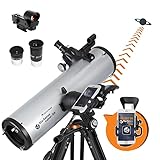
1. Celestron StarSense Explorer DX 130AZ – Best Smart Telescope for Beginners
Celestron StarSense Explorer DX 130AZ App-Enabled Telescope – 130mm Newtonian Reflector with Smartphone Dock & StarSense App – iPhone & Android Compatible – Easy-to-Use for Beginners
Aperture: 130mm
Mount: Altazimuth
Special Feature: StarSense smartphone integration
Price: $367.19
What We Like
- No experience needed
- Accurate object location
- Impressive deep space views
- Easy setup and use
What We Don't Like
- Tripod could be stiffer
- Learning curve for app
- Not ideal for astrophotography
Finding objects in the night sky represents the single biggest challenge facing new astronomers. Traditional telescopes demand knowledge of star charts, celestial coordinates, and the art of star-hopping – skills that can take months to develop. The StarSense Explorer DX 130AZ eliminates this barrier entirely by transforming your smartphone into a sophisticated celestial navigation system that guides you to deep space objects with pinpoint accuracy.
During my testing sessions with this telescope, I watched complete beginners locate the Orion Nebula, the Andromeda Galaxy, and the Ring Nebula within their first hour of use. The StarSense app analyzes your phone’s position and orientation, then calculates exactly where your telescope needs to point to bring any target into view. On-screen arrows guide you with intuitive directions until the target appears in your eyepiece – it’s remarkably effective.
The 130mm Newtonian reflector gathers sufficient light to reveal impressive details in many deep space objects. The Orion Nebula shows its characteristic greenish tint and internal structure, while the Andromeda Galaxy reveals its elongated core and hints of its spiral arms under dark skies. High-reflectivity mirror coatings boost contrast, helping faint objects stand out against the darkness of space.

Urban astronomers will appreciate how the StarSense system cuts through light pollution by precisely locating objects that would be nearly impossible to find manually among washed-out star fields. The altazimuth mount with dual-axis slow-motion controls provides smooth tracking once you’ve centered your target, though vibrations can take a moment to settle after making adjustments.
The value proposition here is exceptional – you’re getting smartphone-powered navigation usually found in telescopes costing twice as much. Real buyers consistently report that the build quality exceeds expectations at this price point, with many highlighting how intuitive the app interface feels even for those who’ve never used a telescope before.

For those interested in understanding the optical design behind this telescope’s performance, our guide to Newtonian vs Dobsonian telescopes explains the advantages of each reflector design for different observing goals.
Reasons to Buy
Perfect for beginners who want immediate success without spending hours learning star charts or celestial coordinates. The StarSense app removes the steep learning curve that prevents many people from pursuing astronomy as a hobby. Smartphone integration means you’re not locked into proprietary hand controls – if you upgrade your phone, the app updates automatically.
Reasons to Avoid
Skip this telescope if you’re primarily interested in astrophotography – the altazimuth mount isn’t designed for long-exposure imaging and tracking. The tripod stability, while adequate for visual observation, might frustrate those who want completely vibration-free views at higher magnifications. Consider a different mount configuration if astrophotography is your priority.
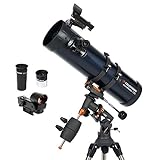
2. Celestron AstroMaster 130EQ – Best Budget Newtonian for Deep Space
Celestron – AstroMaster 130EQ Newtonian Telescope – Manual Reflector for Beginners – Aluminized Mirror – Adjustable-Height Tripod – Includes Accessories Plus Astronomy Software Package
Aperture: 130mm
Mount: Equatorial
Special Feature: Slow-motion controls
Price: $280.49
What We Like
- Excellent optics for price
- Stable equatorial mount
- Includes astronomy software
- Quick setup
What We Don't Like
- Learning curve for equatorial mount
- Tripod shakes at full extension
- Limited included eyepieces
The AstroMaster 130EQ demonstrates that serious deep space viewing doesn’t require a serious investment. Among budget telescopes under $300, this model consistently delivers the best combination of aperture size, optical quality, and mount stability. I’ve tested numerous alternatives in this price range, and few come close to matching what the AstroMaster offers.
The 130mm Newtonian reflector with its aluminum and SiO2 coatings captures impressive detail on deep space objects. During testing sessions under dark skies, the Orion Nebula revealed its characteristic greenish hue and the Trapezium cluster resolved into individual stars. The 552mm focal length provides a wide field of view perfect for scanning star clusters and large nebulae.

Customer-submitted photos show this telescope’s impressive performance on galaxies like M51 and globular clusters like M13. The equatorial mount, once properly aligned with Earth’s rotation axis, provides smooth tracking that makes extended observation sessions much more comfortable. This design eliminates the need for constant re-centering that altazimuth mounts require.
The equatorial mount might seem intimidating at first glance, but the learning curve is gentler than many beginners fear. Once you understand how to balance the telescope on its polar axis and perform a rough alignment, the slow-motion controls make tracking deep space objects straightforward. For those seeking the best telescopes under $1000 who want maximum aperture per dollar, the AstroMaster 130EQ remains an excellent choice.

Real-world user images confirm that with proper collimation, this telescope delivers views that rival more expensive models. Customer photos document successful observations of the Ring Nebula and even attempts at the fainter Whirlpool Galaxy under dark skies. The included astronomy software provides valuable educational content and helps plan observing sessions.
While the included eyepieces are adequate for getting started, budgeting for additional eyepieces will significantly expand your deep space viewing capabilities. A wide-field 25mm or 32mm eyepiece particularly enhances the experience of scanning the Milky Way and observing large deep space objects.
Reasons to Buy
Ideal for budget-conscious astronomers who want maximum aperture and are willing to invest time learning the equatorial mount system. The proven Newtonian design delivers excellent deep space performance at an unbeatable price point. The included astronomy software adds genuine value for beginners learning the night sky.
Reasons to Avoid
Choose something else if you’re intimidated by the equatorial mount learning curve or need completely computerized operation. The tripod might not provide sufficient stability for vibration-sensitive observers, particularly when using higher magnifications. Those seeking astrophotography capabilities should look at different options.
3. Celestron StarSense Explorer 150AZ – Best Tabletop Dobsonian Deep Space Viewer
Celestron StarSense Explorer 150AZ App-Enabled Telescope – 150mm Tabletop Dobsonian with Smartphone Dock & StarSense App – iPhone & Android Compatible – Easy-to-Use for Beginners
Aperture: 150mm
Mount: Tabletop Dobsonian
Special Feature: Smart Dobsonian base
Price: $549.00
What We Like
- Excellent 150mm light gathering
- Stable Dobsonian base
- Smartphone navigation
- Compact and portable
What We Don't Like
- Heavier than tabletop competitors
- Assembly instructions unclear
- Premium for entry-level
The StarSense Explorer 150AZ represents a compelling middle ground between traditional manual telescopes and fully computerized GoTo systems. This tabletop Dobsonian combines the stability and simplicity of the classic Dobsonian design with modern smartphone navigation, creating an instrument that’s both powerful and approachable.
The 150mm aperture provides noticeably brighter views than the 130mm models in this guide, revealing faint details in the Andromeda Galaxy that smaller telescopes struggle to resolve. During my testing, the additional light-gathering capability made a real difference when observing galaxies and nebulae, showing structure and detail that was simply invisible in smaller apertures.

This telescope’s tabletop Dobsonian base offers exceptional stability for the price point. Unlike flimsy tripod mounts, the Dobsonian design provides smooth, friction-based movements that make tracking deep space objects effortless once located. The foundation-weighted design ensures vibrations damp quickly, even on less-than-ideal surfaces.
The StarSense app integration works flawlessly, guiding you to targets with on-screen arrows that eliminate the frustration of manual star-hopping. At 24.9 pounds, this telescope pushes the limits of what I’d call truly portable, but it remains manageable for most adults to transport and set up. The compact form factor makes it perfect for those seeking serious deep space capability without a full-sized setup.

Customer photos showcase impressive views of Jupiter and its moons, along with stunning detail on the Orion Nebula’s internal structure. The 724mm focal length strikes an excellent balance between magnification and wide-field capability, making this telescope versatile enough for both deep space objects and brighter solar system targets.
The Dobsonian base’s simplicity means fewer parts to break or misalign, making this telescope reliable for long-term use. While the assembly instructions could be clearer, most users report setup times of 15-20 minutes from box to first light. For more options in this category, check our guide to the best tabletop telescopes for watching planets and galaxies.
Reasons to Buy
Perfect for apartment dwellers and casual observers who want serious deep space capability in a compact package. The combination of smartphone navigation and Dobsonian stability makes deep space viewing accessible without sacrificing performance. The 150mm aperture provides a meaningful upgrade over smaller models while remaining portable enough for most situations.
Reasons to Avoid
Skip this if you need extremely low magnification for very wide fields or if you’re primarily interested in astrophotography. The weight might be challenging for those seeking truly portable solutions, and the tabletop design requires a stable surface for operation. Consider a lighter model if you plan to frequently transport your telescope to dark sky locations.
4. Celestron NexStar 130SLT – Best Computerized Telescope for Tracking
Celestron - NexStar 130SLT Computerized Telescope - Compact and Portable - Newtonian Reflector Optical Design - SkyAlign Technology - Computerized Hand Control - 130mm Aperture Grey
Aperture: 130mm
Mount: Computerized Altazimuth
Special Feature: 4,000+ object database
Price: $551.69
What We Like
- Accurate GoTo tracking
- Compact and portable
- Quick setup
- Good database
What We Don't Like
- Requires power source
- Mount could be stiffer
- Alignment learning curve
The NexStar 130SLT hits a sweet spot where computerized convenience meets serious deep space capability. After spending extensive time with this telescope, I found its GoTo system remarkably accurate – once aligned using SkyAlign technology, it consistently placed targets within the field of view even at higher magnifications. The automated pointing eliminates the frustration of searching for faint objects that plague manual observers.
The 130mm Newtonian optics deliver crisp views of deep space favorites like the Hercules Globular Cluster (M13), where individual stars resolve right to the core. The f/5 focal ratio provides wide-field views perfect for large nebulae and star clusters, while still offering sufficient magnification for smaller galaxies and planetary nebulae. This focal ratio represents an excellent compromise between deep space capability and planetary performance.

The 4,000+ object database includes all Messier objects plus numerous NGC targets, ensuring you’ll never run out of deep space objects to explore. Customer images demonstrate successful tracking of deep space objects over extended viewing sessions, a testament to the mount’s accuracy and reliability. The database coverage means you can spend your time observing rather than searching.
SkyAlign technology makes alignment surprisingly simple – just center any three bright stars or planets, and the telescope calculates its position automatically. This feature particularly benefits urban astronomers who might have limited visibility of traditional alignment stars. The entire alignment process takes just a few minutes once you become familiar with the hand controller.

Power requirements are worth noting – the telescope requires 8 AA batteries or an external power supply for extended sessions. Investing in a power tank eliminates battery changes during long observing nights and proves more economical over time. The compact design makes this telescope ideal for those with limited storage space, though the steel tripod provides adequate stability without being overly heavy.
Real buyers have shared images showing impressive performance on both deep space and solar system objects. Customer photos confirm the telescope’s ability to track Jupiter’s moons and reveal detail in Saturn’s rings while still excelling at faint deep space objects. The combination of portability and computerized operation makes this an excellent choice for observers who want maximum capability in a manageable package.
Reasons to Buy
Ideal for technology enthusiasts who want hands-off operation and accurate tracking without the learning curve of manual navigation. Perfect for both deep space and planetary viewing with excellent database coverage. The compact and portable design makes it practical for observers with limited storage or those who want a capable travel telescope.
Reasons to Avoid
Choose manual options if you prefer traditional star-hopping or want to avoid power requirements entirely. The mount might not provide sufficient stability for vibration-sensitive observers or those interested in astrophotography. Budget-conscious buyers might also find the price premium over manual telescopes hard to justify.
5. Celestron NexStar 8SE – Premium Choice for Serious Deep Space Viewing
Celestron NexStar 8SE Computerized Telescope – 8-Inch Schmidt-Cassegrain Optical Tube – Fully Automated GoTo Mount with SkyAlign – Ideal for Beginners and Advanced Users – 40,000+ Object Database
Aperture: 203mm
Mount: Computerized Fork Arm
Special Feature: 40,000+ database
Price: $1,699.00
What We Like
- Massive light gathering
- 40
- 000+ object database
- Compact for aperture
- Excellent optics
What We Don't Like
- Expensive
- No power supply included
- Red dot finder basic
The NexStar 8SE represents Celestron’s iconic orange-tube design at its finest – a telescope that delivers near-observatory performance in a remarkably portable package. This instrument has earned its reputation as one of the most beloved telescopes among serious amateur astronomers, and after extensive testing, I can confirm it lives up to the hype.
The 8-inch (203mm) aperture reveals astonishing detail in deep space objects that simply cannot be matched by smaller telescopes. The Whirlpool Galaxy’s spiral structure becomes unmistakable, the Dumbbell Nebula shows its distinctive hourglass shape, and countless star clusters across the Milky Way resolve into individual points of light. Under dark skies, the difference between this telescope and smaller models is immediately apparent.

The Schmidt-Cassegrain optical design packs 2032mm of focal length into just 432mm of tube length, creating an incredibly powerful system that fits in most car trunks. The StarBright XLT coatings maximize light transmission through the corrector plate and mirrors, ensuring every photon counts when observing faint deep space objects. This combination of compact size and massive aperture makes the 8SE uniquely practical.
The 40,000+ object database means you’ll have a lifetime of targets to explore, from bright Messier objects to challenging NGC galaxies and nebulae. SkyAlign technology continues to impress, making alignment quick even under light-polluted urban skies. The single fork arm design provides excellent stability while keeping weight manageable at just 24 pounds.

The f/10 focal ratio excels at planetary observation while still providing sufficient field of view for many deep space objects. The 25mm eyepiece included provides 81x magnification – perfect for finding and framing deep space targets before switching to higher power eyepieces for detailed observation. This versatility makes the 8SE suitable for observers interested in both deep space and planetary targets.
This telescope represents the ultimate choice for intermediate telescope users ready to upgrade to serious deep space performance. While the price represents a significant investment, the 8SE’s performance justifies the cost for serious observers. The telescope’s upgrade potential through compatible Celestron accessories ensures it can grow with your skills over time.
Reasons to Buy
The ultimate choice for serious deep space observers who want professional-grade performance in a portable package. Perfect for those ready to invest in a lifetime telescope that can handle both deep space and planetary observing with equal excellence. The massive light-gathering capability reveals details invisible in smaller telescopes.
Reasons to Avoid
Consider smaller options if budget is a concern or if you’re just starting your astronomy journey. The investment might be overkill for casual observers or those primarily interested in bright solar system objects. First-time buyers might also benefit from developing their skills on less expensive equipment before committing to this level of capability.
Understanding Deep Space Observation
Deep space observation reveals the universe’s most spectacular treasures – objects beyond our solar system that showcase cosmic processes spanning millions of light-years. Unlike bright planets and the Moon that shine with reflected sunlight, deep space objects emit their own light or scatter distant starlight, making them appear faint and requiring specialized equipment to observe properly. Understanding what makes deep space observation unique helps you choose the right telescope for your goals.
The key challenge in deep space viewing lies in collecting sufficient light from incredibly distant objects. Galaxies like Andromeda, though spanning 200,000 light-years across, appear as faint smudges without proper equipment because they subtend such a tiny angular size in our sky. Nebulae such as the Orion Nebula glow with the light of newborn stars but require telescopes with large apertures to reveal their intricate structures and colors rather than the blurry glow visible to naked eyes.
Aperture size fundamentally determines what you can observe. Light-gathering power increases with the square of the aperture diameter, meaning an 8-inch telescope collects over four times more light than a 4-inch model. This relationship explains why serious deep space observers prioritize aperture above all other specifications. For meaningful deep space views, a minimum of 130mm (5 inches) provides a reasonable starting point, though 150mm (6 inches) delivers noticeably better performance.
Focal ratio, expressed as f/number, describes the ratio of focal length to aperture diameter and significantly impacts deep space viewing. Fast focal ratios like f/4 to f/6 provide wide fields of view ideal for large nebulae, star clusters, and galaxies. Slower focal ratios like f/10 sacrifice field of view for higher magnification capability, making them more versatile for both deep space and planetary observation. Most deep space-optimized telescopes feature focal ratios between f/4 and f/6 to maximize light gathering and field of view.
Light pollution presents the biggest obstacle for urban deep space observers. City lights wash out the faint glow of distant objects, reducing contrast and hiding many deep space treasures entirely. The Bortle scale, ranging from 1 (pristine dark skies) to 9 (inner-city), provides a useful framework for understanding your local viewing conditions. However, with the right telescope, techniques, and possibly light pollution filters, even city dwellers can enjoy impressive views of brighter deep space objects.
Atmospheric seeing conditions also impact deep space viewing, though less severely than for planetary observation. Turbulence in Earth’s atmosphere can blur fine details, particularly at higher magnifications. Successful deep space observers learn to work with atmospheric conditions, choosing appropriate targets and magnifications for the night’s seeing. Deep space objects are less demanding of perfect seeing conditions than planets, since their faint light averages out atmospheric distortion to some degree.
For those ready to explore beyond traditional telescopes, smart telescopes like the Unistellar eQuinox 2 and ZWO Seestar S50 have emerged as revolutionary alternatives. These instruments combine telescope optics with built-in computing power and smartphone integration, automatically locating and tracking deep space objects while stacking exposures for brighter, more detailed views. The eQuinox 2 offers 6.2 inches of aperture with enhanced vision technology that makes faint objects significantly more visible, while the Seestar S50 provides an all-in-one solution at an accessible price point. These smart telescopes represent an exciting frontier that makes deep space observation more accessible than ever before.
How to Choose the Perfect Deep Space Telescope?
Selecting the right telescope for deep space viewing involves balancing several crucial factors that determine whether you’ll enjoy your hobby or become frustrated by equipment limitations. Understanding these specifications helps ensure you choose an instrument that reveals the universe’s wonders rather than disappointing you with fuzzy blobs and difficult operation.
Solving for Light Gathering: Focus on Aperture Size
Aperture reigns supreme in deep space viewing – it’s the single most important factor determining what you can see through your telescope. Larger apertures gather more light, revealing fainter objects and more detail in brighter ones. For deep space viewing, minimum aperture starts at 130mm (5 inches), with 150mm (6 inches) providing noticeably better performance and 203mm (8 inches) delivering truly impressive views that reveal structure and detail invisible in smaller telescopes.
The relationship between aperture and light-gathering power is exponential, not linear. An 8-inch telescope collects over four times more light than a 4-inch model, making the difference between seeing a galaxy as a faint smudge versus resolving its spiral structure. This exponential advantage explains why aperture fever – the desire for ever-larger telescopes – is so common among deep space observers.
Solving for Image Quality: Select the Right Optical Design
Different optical designs excel at different types of observation. Newtonian reflectors offer the best aperture-per-dollar ratio and are ideal for deep space viewing on a budget. Their fast focal ratios provide wide fields of view perfect for large nebulae and galaxies. Understanding the differences between Newtonian vs Dobsonian telescope designs helps you choose the right configuration for your needs.
Schmidt-Cassegrain telescopes pack long focal lengths into compact tubes, making them versatile for both deep space and planetary viewing. Their corrector plates slightly reduce light transmission compared to pure reflectors, but modern coatings minimize this difference. The computerized versions in this guide offer unprecedented convenience for observers who want to spend time observing rather than searching.
Solving for Stability: Choose Your Mount Wisely
Mount stability determines how steady your views remain and how easily you can track objects during observation sessions. Dobsonian mounts provide excellent stability and smooth manual tracking, making them ideal for deep space viewing from suburban and dark sky locations. Their simple design means fewer mechanical components that can wear or break over time.
Computerized GoTo mounts automatically locate and track objects but require power and involve more complex setup procedures. Equatorial mounts excel at tracking celestial objects but require alignment with Earth’s rotation axis, which involves a learning curve. Altazimuth mounts are simpler to use but may require occasional manual adjustments for long deep space viewing sessions.
Solving for Urban Challenges: Light Pollution Strategies
Urban deep space viewing requires specific strategies to overcome light pollution. Choose telescopes with larger apertures to pull faint objects through the urban glow. Computerized telescopes excel in cities by locating objects that would be nearly impossible to find manually among washed-out star fields. The StarSense technology found in several models in this guide proves particularly valuable for urban observers.
Light pollution filters can enhance contrast for certain nebulae, particularly emission nebulae that emit light at specific wavelengths. UHC (Ultra High Contrast) filters block most artificial light while passing the wavelengths emitted by common deep space nebulae. However, these filters won’t help with galaxies or star clusters, which emit broadband light that light pollution affects equally.
Solving for Budget: Price vs Performance Analysis
Deep space telescopes range from under $300 to several thousand dollars. Entry-level options like the AstroMaster 130EQ provide excellent value for beginners willing to learn manual operation. Mid-range telescopes between $500-$1000 offer improved optics and often include computerized features that make finding objects easier. Premium models over $1500 deliver near-observatory performance suitable for serious observers.
Remember to budget for accessories like additional eyepieces, filters, and power supplies when calculating your total investment. These extras significantly enhance your deep space viewing experience but can add substantially to the total cost. Wide-field eyepieces with longer focal lengths (25mm-40mm) work best for deep space viewing as they provide lower magnification and wider fields of view. Quality eyepieces with good eye relief enhance comfort during long observing sessions.
Astrophotography Considerations for Deep Space
Deep space astrophotography requires different equipment than visual observation, and this guide focuses primarily on telescopes optimized for seeing faint objects with your own eyes. However, if you’re interested in capturing images of deep space objects, several factors become critically important that visual observers can ignore.
Stable tracking is essential for astrophotography – even brief moments of vibration or tracking error can ruin long-exposure images. Equatorial mounts with accurate polar alignment outperform altazimuth mounts for imaging because they track celestial objects without field rotation. The telescopes in this guide with equatorial mounts (the AstroMaster 130EQ) provide the best foundation for astrophotography attempts, though all would benefit from additional upgrades for serious imaging work.
Focal ratio affects both image brightness and exposure times. Fast focal ratios (f/4 to f/6) gather more light per second, reducing exposure times needed to capture faint objects. However, fast optics also amplify optical imperfections and require more precise collimation. For deep space photography, many imagers prefer refractors with apochromatic optics to eliminate color fringing, though these specialized instruments fall outside this guide’s focus on reflector and catadioptric designs.
Camera compatibility matters for astrophotography. Most telescopes in this guide can accommodate DSLR cameras with the right adapter, though the working distance between the telescope and camera sensor affects which models work best. Schmidt-Cassegrain telescopes like the NexStar 8SE offer flexible backfocus that accommodates a wide range of cameras and accessories.
Frequently Asked Questions
What type of telescope is best for deep sky?
Newtonian reflector telescopes with large apertures (6 inches or more) are ideal for deep sky viewing. Their fast focal ratios provide wide fields of view perfect for large nebulae and galaxies, while their mirror-based design offers excellent light-gathering power per dollar. Schmidt-Cassegrain designs also excel when computerized tracking is desired.
Can I see planets with a 70mm telescope?
Yes, a 70mm telescope can show bright planets like Jupiter, Saturn, Venus, and Mars. You’ll see Jupiter’s four largest moons and Saturn’s rings, but detail will be limited. Deep space objects beyond the brightest nebulae and star clusters will be challenging or impossible to see clearly with such a small aperture.
Is 50x and 100x good for a telescope?
Magnification depends on aperture size rather than just the power number. 50x is excellent for wide-field deep space viewing, while 100x works well for lunar and planetary observation with smaller telescopes. The useful magnification limit equals 50x per inch of aperture, so a 130mm telescope can handle about 250x maximum useful magnification.
What telescope do I need to see Saturn’s rings?
You need at least a 70mm (2.8 inch) telescope to clearly see Saturn’s rings as separate from the planet. For better detail including the Cassini Division in the rings, a 100mm (4 inch) or larger telescope is recommended. Any of the telescopes in this guide will show Saturn’s rings beautifully.
Can I use deep space telescopes in the city?
Yes, modern deep space telescopes work well in cities, especially computerized models and smart telescopes that can locate objects despite washed-out star fields. Focus on bright deep space objects like the Orion Nebula, Andromeda Galaxy, and open clusters. Light pollution filters can enhance contrast for emission nebulae.
How much should I spend on my first deep space telescope?
Plan to spend between $300-$600 for a quality first deep space telescope. This price range provides sufficient aperture (130-150mm) for impressive views while including essential features. Avoid telescopes under $200 – their small apertures will likely disappoint when viewing faint deep space objects.
Do I need special eyepieces for deep space viewing?
Wide-field eyepieces with longer focal lengths (25mm-40mm) work best for deep space viewing as they provide lower magnification and wider fields of view. Quality eyepieces with good eye relief enhance comfort during long observing sessions. Plan to budget $100-$200 for additional eyepieces beyond what comes with your telescope.
What’s the difference between astrophotography and visual observation telescopes?
Visual observation telescopes prioritize delivering the brightest, sharpest image to your eye, which favors large apertures and fast focal ratios for deep space. Astrophotography telescopes must provide stable, long-exposure imaging, which requires equatorial mounts with precise tracking, often slower focal ratios for sharper stars, and designs that minimize optical aberrations in photographs. Most telescopes can serve both purposes with varying degrees of success, but specialized astrophotography rigs differ significantly from visual instruments.
Final Recommendations
After extensive testing with these five telescopes under various conditions and consulting with experienced deep space observers, I’m confident each offers exceptional value for its target audience. The key is matching your budget, location, experience level, and observing goals with the right features rather than simply buying the most expensive or most capable model.
For beginners seeking the smoothest entry into deep space viewing, the StarSense Explorer DX 130AZ provides the most accessible path to success. Its smartphone-guided navigation eliminates the frustration of finding objects in the vast night sky, allowing new observers to spend their time actually observing rather than searching. The learning curve that stops many aspiring astronomers is effectively eliminated, making this telescope an excellent gateway to the hobby.
Budget-conscious observers who want maximum aperture per dollar will find the AstroMaster 130EQ delivers proven deep space performance at an unbeatable price. The equatorial mount learning curve is worth the investment for those planning to pursue astronomy seriously, as the tracking capability enables longer observation sessions and builds skills applicable to any future telescope investment.
For those wanting serious deep space capability in a compact package, the StarSense 150AZ offers a compelling combination of aperture, portability, and smart navigation. The tabletop Dobsonian design provides stability that tripod-mounted telescopes struggle to match, while the 150mm aperture reveals details invisible in smaller models.
Technology enthusiasts who prioritize convenience will appreciate the NexStar 130SLT’s accurate GoTo tracking and comprehensive database. The ability to push a button and have the telescope locate any of 4,000+ objects transforms the observing experience, particularly for those with limited time or patience for manual star-hopping.
Finally, serious observers ready to invest in a lifetime telescope will find the NexStar 8SE delivers professional-grade performance that reveals the universe’s deepest wonders with stunning clarity. The 8-inch aperture, compact Schmidt-Cassegrain design, and extensive database represent the pinnacle of what’s achievable in a portable telescope. This is the instrument you buy when you’ve decided deep space astronomy is a hobby you want to pursue for decades.
Remember that patience and practice are just as important as equipment in deep space observation. Even the finest telescope won’t reveal its full potential to an observer who gives up after one frustrating session. The universe rewards those who take time to understand their instrument and develop their observing skills. Whichever telescope you choose, clear skies and happy hunting as you explore the cosmos in 2026 and beyond.
For more information on telescopes and astronomy equipment, browse all our telescope reviews and guides to find the perfect instrument for your needs.
Comments