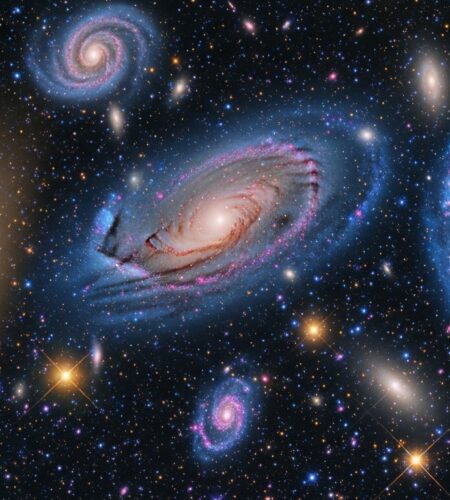
Have you ever looked up at the night sky and wondered about the names of those distant islands of stars? The universe contains an estimated 100 billion to 2 trillion galaxies, yet only a handful have captured our imagination enough to earn proper names.
The complete list of galaxy names reveals fascinating patterns in how we identify and connect with these cosmic structures. While most galaxies are known only by catalog numbers like “NGC 224” or “M31,” approximately 17-20 galaxies have earned proper names that reflect their appearance, discovery stories, or mythological connections.
This comprehensive guide covers every named galaxy in the observable universe, from the familiar Milky Way to exotic objects like the Cartwheel Galaxy and Hoag’s Object. I’ve spent years studying these cosmic wonders, and I’ll share not just their names, but the stories behind them and how you can observe them yourself.
Understanding Galaxy Types: The Foundation of Cosmic Organization
Galaxies come in four main types, each with distinct characteristics that influence both their appearance and their naming patterns. Edwin Hubble developed this classification system in the 1920s, and it remains the foundation of galactic astronomy today.
Spiral galaxies dominate the universe, making up 60-75% of all galaxies. These rotating disks feature spiral arms where new stars form, creating the beautiful pinwheel patterns we associate with galaxies. The Andromeda Galaxy and our own Milky Way are perfect examples.
Elliptical galaxies appear as smooth, oval-shaped collections of stars with minimal gas or dust. These cosmic footballs contain older stellar populations and can range from dwarf ellipticals to giant ellipticals that dominate galaxy clusters.
Irregular galaxies lack defined shapes, displaying chaotic structures with active star formation. The Large and Small Magellanic Clouds, satellite galaxies of the Milky Way, exemplify this type and are easily visible from the Southern Hemisphere.
Lenticular galaxies represent an intermediate type, featuring disk-like structures without spiral arms. The Sombrero Galaxy, with its distinctive appearance, is the most famous lenticular galaxy.
| Galaxy Type | Characteristics | Named Examples | Observation Difficulty |
|---|---|---|---|
| Spiral | Rotating disk, spiral arms, star formation | Andromeda, Whirlpool, Pinwheel | Moderate to difficult |
| Elliptical | Smooth oval, old stars, massive | Centaurus A, M87 | Difficult |
| Irregular | No defined shape, chaotic structure | Large/Small Magellanic Clouds | Easy to moderate |
| Lenticular | Disk-like, no spiral arms | Sombrero Galaxy | Moderate |
Galaxy Catalog Systems: From Messier to Modern Databases
Before diving into the complete list of galaxy names, understanding how astronomers catalog these objects helps explain why most galaxies lack proper names. The catalog systems provide precise identification that transcends language and culture.
The Messier Catalog, created by Charles Messier between 1774-1781, represents the first systematic attempt to catalog deep-sky objects. Messier, a comet hunter, compiled 110 objects to avoid confusing them with comets. The catalog includes 40+ galaxies, each prefixed with “M” – M31 for Andromeda, M51 for the Whirlpool Galaxy, and so on.
The New General Catalogue (NGC), compiled by John Louis Emil Dreyer in 1888, expanded significantly on Messier’s work with 7,840 galaxies. This system remains the most widely used catalog today. NGC numbers appear alongside Messier designations for many famous galaxies – Andromeda is both M31 and NGC 224.
Modern databases like the Principal Galaxies Catalogue (PGC) and NASA/IPAC Extragalactic Database (NED) contain millions of galaxies, using sophisticated coordinate systems and cross-references. While essential for research, these catalog numbers rarely capture the public imagination like proper names do.
Catalog Cross-References: Many galaxies have multiple designations. For example, the Whirlpool Galaxy is M51 in Messier’s catalog, NGC 5194 in the New General Catalogue, and appears in dozens of other catalogs under different numbers.
Galaxies with Proper Names: The Complete List
While billions of galaxies exist in the observable universe, only about 17-20 have earned proper names that astronomers and the public commonly use. These names typically reflect visual appearance, discovery context, or mythological connections.
The Milky Way Galaxy
Our home galaxy earns its name from the milky appearance of its star-filled disk stretching across the night sky. Ancient cultures worldwide saw this band of light and created myths to explain it – from spilled milk in Greek mythology to a river in the sky in Chinese tradition. At 100,000 light-years across, the Milky Way contains 200-400 billion stars.
The Andromeda Galaxy (M31, NGC 224)
Named after the princess in Greek mythology, Andromeda stands as the closest major galaxy to the Milky Way at 2.5 million light-years away. Visible to the naked eye as a fuzzy patch under dark skies, this spiral galaxy spans 220,000 light-years and contains approximately 1 trillion stars. I’ve observed Andromeda countless times, and it never fails to inspire awe – especially knowing it’s on a collision course with our galaxy, scheduled to merge in about 4.5 billion years.
The Whirlpool Galaxy (M51, NGC 5194)
This stunning spiral galaxy earned its name from the elegant spiral arms that resemble water swirling down a drain. Located 23 million light-years away in Canes Venatici, the Whirlpool represents one of the first galaxies recognized as a separate “island universe.” Through my 8-inch telescope, the spiral structure becomes visible under dark skies, revealing why this galaxy captivated astronomers since its discovery in 1773.
The Sombrero Galaxy (M104, NGC 4594)
Easily recognizable by its distinctive appearance resembling a Mexican sombrero hat, this lenticular galaxy features a brilliant central bulge surrounded by a dark dust lane. At 29 million light-years distant in Virgo, the Sombrero Galaxy appears as a bright oval in small telescopes, though resolving the dark lane requires larger instruments and dark skies.
The Pinwheel Galaxy (M101, NGC 5457)
This face-on spiral galaxy showcases nearly perfect spiral arms resembling a pinwheel toy. Located 21 million light-years away in Ursa Major, the Pinwheel presents challenges for observers due to its low surface brightness. I’ve found that dark adaptation and averted vision techniques help reveal its structure through 10-inch or larger telescopes.
The Triangulum Galaxy (M33, NGC 598)
As the third-largest galaxy in our Local Group, Triangulum earns its name from its location in the constellation Triangulum. At 3 million light-years away, this spiral galaxy appears as a large, diffuse glow under dark skies. While challenging to observe due to its spread-out light, Triangulum rewards patient observers with hints of its spiral structure through larger amateur telescopes.
The Large and Small Magellanic Clouds
Named after Ferdinand Magellan, who documented them during his circumnavigation of the globe, these irregular dwarf galaxies orbit the Milky Way as satellites. The Large Magellanic Cloud (LMC) lies 163,000 light-years away, while the Small Magellanic Cloud (SMC) resides at 200,000 light-years. Visible only from the Southern Hemisphere, these galaxies appear as detached portions of the Milky Way to naked-eye observers and offer spectacular views through binoculars.
The Cigar Galaxy (M82, NGC 3034)
This starburst galaxy earned its name from its elongated, cigar-like appearance. Located 12 million light-years away in Ursa Major, M82 experiences intense star formation triggered by interaction with its neighbor, Bode’s Galaxy. Through telescopes, the Cigar Galaxy displays dark dust lanes and occasional hints of its turbulent activity.
The Black Eye Galaxy (M64, NGC 4826)
Also known as the Sleeping Beauty Galaxy, this spiral galaxy features a prominent dark dust band that creates the appearance of a black eye. Located 17 million light-years away in Coma Berenices, the Black Eye Galaxy’s unique structure results from the outer regions rotating opposite to the inner regions – a puzzle that continues to fascinate astronomers.
Bode’s Galaxy (M81, NGC 3031)
Named after its discoverer Johann Elert Bode in 1774, this grand spiral galaxy lies 12 million light-years away in Ursa Major. Bode’s Galaxy forms a striking pair with the Cigar Galaxy (M82), both visible in the same telescopic field. Through my telescope, M81 displays beautiful spiral arm structure under dark skies.
Centaurus A (NGC 5128)
This peculiar elliptical galaxy earned its designation from its location in Centaurus and its classification as a radio source. At 11 million light-years away, Centaurus A features a distinctive dust lane across its bright core, the result of a merger between an elliptical and a smaller spiral galaxy. It’s one of the brightest radio sources in the sky and a popular target for Southern Hemisphere observers.
The Cartwheel Galaxy (PGC 2248)
This ring galaxy earned its name from the wagon wheel-like structure resulting from a high-speed collision with another galaxy. Located 500 million light-years away in Sculptor, the Cartwheel features a bright, ring-like structure filled with young blue stars, surrounding a older, yellowish core. While too faint for most amateur telescopes, Hubble images reveal spectacular detail of this cosmic collision aftermath.
Hoag’s Object (PGC 54559)
Named after its discoverer Arthur Hoag in 1950, this nearly perfect ring galaxy remains one of the most mysterious objects in the universe. Located 600 million light-years away in Serpens Caput, Hoag’s Object features a bright ring of young stars surrounding a older, yellowish core, with seemingly no connection between them. This peculiar structure continues to puzzle astronomers.
The Tadpole Galaxy (UGC 10214)
This distorted spiral galaxy earned its name from the 280,000 light-year-long tail of stars, gas, and dust extending from its main body. Located 420 million light-years away in Draco, the Tadpole’s distinctive shape resulted from a close encounter with a smaller galaxy that stripped material from its spiral arms.
The Antennae Galaxies (NGC 4038/4039)
This pair of colliding galaxies earned its name from the long, antenna-like tails produced by their gravitational interaction. Located 45 million light-years away in Corvus, the Antennae represent one of the closest and youngest colliding galaxy pairs known. In about 400 million years, these galaxies will complete their merger, forming a single elliptical galaxy.
The Sunflower Galaxy (M63, NGC 5055)
This spiral galaxy earned its name from the bright, patchy spiral arms that resemble sunflower petals. Located 24 million light-years away in Canes Venatici, the Sunflower Galaxy displays beautiful structure through moderate-sized telescopes under dark skies.
The Cigar Galaxy’s Companion – The Supernova Galaxy (NGC 3077)
Named for its irregular, disturbed appearance likely caused by gravitational interaction with M81 and M82, this galaxy lies 12.5 million light-years away in Ursa Major. NGC 3077 experienced a supernova in 1962, earning it the nickname “Supernova Galaxy.”
The Cocoon Galaxy (NGC 4490)
This barred spiral galaxy earned its name from the cocoon-like dust lane obscuring parts of its structure. Located 30 million light-years away in Canes Venatici, the Cocoon Galaxy interacts with its smaller companion NGC 4485, creating star formation regions and tidal tails.
Observing Galaxies: A Practical Guide for Amateur Astronomers
After years of observing galaxies with various equipment under different conditions, I’ve learned that successful galaxy observation requires specific techniques and the right gear. Unlike bright planets and stars, galaxies present challenges due to their low surface brightness and distance.
For beginners, I recommend starting with beginner telescopes for galaxy viewing with at least 6-inch aperture. Galaxies demand light-gathering power more than magnification – I’ve seen the Andromeda Galaxy beautifully through 7×50 binoculars, yet it remains disappointing through small telescopes with too much magnification.
⚠️ Important: Dark skies are essential for galaxy observation. Even the brightest galaxies disappear under light-polluted skies. Plan your observing sessions around new moon periods and travel to dark locations when possible.
Location matters immensely. I’ve observed the Whirlpool Galaxy from my suburban backyard and barely detected it as a faint smudge, yet the same galaxy revealed spiral structure from a dark sky site just 50 miles away. Use tools like field of view calculations for astronomy to plan your observations effectively.
✅ Pro Tip: Use averted vision – looking slightly away from the galaxy’s center – to bring out detail in your peripheral vision, which is more sensitive to low light.
Seasonal planning helps too. Different galaxies appear at different times of year. Spring offers galaxy-rich regions in Virgo and Coma Berenices. Fall brings Andromeda and its companions into prime viewing. Winter highlights galaxies in Orion and surrounding constellations.
Equipment recommendations beyond telescopes include star charts or astronomy apps with constellation identification for finding galaxies. Red flashlights preserve night vision, and comfortable seating prevents fatigue during long observation sessions.
⏰ Time Saver: Start with the brightest galaxies – Andromeda (M31), the Triangulum Galaxy (M33), and Bode’s Galaxy (M81) – before attempting fainter objects. These build confidence and observation skills.
For serious galaxy observers, I recommend upgrading to the best telescopes for viewing galaxies with 12-inch or larger aperture. These instruments reveal structure in hundreds of galaxies, transforming faint smudges into detailed cosmic wonders. Remember that quality eyepieces matter too – wide-field eyepieces with good eye relief provide the most comfortable galaxy viewing experience.
Galaxy Statistics: Numbers That Define Our Universe
The scale of galaxy numbers challenges comprehension. Current estimates suggest 100 billion to 2 trillion galaxies exist in the observable universe. This vast range reflects the difficulty of counting objects across cosmic distances and the limitations of our observation technology.
The Milky Way contains 200-400 billion stars, while larger galaxies like Andromeda host approximately 1 trillion stars. Dwarf galaxies may contain as few as a few million stars, yet these smaller galaxies actually outnumber their larger counterparts.
Galaxies group into clusters of hundreds to thousands of members. Our Local Group contains approximately 80 galaxies, dominated by the Milky Way, Andromeda, and Triangulum. The Virgo Cluster, nearest major cluster to us, contains over 1,300 galaxies.
Light from the most distant galaxies detected has traveled over 13 billion years to reach us, meaning we see these galaxies as they were when the universe was young. Each new generation of telescopes reveals fainter, more distant galaxies, pushing our cosmic horizon further back in time.
The Future of Galaxy Discovery
New telescopes continue expanding our knowledge of the universe. The James Webb Space Telescope, operational since 2026, reveals galaxies from the universe’s first billion years, challenging our understanding of galaxy formation. Large ground-based telescopes like the Vera C. Rubin Observatory will catalog billions of galaxies over the next decade.
Astronomers discover new galaxies constantly, though proper names remain rare. Most new discoveries join the catalogs as numbers, maintaining the systematic approach that enables scientific study across languages and cultures.
Amateur astronomers contribute significantly to galaxy discovery and monitoring. Supernova discoveries in nearby galaxies often come from dedicated amateurs who know these objects so well they immediately notice when something changes. Citizen science projects like Galaxy Zoo allow volunteers to classify galaxies, contributing to real research while learning about these cosmic structures.
As we continue exploring the universe, the complete list of galaxy names will likely grow slowly, adding a few more proper names for exceptional objects. But billions more will join the catalogs, each with a precise designation that allows astronomers worldwide to study, compare, and understand our cosmic neighborhood.
Frequently Asked Questions
How many galaxies have proper names?
Only about 17-20 galaxies have commonly used proper names. The vast majority of the universe’s 100 billion to 2 trillion galaxies are known only by catalog numbers like NGC 224 or M31.
What is the name of our galaxy?
Our galaxy is called the Milky Way. It earned this name from the milky appearance of its star-filled disk as seen from Earth. The Milky Way is a barred spiral galaxy containing 200-400 billion stars.
How many types of galaxies exist?
Galaxies are classified into four main types: spiral (60-75% of galaxies), elliptical (10-15%), irregular (25%), and lenticular (10%). Each type has subcategories based on specific characteristics like bar structure or arm patterns.
What is the rarest type of galaxy?
Ring galaxies are among the rarest types, formed when smaller galaxies pass through larger ones, creating ring-like structures. Hoag’s Object and the Cartwheel Galaxy are famous examples. Peculiar galaxies resulting from collisions are also relatively uncommon.
Can you see galaxies with the naked eye?
Only three galaxies are visible to the naked eye from Earth: the Milky Way (our home galaxy), the Andromeda Galaxy (M31), and the Large and Small Magellanic Clouds (from the Southern Hemisphere). All others require telescopes or binoculars.
What is the coolest galaxy name?
Subjective, but popular choices include the Whirlpool Galaxy for its elegant spiral arms, the Sombrero Galaxy for its distinctive appearance, and the Black Eye Galaxy for its dramatic dark dust lane. The Cartwheel Galaxy and Tadpole Galaxy also have visually descriptive names.
How are galaxies named?
Most galaxies receive catalog numbers from systematic surveys like the New General Catalogue (NGC) or Messier Catalog. Proper names typically come from visual appearance (Sombrero), mythological references (Andromeda), or discoverers (Bode’s Galaxy). The International Astronomical Union standardizes naming conventions.
What is the closest galaxy to Earth?
Several dwarf galaxies orbit the Milky Way closer than others. The Canis Major Dwarf Galaxy at 25,000 light-years is currently considered the closest, followed by the Sagittarius Dwarf Elliptical Galaxy at 70,000 light-years. The Large Magellanic Cloud at 163,000 light-years is the closest major satellite galaxy.
Final Thoughts on Galaxy Names
The complete list of galaxy names reflects our evolving relationship with the cosmos. From ancient cultures seeing myths in the Milky Way to modern astronomers systematically cataloging billions of galaxies, these names connect us to the vastness of space.
While only a fraction of galaxies have proper names, each catalog number represents a real island of stars, planets, and potentially life. The next time you look at the night sky, remember that you’re seeing just a tiny fraction of the billions of galaxies that fill our universe.
Whether you’re an amateur astronomer seeking to observe these cosmic wonders or simply curious about our place in the universe, understanding galaxy names and their stories enriches our appreciation of the cosmos. The universe continues to reveal its secrets, and future discoveries will undoubtedly add to our understanding of these magnificent structures.
Happy stargazing, and may you find your own connection to the galaxies that fill our night sky.