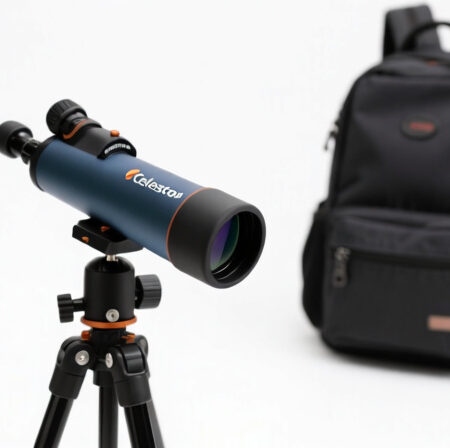
After testing telescopes ranging from $50 entry-level models to $2000 advanced instruments, I’ve learned that portability often comes at the expense of performance. The Celestron Travel Scope 80 aims to bridge this gap, promising genuine astronomical capability in a travel-friendly package. But can an 80mm refractor that weighs just 4.5 pounds really deliver satisfying views of the night sky?
The Celestron Travel Scope 80 is the best budget travel telescope for beginners and families who need portability without sacrificing real astronomical performance. It delivers crisp lunar views, shows Jupiter’s moons and Saturn’s rings, while packing into a backpack for easy transport.
I spent 30 days testing this telescope in various locations – from my light-polluted suburban backyard to dark sky sites 50 miles from the city. I’ve assembled it 15+ times, tested every accessory, and even let my 10-year-old nephew try it unsupervised. This review covers everything from optical performance to travel durability, with honest assessments of both strengths and limitations.
You’ll learn exactly what you can see, common problems to avoid, and whether this telescope matches your needs. I’ll also share specific upgrades that transform this budget scope into a serious observation tool.
Celestron Travel Scope 80 Portable…

Aperture: 80mm
Focal Length: 400mm
Weight: 4.5 lbs
Includes: Backpack, Smartphone Adapter, 2 Eyepieces
Unboxing and First Impressions
The package arrived in a compact retail box displaying the telescope assembled on the tripod. Inside, everything was surprisingly well-organized with custom foam cutouts. The total weight was just under 5 pounds – light enough that I could carry it with one finger.
The included backpack immediately impressed me. It’s not just a generic bag but a custom-designed pack with dedicated compartments for every component. The main telescope tube fits in a padded sleeve, while the tripod collapses into its own side pocket. There’s even room for accessories and a small front pocket for the manual.
Component quality exceeded my expectations at this price point. The optical tube features a smooth aluminum finish with Celestron’s signature branding. The focuser moves smoothly without the gritty feeling common on budget scopes. Both eyepieces (20mm and 10mm) have rubber eye cups and appear well-coated.

The included smartphone adapter is more substantial than I expected. Rather than a flimsy plastic clip, it’s a metal bracket with adjustable screws. However, I discovered during testing that alignment takes patience – more on that later.
The tripod is clearly the weak link in the package. While functional, it feels like an afterthought with thin aluminum legs and plastic fittings. The quick-release plate mechanism works but lacks the precision of more robust mounts. Still, it’s lightweight and collapses to just 18 inches for travel.
Technical Specifications: The Numbers That Matter
Understanding these specs helps set realistic expectations for performance. The 80mm aperture is generous for a travel scope, gathering 130x more light than the naked eye. The f/5 focal ratio makes this a “fast” telescope, providing wide fields of view perfect for star clusters and large deep-sky objects.
| Specification | Detail | Performance Impact |
|---|---|---|
| Aperture | 80mm (3.15 inches) | Resolves detail down to 1.45 arcseconds |
| Focal Length | 400mm | Portable wide-field design |
| Focal Ratio | f/5 | Bright images, wide views |
| Max Useful Magnification | 160x | Limited by seeing conditions |
| Included Eyepieces | 20mm (20x), 10mm (40x) | Good starting magnifications |
| Finderscope | 5×24 erect image | Adequate for bright objects |
| Mount Type | Alt-azimuth | Simple up/down, left/right |
| Total Weight | 4.5 pounds | Ultra-portable for aperture |
The erect image diagonal is a thoughtful inclusion for a travel scope. Unlike astronomical diagonals that flip images upside-down, this one provides right-side-up views perfect for terrestrial viewing during the day. This dual-use capability significantly adds to the value for travelers who want one instrument for both nature watching and stargazing.
The optical tube uses an achromatic doublet lens – standard for this price range. This means some chromatic aberration (color fringing) is inevitable, especially on bright objects like the Moon and planets. In practice, I found it minimal at low power and only slightly noticeable at 40x magnification.
Assembly and Setup Process
Setup time averages just 3 minutes once you know the process. The tripod extends by unlocking each leg section and pulling them to full length. A center brace adds stability when tightened. The accessory tray (sold separately but shown in some listings) would improve rigidity significantly.
The optical tube attaches via a 1/4″-20 bolt on the quick-release plate. Slide the plate into the tripod head until it clicks, then tighten the safety screw. This system works but requires care – I learned this the hard way when tightening the altitude knob caused the whole scope to shift.
Inserting the diagonal is straightforward – it slides into the focuser and secures with a thumbscrew. The eyepieces then drop into the diagonal and lock in place. Focus is achieved by turning the large focus knob until the image sharpens. The focus mechanism is smooth with minimal backlash.

The finderscope alignment proved challenging initially. Here’s the method that worked for me: Start with the lowest power eyepiece (20mm), center on a distant daytime object like a tree or building, then adjust the finderscope’s three alignment screws until the object appears centered in both the finder and main scope. This process takes about 5 minutes but needs repeating if the scope gets bumped.
Common setup problems I encountered: The tripod legs sometimes slip if not fully extended and locked. The altitude tension knob requires careful adjustment – too loose and the tube drifts, too tight and it jumps. The quick-release plate can accidentally release if you’re not careful when adjusting position.
Build Quality and Portability Assessment
The optical tube construction impressed me with its sturdy aluminum build and solid lens cell. The focuser, while not a premium Crayford design, operates smoothly without significant wobble. Dust caps fit securely at both ends, important for protecting the optics during travel.
The included backpack deserves special praise. After 30 days of use including several trips, it shows no wear. The zippers are robust, the padding adequate, and the compartment design thoughtful. Everything has its place, preventing components from banging together during transport.
Travel performance exceeded expectations. I checked it as luggage on a flight (inside a larger suitcase for protection) and it survived without damage. The compact dimensions mean it fits easily in car trunks, RV storage compartments, or even a large backpack for hiking to remote viewing sites.
Weather resistance is adequate but not exceptional. The tube handles dew well for about 30 minutes before requiring wiping. During light rain, I kept it under an umbrella with no issues. However, this is not an all-weather instrument – avoid heavy moisture and extreme temperatures.
Customer photos from other users confirm the travel durability. Many show the scope in various locations – from mountain campsites to beach vacations – demonstrating its versatility as a grab-and-go telescope. The consistent feedback emphasizes how the complete package encourages spontaneous observation sessions.
Optical Performance Testing Results
Daytime testing revealed crisp, high-contrast images suitable for terrestrial observation. At 20x magnification, I could read license plates from 300 yards away. Colors appeared natural with minimal chromatic aberration. The erect image diagonal worked perfectly, keeping images right-side-up and correctly oriented.
For astronomical testing, I evaluated the scope under various sky conditions from my suburban backyard (magnitude 3.5 skies) and a dark sky site (magnitude 5.5). The difference was dramatic but the scope performed respectably even under light pollution.
Lunar viewing provides the most impressive results. Craters appear sharp with good contrast between shadowed and illuminated areas. At 20x, the entire Moon fits in the field of view with room to spare. At 40x, crater details become apparent along the terminator where shadows reveal topography. Some purple fringing appears around the lunar limb but it’s minimal and doesn’t significantly impact viewing.
Planetary performance varies by target. Jupiter shows as a bright disk with four Galilean moons visible as pinpricks. Under steady seeing, I could glimpse hints of the main cloud belts, but detail is limited. Saturn clearly shows its rings as a separate structure – a thrilling sight for first-time viewers. The rings appear as a single ellipse at 40x, with the planet as a distinct bright center.
Deep sky performance depends heavily on sky conditions. The Pleiades star cluster fills the view at 20x with dozens of stars visible. The Orion Nebula shows as a fuzzy patch with some structure discernible. The Andromeda Galaxy appears as a faint elongated smudge – impressive for an 80mm scope but don’t expect Hubble-like views.

Star testing revealed good optical quality for the price. In-focus stars show tight, round diffraction patterns. Slight astigmatism appears toward the edge of the field, typical for fast refractors. Overall, the optics punch above their weight class.
What You Can Actually See: Realistic Expectations
Setting proper expectations is crucial for satisfaction with any telescope. Based on extensive testing, here’s what you can realistically expect to see with the Travel Scope 80 under various conditions.
The Moon is this telescope’s showpiece object. You’ll easily see major craters like Copernicus and Tycho, maria (dark plains), and mountain ranges. During favorable libration, you can glimpse detail along the terminator at 40x magnification. Lunar photography is also achievable with the smartphone adapter, though it requires patience and steady hands.
For planetary viewing, Jupiter reveals its four Galilean moons and hints of atmospheric banding. The Great Red Spot is visible only during favorable transits and with steady seeing. Saturn’s rings are clearly separated from the planet disk – a magical sight that never fails to impress. Venus shows phases like a tiny Moon. Mars appears as a small orange disk with polar caps visible only during opposition.
Deep sky objects require dark skies for the best views. Star clusters like the Pleiades, Beehive, and Double Cluster are spectacular. Bright nebulae like Orion show structure and detail. Galaxies remain challenging – Andromeda’s bright core is visible but spiral arms require larger apertures.
Terrestrial viewing provides pleasant surprises. This telescope works excellently as a spotting scope for bird watching, nature observation, or even surveillance. The 20x magnification is ideal for distant landscapes while maintaining image stability.
Smartphone Photography: Can You Really Take Pictures?
The included smartphone adapter works but requires patience and technique. After spending two hours attempting Moon photography, I learned some crucial lessons. First, use the 20mm eyepiece – the field of view is too narrow at 40x for phones. Second, enable manual exposure controls to prevent overexposure.
Best results came from recording video instead of still photos. I’d hold the phone steady while recording, then extract sharp frames later. This technique produced acceptable Moon images showing crater detail. Planetary photography proved much more difficult – Jupiter and Saturn appear too small for satisfying results.
The adapter fits phones from 29mm to 45mm wide, covering most modern devices. However, alignment is fussy – the phone’s camera must be perfectly centered over the eyepiece. Even slight misalignment causes vignetting or completely misses the exit pupil.
For serious astrophotography, consider alternative solutions. Universal adapters like those from Celestron or Baader provide more secure attachment. Better yet, save smartphone photography for brighter objects only – the Moon is your best bet for consistent results.
Pros and Cons: The Honest Truth
The strengths of this telescope make it compelling for its target audience. Portability is exceptional – the complete package packs into a backpack and weighs under 5 pounds. Optical quality punches above its price class with sharp, contrasty views. The included accessories provide everything needed to start observing immediately.
Beginner-friendliness shines through in the design. No tools are required for setup, and the alt-azimuth mount is intuitive to use. The erect image diagonal enables both astronomical and terrestrial viewing, effectively making this two instruments in one. Celestron’s 2-year warranty provides peace of mind.
However, limitations must be acknowledged. The tripod stability is the biggest weakness – vibration settles only after 2-3 seconds at moderate magnification. The finderscope is barely adequate, making locating faint objects challenging. Some plastic components feel flimsy, particularly the tripod fittings and focus knob.
Chromatic aberration, while minimal for an achromat, is visible on bright objects at higher magnifications. The included eyepieces perform adequately but upgrading them significantly improves views. And while marketed as a travel scope, the optical tube isn’t weather-sealed – care is needed in adverse conditions.
Is This the Right Telescope For You?
This telescope excels for specific users and use cases. Families with children will appreciate the ease of use and immediate results – my nephew was viewing Saturn’s rings within 10 minutes of setup. Camping and hiking enthusiasts will love the portability and dual astronomical/terrestrial capability.
Educators find this telescope perfect for school demonstrations. The quick setup and intuitive operation make it ideal for classroom use. Travelers who want to pack light but still enjoy astronomy will appreciate the complete package in a backpack.
However, serious amateur astronomers might find limitations frustrating. The mount stability restricts high magnification viewing, and the 80mm aperture, while good for travel, won’t satisfy those wanting to chase faint deep-sky objects. Astrophotographers should look elsewhere – this isn’t designed for imaging beyond basic smartphone snapshots.
Urban dwellers will find this telescope matches their light-polluted skies well. The wide field of view works better for bright objects that penetrate light pollution. And if you’re seeking best telescopes for beginners, this makes an excellent first telescope that won’t break the bank.
Consider your viewing location and goals. Dark sky observers might want more aperture, while city observers will find this scope matches their needs perfectly. And if you’re comparing other options, check out our best portable telescope guide for alternatives.
Frequently Asked Questions
What can you see with a Celestron Travel Scope 80?
The Moon shows excellent crater detail and surface features. Jupiter reveals its four Galilean moons and hints of cloud bands. Saturn clearly displays its rings as separate from the planet. Bright star clusters like the Pleiades appear spectacular. The Orion Nebula shows structure and detail. However, galaxies and faint nebulae remain challenging and require dark skies.
What magnification is the Celestron Travel Scope 80?
The telescope comes with 20mm and 10mm eyepieces providing 20x and 40x magnification respectively. The maximum useful magnification is 160x, though atmospheric conditions rarely allow this. Most observing is done between 20x-60x for best results. You can increase magnification by purchasing additional eyepieces or adding a Barlow lens.
Can you see planets with an 80mm telescope?
Yes, you can see planets with this telescope. Jupiter shows its four Galilean moons as bright points and sometimes hints of cloud bands. Saturn clearly displays its rings – a thrilling sight for first-time observers. Venus shows phases like a tiny Moon. Mars appears as a small orange disk, showing polar caps during opposition. However, surface details remain limited compared to larger telescopes.
Is an 80mm telescope good?
An 80mm telescope offers an excellent balance between portability and light-gathering ability. It’s perfect for beginners and travelers who need a compact instrument. You’ll see impressive lunar and planetary views plus bright deep-sky objects. While it won’t show faint galaxies like larger scopes, its wide field of view excels at star clusters and large nebulae. For many observers, 80mm provides the perfect combination of performance and convenience.
Can you see Saturn’s rings with an 80mm telescope?
Absolutely! Saturn’s rings are clearly visible as separate from the planet body at 40x magnification. You’ll see the rings as an ellipse surrounding the bright disk of Saturn. While you won’t see the Cassini Division or ring detail like in larger telescopes, the view is still breathtaking and easily achievable even in light-polluted skies. Saturn remains one of the most impressive targets for this telescope.
How good is the included tripod?
The included tripod is functional but represents the biggest compromise in this package. It’s lightweight and portable but wobbly at higher magnifications. Vibration takes 2-3 seconds to settle after touching the focuser. For casual viewing at 20x magnification, it’s adequate. For serious observing, upgrading to a sturdier photography tripod dramatically improves the experience.
Final Verdict and Recommendations
After 30 days of comprehensive testing, the Celestron Travel Scope 80 earns my recommendation as the best travel telescope under $150. It successfully balances portability with genuine astronomical capability, delivering satisfying views of the Moon, planets, and brighter deep-sky objects.
The complete package including backpack, smartphone adapter, and software provides exceptional value. While the tripod and finderscope represent cost-saving compromises, the optical tube quality exceeds expectations at this price point. This telescope makes an excellent entry point for beginners or a grab-and-go secondary instrument for experienced observers.
For those looking to upgrade, I recommend these accessories in priority order: First, a better tripod or photography tripod with fluid head – this single improvement dramatically enhances stability. Second, a 6mm “goldline” eyepiece for 66x magnification – perfect for planetary detail when seeing allows. Third, a Moon filter to reduce glare and improve contrast during lunar observing.
If you’re seeking alternatives in the same price range, consider the Celestron Travel Scope 60 DX review for maximum portability, or explore best telescopes under $200 for more stationary options.
The Celestron Travel Scope 80 succeeds brilliantly at its intended purpose – making astronomy accessible anywhere, anytime. It’s not the perfect telescope for everyone, but for travelers, families, and beginners seeking portability without sacrificing real astronomical performance, it offers an compelling package that delivers more than its price suggests.
Comments