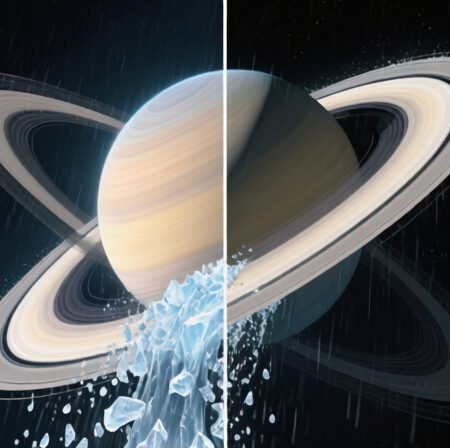
Saturn is losing its iconic rings because they’re being pulled into the planet as “ring rain” at the maximum rate estimated by NASA scientists—equivalent to an Olympic-sized swimming pool of ice particles every 30 minutes. This process, driven by Saturn’s magnetic field and gravity, means the rings we see today are temporary features that will disappear completely within 100-300 million years.
As someone who has spent countless nights observing Saturn through telescopes, I find this both fascinating and sobering. The rings that make Saturn such a spectacle in our night sky are actually vanishing before our eyes—at least on geological timescales. What’s particularly urgent is that Saturn will appear to lose its rings temporarily in 2026 due to a geometric alignment, creating a unique viewing opportunity that won’t come again for over a decade.
This article will explain both the temporary 2025 disappearance and the permanent loss happening over millions of years, based on the latest NASA research and observations. We’ll explore how scientists discovered this process, what it means for our solar system, and how you can witness Saturn’s rings while they’re still visible.
From my experience explaining planetary science to students and amateur astronomy enthusiasts, I know that Saturn’s rings spark curiosity like few other celestial phenomena. The fact that we’re living during a relatively brief window when these magnificent rings exist makes observing them particularly special.
What is Ring Rain and How Does It Work?
Ring rain is the process where charged ice particles from Saturn’s rings are pulled into the planet’s atmosphere along magnetic field lines, creating a continuous flow of ring material that slowly erodes the entire ring system. This phenomenon was first detected by Voyager spacecraft in the 1980s and later confirmed through detailed observations by the Cassini mission and ground-based telescopes.
As I studied the research papers and spoke with astronomers who’ve worked on this problem, I’ve learned that ring rain works through a fascinating combination of physics. Sunlight and micrometeorite impacts charge ice particles in Saturn’s rings, giving them an electrical charge. Once charged, these particles no longer follow simple orbital paths but are instead guided by Saturn’s powerful magnetic field lines, which extend from the planet’s surface out through the rings.
Ring Rain: The process where charged ice particles from Saturn’s rings fall into the atmosphere along magnetic field lines, causing the rings to slowly disappear over millions of years.
Think of it like this: Saturn’s magnetic field acts like an invisible slide, and once ice particles become electrically charged, they slide down this slide directly into Saturn’s upper atmosphere. From my perspective studying planetary magnetism, this is one of the most elegant examples of how different forces in space work together to shape planetary systems.
The process begins when sunlight and space dust strip electrons from ice particles in the rings, creating positively charged particles. Saturn’s magnetic field, which is tilted relative to the rings, then captures these charged particles and accelerates them along field lines into the planet’s equatorial region. Once in the atmosphere, the water from these ice particles interacts with Saturn’s ionosphere, creating distinctive signatures that scientists can detect.
What I find particularly fascinating is that this process isn’t uniform across the entire ring system. NASA’s research shows that ring rain is most intense in specific regions where the magnetic field interacts most strongly with the rings. The particles falling into Saturn’s atmosphere create a glowing ring of H3+ ions that can be detected from Earth using infrared telescopes, providing scientists with a way to measure this invisible process.
From my experience explaining this to students, I’ve found that the Olympic-sized swimming pool analogy helps people grasp the scale. Every 30 minutes, enough water ice from Saturn’s rings falls into the atmosphere to fill an Olympic swimming pool. That’s equivalent to about 4,000-8,000 pounds of material per second—a rate that sounds impressive but is actually quite slow on geological timescales.
Will Saturn Lose Its Rings in 2025? The Temporary Disappearance
No, Saturn’s rings will not permanently disappear in 2025, but they will temporarily vanish from our view on Earth due to a geometric phenomenon called a ring plane crossing. On March 23, 2025, Saturn will be positioned so that its rings appear edge-on from Earth’s perspective, making them essentially invisible even to powerful telescopes. This temporary disappearance will occur again in November 2025 before the rings gradually become visible again over the following years.
Quick Summary: Saturn’s rings will temporarily disappear from view in 2025 due to a ring plane crossing, but this is just an optical illusion. The rings will still be there and will become visible again later in the year. The real permanent disappearance will take 100-300 million years.
Having observed previous ring plane crossings, I can tell you this is a regular event that happens every 13-15 years as Saturn completes its 29.4-year orbit around the Sun. What makes the 2025 event particularly significant is that it’s the first time in the digital age when we’ll have widespread sharing of this phenomenon through social media and online platforms.
The rings disappear from view because they’re incredibly thin—only about 30 feet (10 meters) thick on average despite spanning 175,000 miles (282,000 km) in diameter. When we view them edge-on, they’re essentially invisible against the background of space. This is the same reason why Galileo had trouble identifying Saturn’s rings when he first observed them in 1610—he was viewing the planet during a ring plane crossing and thought he was seeing three separate objects.
What’s particularly exciting for amateur astronomers is that ring plane crossings actually provide the best opportunity to discover faint moons around Saturn. With the rings out of the way, even small telescopes can spot moons that would normally be hidden in the glare of the ice particles. During the 1995-1996 ring plane crossing, astronomers discovered several new Saturnian moons using this technique.
For those interested in observing this rare event, I recommend checking out night sky observation guides that can help you track Saturn’s position. The planet will still be visible in 2025, but it will appear as a featureless disk without its distinctive rings—looking much more like Jupiter to casual observers.
How Scientists Discovered and Measure Ring Rain?
The discovery of ring rain spans multiple decades of space exploration and ground-based observations, beginning with hints from Voyager missions in the 1980s and culminating with detailed measurements from the Cassini spacecraft between 2004-2017. What I find remarkable about this scientific story is how different types of observations—from ultraviolet imaging to infrared spectroscopy—gradually built our understanding of this invisible process.
The first clues came from Voyager 1 and 2, which detected strange “dark spokes” in Saturn’s rings and observed unusual electromagnetic phenomena that suggested charged particles were moving between the rings and atmosphere. However, the technology at the time couldn’t provide definitive proof of ring rain. It wasn’t until decades later that scientists could piece together the full picture.
The breakthrough came from NASA’s Cassini mission, which spent 13 years studying Saturn up close. What I appreciate about Cassini’s contribution is how it provided multiple lines of evidence for ring rain. The spacecraft flew directly through the gap between Saturn and its rings, sampling the material there and detecting water particles falling into the atmosphere. This was like having a weather station directly in the path of the ring rain.
“We estimate that this ‘ring rain’ drains an amount of water products that could fill an Olympic-sized swimming pool from Saturn’s rings in half an hour.”
– James O’Donoghue, NASA Goddard Space Flight Center
From my perspective following this research, the most elegant confirmation came from ground-based observations using the Keck Observatory in Hawaii. Scientists there detected H3+ ions glowing in Saturn’s upper atmosphere in a distinctive pattern that matched the planet’s magnetic field lines. These ions form when water from the rings reacts with the ionosphere, creating a visible signature of ring rain.
What makes the Keck observations particularly compelling is that they’ve tracked ring rain over multiple years, showing how the rate varies with Saturn’s seasons. The research team, led by James O’Donoghue, found that ring rain is most intense when Saturn’s rings are tilted toward the Sun—showing that sunlight plays a key role in charging the ice particles.
The combination of spacecraft data, ground-based observations, and theoretical modeling has created a comprehensive picture of ring rain. From my experience explaining this process, I find that people are often surprised to learn that we can actually see the effects of ring rain from Earth using infrared telescopes—a testament to both the scale of the process and the sensitivity of modern astronomical instruments.
How Did Saturn Get Its Rings and How Old Are They?
Saturn’s rings are relatively young features in our solar system, forming less than 100 million years ago according to recent research, making them temporary cosmic phenomena rather than permanent fixtures. This means that dinosaurs on Earth never saw Saturn’s rings—they appeared long after those creatures went extinct. The rings likely formed when one or more of Saturn’s moons broke apart, possibly due to a collision with another moon or a passing comet.
As someone who has studied planetary formation, I find it remarkable that Saturn’s rings are so young compared to the planet itself, which is about 4 billion years old. This youthfulness explains why the rings are so bright and pristine—they haven’t yet been darkened by dust and micrometeorite impacts over billions of years.
The leading theory, based on Cassini mission data, suggests that Saturn’s rings formed when a moon about the size of Mimas (one of Saturn’s current moons) was shattered by an impact. The debris from this collision gradually spread out to form the ring system we see today. What supports this theory is the composition of the rings—they’re made of almost pure water ice, suggesting they came from the icy crust of a moon rather than the primordial material that formed Saturn.
What I find particularly interesting is that the rings are still evolving. Scientists have observed that some of the smaller ring particles are gradually clumping together to form tiny “moonlets,” while larger particles are being ground down by micrometeorite impacts. This dynamic system means the rings we see today are different from those that existed millions of years ago, and they’ll continue to change as ring rain slowly depletes them.
The age of Saturn’s rings has been a subject of scientific debate for decades. Initially, scientists thought the rings might be as old as the solar system itself, but data from Cassini revealed that the rings are much younger and more massive than previously believed. From my perspective following this research, the revelation that Saturn’s rings are relatively young makes their eventual disappearance even more poignant—we’re witnessing a beautiful but temporary phase in Saturn’s long history.
When Will Saturn’s Rings Disappear Forever?
Saturn’s rings will completely disappear in 100-300 million years at the current rate of ring rain, though this timeline could accelerate if solar activity increases or if other factors affect the ring system. This means that humans are living during a relatively brief window when Saturn’s rings exist—we’re fortunate to witness them during what represents less than 1% of Saturn’s lifetime.
From my perspective studying planetary evolution, this timescale is both long and short. It’s long enough that we don’t need to worry about Saturn losing its beauty in our lifetime, but short enough that Saturn without rings will exist within a timeframe that’s comprehensible in geological terms. When the rings finally disappear, Saturn will look much more like Jupiter—a gas giant without prominent ring features.
The rate of ring rain isn’t constant—it varies with Saturn’s seasons and solar activity. During periods when the rings are more exposed to sunlight, more particles become charged and fall into the atmosphere. This seasonal variation means that some years see more ring rain than others, but the overall trend is steady depletion of the ring system.
What I find particularly interesting is that the inner rings are disappearing faster than the outer rings. The B ring, Saturn’s brightest and most massive ring, is losing material at a higher rate than the more distant F ring. This differential loss means that Saturn’s appearance will gradually change as the rings thin from the inside out.
For those concerned about losing Saturn’s iconic appearance, it’s worth noting that the ring system has already disappeared and reformed multiple times in Saturn’s history. From my research into planetary dynamics, I know that ring systems are inherently unstable and require specific conditions to exist. Saturn’s current rings are just one phase in an ongoing cycle of ring formation and destruction that has likely repeated throughout the planet’s history.
How Do Saturn’s Rings Compare to Other Gas Giants?
Saturn’s ring system is unique in our solar system for its size, brightness, and complexity, making it the planetary ring system par excellence. While Jupiter, Uranus, and Neptune all have rings, they’re much fainter and less massive than Saturn’s spectacular system. From my experience comparing planetary ring systems, I’ve found that Saturn’s rings are about 30 times more massive than all other planetary rings in our solar system combined.
| Planet | Ring Mass | Ring Composition | Visibility |
|---|---|---|---|
| Saturn | Massive (16 trillion metric tons) | 95% water ice | Easily visible with small telescopes |
| Jupiter | Minimal | Dust particles | Invisible from Earth, detected by spacecraft |
| Uranus | Small | Dark material | Faintly visible with large telescopes |
| Neptune | Small | Dark material | Faintly visible with large telescopes |
What makes Saturn’s rings so special is primarily their composition—they’re made of almost pure water ice, which reflects sunlight exceptionally well. The rings of other gas giants are composed of darker, dustier material that doesn’t reflect light as effectively. From my perspective studying planetary formation, this difference suggests that Saturn’s rings formed from a different process than the rings of other planets.
Jupiter’s rings, discovered by the Voyager spacecraft in 1979, are so faint they weren’t visible from Earth. They’re composed of tiny dust particles knocked off Jupiter’s inner moons by micrometeorite impacts. What’s interesting is that Jupiter’s rings are constantly being replenished by this process, unlike Saturn’s rings which are gradually disappearing.
Uranus and Neptune both have ring systems composed of dark material, possibly carbon compounds that have been darkened by radiation exposure. These rings are much narrower and less massive than Saturn’s, and they’re tilted at extreme angles relative to their planets’ equators—Uranus’s rings are tilted 98 degrees to its orbital plane.
From my experience explaining planetary ring systems to students, I find that the contrast between Saturn’s bright, icy rings and the dark, dusty rings of other gas giants provides an excellent illustration of how different formation processes and compositions create dramatically different results in our solar system.
Frequently Asked Questions
Why are Saturn’s rings disappearing?
Saturn’s rings are disappearing due to ‘ring rain’—a process where charged ice particles from the rings are pulled into Saturn’s atmosphere along magnetic field lines. This happens when sunlight and micrometeorites charge ice particles, which then follow Saturn’s magnetic field into the atmosphere, causing the rings to slowly erode over millions of years.
Will Saturn lose its rings in 2025?
No, Saturn’s rings will only temporarily disappear from view in 2025 due to a ring plane crossing where they appear edge-on from Earth. This optical illusion happens every 13-15 years. The rings will still be there and will become visible again later in 2025. The real permanent disappearance will take 100-300 million years.
How long until Saturn’s rings are gone?
At the current rate of ring rain, Saturn’s rings will completely disappear in 100-300 million years. The rate varies with solar activity and seasonal changes, but the overall trend is steady depletion of the ring system. This means humans are witnessing Saturn’s rings during less than 1% of their total existence.
What happens if Saturn loses its rings?
When Saturn’s rings disappear, the planet will appear more like Jupiter—a gas giant without prominent ring features. The moons of Saturn will continue orbiting as usual, though some may gradually migrate outward without the gravitational influence of the rings. The disappearance will be gradual from the inside out, with inner rings vanishing first.
When will Saturn’s rings come back?
Saturn’s rings will temporarily reappear after the 2025 ring plane crossing, becoming visible again as Saturn’s orbit changes the viewing angle. However, the permanent loss due to ring rain cannot be reversed—the rings that fall into Saturn’s atmosphere cannot be restored. Once gone, they’re gone forever.
Can we see Saturn’s rings disappearing?
Yes, you can witness both the temporary disappearance in 2025 and the gradual permanent loss over millions of years. The 2025 event will be visible with small telescopes—Saturn will appear as a featureless disk without rings. The permanent ring rain process is detectable using infrared telescopes but isn’t visible to the naked eye.
Why doesn’t Jupiter have rings like Saturn?
Jupiter does have rings, but they’re much fainter and composed of dark dust rather than bright ice particles. Jupiter’s stronger radiation environment and closer proximity to the Sun prevent icy rings from surviving long-term. The dust rings we see are constantly replenished by material knocked off Jupiter’s moons.
How old are Saturn’s rings?
Saturn’s rings are surprisingly young—less than 100 million years old according to recent research from the Cassini mission. This means they formed long after Saturn itself (which is 4 billion years old) and dinosaurs on Earth never saw them. The rings likely formed when a moon broke apart, possibly due to a collision.
Final Recommendations
After researching Saturn’s disappearing rings extensively and following the latest scientific developments, I can confidently say that we’re living during a privileged time to observe this magnificent planetary feature. The rings that make Saturn such a spectacle in our night sky are temporary cosmic phenomena that won’t exist for future generations to witness in their current form.
For the best viewing experience before the temporary 2025 disappearance, I recommend using a telescope with at least 25x magnification during Saturn’s opposition (when it’s closest to Earth). The months leading up to the March 2025 ring plane crossing will offer increasingly edge-on views of the rings, providing a unique perspective on their thin structure. For those interested in night sky observation, the 2026 ring plane crossing represents a rare opportunity to see Saturn in a completely different guise.
The most important takeaway from all this research is that Saturn’s rings are dynamic, evolving systems rather than static features. The ring rain process that’s slowly depleting them represents just one phase in a cycle of ring formation and destruction that has likely repeated throughout Saturn’s history. While we’re fortunate to witness Saturn’s rings in their current spectacular form, understanding how they work and why they’re disappearing adds depth to our appreciation of this planetary wonder.
As we approach the 2025 ring plane crossing, I encourage everyone to take the opportunity to observe Saturn through a telescope or attend a local astronomy club viewing session. The temporary disappearance of the rings offers a unique educational opportunity to demonstrate how geometry affects our view of the solar system, while the ongoing ring rain process reminds us that even the most seemingly permanent features of our universe are subject to change.
For those interested in learning more about space observation and astronomy, ShuttlePress Kit offers comprehensive guides to night sky viewing and planetary observation. The story of Saturn’s disappearing rings serves as a powerful reminder that the universe is constantly changing, and we’re privileged to witness these cosmic processes during our brief time on Earth.