When you look up at the night sky, you might wonder why galaxies like our Milky Way appear as stunning flat disks rather than spherical blobs. This fundamental question reveals deep truths about how the universe structures itself on the grandest scales.
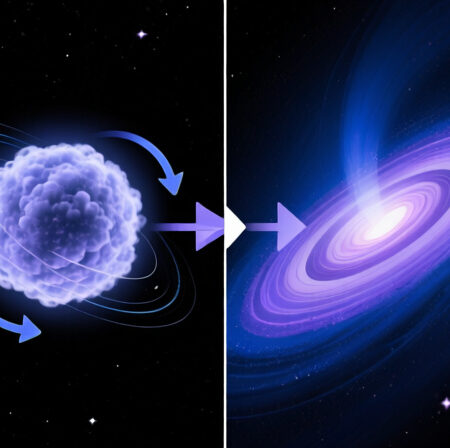
Galaxies are flat due to the conservation of angular momentum during their formation from rotating gas clouds, where centrifugal forces create a disk shape as gravitational collapse occurs. Just like a spinning pizza dough flattens into a perfect circle, galaxies naturally form disks as they rotate and collapse under gravity.
I’ve spent years studying this cosmic phenomenon, and the answer combines elegant physics with breathtaking observational evidence. The same principle that makes an ice skater spin faster when they pull their arms in also shapes entire galaxies across billions of light-years of space.
Understanding why galaxies form disks instead of spheres reveals fundamental physics governing our universe and connects us to astronomy and astrophysics principles that govern everything from planetary systems to galaxy clusters.
Galaxy Formation: From Gas Clouds to Cosmic Structures
Galaxies begin their journey as enormous clouds of gas and dark matter stretching hundreds of thousands of light-years across. These primordial clouds contain mostly hydrogen and helium, with trace amounts of heavier elements forged in earlier generations of stars.
As gravity begins to pull these massive clouds together, any slight initial rotation becomes critically important. Even a tiny amount of spin—just one kilometer per hour at the cloud’s edge—dramatically increases as the cloud collapses, much like water swirling down a drain speeds up as it approaches the center.
The formation process takes hundreds of millions of years, during which the cloud fragments into smaller regions that eventually become stars. Throughout this collapse, the cloud’s rotation axis defines a preferred direction in space, creating the foundation for the eventual disk structure.
Within these collapsing clouds, nebulae and star formation regions emerge as denser pockets of gas ignite nuclear fusion, giving birth to the first generations of stars that will eventually populate the galactic disk.
Angular Momentum: The Physics Behind Flat Galaxies
Angular momentum is the key player in galaxy flattening. This fundamental property of rotating systems cannot be created or destroyed—it’s conserved. As a galaxy’s gas cloud collapses under gravity, its rotation speed must increase to conserve this angular momentum.
Imagine an ice skater spinning with arms extended. When they pull their arms close to their body, they spin dramatically faster. The same principle applies to galaxies: as the gas cloud contracts from hundreds of thousands of light-years across to just a few thousand, its rotation speed increases exponentially.
This rapid rotation creates centrifugal force that pushes material outward, perpendicular to the rotation axis. Material above and below the galactic plane experiences this outward push most strongly, while material in the plane faces less resistance. The result is a natural flattening process that creates a thin disk.
The physics can be expressed through the angular momentum equation L = Iω, where L is angular momentum, I is the moment of inertia, and ω is angular velocity. As I decreases during collapse, ω must increase to keep L constant, spinning the galaxy faster and flattening it into a disk.
Angular Momentum: A measure of rotational motion that remains constant in isolated systems, causing spinning objects to speed up when they contract and slow down when they expand.
Centrifugal force—the same force that keeps water in a bucket when you swing it overhead—balances gravity in the radial direction but not along the rotation axis. This creates the characteristic thin disk shape we observe in spiral galaxies like our Milky Way.
How Spiral Galaxies Form Their Disks?
The disk formation process involves what physicists call “dissipative processes”—collisions between gas particles that convert ordered motion into heat. Unlike stars, which can pass by each other without interacting, gas clouds collide and lose energy, causing them to settle into the lowest energy configuration: a thin, rotating disk.
These gas cloud interactions act like friction, gradually circularizing orbits and flattening the galaxy. Material moving in random directions collides and settles into orderly rotation around the galactic center, much like marbles rolling around a bowl eventually settle into circular paths at the bottom.
The galactic disk reaches equilibrium when gravitational attraction pulling inward balances centrifugal force pushing outward. This balance creates a stable configuration that can persist for billions of years, with stars and gas orbiting the galactic center in orderly, nearly circular paths.
Spiral arms emerge from this disk structure through density waves—regions of slightly higher density that move through the disk like traffic jams on a highway. As gas clouds enter these density waves, they compress and trigger new star formation, creating the bright spiral patterns we see in many galaxies.
Not All Galaxies Are Flat: Ellipticals and Irregulars
While spiral galaxies dominate our observations, not all galaxies are flat. Elliptical galaxies range from nearly spherical to highly elongated shapes, lacking the disk structure of spirals. These galaxies typically form through galaxy collisions or from gas clouds with minimal initial rotation.
When galaxies collide, their stars and gas interact chaotically, destroying ordered disk rotation. The resulting elliptical galaxy has stars moving in random orbits, creating a spherical or ellipsoidal shape rather than a flat disk. Without the organized rotation of spirals, no centrifugal force flattens these galaxies into disks.
Dark matter plays a crucial role too. While regular matter forms the visible disk through collisions and energy loss, dark matter particles don’t interact with each other or with regular matter. This collisionless behavior allows dark matter to remain in a spherical halo surrounding the galaxy, providing the gravitational framework that influences the visible disk’s structure.
| Feature | Spiral Galaxies | Elliptical Galaxies |
|---|---|---|
| Shape | Flat disk with spiral arms | Spherical or ellipsoidal |
| Star orbits | Orderly, circular in disk | Random orientations |
| Gas content | Rich in gas and dust | Little gas or dust |
| Star formation | Ongoing in spiral arms | Mostly older stars |
| Formation | Gradual from rotating clouds | Often from collisions |
Irregular galaxies, lacking any defined shape, often result from gravitational interactions or ongoing collisions that disrupt normal galaxy formation processes. These cosmic misfits remind us that galaxy formation is a complex process with many possible outcomes.
How We Know Galaxies Are Actually Flat?
We don’t have to guess about galaxy shapes—observational evidence provides clear proof. When we view spiral galaxies edge-on, they appear as thin lines with a central bulge, like the Sombrero Galaxy or NGC 891. These edge-on views reveal disks only about 1,000 light-years thick but 100,000 light-years across—a ratio of 100:1.
Detailed observations using radio telescopes and the Hubble Space Telescope measure galaxy rotation directly. Stars and gas on one side of a galaxy move toward us (blueshifted) while those on the other move away (redshifted), proving organized rotation around a central axis—the hallmark of a disk structure.
Our own Milky Way provides the most compelling evidence. From our position within the disk, we see the band of the Milky Way stretching across the sky—a panoramic view of our galactic disk from inside. Careful mapping of star positions and motions confirms we live in a typical spiral galaxy, approximately 100,000 light-years in diameter but only 1,000 light-years thick.
For amateur astronomers wanting to observe these cosmic disks themselves, using deep space telescopes reveals the true structure of distant galaxies. Edge-on spirals appear as thin lines with distinctive central bulges, while face-on spirals show their full spiral patterns in all their glory.
The Mathematics Behind Galaxy Shapes
The physics governing galaxy shapes follows precise mathematical relationships. The virial theorem, which relates kinetic and potential energy in gravitating systems, helps explain why galaxies reach stable configurations. For rotating systems, this theorem must include rotational energy, leading naturally to disk formation.
Density calculations show why disks are so thin. The average density of a spiral galaxy’s disk is only about 0.1 solar masses per cubic parsec—nearly empty space by earthly standards. This low density allows gravity to organize matter efficiently into thin structures without the turbulence that would disrupt thicker configurations.
The scale height of galactic disks—how thick they are perpendicular to the plane—typically follows an exponential distribution, with most material concentrated within a few hundred light-years of the central plane. This mathematical pattern emerges from the balance between gravitational attraction and the random motions of stars and gas.
“The remarkable thinness of spiral galaxy disks—one hundred times wider than they are thick—represents one of nature’s most elegant demonstrations of angular momentum conservation on cosmic scales.”
– Dr. Frank van den Bosch, Yale University Astronomy Department
Frequently Asked Questions
Why are galaxies flat and not spherical?
Galaxies are flat due to conservation of angular momentum. As gas clouds collapse under gravity, any initial rotation causes them to spin faster and flatten into disks, similar to how spinning pizza dough spreads into a flat circle.
Why is the Milky Way flat?
The Milky Way is flat because it formed from a rotating gas cloud. Over billions of years, conservation of angular momentum caused the gas to flatten into a disk about 100,000 light-years across but only 1,000 light-years thick.
Are there spherical galaxies?
Yes, elliptical galaxies are roughly spherical or ellipsoidal. These galaxies form through galaxy collisions or from gas clouds with minimal rotation, so their stars orbit in random directions rather than in a flat disk.
Why don’t galaxies collapse into balls?
Galaxies don’t collapse into balls because their rotation creates centrifugal force that balances gravity’s inward pull in the disk plane. This balance creates a stable disk configuration rather than a spherical collapse.
What role does dark matter play in galaxy shapes?
Dark matter forms a spherical halo around galaxies because it doesn’t collide with itself or regular matter. This invisible halo provides most of the galaxy’s mass and gravitational framework, influencing how the visible disk forms and rotates.
How do we know galaxies are actually flat?
We observe edge-on galaxies that appear as thin lines with central bulges, measure rotation patterns showing organized disk motion, and see our own Milky Way as a band of stars across the sky—clear evidence of flat disk structures.
Final Thoughts
The flatness of galaxies represents one of the universe’s most elegant demonstrations of fundamental physics at work. From simple conservation laws emerge the magnificent spiral disks that dominate the cosmos, each containing billions of stars following orderly paths through space.
Understanding why galaxies form disks rather than spheres connects us to deep truths about how the universe organizes itself. The same principles that flatten spinning pizza dough or keep water in a swung bucket also shape the largest structures in the cosmos, revealing the beautiful unity of physics across all scales.
For those inspired to explore these cosmic disks themselves, modern telescopes for viewing galaxies bring these distant structures into view, while space observation apps help identify and track these magnificent cosmic islands in the night sky.
The next time you see the Milky Way stretching across the night sky, remember that you’re looking across a vast, thin disk—a cosmic pancake shaped by the simple yet profound law of angular momentum conservation, written across the universe in stars and gas spanning hundreds of thousands of light-years. For more fascinating astronomy articles, explore our collection of cosmic discoveries.
Comments