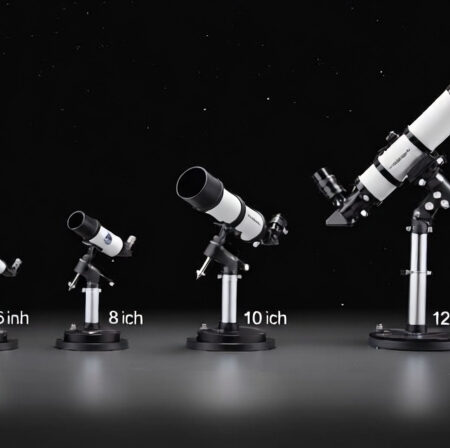
Standing under a dark sky for the first time with a telescope can be life-changing. I still remember my first view of Saturn’s rings through a properly sized Dobsonian – it’s a moment that stays with you forever.
For most beginners, an 8-inch Dobsonian telescope offers the perfect balance of performance and portability. This size provides enough light-gathering power to reveal impressive details in planets, galaxies, and nebulae while remaining manageable for one person to set up and transport.
Dobsonian telescopes are Newtonian reflectors mounted on simple altazimuth bases, designed by John Dobson in the 1960s to make large-aperture astronomy accessible to everyone. Their genius lies in maximizing aperture (the diameter of the main mirror) while minimizing cost and complexity.
In this guide, I’ll walk you through every available Dobsonian size from compact tabletop models to massive light buckets, help you understand the trade-offs between aperture and portability, and match specific telescope sizes to your observing goals and living situation.
Understanding Aperture: Why Size Matters in Dobsonian Telescopes
Aperture is the single most important factor in telescope performance. It determines how much light your telescope can gather, which directly affects what celestial objects you can see and how much detail you can resolve.
Light gathering power increases with the square of the aperture. This means an 8-inch telescope doesn’t gather just 33% more light than a 6-inch – it gathers nearly 78% more! This exponential relationship is why aperture matters so much in astronomy.
Resolution capability also scales with aperture. Larger apertures can resolve finer details and separate close double stars that smaller telescopes cannot distinguish. This becomes crucial when observing planetary details, lunar features, and globular star clusters.
Aperture: The diameter of a telescope’s primary mirror or lens, measured in inches or millimeters. Larger apertures gather more light and provide higher resolution.
Maximum useful magnification follows a simple rule: approximately 50x per inch of aperture under ideal conditions. An 8-inch Dobsonian can theoretically reach 400x magnification, though atmospheric conditions often limit practical use to 200-250x.
The limiting magnitude (faintest star visible) also improves with aperture. While a 6-inch telescope might show stars to magnitude 13.5, an 8-inch can reach magnitude 14, and a 12-inch can detect objects down to magnitude 15. This seemingly small difference reveals thousands of additional celestial objects.
Dobsonian Size Breakdown: 6-Inch to 16-Inch Apertures Compared
Tabletop and 6-Inch Dobsonians: Compact Starting Points
Tabletop Dobsonians typically feature 4.5 to 5-inch apertures and weigh under 20 pounds. They’re designed for ultimate portability and can be set up on any stable surface. These models excel as quick-look instruments or second telescopes for experienced observers.
Full-sized 6-inch Dobsonians represent the entry point for serious observing. Weighing 30-40 pounds total, they’re easily managed by one person and can reveal impressive detail in the Moon and planets, plus brighter deep sky objects like the Orion Nebula and Andromeda Galaxy.
The 6-inch aperture provides enough light gathering to show the Cassini Division in Saturn’s rings, the Great Red Spot on Jupiter, and several moons of both planets. Deep sky objects appear as faint fuzzy patches, but the brightest nebulae and galaxies show structure.
These smaller Dobsonians excel for urban observers and beginners on tight budgets. Their quick setup time (under 5 minutes) means more time observing and less time preparing. They’re also perfect for impromptu observing sessions or quick trips to darker skies.
8-Inch Dobsonians: The Sweet Spot for Beginners
The 8-inch Dobsonian stands as the most recommended size for beginners, and for good reason. This aperture hits the perfect balance between light-gathering power and portability, making it the telescope most observers keep long-term.
With 8 inches of aperture, you gain access to over 2,000 galaxies, numerous nebulae, and hundreds of star clusters. Planetary detail increases dramatically – Jupiter’s cloud bands show subtle color variations, Saturn’s rings display the Cassini Division clearly, and Mars reveals surface features during opposition.
Deep sky objects transform from faint smudges in smaller scopes to structured wonders. The Orion Nebula shows intricate detail in its inner regions, the Andromeda Galaxy displays dust lanes and companion galaxies, and globular clusters resolve to the core.
Total weight typically ranges from 45-55 pounds, with the optical tube assembly weighing around 20 pounds. Most adults can easily manage the two-piece assembly, carrying the base and tube separately. Setup time remains under 10 minutes with practice.
The 8-inch aperture performs well even in moderately light-polluted skies. Its light-gathering power cuts through urban glow to reveal impressive detail in brighter objects, making it versatile for various observing locations.
10-Inch Dobsonians: The Serious Observer’s Choice
The 10-inch Dobsonian marks the transition into serious deep sky observing territory. This aperture gathers 56% more light than an 8-inch, revealing significantly fainter objects and more detail throughout the cosmos.
Galaxies that were barely detectable in an 8-inch become impressive spectacles. The Whirlpool Galaxy shows its spiral structure, the Veil Nebula displays intricate filaments, and dozens of galaxies in the Virgo Cluster become accessible in a single night.
Planetary viewing reaches new levels of detail. Jupiter’s Great Red Spot becomes more defined, Saturn’s moons reveal themselves as tiny disks, and Mars shows subtle albedo features during favorable oppositions. The increased resolution helps split tighter double stars.
The weight increases to 65-75 pounds total, with the optical tube weighing 30-35 pounds. This size requires more consideration for transport and storage but remains manageable for most adults. The tube length extends to 55-60 inches, requiring some storage planning.
Setup time increases slightly to 10-15 minutes due to the larger components. Many observers find the performance gains well worth the extra effort, especially under dark skies where the 10-inch truly excels.
12-Inch and Larger Dobsonians: Maximum Light Gathering
Entering the 12-inch category marks a significant leap in deep sky performance. These telescopes gather 44% more light than 10-inch models and 125% more than 8-inch apertures, revealing the universe in stunning detail.
Faint galaxies that challenge 10-inch scopes become impressive in 12-inch instruments. The Pinwheel Galaxy shows spiral arms studded with star-forming regions, the Helix Nebula displays its intricate structure, and dozens of nebulae in the summer Milky Way reveal hidden details.
Weight becomes a serious consideration at 80-100 pounds total. The optical tube assembly alone weighs 45-50 pounds, often requiring two people or specialized handling equipment. Storage space needs increase significantly, with some tubes exceeding 6 feet in length.
14-inch and 16-inch Dobsonians represent the upper limit of portable amateur astronomy. These instruments require considerable planning for transport and setup, often needing disassembly for movement. However, their performance under dark skies borders on professional observatory capabilities.
16-inch and larger Dobsonians typically require step stools or ladders for comfortable viewing when pointing near the zenith. Collimation becomes more critical and challenging, and thermal acclimation times increase to 30-60 minutes.
| Aperture Size | Total Weight | Light Gathering Power | Limiting Magnitude | Best Use Case |
|---|---|---|---|---|
| 4.5-5″ Tabletop | 15-20 lbs | 1x (baseline) | 12.5 | Quick observing, second scope |
| 6″ | 30-40 lbs | 1.8x | 13.5 | Beginners, urban observing |
| 8″ | 45-55 lbs | 3.2x | 14.0 | All-around performance |
| 10″ | 65-75 lbs | 5.0x | 14.5 | Serious deep sky |
| 12″ | 80-100 lbs | 7.2x | 15.0 | Advanced deep sky |
| 16″ | 120-150 lbs | 12.8x | 15.7 | Dedicated enthusiast |
Matching Dobsonian Size to Your Observing Needs
The Urban Apartment Dweller
If you live in an apartment with limited storage and must transport your telescope to observe, consider a 6-inch or 8-inch Dobsonian. These sizes can be disassembled and stored in a closet or corner, then transported in a standard vehicle.
For extreme space constraints, tabletop models offer surprising performance in compact packages. While they won’t reveal the faintest galaxies, they provide excellent views of the Moon, planets, and brighter deep sky objects.
Urban light pollution limits telescope performance regardless of aperture. An 8-inch Dobsonian provides enough light gathering to cut through moderate glow while remaining portable enough for regular use. Budget-friendly Dobsonian options make this size accessible even for beginners.
The Suburban Backyard Observer
Suburnal observers with dedicated storage space can consider 8-inch to 10-inch Dobsonians. These sizes provide excellent performance while remaining manageable for backyard setup and occasional transport to darker sites.
The 8-inch Dobsonian remains the sweet spot for most suburban observers. It’s large enough to provide impressive views of deep sky objects yet small enough for quick setup on weeknights. The performance jump to 10-inch might not justify the increased weight and storage requirements for occasional observing.
Consider your local seeing conditions. If you rarely experience steady atmospheric conditions, the extra resolution of larger apertures may go unused. Telescope pricing by size shows the 8-inch offers excellent value for suburban use.
The Dark Sky Enthusiast
If you regularly travel to dark sky sites or live in rural areas with minimal light pollution, a 10-inch or 12-inch Dobsonian will reveal the universe’s full glory. These apertures excel at faint deep sky objects that remain invisible to smaller instruments.
The 10-inch Dobsonian represents the perfect balance of performance and portability for dark sky observers. It’s large enough to show impressive detail in galaxies and nebulae yet manageable for regular transport to observing sites.
Dedicated dark sky enthusiasts with permanent observing locations might consider 12-inch or larger instruments. These telescopes truly shine under pristine skies, revealing thousands of deep sky objects in incredible detail. Deep space observation capabilities increase dramatically with each aperture step beyond 10 inches.
The Family or Group Observer
For family observing sessions or star party attendance, consider an 8-inch Dobsonian. This size provides impressive views for beginners while remaining manageable for multiple users of different heights and strengths.
The eyepiece height on an 8-inch Dobsonian works well for both children and adults when pointed at most objects. Two adults can easily transport and set up this size, making it ideal for family astronomy activities.
Consider the telescope types comparison when choosing for family use. Dobsonians’ intuitive movements and stable platforms make them excellent for sharing views among multiple observers.
The Budget-Conscious Beginner
For beginners with limited budgets, a 6-inch or 8-inch Dobsonian offers the best value. These apertures provide impressive performance while keeping initial investment reasonable.
While it might be tempting to purchase a smaller telescope initially, many beginners outgrow 6-inch models within 6-12 months. The additional investment in an 8-inch Dobsonian typically provides longer-term satisfaction and delays the need for upgrading.
Remember to budget for essential accessories beyond the telescope itself. Quality eyepieces, a collimation tool, and observing chair add to the total cost but significantly enhance the viewing experience. Affordable telescope options show that quality doesn’t require breaking the bank.
Beyond Aperture: Storage, Transport, and Setup Realities
Storage Solutions for Every Living Situation
Storage is often underestimated when selecting telescope size. A 10-inch Dobsonian requires a dedicated space with at least 5 feet of vertical clearance and 2 feet of floor space. Consider closet corners, spare rooms, or garage space before purchasing.
Apartment dwellers might explore creative storage solutions. Some observers disassemble their telescopes after each session, storing the tube horizontally and base separately. Protective cases can help prevent damage during frequent assembly and disassembly.
For homeowners with dedicated space, consider a permanent setup area or rolling storage solution. Keeping the telescope assembled reduces setup time and encourages more frequent observing sessions.
Transportation Methods and Considerations
Transporting your telescope to dark sky sites requires planning. An 8-inch Dobsonian typically fits in most vehicles when disassembled, while 10-inch and larger models may require SUVs or trucks.
Invest in quality transport accessories. Padded cases protect the optical tube during movement, while wheeled dollies or hand trucks make moving heavy components easier. Some observers build custom transport boxes sized to their vehicle.
Consider your physical limitations honestly. If you have back problems or limited strength, smaller telescopes that you can comfortably manage will see more use than larger ones that struggle to set up.
Setup Time and Complexity
Setup time increases with telescope size. Tabletop models require only 1-2 minutes, 6-8 inch Dobsonians need 5-10 minutes, while 12-inch and larger models can require 15-30 minutes for complete setup including collimation.
Factor in acclimation time. Larger mirrors need 20-60 minutes to reach ambient temperature, especially during cold weather. Rushing this process results in distorted images until the telescope stabilizes.
Practice makes perfect. With experience, setup time decreases significantly. Consider doing a dry run at home before heading to a dark sky site to ensure you have all necessary tools and understand the process.
✅ Pro Tip: Keep a setup checklist with your telescope. Include collimation tools, eyepieces, star charts, and red flashlight. This prevents forgotten items and reduces setup frustration.
Dobsonian Telescope Costs by Size: What to Expect
Price Ranges by Aperture Size
Dobsonian telescope prices scale with aperture size, but not always linearly. Entry-level 6-inch models start around $250-350, offering excellent value for beginners. Prices include basic 25mm and 10mm eyepieces, though upgrading these significantly improves performance.
The 8-inch Dobsonian market offers the best value. Quality models range from $400-700, representing the sweet spot between cost and performance. Dobsonians under $500 often provide impressive performance for budget-conscious buyers.
Step up to 10-inch models and expect to pay $600-1000. These telescopes include upgraded features like better focusers and improved mirror coatings. The price jump reflects increased material costs and more complex manufacturing.
Large apertures (12-inch and above) command premium prices. Expect to invest $800-1500 for 12-inch models, while 16-inch Dobsonians can exceed $3000. These prices often include advanced features like cooling fans and upgraded components.
Accessory Budget Planning
Plan to spend 20-30% of your telescope budget on essential accessories. Quality eyepieces ($50-150 each) dramatically improve viewing experience. A collimation tool ($20-50) is essential for maintaining optical performance.
Consider observing comfort accessories. An adjustable observing chair ($100-200) prevents back strain during extended sessions. A step stool or ladder ($50-150) becomes necessary for larger Dobsonians when observing objects near zenith.
Don’t forget protection and transport. Dust covers ($30-50) protect your investment when not in use. Padded cases or bags ($100-300) make transport easier and prevent damage during movement to observing sites.
Long-Term Value Considerations
Dobsonian telescopes hold their value well in the used market. Quality models typically retain 50-70% of their original price after 3-5 years, making them excellent long-term investments in your astronomy hobby.
Consider upgrade paths. Many observers start with 6-inch or 8-inch Dobsonians, then upgrade to larger apertures as experience grows. Buying quality initially often provides better resale value when upgrading.
Factor in long-term costs. Larger telescopes may require additional accessories like coma correctors for fast focal ratios or cooling fans for larger mirrors. These incremental costs add up over time but significantly enhance performance.
Our Size Recommendations: Making Your Final Decision
Best Dobsonian Size for Most Beginners
For most beginners, the 8-inch Dobsonian telescope offers the ideal combination of performance, portability, and value. This aperture provides impressive views of planets and deep sky objects while remaining manageable for one person to set up and transport.
The 8-inch size delivers enough light-gathering power to keep beginners engaged for years. You’ll never outgrow this telescope – it remains an excellent instrument even after adding larger apertures to your collection.
This size performs well in various conditions, from urban backyards to dark sky sites. Its versatility makes it an excellent first telescope that won’t limit your growth as an observer.
When to Choose Smaller Apertures?
Select a 6-inch or tabletop Dobsonian if you have severe storage limitations, must transport your telescope frequently, or have budget constraints. These smaller models still provide impressive views of brighter objects and excel at lunar and planetary observing.
Consider compact telescope alternatives if space is extremely limited. These models can be stored in small closets and set up on any stable surface, making them perfect for apartment dwellers.
Urban observers with significant light pollution might find smaller apertures more practical. The performance difference between 6-inch and 8-inch telescopes diminishes under heavy sky glow, making portability the more important factor.
When to Choose Larger Apertures?
Step up to 10-inch or larger Dobsonians if you have dedicated storage space, plan to observe from dark locations, or have specific interest in faint deep sky objects. These telescopes truly shine under dark skies and reveal details impossible with smaller apertures.
Experienced observers with specific goals might choose 12-inch or larger models. If you’re committed to observing faint galaxies, nebulae, and star clusters, the additional light gathering becomes worth the increased complexity.
Consider your physical abilities honestly. Larger telescopes require more strength and space to set up. If you’re physically limited, an 8-inch Dobsonian that sees regular use provides more enjoyment than a larger instrument that rarely leaves storage.
Final Decision Factors
Consider your observing goals first. If you want to see faint deep sky objects, aperture becomes the priority. If planetary and lunar viewing appeals more, moderate apertures with high-quality optics provide excellent performance.
Be realistic about your living situation. Measure your storage space and transport vehicle before purchasing. A telescope that’s difficult to set up or move will see less use regardless of its performance capabilities.
Plan for the long term. Consider whether this telescope will complement future purchases or serve as your primary instrument for years. Quality Dobsonians hold their value well, making them excellent long-term investments in your astronomy journey.
Final Recommendations
After helping dozens of beginners select their first Dobsonian telescope, I consistently find that 8-inch models provide the best balance of performance and usability. This aperture offers impressive views of both planets and deep sky objects while remaining manageable for most adults to set up and transport.
The best telescope is the one you’ll use most often. A perfectly sized 8-inch Dobsonian that sees regular use will provide more enjoyment than a massive 16-inch instrument that rarely leaves storage due to its size and complexity.
Consider your long-term astronomy goals. If you’re serious about deep sky observing and have adequate storage, starting with a 10-inch Dobsonian might save you money on future upgrades. However, most observers find that an 8-inch telescope satisfies their observing needs for several years before feeling the urge to upgrade.
Remember that aperture matters, but comfort and convenience determine how often you’ll observe. Choose a telescope size that fits your living situation, physical abilities, and observing goals. The night sky will be there regardless of your telescope’s size, and even a modest 6-inch Dobsonian can provide lifetime of cosmic wonder.