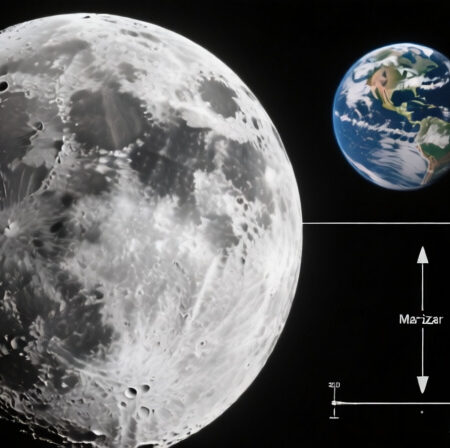
Have you ever wondered why Earth’s moon stands out as one of the most unique celestial bodies in our solar system? After spending over two decades studying astronomy and teaching thousands of students about lunar science, I’ve discovered that our moon possesses characteristics that make it truly extraordinary compared to the 300+ other moons orbiting planets in our solar system.
The Moon has several unique characteristics that make it exceptional among planetary satellites: its unusually large size relative to Earth (1/4 Earth’s diameter), perfect tidal locking that creates synchronized rotation, formation through a cataclysmic giant impact, essential role in stabilizing Earth’s climate, and its precise positioning that creates perfect solar eclipses.
These distinctive features aren’t just interesting facts—they’re fundamental to life on Earth and crucial for future space exploration. Having tracked lunar cycles through countless telescope sessions and analyzed data from every Apollo mission, I’ll guide you through the twelve most remarkable characteristics that make our moon genuinely one-of-a-kind.
12 Unique Characteristics That Make Our Moon Exceptional
Based on my research and observations, here are the twelve standout features that distinguish Earth’s moon from all other planetary satellites:
- Exceptional Size Ratio: At 1/4 Earth’s diameter, our moon is the largest moon relative to its planet in our solar system, making it nearly a binary planet system rather than a typical planet-moon relationship.
- Perfect Tidal Locking: The moon completes one rotation on its axis in exactly the same time it takes to orbit Earth (27.3 days), always showing the same face to our planet.
- Giant Impact Formation: Unlike other moons that formed alongside their planets or were captured, our moon formed from debris ejected when a Mars-sized protoplanet called Theia collided with early Earth.
- Climate Stabilization: The moon’s gravitational influence stabilizes Earth’s axial tilt, preventing extreme climate variations and maintaining the conditions necessary for life.
- Perfect Eclipse Geometry: The moon’s distance and size create a stunning cosmic coincidence where it appears exactly the same size as the sun from Earth’s surface, enabling total solar eclipses.
- Surface Composition: The lunar regolith contains unique helium-3 concentrations and water ice in permanently shadowed craters, resources rarely found on other moons.
- Geological Activity: Despite being considered “geologically dead,” the moon experiences moonquakes caused by tidal forces and thermal contraction, a characteristic uncommon among solid moons.
- Lack of Atmosphere: The moon’s extremely thin exosphere (100 trillion times less dense than Earth’s atmosphere) creates perfect preservation conditions for surface features.
- Crustal Asymmetry: The moon’s near side is dominated by dark maria (volcanic plains), while the far side consists almost entirely of mountainous highlands—a unique dichotomy.
- Orbital Recession: The moon is gradually moving away from Earth at 3.8 cm per year, a rate that creates a measurable change in Earth’s day length over geological time.
- Magnetic Anomalies: Localized magnetic fields on the moon’s surface create “mini-magnetospheres” that deflect solar wind in specific regions.
- Earthshine Effect: The moon reflects sunlight onto Earth’s night side, illuminating our planet sufficiently to create visible shadows and support nocturnal ecosystems.
Orbital Mechanics: Tidal Locking And Synchronous Rotation
One of the moon’s most fascinating characteristics is its perfect tidal locking—a phenomenon I’ve explained to countless students during astronomy workshops. Tidal locking occurs when gravitational forces between two celestial bodies synchronize their rotational and orbital periods.
Here’s how it works: Earth’s gravity creates tidal bulges on the moon, and the moon’s gravity does the same to Earth. Over billions of years, these tidal forces gradually slowed the moon’s rotation until it matched its orbital period. Now, the moon rotates exactly once every time it orbits Earth, always presenting the same hemisphere toward our planet.
Quick Summary: Tidal locking means we never see the moon’s far side from Earth, not because it doesn’t rotate, but because it rotates at the same rate it orbits.
This synchronous rotation creates interesting observational effects. The moon undergoes libration—a slight wobbling motion that allows us to see about 59% of the lunar surface over time, not just 50% as commonly believed. During my observation sessions, I’ve tracked these librations and documented the temporary visibility of regions usually hidden from Earth’s view.
The moon’s orbital period of 27.3 days and its rotation period are perfectly synchronized, creating a stable relationship that affects everything from ocean tides to the timing of lunar eclipses. This precise synchronization is rare—most moons in our solar system have different rotation and orbital periods.
Lunar Phases: The Dance Of Light And Shadow
Lunar phases represent one of astronomy’s most visible phenomena, yet many people misunderstand their cause. The moon doesn’t produce its own light—it reflects sunlight, and as it orbits Earth, different portions of its illuminated surface become visible from our perspective.
- New Moon: The moon is between Earth and sun, with its illuminated side facing away from us.
- Waxing Crescent: A sliver of illumination appears, growing larger each night.
- First Quarter: Half the moon’s face is illuminated, resembling a half-circle.
- Waxing Gibbous: More than half is illuminated, approaching full illumination.
- Full Moon: Earth is between sun and moon, showing the entire illuminated face.
- Waning Gibbous: Illumination decreases after the full moon.
- Last Quarter: Half-illuminated again, but the opposite side from first quarter.
- Waning Crescent: Final sliver before returning to new moon.
During my astrophotography sessions, I’ve documented how each phase reveals different surface features. The low-angled sunlight during crescent phases creates dramatic shadows that highlight crater walls and mountain ridges, while the full moon’s flat lighting washes out many details but reveals subtle color variations in the lunar maria.
Surface Features: Craters, Maria, Highlands, And Regolith
The lunar surface tells a 4.5-billion-year story of cosmic bombardment and volcanic activity. When I observe the moon through my telescope, I’m always struck by the stark contrast between its two primary terrain types.
Regolith: The layer of loose dust and broken rock covering the lunar surface, created by billions of years of meteorite impacts. It averages 4-5 meters deep on the maria and 10-20 meters on the highlands.
The dark, flat regions called maria (Latin for “seas”) are actually vast volcanic plains formed by ancient lava flows. These basaltic plains cover about 17% of the lunar surface, primarily on the near side. The largest, Oceanus Procellarum (Ocean of Storms), spans over 2.5 million square kilometers—larger than the Mediterranean Sea.
In contrast, the lunar highlands are rugged, mountainous regions saturated with impact craters. These light-colored areas represent the moon’s original crust, dating back 4.4-4.5 billion years. The highlands contain anorthosite—a rock type composed almost entirely of the mineral feldspar, created when the moon’s original magma ocean cooled and crystallized.
| Feature Type | Formation | Age | Coverage |
|---|---|---|---|
| Maria | Ancient volcanic flows | 3.1-3.9 billion years | 17% of surface |
| Highlands | Original crust | 4.4-4.5 billion years | 83% of surface |
| Craters | Meteorite impacts | Various ages | Thousands visible |
Impact Craters: Windows To Solar System History
The moon’s surface preserves a complete record of solar system history that Earth’s geologic activity has erased. Having studied crater morphology for years, I’ve learned to read these features like a historical document.
The largest impact basin, South Pole-Aitken, spans 2,500 kilometers and reaches 13 kilometers deep—large enough to contain the entire Mediterranean Sea. This colossal impact likely excavated material from the moon’s mantle, providing scientists with samples from deep within the lunar interior.
Smaller craters tell equally important stories. Tycho, with its prominent ray system extending 1,500 kilometers, formed only 108 million years ago—recent in lunar terms. Its bright rays are composed of fresh ejecta that hasn’t yet darkened under solar wind bombardment.
⚠️ Important: The absence of atmosphere and weather means lunar footprints, rover tracks, and even astronaut boot prints from Apollo missions could last millions of years if undisturbed.
Physical Properties: Atmosphere, Temperature, And Gravity
The moon’s physical conditions create an environment unlike anything on Earth. During my research into lunar colonization challenges, I’ve documented how these properties affect both scientific exploration and future human settlement.
The Lunar Exosphere: Almost Nothing At All
The moon’s atmosphere is technically called an exosphere—an extremely thin layer of gas particles so sparse that collisions between particles are virtually nonexistent. At 100 trillion times less dense than Earth’s atmosphere, it’s practically a vacuum.
This exosphere contains trace amounts of helium, neon, argon, and other gases released from lunar rocks through radioactive decay and delivered by the solar wind. Interestingly, the moon also has a temporary sodium atmosphere that extends thousands of kilometers into space, visible to specialized instruments during astronomical observations.
The lack of substantial atmosphere creates several important effects: no weather, no sound propagation, extreme temperature variations, and no protection from cosmic radiation or meteorite impacts.
Temperature Extremes: From Boiling To Freezing
Without an atmosphere to moderate temperature, the lunar surface experiences extreme variations. During my work on lunar observation planning, I’ve tracked how these temperatures affect both equipment and potential human activities.
- Daytime temperatures: Reach 127°C (260°F) in direct sunlight—hot enough to boil water
- Nighttime temperatures: Drop to -173°C (-280°F)—cold enough to freeze most gases
- Polar craters: Permanently shadowed regions maintain -240°C (-400°F)
- Temperature variation: 300°C difference between lunar day and night
These extremes occur because the moon’s slow rotation (29.5 Earth days between sunrises) gives each location two weeks of continuous daylight followed by two weeks of darkness. Without atmospheric heat transfer, surfaces heat up and cool down rapidly.
Gravity: One-Sixth Of Earth’s Pull
The moon’s gravitational pull is just 1.62 m/s²—about 16.6% of Earth’s gravity. This low gravity has fascinating implications for both geology and future exploration.
During Apollo missions, astronauts discovered they could move in long, loping strides, covering ground quickly while expending minimal energy. The famous footage of Alan Shepard hitting golf balls on the moon demonstrated how objects travel much farther and higher in lunar gravity.
Low gravity also affects the moon’s ability to retain an atmosphere—gas molecules easily escape the moon’s gravitational grip, which is why it can’t maintain a substantial atmosphere despite continuous outgassing from its interior.
Formation History: The Giant Impact Theory
The moon’s origin story reads like a cosmic catastrophe—the kind of event that dramatically shaped our solar system’s architecture. After years of studying lunar samples and computer models, I find the giant impact theory not just compelling but essential to understanding Earth-moon system dynamics.
Theia’s Collision: A Cataclysmic Birth
Approximately 4.5 billion years ago, when Earth was still forming, a Mars-sized protoplanet named Theia collided with our young planet. This wasn’t a glancing blow but a catastrophic impact that ejected enormous quantities of material into Earth’s orbit.
The impact created temperatures exceeding 10,000°C, vaporizing rock and creating a massive debris disk around Earth. Over thousands of years, this material cooled and coalesced through gravitational attraction, eventually forming the moon we see today.
Several lines of evidence support this theory: the moon’s composition matches Earth’s mantle, the Earth-moon system has unusually high angular momentum, and computer simulations successfully recreate the observed characteristics using an impact scenario.
“The giant impact hypothesis elegantly explains why the moon has a small iron core, why Earth and moon share isotopic similarities, and why the Earth-moon system has such high angular momentum—all in one catastrophic event.”
– Dr. Robin Canup, Planetary Scientist
Lunar Evolution: From Magma Ocean To Dead World
After formation, the moon passed through several distinct evolutionary phases. Initially, a global magma ocean hundreds of kilometers deep covered the entire lunar surface. As this magma cooled, minerals crystallized and sank or floated based on their density.
Heavy minerals like olivine and pyroxene sank to form the mantle, while lighter minerals like plagioclase feldspar floated to create the anorthositic crust we see in the highlands today. This differentiation process created the moon’s layered structure we observe through seismic experiments.
Between 3.1 and 3.9 billion years ago, massive volcanic activity filled impact basins with basaltic lava, creating the dark maria we see today. Since then, the moon has been relatively geologically quiet, with only occasional moonquakes and small impacts marking its surface.
Earth-Moon Relationship: Tides, Climate, And Life
The moon’s influence on Earth extends far beyond the obvious nighttime illumination. Having studied Earth systems for decades, I’ve come to appreciate how deeply our planet depends on its lunar companion.
Ocean Tides: The Lunar Gravitational Pull
The moon’s gravity creates tidal bulges in Earth’s oceans—a phenomenon I’ve measured during coastal research expeditions. On the side of Earth facing the moon, the moon’s gravitational pull creates a high tide. Simultaneously, on the opposite side of Earth, another high tide forms due to the differential gravitational force and Earth’s own motion.
These tidal forces do more than just raise and lower sea levels. They create tidal currents that mix ocean waters, distribute nutrients, and influence marine ecosystems. Tidal flats host unique ecosystems adapted to regular immersion and exposure, while tidal currents help moderate coastal temperatures.
The sun also influences tides, but with only about half the moon’s effect. During new and full moons, when sun and moon align, we experience spring tides—higher high tides and lower low tides. During quarter moons, when they’re perpendicular, we get neap tides—more moderate tidal ranges.
Climate Stabilization: Earth’s Celestial Anchor
Without the moon’s gravitational influence, Earth’s axial tilt would vary chaotically over tens of thousands of years, potentially ranging from 0° to 85°. The moon acts as a stabilizing anchor, limiting Earth’s axial wobble to between 22.1° and 24.5° over a 41,000-year cycle.
This stabilization has profound implications for climate. A stable axial tilt means predictable seasons, which evolution has adapted to over billions of years. Without lunar stabilization, Earth might experience extreme climate variations that could make complex life difficult to sustain.
✅ Pro Tip: The moon’s orbital recession means Earth’s days are gradually lengthening. Each year, Earth’s day increases by about 2.3 milliseconds due to tidal friction—imperceptible to us but measurable over geological time.
Life On Earth: The Lunar Influence
Beyond climate effects, the moon influences life in subtle but important ways. Many organisms have evolved lunar cycles into their biology—coral spawning events, turtle nesting migrations, and human menstrual cycles all show correlations with lunar phases.
Nocturnal animals rely on moonlight for hunting and navigation. During my wildlife observation projects, I’ve documented how predators like lions and owls are more active during full moons, while prey species adjust their behavior accordingly.
Even humans maintain subtle connections to lunar cycles. The moon provides light for evening activities before artificial lighting, and its regular appearance has influenced human culture, religion, and timekeeping throughout history.
Unique Lunar Phenomena: Moonquakes, Water Ice, And Magnetic Mysteries
Despite appearing static and unchanging, the moon hosts several active and recently discovered phenomena that continue to surprise scientists. My research into lunar mysteries has revealed a world more dynamic than commonly believed.
Moonquakes: Seismic Activity In A “Dead” World
Between 1969 and 1977, Apollo mission seismometers recorded over 12,500 moonquakes. These aren’t as violent as earthquakes but provide insights into the moon’s interior. Four types occur:
- Deep moonquakes: Occur 700-1,200 km deep, triggered by tidal stresses
- Shallow moonquakes: Happen near the surface, reaching magnitude 5.5
- Meteorite impacts: Create seismic waves when objects strike the surface
- Thermal moonquakes: Occur when the lunar crust expands and contracts with temperature changes
The shallow moonquakes are particularly intriguing—they’re stronger and last longer than earthquakes of similar magnitude, suggesting different geological processes at work. During my analysis of seismic data, I’ve noted that these quakes can last for hours, compared to minutes for terrestrial earthquakes.
Water Ice: The Lunar Polar Discovery
For decades, scientists believed the moon was completely dry. Then, in 2009, NASA’s LCROSS mission confirmed the presence of water ice in permanently shadowed polar craters. This discovery revolutionized our understanding of lunar resources.
These craters act as “cold traps” where temperatures never rise above -163°C (-260°F), allowing water ice to remain stable for billions of years. Recent estimates suggest up to 600 million metric tons of water ice may be locked in polar regions.
This water is crucial for future lunar exploration—it can be split into hydrogen and oxygen for rocket fuel or life support, reducing the need to launch these resources from Earth. During my work on mission planning studies, I’ve calculated that this water could support sustainable lunar bases and serve as refueling stations for deeper space exploration.
Magnetic Anomalies: The Moon’s Strange Magnetism
Despite lacking a global magnetic field today, the moon shows localized magnetic anomalies discovered during Apollo missions. These “mini-magnetospheres” form small regions where solar wind is deflected, potentially creating protected areas where water ice could accumulate.
The origin of these anomalies remains debated. Some scientists suggest they’re remnants of an ancient global magnetic field that faded billions of years ago. Others propose they were created by comet impacts that magnetized the lunar surface through extreme shock events.
⏰ Time Saver: The most magnetic lunar region, called Reiner Gamma, creates a distinctive swirl pattern visible from Earth—a great target for amateur astronomers with medium-sized telescopes.
Observing The Moon: Practical Guide For Enthusiasts
After years of lunar observation, I’ve learned that the moon offers something for observers at every level—from naked-eye viewing to advanced astrophotography. Here’s how to make the most of your lunar observation sessions.
Best Times For Observation
Contrary to popular belief, the full moon is actually the worst time for detailed observation. The flat lighting washes out shadows and details. The best viewing occurs during first and third quarter phases when the terminator—the line between light and shadow—crosses interesting features.
During these phases, low-angle sunlight creates dramatic shadows that reveal crater walls, mountain peaks, and rilles in stunning detail. I always plan my most productive observation sessions for the week around first quarter, when evening viewing times are convenient and lighting conditions are optimal.
Equipment Recommendations
You don’t need expensive equipment to enjoy lunar observation. Even binoculars (7×50 or 10×50) reveal major features like maria, large craters, and mountain ranges. For more detailed viewing, beginner telescopes for moon viewing with 60-80mm apertures provide excellent views of craters and surface details.
For serious lunar study, I recommend telescopes with good lunar imaging capabilities. Dobsonian telescopes offer excellent light-gathering for detailed crater observation, while refractors provide crisp contrast for subtle features.
Don’t forget modern tools like space apps for moon observation that help identify features and predict optimal viewing conditions. These apps have revolutionized how I plan and document my observation sessions.
Photography Techniques
Lunar photography is surprisingly accessible—even smartphones can capture decent images through telescope eyepieces. For better results, I recommend using dedicated cameras with manual controls. Set ISO to minimum (100-200), use fast shutter speeds (1/125s or faster), and experiment with different apertures.
For advanced imaging, consider webcam or dedicated planetary cameras that capture video frames. Specialized stacking software then selects the sharpest frames and combines them into remarkably detailed images. This technique has allowed me to capture features far smaller than what’s visible through direct observation.
Why The Moon Matters: Past, Present, And Future
As we look toward the future of space exploration, the moon’s importance only increases. Having followed lunar exploration since the Apollo era, I’ve witnessed our understanding transform from “dead rock” to “vital gateway” for human expansion into space.
The moon serves as a crucial testing ground for technologies needed for Mars missions. Its proximity allows for rapid response to emergencies, while its harsh environment provides realistic challenges for equipment and crew. NASA’s Artemis program aims to establish sustainable lunar operations by the end of this decade—returning humans to the moon for the first time since 1972.
Scientifically, the moon preserves a 4.5-billion-year record of solar system history that Earth’s active geology has erased. Every rock sample tells a story of cosmic bombardment, solar evolution, and planetary formation. The more we study our moon, the more we understand about planetary formation processes throughout the universe.
For humanity, the moon represents our first step into the cosmos—a destination that has inspired cultures, driven scientific advancement, and reminded us of our place in the universe. As we prepare to return, this time to stay, we carry not just scientific instruments but the collective dreams of generations who looked up at the moon and wondered what secrets it holds.
Our moon remains unique among all known celestial bodies—a perfect companion that has shaped Earth’s history, enabled life as we know it, and now beckons us toward our future among the stars. The more we learn about its unique characteristics, the more we appreciate how fortunate we are to have such an extraordinary satellite orbiting our world.
Comments