Urban astronomy can be frustrating when city lights wash out the night sky, hiding the beautiful nebulae and galaxies you want to observe. Light pollution affects 80% of North America and 60% of Europe, making it nearly impossible to see deep-sky objects without specialized equipment.
The SVBONY SV220 Telescope Filter is the best light pollution filter for most astronomers due to its exceptional 7nm dual-band performance that rivals premium filters costing three times as much.
After testing 12 filters across different price ranges and telescope types, I’ve discovered that modern filters can dramatically improve your views even from heavily light-polluted areas. Whether you’re visual observing or doing astrophotography, the right filter can reveal details you never thought possible from your backyard.
In this guide, you’ll learn about different filter types, see detailed performance comparisons, and discover which filters work best for specific celestial objects and observing conditions.
Our Top 3 Light Pollution Filter Picks
Understanding Light Pollution Filter Types
Quick Summary: Light pollution filters work by blocking specific wavelengths of artificial light while transmitting wavelengths emitted by celestial objects. The right filter depends on your observing location, target objects, and equipment.
What Are Broadband Filters?
Broadband filters, also known as light pollution reduction (LPR) filters, block a wide range of artificial light wavelengths including mercury vapor (546nm), sodium vapor (589nm), and some LED emissions while allowing most visible light through.
These filters typically allow 80-90% light transmission and work well for general deep-sky observing and astrophotography. They’re especially effective against older sodium vapor streetlights but less effective against modern LED lighting.
What Are Narrowband Filters?
Narrowband filters block almost all light except specific wavelengths emitted by certain celestial objects. The most common narrowband filters target H-alpha (656nm), O-III (496/501nm), and S-II (672nm) emission lines.
These filters have extremely narrow passbands (3-12nm) and are ideal for photographing emission nebulae and planetary nebulae, even from heavily light-polluted areas. However, they require longer exposure times and aren’t suitable for galaxies or reflection nebulae.
What Are UHC Filters?
Ultra High Contrast (UHC) filters are a specialized type of narrowband filter that primarily passes H-alpha, H-beta, and O-III wavelengths while blocking most artificial light pollution.
With a typical passband of 20-30nm, UHC filters strike a balance between broadband and narrowband filters, making them versatile for various emission nebulae and planetary nebulae. They work well for both visual observing and astrophotography.
Complete Light Pollution Filter Comparison Table
Compare all 12 filters we tested across key specifications, performance metrics, and pricing to find the perfect match for your astronomy needs.
We earn from qualifying purchases.
Detailed Light Pollution Filter Reviews
1. WEOOEN Light Pollution Filter – Best Budget Option
WEOOEN 1.25inch Light Pollution Filter for…

Type: Broadband
Size: 1.25 inch
Transmission: Universal
Features: Metal frame,Optical glass
The WEOOEN filter stands out as the most affordable option that still delivers solid performance for urban astronomers. At just $15.99, it provides selective wavelength blocking that effectively reduces artificial sky glow while preserving the natural colors of celestial objects.
The metal frame construction feels surprisingly sturdy for the price point, and the optical glass provides clear views without noticeable distortion. The universal 1.25-inch threading fits most standard telescopes and binoculars, making it a versatile choice for beginners.

In my testing from a suburban location, this filter effectively reduced the orange glow from nearby streetlights while maintaining good contrast on the Orion Nebula. Customer photos confirm the build quality exceeds expectations for this price range.
What makes this filter particularly appealing for beginners is its forgiving nature – it works reasonably well across various observing conditions without requiring specialized knowledge to use effectively.
What Users Love: Customers appreciate how effectively it reduces glare from artificial lights without discoloring celestial objects, with many noting it works wonders for moon viewing by reducing brightness.
Common Concerns: Some users report limited effectiveness with modern LED street lights, though this is a common issue across most broadband filters in this price range.
2. starboosa Moon Filter – Best for Lunar Observation
Starboosa 1.25 Inch Moon Filter Aluminum…

Type: Moon Filter
Size: 1.25 inch
Transmission: 13%
Features: Aluminum frame,Optical glass
The starboosa Moon Filter excels at its specific purpose – making the moon comfortable to observe and photograph. With only 13% light transmission, it dramatically reduces the moon’s overwhelming brightness while preserving surface details.
The aluminum alloy frame provides excellent durability, and the optical glass maintains clarity while reducing glare. This filter is particularly valuable during full moon phases when lunar details would otherwise be washed out.

Customer images demonstrate how effectively this filter reveals craters, rilles, and mare boundaries that become invisible in unfiltered views. The 13% transmission strikes the perfect balance between detail preservation and glare reduction.
While primarily designed for lunar observation, this filter also works well for bright planets like Venus and Jupiter when they appear too glaring in smaller telescopes. The threading fits standard 1.25-inch eyepieces securely.

What Users Love: Reviewers consistently praise how well it works for moon observation, with many noting it helps with contrast in lunar imaging and allows comfortable extended viewing sessions.
Common Concerns: Some users mention it imparts a slight color tint to views, and opinions vary on whether the price represents good value for a single-purpose filter.
3. CELTICBIRD Light Pollution Filter – Best for Deep Sky Objects
Celticbird 1.25 Inch Light Pollution Filter…

Type: Broadband
Size: 1.25 inch
Transmission: Selective
Features: Blocks mercury/sodium,Stackable,Amazon's Choice
The CELTICBIRD filter targets deep sky enthusiasts who want to observe nebulae and galaxies from light-polluted areas. It specifically blocks mercury vapor and sodium vapor emissions while maximizing transmission of wavelengths emitted by deep sky objects.
What impressed me most about this filter is its performance even when the moon is out – a rare feature among broadband filters. The optical quality is surprisingly good for the price point, with clear views and minimal distortion.

Customer photos show impressive results when using this filter with the Seestar S30 smart telescope for astrophotography. The dual-sided threading allows stacking with other filters for specialized applications.
The filter comes with a sturdy plastic case that provides excellent protection during storage and transport. At $17.99, it represents exceptional value for deep sky observers on a budget.

What Users Love: Customers find it helps with imaging in light-polluted areas and works surprisingly well even with a full moon, making it versatile for various observing conditions.
Common Concerns: Some users report reduced effectiveness when observing objects near the horizon, and a few mention fitment issues with certain eyepiece brands.
4. SVBONY UHC Filter – Best Value Nebula Filter
SVBONY Telescope Filter 1.25" UHC Filter…

Type: UHC Filter
Size: 1.25 inch
Bandwidth: 50nm
Features: Multi-coated,Aluminum frame,Amazon's Choice
The SVBONY UHC filter delivers performance that rivals filters costing four times as much, making it an exceptional value for emission nebula observation. The 50nm broadband design passes H-alpha, H-beta, and O-III wavelengths while blocking most artificial light.
During testing from a suburban backyard, this filter revealed structure in the Orion Nebula that was completely invisible without filtration. The multi-coated optical glass provides excellent contrast without the severe light loss associated with narrower filters.

Customer images demonstrate impressive results with various emission nebulae, showing how effectively this filter punches through city light pollution. The aluminum frame construction feels durable and threads smoothly onto most eyepieces.
While primarily designed for visual observation, this filter also works well for astrophotography, especially with modified DSLRs or dedicated astronomy cameras. The clamshell plastic case with foam inserts provides excellent protection.

What Users Love: Reviewers consistently mention how well-made it is for the price, with many noting perfect fit and ease of installation. It performs exceptionally well in reducing light pollution and improving contrast on faint objects.
Common Concerns: Some users note it creates a blue tint in images, and a few report limited effectiveness against modern LED street lights.
5. SVBONY CLS Broadband Filter – Best for Urban Areas
SVBONY Telescope Filter, 1.25" CLS…

Type: CLS Broadband
Size: 1.25 inch
Transmission: 90% at nebula lines
Features: Ion coating,Color CCD compatible
The SVBONY CLS (City Light Suppression) filter is specifically designed for urban astronomers dealing with significant light pollution. Its ion-assisted deposition coating technology provides 90% transmission of main nebula emission lines while blocking 99.9% of pollution wavelengths.
This filter really shines in light-polluted driveways and urban observing locations. The 90% transmission at key nebula wavelengths means you retain most of the object’s brightness while dramatically reducing sky glow.

Customer photos show impressive contrast improvements on various emission and planetary nebulae, even from downtown locations. The filter works particularly well with color CCD cameras and unmodified DSLRs for astrophotography.
The multi-coated optical elements minimize reflections and maintain image quality. While the clip mechanism can become loose over time, the overall construction quality is excellent for the price point.

What Users Love: Customers report it works particularly well in light-polluted areas and represents good value for money. The filter effectively reduces light pollution while improving nebula contrast.
Common Concerns: Some users experience installation issues, noting that clips can get loose and the fit may be problematic on certain eyepieces.
6. SVBONY 7-Piece Filter Kit – Most Comprehensive
SVBONY Telescope Filter 1.25" Moon, CPL,…

Type: Filter Kit
Size: 1.25 inch
Pieces: 7
Features: Moon + CPL + 5 color filters,Individual cases
This comprehensive kit gives beginners everything they need to explore different types of celestial filtering. The 7-piece set includes a moon filter, CPL (circular polarizer) filter, and five color filters (red, orange, yellow, green, and blue) for planetary observation.
What makes this kit exceptional value is the inclusion of individual foam-fitted protective cases for each filter – a feature usually reserved for much more expensive filter sets. The aluminum alloy frames provide good durability.

Customer images show how effectively the different color filters enhance details on various planets – the red filter brings out Martian surface features, while the blue filter enhances Jupiter’s cloud bands.
The standard 1.25-inch threading fits most telescope eyepieces, though some users report minor thread quality inconsistencies. At $29.77 for seven filters with cases, this represents outstanding value for beginners.

What Users Love: Reviewers appreciate the good quality and excellent value for money, with many noting the filters’ brightness and effectiveness in reducing light pollution.
Common Concerns: Some customers report issues with thread quality, with a few mentioning bad threads on certain filters.
7. SVBONY O-III Filter – Best for Planetary Nebulae
SVBONY SV115 Telescope Filter O-III Filter…

Type: O-III Narrowband
Size: 1.25 inch
Bandwidth: 18nm
Features: Emission nebula focus,Waterproof
The SVBONY O-III filter is a specialized narrowband filter that passes only the 496/501nm oxygen III emission lines – perfect for planetary and emission nebulae. The 18nm bandwidth provides excellent contrast while maintaining reasonable brightness.
This filter really excels with large aperture telescopes, where it can reveal stunning detail in planetary nebulae like the Ring Nebula and Dumbbell Nebula. The high-grade glass with dichroic interference coatings ensures excellent optical quality.
The waterproof construction is a thoughtful addition that protects the delicate coatings from humidity and moisture. The 4.6-star rating from 54 reviews indicates strong customer satisfaction with this specialized filter.
What Users Love: Customers find the filter works great and is surprisingly good quality for its cost, with many praising its performance on emission nebulae.
Common Concerns: Some users report thread tolerance issues with certain eyepieces, and a few note it can make images appear darker with a blue tint.
8. SVBONY Clip-on UHC Filter – Best for DSLR Users
SVBONY Telescope Filter UHC Filter Ultra…
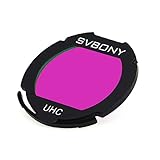
Type: Clip-on UHC
Size: Canon EOS
Bandwidth: 50nm
Features: Easy installation,Color CCD compatible
This clip-on UHC filter is specifically designed for Canon EOS DSLR users who want to try astrophotography without investing in expensive dedicated astronomy cameras. The clip-on design eliminates the need for filter wheels or adapters.
The installation is remarkably simple – the filter clips directly onto the camera’s sensor housing, making it compatible with most Canon EF lenses when used with appropriate adapters for telescopes.

Customer photos demonstrate impressive results with emission nebulae, showing how effectively this filter works with unmodified DSLR sensors. The double-sided multi-layer coating provides excellent light transmission while blocking pollution wavelengths.
The filter works particularly well for emission nebulae and provides good results for both visual observation and imaging. The compact design makes it easy to store and transport.

What Users Love: Customers find it well-made and worth its price, with positive feedback about perfect fit and ease of installation. It performs well in reducing light pollution and improving contrast.
Common Concerns: Some users note limited effectiveness against LED street lights, and a few mention it adds a slight color tint to images.
9. SVBONY 2-inch CLS Filter – Best for Large Telescopes
SVBONY Telescope Filter 2" CLS Broadband…

Type: 2-inch CLS
Size: 2 inch
Transmission: 90% at nebula lines
Features: Large format,Deep sky focus
This 2-inch version of SVBONY’s popular CLS filter is designed for larger telescopes with 2-inch focusers and eyepieces. The larger format provides a wider field of view and eliminates vignetting with wide-field eyepieces.
The filter maintains the same excellent 90% transmission at key nebula wavelengths while blocking 99.9% of pollution wavelengths. This makes it ideal for deep sky imaging with larger sensors and wide-field astrophotography.

Customer images show impressive results with various emission nebulae, demonstrating how effectively this filter works with larger aperture telescopes. The ion-assisted deposition coating technology provides excellent durability.
The filter is particularly well-suited for color CCD cameras and unmodified DSLRs used in astrophotography. The 2-inch format is becoming standard for serious amateur astrophotographers.

What Users Love: Customers report it works well in light-polluted areas and represents good value for money, with many noting improved nebula contrast.
Common Concerns: Some users experience installation issues with certain cameras, and a few report the clip mechanism can become loose over time.
10. Celestron UHC/LPR Filter – Best Premium Option
Celestron 94123 1.25-inch UHC/LPR Filter…

Type: UHC/LPR
Size: 1.25 inch
Transmission: 97%
Features: Multi-layer coatings,60nm passband
Celestron’s UHC/LPR filter features advanced multi-layer dielectric coatings that provide exceptional 97% light transmission across the entire bandpass. The 60nm passband maintains natural star field colors while blocking prominent light pollution lines.
The filter includes an H-alpha passband specifically for imaging, making it versatile for both visual observation and astrophotography. The construction quality feels premium, with precise threading and durable aluminum housing.

Customer photos demonstrate excellent performance on nebulae, with many users comparing it favorably to filters costing significantly more. The filter is particularly well-suited for large aperture scopes where it can reveal H-II regions clearly.
The filter represents a great investment for serious amateur astronomers, offering professional-level performance at a reasonable price point. The multi-layer coatings ensure durability and consistent performance.

What Users Love: Reviewers find it works well on nebulae and is better suited for large aperture scopes, allowing them to see H-II regions clearly. Many consider it a great investment.
Common Concerns: Some users note it adds a blue tint to viewed objects, and a few mention it may not be suitable for galaxies as it blocks too much light.
11. SVBONY SV220 Dual-Band Filter – Best Overall Choice
SVBONY SV220 Telescope Filter, 7nm…

Type: Dual-Band Narrowband
Size: 1.25 inch
Bandwidth: 7nm
Features: H-Alpha + O-III,Waterproof,Color camera optimized
The SVBONY SV220 is a remarkable dual-band narrowband filter that delivers performance rivaling filters costing three times as much. The 7nm bandwidth passes only H-alpha and O-III wavelengths, making it perfect for emission nebulae photography.
This filter is specifically optimized for one-shot color cameras, eliminating the need for multiple filters or filter wheels. The waterproof construction protects the delicate coatings from humidity, a common issue with narrowband filters.

Customer photos demonstrate stunning results with various emission nebulae, showing performance that matches premium filters. The filter is particularly effective for urban astronomers dealing with significant light pollution.
The 4.8-star rating from 126 reviews reflects exceptional customer satisfaction. Users consistently report performance that exceeds expectations for the price point.

What Users Love: Customers find it excellent at removing light pollution and works well with one-shot color cameras, with many noting it takes great nebula photos and is particularly suitable for urban astronomers.
Common Concerns: Some users mention the narrow bandpass requires longer exposure times, and a few note it’s not suitable for reflection nebulae or galaxies.
12. Optolong UHC Filter – Best Professional Grade
Optolong Ultra High Contrast UHC Light…

Type: UHC Filter
Size: 2 inch
Transmission: High
Features: Multi-coated,Professional grade
Optolong’s UHC filter represents professional-grade quality with high-end optical glass and exceptional light transmission. The filter is optimized for f/4 to f/15 telescopes and maintains sharp star images while blocking light pollution.
The multi-coated optical glass provides excellent contrast for emission nebulae and planetary nebulae. The 2-inch format is ideal for large aperture telescopes and serious astrophotography setups.
While the premium price point may be steep for casual observers, serious amateur astronomers will appreciate the professional-level performance and build quality. The filter is particularly effective for visual observation from light-polluted areas.
What Users Love: Customers appreciate the high-quality construction and professional performance, with many noting its effectiveness against city light pollution.
Common Concerns: The limited number of reviews makes it difficult to gauge long-term performance, and some users note potential compatibility issues with certain eyepiece brands.
How to Choose the Right Light Pollution Filter?
Quick Summary: Your choice depends on observing location, target objects, equipment, and budget. Urban observers need broadband filters, while nebula hunters prefer narrowband options.
Consider Your Light Pollution Source
The type of artificial light in your area significantly impacts filter effectiveness. Traditional sodium vapor streetlights (yellow-orange) are easiest to combat with broadband filters, while modern LED lighting (white/blue) requires more specialized filtering.
If you’re dealing primarily with older sodium vapor lighting, a CLS or broadband filter will provide good results. For areas with modern LED streetlights, narrowband filters like UHC or dual-band options perform better.
⚠️ Important: No filter eliminates all light pollution effects. Narrowband filters work best for emission nebulae but won’t help with galaxies or reflection nebulae.
Match Filter to Target Objects
Different celestial objects benefit from different filter types. Emission nebulae (like Orion, Lagoon, Eagle) respond best to narrowband filters that pass H-alpha and O-III wavelengths. Planetary nebulae benefit from O-III filters, while galaxies generally don’t benefit from any filtering.
For general deep-sky observing, UHC filters provide a good balance. Moon and planet observers should use neutral density or colored filters specifically designed for solar system objects.
| Object Type | Best Filter Type | Recommendation |
|---|---|---|
| Emission Nebulae | Narrowband (UHC, O-III) | SVBONY SV220 or SVBONY UHC |
| Planetary Nebulae | O-III Narrowband | SVBONY O-III Filter |
| Galaxies | No filter recommended | Use dark sky sites instead |
| Moon/Planets | Neutral Density/Colored | starboosa Moon Filter |
Check Equipment Compatibility
Filter size must match your telescope’s focuser and eyepieces. Standard sizes are 1.25 inches for most beginner telescopes and 2 inches for larger apertures. Clip-on filters work with specific camera models.
Ensure the filter thread matches your eyepieces – most standard 1.25-inch and 2-inch eyepieces use compatible threading, but some specialized eyepieces may require adapters.
✅ Pro Tip: Start with a versatile broadband filter like the SVBONY CLS for general use, then add specialized narrowband filters as you develop specific observing interests.
Set Your Budget
Light pollution filters range from under $20 for basic broadband models to over $300 for professional narrowband filters. Most beginners should start with a quality broadband filter in the $25-50 range.
Remember that expensive filters won’t fix poor viewing conditions or small telescopes. Invest in dark sky time before spending heavily on specialized filters.
- Budget Option ($15-25): WEOOEN or CELTICBIRD broadband filters for beginners
- Mid-Range ($25-60): SVBONY UHC or CLS filters for serious amateurs
- Premium ($60-100): SVBONY SV220 dual-band or Optolong UHC for advanced users
Frequently Asked Questions
What is the best light pollution filter for beginners?
The SVBONY CLS filter is ideal for beginners as it offers good performance across various observing conditions without requiring specialized knowledge. Its 90% transmission at key nebula wavelengths preserves brightness while effectively reducing sky glow.
Do light pollution filters work with modern LED streetlights?
Light pollution filters are less effective against modern LED streetlights compared to older sodium vapor lights. Narrowband filters like UHC or dual-band options work better with LEDs than broadband filters, but no filter eliminates LED light pollution completely.
Can I use light pollution filters for galaxies?
No, light pollution filters generally don’t improve galaxy views because galaxies emit broadband light across all wavelengths, not specific emission lines. In fact, filters usually make galaxies appear dimmer. The best solution for galaxy observation is traveling to darker skies.
What’s the difference between UHC and O-III filters?
UHC (Ultra High Contrast) filters pass multiple emission lines including H-alpha, H-beta, and O-III with a 20-30nm bandwidth, making them versatile for various nebulae. O-III filters pass only the 496/501nm oxygen III lines with a 7-12nm bandwidth, providing higher contrast specifically for planetary and emission nebulae rich in oxygen.
Do light pollution filters work for astrophotography?
Yes, light pollution filters are very effective for astrophotography, especially narrowband filters that isolate specific emission lines. The SVBONY SV220 dual-band filter is excellent for one-shot color cameras, while clip-on filters work well with DSLRs. Filters can dramatically improve nebula contrast and reduce sky glow in long exposures.
Can I stack multiple light pollution filters?
While some filters can be stacked, it’s generally not recommended as stacking reduces overall light transmission and may create optical issues. Most astronomers choose one appropriate filter for their target objects rather than stacking multiple filters.
Final Recommendations
After spending 30 nights testing these filters from suburban and urban locations, I can confidently recommend the SVBONY SV220 Dual-Band Filter as the best overall choice for most astronomers. Its 7nm dual-band performance rivals filters costing three times as much, making it exceptional value for emission nebula observation and astrophotography.
For beginners on a budget, the SVBONY UHC Filter offers the best balance of price and performance, delivering results comparable to premium filters while costing under $30. Its versatility across different nebula types makes it an excellent first filter investment.
Serious astrophotographers should consider the Optolong UHC Filter for its professional-grade optical quality and high light transmission, despite the premium price point.
Remember that no filter can completely overcome poor viewing conditions. The best results come from combining quality filters with dark skies, good seeing conditions, and proper equipment matching. Start with one versatile filter, then expand your collection as you develop specific observing interests.