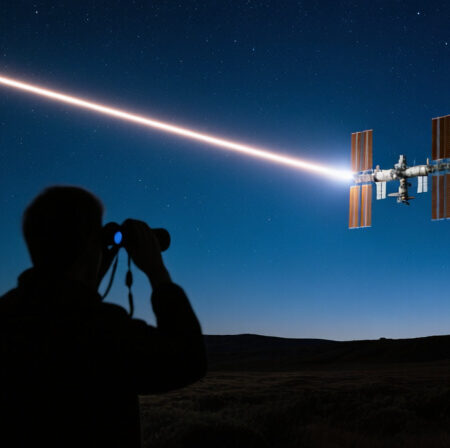
Have you ever looked up at the night sky and wondered about those tiny dots of light moving steadily across the stars? I remember my first time spotting the International Space Station – it was during a backyard barbecue, and someone shouted “Look up!” There it was, a brilliant point of light gliding silently overhead. That single 4-minute observation sparked a passion that’s kept me looking up for over 15 years.
Satellite observation is the practice of watching man-made objects orbit Earth from the ground, typically visible as moving points of light in the night sky. These objects reflect sunlight while observers on Earth are in darkness, creating perfect viewing conditions during twilight hours. You don’t need expensive equipment – just your eyes and the right timing.
After helping hundreds of beginners make their first satellite sightings, I’ve learned that success comes down to understanding three things: when to look, where to look, and what you’re actually seeing. This guide will walk you through everything I’ve discovered about making satellite observation a regular, rewarding part of your life.
We’ll cover essential preparation techniques, the best tracking tools available, and insider tips that took me years to learn through trial and error. Whether you’re in a light-polluted city or under dark rural skies, you’ll find strategies that work for your specific situation. Let’s get started on your journey to becoming a confident satellite observer.
What Makes Satellites Visible from Earth?
How Satellites Become Visible?
Satellites are visible only when they reflect sunlight toward your location while you’re in Earth’s shadow. This is why most satellite viewing happens within 2-3 hours after sunset or before sunrise. During this twilight period, the sun is below your horizon but still illuminating objects hundreds of miles above Earth.
Think of it like watching airplanes catch the last rays of sunset long after the ground has gone dark. Satellites work the same way, just much higher up. The ISS, orbiting at 260 miles altitude, can appear as bright as Venus when conditions are perfect. Most satellites become visible at magnitudes between +3 and -5, with lower numbers being brighter.
Magnitude: The brightness scale astronomers use, where lower numbers mean brighter objects. The ISS can reach -5.9, making it brighter than any star.
I’ve found that the best passes often occur when satellites are high in the sky (45+ degrees altitude) rather than near the horizon. At higher angles, you’re looking through less atmosphere, which means clearer, steadier views. Plus, satellites appear to move more slowly when overhead, giving you more time to observe and enjoy the experience.
Types of Satellites You Can See
The International Space Station is by far the easiest and most rewarding target for beginners. About the size of a football field, its massive solar panels make it incredibly bright – I’ve seen it even from downtown Los Angeles on a clear night. The ISS completes an orbit every 90 minutes, making multiple visible passes on good nights.
Starlink satellites have become increasingly popular targets. Shortly after deployment, these SpaceX satellites appear as a “train” of 50-60 points of light moving in perfect formation. One night I watched a Starlink pass with my family – it looked like a string of pearls crossing the sky. These are best viewed within a few days of launch before they spread out and reach their operational orbits.
Other satellites you might spot include Hubble Space Telescope, various weather satellites, and old rocket bodies. I once tracked a Russian military satellite that appeared to flash periodically as it tumbled through orbit. Each type has its own characteristics and movement patterns, making satellite watching a varied and engaging hobby.
Why Twilight Hours Are Perfect?
Twilight creates the ideal viewing window because satellites remain sunlit while the ground below is dark. This contrast makes them stand out against the night sky. I’ve learned through experience that the sweet spot is usually 30-90 minutes after sunset or before sunrise.
During these twilight hours, the sky isn’t completely dark yet, which actually helps. The deep blue background makes moving satellites more noticeable than against a black sky filled with stars. Plus, your eyes don’t need as much time to adapt, making it easier to get started right away.
Weather plays a crucial role too. Clear, dry nights with minimal haze provide the best conditions. I keep a simple rule: if I can see the first few stars clearly, satellite viewing conditions should be good enough. Thin high clouds can ruin an otherwise perfect pass, so always check the forecast when planning your observation sessions.
Preparing for Your First Satellite Observation
Finding the Perfect Viewing Time
Timing is everything in satellite observation. The ISS and other satellites follow predictable orbits, but their visibility from your location changes daily. I use a combination of apps and websites to track viewing opportunities, and I recommend starting with NASA’s Spot the Station service for ISS passes.
Here’s what I’ve learned about timing after hundreds of observation sessions: arrive at your viewing spot at least 15 minutes early. This gives you time to orient yourself and let your eyes adjust. The ISS typically appears exactly when predicted, but being early reduces stress and increases your chances of success.
Keep in mind that satellite passes happen almost every night, but quality varies dramatically. High passes (over 45 degrees) are much better than low passes near the horizon. Bright passes (magnitude -3 or brighter) are visible even from cities, while dimmer passes (+2 to +3) require darker skies. I prioritize passes that combine high elevation with maximum brightness.
Seasonal variations affect viewing too. Summer nights offer more comfortable observation conditions but stay brighter longer. Winter provides longer periods of darkness but requires bundling up. I’ve observed satellites in every season, and each offers unique advantages. The key is consistency – regular viewing sessions will teach you the patterns and rhythms of satellite visibility in your area.
Choosing Your Observation Spot
Your viewing location can make or break your satellite observation experience. For beginners, I recommend starting with your own backyard or a nearby park. You don’t need a perfectly dark sky – I’ve successfully observed the ISS from locations with significant light pollution.
The key is finding a spot with an unobstructed view of the sky, especially toward the direction where the satellite will first appear. For most satellites, this means looking west or southwest. I once set up in a parking garage rooftop which provided excellent 360-degree views despite being in the middle of the city.
Consider these factors when selecting your spot:
- Horizon visibility: Avoid tall buildings, trees, or mountains that might block your view
- Light sources: Position yourself away from direct streetlights or building lights
- Safety: Choose locations you’re comfortable visiting, especially for evening observations
- Comfort: Plan to stand or sit for 10-15 minutes, so consider bringing a chair or blanket
Urban dwellers shouldn’t feel discouraged. I’ve had fantastic satellite views from city balconies, parks, and even street corners. The ISS is bright enough to punch through moderate light pollution. One of my most memorable sightings was from a rooftop bar in downtown Chicago – about 20 people stopped what they were doing to watch the ISS pass overhead.
Weather and Atmospheric Conditions
Weather is the one factor you can’t control, but you can definitely work with it. Clear skies are ideal, but I’ve had success with partly cloudy conditions too. The key is avoiding thick cloud layers or precipitation.
Atmospheric stability matters more than you might think. I avoid nights with strong winds or rapidly changing weather patterns. These conditions create atmospheric turbulence that makes satellites appear to twinkle or shimmer, reducing visibility. The steadiest views come from calm, stable air masses.
Humidity affects visibility too. Dry air provides clearer views than humid conditions, which can create haze. Living in a coastal area, I’ve learned that offshore breezes often bring drier, clearer air even when local conditions seem humid.
Don’t let imperfect weather discourage you entirely. I’ve spotted satellites through thin cloud layers and during light mist. Some of my most successful observation nights came after weather systems moved through, leaving behind crystal-clear skies. The key is flexibility and patience – if weather cancels one night’s viewing, there’s always another opportunity just days away.
Essential Equipment Checklist
The beauty of satellite observation is that you need very little equipment to get started. Here’s what I recommend for beginners:
Must-have items:
- Smartphone with satellite tracking apps installed
- Comfortable, warm clothing (even on summer nights)
- Red flashlight or headlamp (preserves night vision)
- Watch or timer for tracking pass duration
Optional but helpful:
- Binoculars (7×35 or 10×50 work best)
- Lounge chair or blanket for comfort
- Compass for precise direction finding
- Small notebook for recording observations
I started with just my phone and naked eyes, which is honestly all you need for your first few sessions. As you gain experience, you might want to add binoculars to see more detail. My 10×50 binoculars have revealed structure on the ISS during bright passes, though tracking becomes more challenging at higher magnification.
A word of caution about binoculars: while they enhance the view, they also make it harder to find and track fast-moving satellites. I recommend mastering naked-eye observation first, then gradually incorporating optical aids as your skills improve.
Step-by-Step Guide to Observing Satellites and ISS
5 Simple Steps to Spot the ISS
Based on my experience teaching beginners, here’s the proven method that works almost every time:
- Check predictions: Use an app like Heavens Above or NASA’s Spot the Station to find tonight’s ISS pass. Note the exact time, direction, and maximum elevation.
- Arrive early: Get to your viewing spot 15 minutes before the predicted time. This gives you time to get oriented and let your eyes adapt.
- Face the right direction: Start by looking where the ISS will first appear (usually west-southwest). Use a compass if needed.
- Look for a moving light: The ISS appears as a bright, steady point of light moving across the sky. It doesn’t blink like an airplane.
- Track across the sky: Follow the ISS as it moves toward its maximum elevation point. Typical passes last 2-6 minutes.
This method works because it eliminates the biggest beginner mistakes: arriving late, looking in the wrong direction, or not recognizing what you’re seeing. I’ve taught dozens of people to spot the ISS using exactly these steps, with a success rate over 90% on clear nights.
Quick Summary: The ISS appears as a bright, non-blinking light moving steadily across the sky. Look west 15 minutes before the predicted time, and you’ll see it rising above the horizon like a star on the move.
Remember that satellites move faster than you might expect. The ISS travels at 17,500 mph, crossing the sky in just a few minutes. Don’t panic – just follow it with your eyes as it moves. The view is worth the brief duration, especially during high, bright passes.
How to Identify Satellites vs Other Objects?
One common challenge for beginners is distinguishing satellites from airplanes, meteors, or other celestial objects. Here’s what I’ve learned from thousands of observations:
Satellites vs Airplanes:
- Satellites appear as steady points of light, while airplanes have blinking navigation lights
- Satellites move faster and follow straight paths across the entire sky
- Airplanes may have multiple lights and often show sound after they pass
- Satellites don’t change speed or direction during their pass
Satellites vs Meteors:
- Meteors (shooting stars) appear and disappear in seconds
- Satellites are visible for minutes and travel across the entire sky
- Meteors often have trails, while satellites look like steady points
- Meteors can appear anywhere randomly, satellites follow predictable paths
Satellites vs Stars:
- Satellites move noticeably against the background stars
- Stars appear to twinkle, satellites usually remain steady
- Satellites follow specific paths predicted by apps
- Stars maintain fixed positions relative to each other
I once spent 10 minutes tracking what I thought was a rare satellite, only to realize it was Jupiter rising in the east. Mistakes happen to everyone! The key is patience and learning from experience. After a few successful sessions, you’ll develop an intuitive sense of what to look for.
Advanced Tracking Techniques
Once you’ve mastered basic observation, you might want to try some advanced techniques I’ve developed over the years:
Binocular tracking: This takes practice but reveals amazing detail. I use a technique called “aerobraking” – find the satellite with naked eyes first, then raise binoculars to follow it. Start with low-power binoculars (7×35) before moving to higher magnifications. The ISS through 10×50 binoculars sometimes shows structure during bright passes.
Telescope observation: This is challenging but rewarding. I’ve observed the ISS through a telescope only twice – both times required computerized tracking and perfect conditions. The view of solar panels and modules is unforgettable, but this is definitely an advanced technique requiring specialized equipment.
Satellite photography: Modern smartphones can capture decent satellite images with the right technique. I use a tripod, manual exposure mode, and continuous shooting. The key is keeping the camera steady while following the satellite’s movement. My best ISS photos were taken with 2-3 second exposures at ISO 800.
Group observation: Sharing the experience enhances the enjoyment. I regularly host “satellite parties” where we watch multiple passes in one evening. Having multiple observers increases your chances of spotting satellites and makes the experience more social and engaging.
Best Tools and Apps for Satellite Tracking
The right tools can transform your satellite observation experience from frustrating to fantastic. I’ve tested dozens of apps and websites over the years, and here are my current recommendations:
| App/Website | Best For | Cost | Key Features |
|---|---|---|---|
| Heavens Above | Comprehensive tracking | Free | All satellites, detailed predictions |
| Spot the Station (NASA) | ISS beginners | Free | Simple ISS alerts |
| Stellarium Mobile | Visual tracking | $9.99 | AR mode, beautiful interface |
| Satellite Tracker | Quick predictions | Free/Pro | Push notifications |
| GoSatWatch | Advanced users | $9.99 | Pass filtering, detailed info |
Top Tracking Apps Compared
For beginners, I always recommend starting with NASA’s Spot the Station service. It’s simple, reliable, and focuses exclusively on the ISS – the easiest and most rewarding target. After you’ve spotted the ISS a few times, graduate to Heavens Above for comprehensive satellite tracking.
Heavens Above has been my go-to for years. It provides detailed predictions for thousands of satellites, including the ISS, Starlink trains, and various space debris. The website version is free and comprehensive, while the mobile app offers convenience for field use. I particularly appreciate its accuracy – I’ve never had a pass fail to appear when Heavens Above predicted it.
Stellarium Mobile offers a unique augmented reality mode that shows satellites superimposed on your camera view. While I don’t rely on it for predictions, it’s fantastic for visualizing where satellites will appear. The app’s beautiful interface makes it enjoyable to use, and it doubles as a full-featured planetarium app.
For those who want comprehensive best satellite tracking apps, I’ve found that combining two or three apps gives the best results. NASA Spot the Station for ISS alerts, Heavens Above for detailed planning, and Stellarium for visual confirmation.
Website Resources for Predictions
While mobile apps are convenient, sometimes a desktop computer provides better planning tools. These websites are bookmarked in my browser for regular use:
NASA Spot the Station: The official source for ISS viewing opportunities. Sign up for email or text alerts for your location. I appreciate that it only notifies you about the best, brightest passes – no need to sift through marginal observations.
Heavens-Above.com: The gold standard for comprehensive satellite tracking. The website allows detailed filtering by brightness, altitude, and time of day. I use it weekly to plan my observation schedule and track upcoming Starlink deployment passes.
Calsky: An advanced tool for serious observers. It provides predictions for Iridium flares, satellite transits of the Moon and Sun, and other specialized events. While overwhelming for beginners, it’s invaluable for experienced observers seeking rare phenomena.
Equipment for Better Viewing
While you don’t need equipment to enjoy satellite observation, a few tools can enhance your experience. Here’s what I actually use in my regular observing sessions:
Binoculars: I recommend 10×50 binoculars as the sweet spot for satellite observation. They provide enough magnification to show detail on the ISS during bright passes while remaining handheld. I’ve tried higher powers, but they become difficult to aim and track. Look for models with good coatings and a wide field of view.
Red Flashlight: Essential for preserving night vision while checking apps or taking notes. I use a headlamp with a red LED setting – it keeps my hands free for binoculars or cameras. Avoid white light after your eyes have adapted to darkness.
Camera Equipment: For photography, I use a DSLR with a wide-angle lens on a tripod. My setup includes an intervalometer for automated sequences and a fast lens (f/2.8) for capturing faint satellites. Smartphones can work too – I’ve gotten acceptable ISS photos with an iPhone in night mode.
Comfort Items: Don’t underestimate comfort! I bring a lounge chair for longer sessions, warm layers even on summer nights, and hot drinks for winter observing. Being comfortable makes it easier to stay focused during the crucial minutes of a satellite pass.
Remember that the best equipment is the equipment you’ll actually use. Start simple, add tools as your interest grows, and don’t feel pressured to buy expensive gear. Some of my most memorable satellite observations were made with just my eyes and enthusiasm.
Observing Satellites from Urban Areas
Beating Light Pollution
Living in a city doesn’t mean you can’t enjoy satellite observation. I’ve successfully observed satellites from downtown locations in major cities across the country. The key is understanding how to work with, rather than against, urban lighting conditions.
Light pollution primarily affects your ability to see faint objects, but bright satellites like the ISS remain visible even from heavily illuminated areas. I use a simple rule: if I can see a few of the brightest stars, I can probably spot the ISS. The station’s typical magnitude of -3 to -5 makes it brighter than any star in the sky.
Positioning matters in urban environments. I seek out “urban canyons” – areas between tall buildings that provide darker sky views. Rooftops offer excellent horizon access, while parks provide relief from direct streetlights. One of my favorite urban viewing spots is a pedestrian overpass that offers clear sky views while being above street-level lighting.
Timing becomes even more crucial in cities. I focus on the highest, brightest passes when urban observing. Low-angle passes near the horizon often disappear into city glow, while passes directly overhead remain visible despite surrounding lights. Urban observers should prioritize quality over quantity – one excellent pass per week is better than multiple marginal attempts.
Best City Viewing Locations
After years of urban satellite observation, I’ve identified several types of locations that work well even in light-polluted areas:
Rooftops and elevated areas: Height helps you escape ground-level lighting and provides better horizon views. I’ve had success from apartment building roofs, parking garages (after hours with permission), and hotel balconies. The elevation advantage can make the difference between spotting the ISS and missing it entirely.
Parks and open spaces: Larger parks often have darker areas away from streetlights. I scout locations during daylight to find the darkest corners with clear sky views. Some parks even offer designated dark sky areas or astronomy programs that welcome satellite observers.
Bodies of water: Lakes, rivers, and oceanfronts often provide darker skies as water reflects less light than buildings and pavement. I’ve observed from beaches, marinas, and waterfront parks with excellent results. The unobstructed horizons over water are perfect for satellite watching.
University campuses: Many universities have observatories or astronomy clubs that maintain darker areas on campus grounds. Some offer public observing sessions where you can join experienced observers. Don’t hesitate to reach out – the astronomy community is generally welcoming to newcomers.
Urban Observation Tips
Urban satellite observation requires specific strategies I’ve developed through trial and error:
Use light pollution to your advantage. Streetlights and building lights actually help you navigate and set up equipment without additional lighting. I often arrive at urban viewing spots during late twilight when there’s still some ambient light, then stay through darkness for the best visibility.
Focus on the brightest targets. In urban areas, I prioritize ISS passes over magnitude -3 and ignore dimmer satellites that would be visible from dark sites. The ISS appears bright enough to punch through significant light pollution, making it the perfect urban target.
Consider the lunar cycle carefully. A full moon adds significantly to urban sky glow. I plan urban observation sessions for the week around the new moon when natural light is minimal. During the full moon, I might focus on planets or bright stars instead of satellites.
Embrace technology. Urban observers benefit more from accurate tracking apps and push notifications. When viewing opportunities are limited by light pollution, you can’t afford to miss passes due to timing errors. I set multiple alarms for important passes and use apps with vibration alerts.
Most importantly, don’t let urban conditions discourage you. I’ve watched the ISS with hundreds of people from city locations, and the reaction is always one of wonder and excitement. Satellites connect us to space regardless of where we live, proving that you don’t need a dark sky site to enjoy the cosmos above.
Common Mistakes and How to Avoid Them
Why You Might Be Missing Satellites
After helping countless beginners learn satellite observation, I’ve noticed certain mistakes that consistently lead to failed observations. Here are the most common ones and how to avoid them:
Arriving late: This is perhaps the most frequent error. Satellites move quickly and appear exactly when predicted. I’ve seen people miss the ISS by arriving just two minutes late. My rule: arrive 15 minutes early, relax, and enjoy the wait rather than rushing at the last moment.
Looking in the wrong direction: Many beginners scan the entire sky instead of focusing on where the satellite will first appear. I use a compass app to verify directions before the pass. Remember, most satellites appear from the west and move east, but always check your specific predictions.
Wrong expectations: People often expect satellites to look like sci-fi spaceships with visible details. In reality, even the ISS appears as a bright point of light to the naked eye. Set realistic expectations and focus on the wonder of watching human-made objects in orbit, not on seeing structural details.
Giving up too soon: Sometimes satellites appear a minute or two later than predicted, especially if the pass is low on the horizon. I stay at least 5 minutes past the predicted time, scanning the expected appearance area. Patience has rewarded me with spectacular passes I almost missed.
Not accounting for obstacles: Trees, buildings, or even hills can block your view. I always check my viewing location during daylight to identify potential obstructions. If you’re in an urban area, you might need to move to get a clear line of sight to the satellite’s path.
Quick Fixes for Common Problems
Even experienced observers encounter challenges. Here are my tried-and-true solutions for common satellite observation problems:
Satellite seems dimmer than expected: This usually means it’s farther from your location than ideal, or atmospheric conditions aren’t perfect. Don’t worry – dimmer passes are still visible with persistence. Try using averted vision (looking slightly to the side of where you expect the satellite) to bring out faint objects.
Can’t find the satellite: First, verify you’re looking at the right time and direction. Then, scan slowly with your eyes rather than moving quickly. If you have binoculars, do a wide search of the expected area. Remember that satellites appear as moving points, not stationary objects.
App predictions seem off: Tracking apps are generally accurate to within seconds, but occasional glitches happen. I cross-reference multiple apps when possible. If one app shows a pass while others don’t, trust the majority or check for app updates. Location services errors can also affect predictions – verify your GPS coordinates are correct.
Weather conditions changing: Clouds can appear unexpectedly, especially during variable weather. I check weather radar before heading out and have backup dates planned for important passes. Sometimes thin clouds create windows of visibility – don’t give up immediately if a few clouds appear.
⏰ Time Saver: Set up a “satellite alert” system on your phone with multiple reminders: 30 minutes before, 10 minutes before, and 2 minutes before each pass. This timing prevents the most common mistake of arriving late.
What to Do When Nothing Happens?
Sometimes, despite perfect preparation, you just don’t see the satellite. It happens to everyone – I’ve had nights where I missed passes that should have been obvious. Here’s my approach when observations don’t go as planned:
First, don’t get discouraged. Satellite observation involves factors beyond your control, especially weather and atmospheric conditions. Even professional astronomers have unsuccessful observation nights. The key is persistence and learning from each experience.
Review what happened. Was the prediction accurate? Did you arrive on time? Were you looking in the right direction? I keep a simple observation log noting passes I missed and why. Over time, this helped me identify patterns and improve my success rate.
Try again soon. The beauty of satellite observation is that opportunities come frequently – the ISS passes overhead multiple times daily from many locations. If tonight’s pass doesn’t work out, there’s usually another opportunity in just a few days.
Consider joining a local astronomy group or online community. Sharing experiences with other observers provides moral support and practical tips. I’ve learned valuable techniques from experienced observers who faced the same challenges when starting out.
Remember that each observation, successful or not, builds your skills and knowledge. The satellites will be there tomorrow, next week, and next year. Your ability to find them improves with every attempt, making future observations more rewarding and successful.
Frequently Asked Questions
What to look for when looking for the International Space Station?
Look for a bright, steady point of light moving silently across the sky. The ISS doesn’t blink like airplanes and moves faster than planes. It appears as a bright star-like object, typically magnitude -3 to -5, following a straight path across the sky.
How to observe ISS?
Check predictions for your location, arrive 15 minutes early, and face west. Look for a bright, non-blinking light rising above the horizon. The ISS takes 2-6 minutes to cross the sky depending on pass quality. No equipment needed – naked eye observation works best.
What direction to look for an International Space Station?
The ISS typically appears from the west-southwest direction and moves eastward, but exact directions vary by pass. Always check a tracking app for specific predictions for your location. The satellite’s path depends on your geographic location and the particular orbit pass.
Can you see the International Space Station with your eyes?
Yes, absolutely! The ISS is bright enough to see with naked eyes from almost anywhere on Earth. It often appears brighter than any star, sometimes as bright as Venus. No telescope or binoculars are required – naked eye viewing actually provides the best experience for tracking its movement across the sky.
Can you see the ISS with binoculars?
Yes, binoculars enhance the view but make tracking more challenging. 7×35 or 10×50 binoculars work best. During bright passes, you might see some structure or shape, but the ISS moves quickly, making it difficult to keep in the field of view. Practice with naked eyes first before attempting binocular tracking.
What happens every 90 minutes on the ISS?
The ISS completes one full orbit around Earth every 90 minutes, traveling at 17,500 mph. This means the crew experiences 16 sunrises and 16 sunsets each day. The station’s orbit allows it to pass over different parts of Earth, making it visible from various locations throughout the day and night.
Can you see satellites from ISS?
Yes, ISS crew members can see other satellites from the station. They report seeing satellites as bright points moving against the blackness of space or Earth’s atmosphere. From their unique vantage point, they can observe satellites both above and below the ISS orbit, including Starlink trains and other spacecraft.
What time will the Space Station be visible tonight?
ISS visibility times vary by location and change daily. Use NASA’s Spot the Station service or apps like Heavens Above for accurate predictions. Most visible passes occur within 2-3 hours after sunset or before sunrise. Multiple passes may be visible some nights, while other nights offer no viewing opportunities from your location.
Final Recommendations
Satellite observation has enriched my life in countless ways, connecting me to the cosmos and introducing me to wonderful communities of skywatchers. The tips and techniques I’ve shared come from over 15 years of experience, but the journey never really ends – there’s always something new to learn or observe in the ever-changing sky above.
Start with the ISS, build your confidence, and gradually expand to other satellites as your skills develop. Remember that every observer was once a beginner, and success comes with patience and practice. The satisfaction of spotting a predicted satellite never fades – it’s a small triumph of science, timing, and observation that connects you to the vast network of human activity in space.
Whether you’re observing from a dark rural site or a brightly lit city balcony, the satellites are waiting. They pass overhead every day, silent reminders of our presence in space and our continuing exploration of the cosmos. Look up often, stay curious, and enjoy the incredible show happening right above your head.
Comments