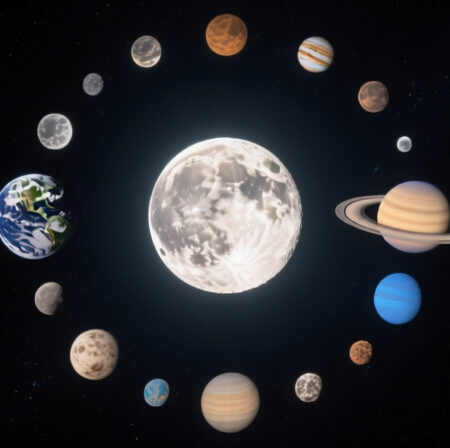
The night sky has captivated humanity for millennia, with the Moon serving as our constant celestial companion. Across cultures and civilizations, people have looked up and given names to Earth’s satellite, the full moons that mark our calendar months, and the hundreds of natural satellites orbiting other planets in our solar system. These moon names connect us to seasonal rhythms, agricultural cycles, cultural traditions, and astronomical discoveries.
Moon names are traditional and scientific designations given to full moons throughout the year and to natural satellites orbiting planets in our solar system. They range from ancient Native American names that track seasonal changes like the “Harvest Moon” to mythologically-inspired designations for planetary moons such as Jupiter’s “Europa” or Saturn’s “Titan.” This comprehensive guide explores every category of moon names, from the familiar full moon names that mark our calendar to the over 290 confirmed moons orbiting planets in our solar system.
Our journey through lunar nomenclature will cover the traditional monthly full moon names, the complete list of planetary moons with their fascinating characteristics, special moon phenomena like blue moons and supermoons, and the cultural origins behind these naming traditions. We’ll also explore lunar phases and how different cultures around the world have developed their own moon naming systems. Whether you’re a student working on an astronomy project, an educator preparing curriculum materials, or simply someone fascinated by our celestial neighbor, this guide provides the most complete reference to moon names available online.
For those interested in a visual journey through the moon and planetary exploration, understanding these names provides essential context for appreciating our solar system’s rich diversity of natural satellites. Let’s begin our comprehensive exploration of moon names and their meanings.
Monthly Full Moon Names: Traditional Calendar System
Traditional moon names originated from Native American cultures who named each full moon based on seasonal activities, natural phenomena, or animal behavior occurring during that time of year. These names helped track the passage of seasons and served as a natural calendar for agricultural and hunting societies. The system of naming full moons by month was later adopted by colonial Americans and popularized through publications like The Old Farmer’s Almanac, making these traditional names part of our cultural heritage.
Each full moon name reflects the specific characteristics of its month in the Northern Hemisphere, from the howling wolves of January to the abundant harvests of autumn. While these names originate primarily from Native American traditions, particularly Algonquin tribes, similar naming systems existed in many cultures worldwide. These traditional moon names help us connect with the seasonal rhythms that governed human life for thousands of years before modern calendars.
| Month | Full Moon Name | Traditional Meaning | Seasonal Significance |
|---|---|---|---|
| January | Wolf Moon | Wolves heard howling in winter | Deep winter, scarce food |
| February | Snow Moon | Heaviest snowfalls of winter | Coldest month, harshest conditions |
| March | Worm Moon | Earthworm casts appear as ground thaws | Spring transition, soil softening |
| April | Pink Moon | Named after pink wildflowers (phlox) | Spring blooms, new growth |
| May | Flower Moon | Flowers bloom abundantly | Poll spring, peak flowering |
| June | Strawberry Moon | Strawberry harvesting season | Early summer, fruit ripening |
| July | Buck Moon | Buck deer grow new antlers | Midsummer, wildlife activity |
| August | Sturgeon Moon | Sturgeon fish most readily caught | Late summer, fishing season |
| September | Corn Moon (or Harvest Moon) | Time for harvesting corn | Autumn harvest, food gathering |
| October | Hunter’s Moon | Time for hunting before winter | Pre-winter preparation |
| November | Beaver Moon | Beavers build dams for winter | Final preparations for cold |
| December | Cold Moon | Coldest time of year | Deep winter, survival mode |
It’s important to note that these traditional moon names apply specifically to the Northern Hemisphere seasons. In the Southern Hemisphere, the seasonal meanings would be reversed – the Wolf Moon occurs during summer in Australia, while the Cold Moon marks their summer solstice. Some cultures in the Southern Hemisphere have developed their own moon naming systems that reflect local seasonal patterns and natural phenomena unique to their regions.
Regional variations in moon names also exist within North America. Different tribes had different names based on their local environment and cultural practices. For example, some coastal tribes might name moons after tidal patterns or fish migrations, while mountain peoples might reference snow conditions or high-altitude wildlife behavior. These regional variations demonstrate how moon naming systems adapt to local ecological contexts and cultural needs.
Planetary Moons: Our Solar System’s Natural Satellites
Beyond Earth’s Moon, our solar system hosts an incredible diversity of natural satellites orbiting other planets. As of 2026, astronomers have confirmed over 290 moons, with new discoveries continuing to expand this number regularly. These planetary moons range from tiny captured asteroids only a few kilometers across to massive bodies larger than planets themselves, like Jupiter’s Ganymede which exceeds even Mercury in size.
Planetary moons are typically named according to conventions established by the International Astronomical Union (IAU), which oversees astronomical nomenclature. Most moons are named after figures from mythology associated with their parent planet – for example, Jupiter’s moons bear names of Jupiter’s lovers and companions from Roman and Greek mythology, while Saturn’s moons are named after Titans and other figures from various mythologies. These naming conventions create a rich tapestry of cultural references spanning global mythological traditions.
The distribution of moons throughout our solar system follows a clear pattern: the gas giant planets Jupiter and Saturn have the most moons, with 95 and 146 confirmed respectively, followed by the ice giants Uranus and Neptune with 27 and 16. Even Mars has two small moons, while inner planets Mercury and Venus have none due to their proximity to the Sun’s gravitational influence. Each planetary system tells a unique story of formation, capture, and orbital evolution that continues to fascinate astronomers.
Earth’s Moon: Our Singular Companion
Earth’s Moon, simply called “the Moon,” is our planet’s only natural satellite and the fifth largest moon in the solar system. Unlike the complex naming systems for other planetary moons, Earth’s satellite has retained this simple designation throughout human history, though various cultures have given it their own names – Luna in Roman mythology, Selene in Greek tradition, and countless other names across different civilizations.
The Moon plays a crucial role in Earth’s systems, stabilizing our planet’s axial tilt, driving ocean tides, and providing the rhythmic cycles that have influenced life and human culture throughout our existence. Its synchronous rotation means we always see the same face, while its orbital period of approximately 27.3 days creates the familiar pattern of lunar phases that have guided calendars and agricultural activities for millennia.
Mars: The Red Planet’s Twin Companions
Mars has two small moons, Phobos and Deimos, both named after the sons of Ares (the Greek equivalent of Mars) from mythology. These moons are unusual in our solar system for their small size and irregular, potato-like shapes, leading many astronomers to believe they are captured asteroids rather than moons that formed with Mars.
- Phobos: The larger of Mars’ two moons at about 22.2 km across, orbits Mars three times per day. Named after the Greek personification of fear, it’s gradually spiraling inward and will either crash into Mars or break up into a ring system in about 50 million years.
- Deimos: The smaller moon at about 12.4 km across, named after the Greek personification of terror. It orbits Mars at a much greater distance than Phobos and takes about 30 hours to complete one orbit.
Jupiter: The King of Moons
Jupiter reigns supreme with 95 confirmed moons as of 2026, making it the planet with the most moons in our solar system. These moons range from the massive Galilean moons – Io, Europa, Ganymede, and Callisto – to dozens of smaller irregular moons captured by Jupiter’s immense gravity. The Galilean moons, discovered by Galileo Galilei in 1610, were crucial evidence supporting the heliocentric model of the solar system and remain among the most fascinating objects for scientific study.
Jupiter’s four largest moons deserve special attention:
- Ganymede: The largest moon in our solar system, even larger than the planet Mercury. This icy world has a thin oxygen atmosphere, its own magnetic field, and potentially a subsurface ocean beneath its icy crust.
- Callisto: The second-largest of Jupiter’s moons and the most heavily cratered body in the solar system. Its ancient surface preserves a record of solar system history dating back over 4 billion years.
- Io: The most volcanically active body in the solar system, with over 400 active volcanoes constantly reshaping its surface. This geological activity results from tidal heating as Jupiter’s immense gravity flexes Io’s interior.
- Europa: Perhaps the most intriguing of Jupiter’s moons for astrobiology, Europa harbors a vast subsurface ocean beneath its icy crust that may contain twice as much water as all of Earth’s oceans combined. This ocean makes Europa a prime target in the search for extraterrestrial life.
Saturn: The Ringed Planet’s Lunar Family
Saturn hosts an impressive family of 146 confirmed moons, many of which interact with the planet’s spectacular ring system. Saturn’s moons range from giant Titan – larger than Mercury – to tiny moonlets only a few kilometers across that shepherd the planet’s rings and maintain their structure through gravitational interactions.
Saturn’s most notable moons include:
- Titan: Saturn’s largest moon and the second-largest in the solar system. Titan is unique among moons for having a thick atmosphere – denser than Earth’s – composed primarily of nitrogen with methane and ethane clouds. Its surface features liquid methane lakes and rivers, making it one of the most Earth-like worlds beyond our planet.
- Enceladus: A small icy moon that has become one of the most exciting targets in the search for life. Enceladus shoots geysers of water vapor and organic compounds from cracks in its icy surface, suggesting a subsurface ocean in contact with a rocky core that could support life.
- Rhea: Saturn’s second-largest moon, an icy world with heavily cratered terrain suggesting an ancient surface. Rhea may have its own ring system, making it the only moon known to potentially have rings.
- Iapetus: Known for its dramatic two-tone coloration, with one hemisphere as dark as coal and the other as bright as snow. This unusual appearance remains one of the mysteries of Saturn’s moon system.
Uranus: The Tilted World’s Moons
Uranus has 27 confirmed moons, all named after characters from the works of William Shakespeare and Alexander Pope. Unlike other planetary systems, Uranus’ moons follow the planet’s extreme axial tilt of 98 degrees, meaning they orbit almost perpendicular to the plane of the solar system. The five largest moons – Miranda, Ariel, Umbriel, Titania, and Oberon – were discovered between 1787 and 1948, while the smaller moons were mostly found by Voyager 2 in 1986 or by ground-based telescopes in recent decades.
Neptune: The Windy Planet’s Moons
Neptune has 16 confirmed moons, dominated by Triton, which accounts for over 99% of all mass orbiting the planet. Triton is unusual among large moons for its retrograde orbit – it orbits opposite to Neptune’s rotation – suggesting it was a dwarf planet captured from the Kuiper Belt rather than forming with Neptune. Triton’s surface shows evidence of cryovolcanism and features nitrogen geysers, making it another fascinating world for scientific study.
Pluto and Dwarf Planets: Beyond the Classical Planets
While not classified as a planet since 2006, Pluto and its moon Charon form a binary system where both bodies orbit a common center of mass located outside Pluto’s interior. This makes Charon the largest moon relative to its primary in the solar system. Pluto has four additional smaller moons – Styx, Nix, Kerberos, and Hydra – all named after figures from Greek mythology associated with the underworld. Other dwarf planets like Eris, Haumea, and Makemake also have small moons, expanding our understanding of moon systems throughout the solar system.
Special Moon Types and Rare Phenomena
Beyond the regular monthly and planetary moon names, several special moon phenomena capture public attention and have their own naming conventions. These rare events occur due to specific orbital alignments, atmospheric conditions, or calendar coincidences that create unique visual experiences. Understanding these special moon types helps appreciate the complexity and beauty of lunar cycles and orbital mechanics.
Blue Moon: The Calendar Rarity
A Blue Moon occurs when we have two full moons in the same calendar month, with the second full moon designated as the “Blue Moon.” This phenomenon happens approximately every 2-3 years due to the mismatch between the lunar cycle (29.5 days) and our calendar months (30-31 days). The term “once in a blue moon” reflects this relative rarity. Despite the name, Blue Moons don’t actually appear blue – the color reference comes from an old English expression meaning “impossible” or “rare.”
Supermoon: The Spectacular Close Approach
A Supermoon occurs when a full moon coincides with the Moon’s closest approach to Earth in its elliptical orbit, known as perigee. At perigee, the Moon appears about 14% larger and 30% brighter than when it’s at its farthest point (apogee). Supermoons typically occur 3-4 times per year when the orbital alignment creates this dramatic visual effect. The term is relatively recent, gaining popularity in the 21st century, though the phenomenon itself has occurred throughout human history.
Blood Moon: The Eclipse Phenomenon
A Blood Moon refers to the reddish appearance of the Moon during a total lunar eclipse. As Earth passes between the Sun and Moon, Earth’s atmosphere filters and refracts sunlight, bending red light onto the lunar surface while blocking other wavelengths. This creates the dramatic blood-red appearance that has inspired both scientific fascination and cultural interpretations throughout history. Blood Moons occur during total lunar eclipses, which happen 2-4 times per year but are only visible from specific regions of Earth.
Harvest Moon: The Autumnal Special
The Harvest Moon is the full moon closest to the autumnal equinox, typically occurring in September (though occasionally in October). What makes the Harvest Moon special is its unique timing relative to sunset – for several nights around the full moon, it rises shortly after sunset, providing extended daylight for farmers to harvest their crops, hence its name. This timing effect occurs because the Moon’s orbital path makes a shallow angle with the horizon around the equinoxes.
Micromoon: The Distant Full Moon
The opposite of a Supermoon, a Micromoon occurs when a full moon coincides with the Moon’s farthest approach from Earth (apogee). During a Micromoon, the lunar disk appears about 14% smaller and 30% dimmer than during a Supermoon. While less dramatic than Supermoons, Micromoons demonstrate the Moon’s elliptical orbit and changing distance from Earth throughout its monthly cycle.
Understanding Lunar Phases: The Moon’s Monthly Cycle
The Moon’s appearance changes throughout its approximately 29.5-day orbit around Earth, creating the familiar pattern of lunar phases that have guided human activities for millennia. These phases result from the changing angle between the Sun, Earth, and Moon, which determines how much of the Moon’s illuminated hemisphere we can see from Earth. Understanding these phases is essential for appreciating both traditional moon names and lunar observation.
- New Moon: The Moon is between Earth and Sun, with its illuminated side facing away from us. The Moon is not visible from Earth during this phase, which marks the beginning of the lunar cycle.
- Waxing Crescent: A small sliver of the Moon becomes visible after the new moon, growing larger each day as more of the illuminated surface comes into view. “Waxing” means the illuminated portion is increasing.
- First Quarter: The Moon appears as a half-circle, with the right side illuminated (in the Northern Hemisphere). This phase occurs about one week after the new moon.
- Waxing Gibbous: More than half of the Moon is illuminated and continues to grow toward full. “Gibbous” refers to the convex shape between quarter and full phases.
- Full Moon: The entire illuminated hemisphere of the Moon faces Earth, creating a complete disk. This is when traditional moon names are applied and when lunar eclipses can occur.
- Waning Gibbous: After the full moon, the illuminated portion begins to decrease. “Waning” means the light is diminishing, though more than half remains visible.
- Last Quarter: Again appearing as a half-circle, but with the left side illuminated (in the Northern Hemisphere). This occurs about three weeks after the new moon.
- Waning Crescent: A decreasing sliver of light visible before returning to the new moon phase, completing the cycle.
For those interested in moon astrophotography, understanding these phases is crucial for planning your observations. Different phases reveal different lunar features – the full moon shows overall brightness but can wash out fine details, while quarter phases provide dramatic shadows that highlight craters and mountains along the terminator (the line between light and dark).
The lunar cycle has historically been used to create lunar calendars, which still influence cultural and religious celebrations worldwide. From determining the dates of Easter in Christianity to marking the beginning of Ramadan in Islam and Rosh Hashanah in Judaism, the Moon’s phases continue to play important roles in modern religious and cultural observances.
Cultural Origins and Global Moon Naming Traditions
The tradition of naming moons extends far beyond the familiar Native American names popularized in Western culture. Indigenous peoples worldwide have developed their own moon naming systems based on local seasonal patterns, wildlife behavior, and agricultural cycles. These diverse naming traditions reflect the deep relationship between human cultures and their local environments, demonstrating how lunar observation has been universal across human societies.
In China, the traditional lunar calendar includes names like the “Plum Rain Moon” for June and the “Chrysanthemum Moon” for September, reflecting the seasonal patterns that have influenced Chinese agriculture and poetry for millennia. Many Chinese moon names appear in classical literature and continue to be used in cultural celebrations like the Mid-Autumn Festival.
Indigenous Australian cultures have developed moon naming systems that reflect the unique seasonal patterns of the Southern Hemisphere, including names related to bushfire seasons, monsoon patterns, and the behavior of Australian wildlife. These naming traditions often incorporate complex astronomical knowledge that has been passed down through oral traditions for tens of thousands of years.
Across Africa, diverse moon naming traditions reflect the continent’s varied climates and ecosystems. From the desert regions of the Sahara to the rainforests of the Congo and the savannas of East Africa, different cultures have developed lunar calendars that track local seasonal patterns relevant to agriculture, pastoral activities, and traditional ceremonies.
Modern Moon Naming and Astronomical Conventions
Today, the International Astronomical Union (IAU) oversees the official naming of newly discovered moons in our solar system. The process typically involves proposals from discoverers, followed by committee review and approval. These naming conventions maintain consistency while honoring cultural and mythological traditions associated with each planet.
For newly discovered moons around Jupiter, the IAU prefers names ending in “a” or “o” for prograde moons (orbiting in the same direction as the planet) and ending in “e” for retrograde moons (orbiting opposite to the planet’s rotation). Saturn’s moon names draw from various mythologies including Greek, Roman, Norse, and Inuit traditions, reflecting the international nature of astronomical discovery.
Recent discoveries continue to expand our moon catalog, particularly around the gas giant planets where powerful telescopes and space missions regularly reveal previously unknown satellites. Each new moon adds to our understanding of planetary formation and evolution, while the naming process connects modern astronomy to humanity’s long tradition of celestial observation and myth-making.
As we continue exploring our solar system through robotic missions and increasingly powerful telescopes, we’ll undoubtedly discover more moons and develop even richer naming traditions. Yet the fundamental human impulse to look at the night sky, find patterns, and give names to what we see remains unchanged – connecting modern astronomers to the ancient skywatchers who first looked up and began the tradition of moon naming that continues to this day.
Frequently Asked Questions
What are the 12 full moons called?
The 12 traditional full moon names are: January – Wolf Moon, February – Snow Moon, March – Worm Moon, April – Pink Moon, May – Flower Moon, June – Strawberry Moon, July – Buck Moon, August – Sturgeon Moon, September – Corn/Harvest Moon, October – Hunter’s Moon, November – Beaver Moon, and December – Cold Moon. These names originated from Native American traditions and reflect seasonal activities and natural phenomena.
How many moons does each planet have?
As of 2025, the confirmed moon counts are: Mercury – 0, Venus – 0, Earth – 1, Mars – 2 (Phobos and Deimos), Jupiter – 95, Saturn – 146, Uranus – 27, Neptune – 16, and Pluto (dwarf planet) – 5. These numbers change occasionally as new moons are discovered, particularly around the gas giant planets.
What is the rarest moon called?
The rarest moon phenomenon is a Super Blue Blood Moon, which occurs when three conditions coincide: a blue moon (second full moon in a month), a supermoon (moon at perigee/closest approach), and a total lunar eclipse (blood moon). This extremely rare combination last occurred in 2018 and won’t happen again until 2037.
Do moon names change in the Southern Hemisphere?
Yes, moon names need seasonal adaptation in the Southern Hemisphere. The traditional Native American moon names reflect Northern Hemisphere seasons, so they would be reversed south of the equator. For example, the Cold Moon occurs during summer in Australia, while the Strawberry Moon happens during their winter. Many Southern Hemisphere cultures have developed their own moon naming systems based on local seasonal patterns.
What is the full moon called in October?
October’s full moon is called the Hunter’s Moon. This name comes from Native American traditions when the leaves have fallen and deer are fattened, making it the ideal time for hunting before winter sets in. The Hunter’s Moon typically follows the Harvest Moon (September full moon closest to autumnal equinox) and provides extended light for evening hunting activities.
How are newly discovered moons named?
Newly discovered moons are named by the International Astronomical Union (IAU), which oversees astronomical nomenclature. Discoverers can propose names following specific conventions for each planet – typically drawing from mythology associated with that planet. For example, Jupiter’s moons are named after Jupiter’s lovers and companions, while Saturn’s moons come from Titans and related mythological figures. The process involves committee review and official approval.
Final Recommendations
Our journey through the complete list of moon names reveals the rich tapestry of human lunar observation across cultures and centuries. From traditional seasonal names that connect us to Earth’s natural rhythms to the scientific classifications of planetary moons that expand our understanding of the solar system, moon naming demonstrates humanity’s enduring relationship with our celestial companion.
As astronomical discoveries continue and we learn more about the moons orbiting distant planets, the tradition of moon naming evolves while maintaining its fundamental purpose – helping us make sense of the night sky and our place within the cosmos. Whether you’re observing the familiar full moons from your backyard or following space missions to distant moons like Europa and Titan, understanding these names enriches your connection to the astronomical heritage shared by all humanity.
For continued exploration of lunar and planetary observation, consider learning more about astronomical calculations and field of view techniques, or consult a comprehensive astronomical terminology guide to deepen your understanding of lunar observation and equipment. The Moon will continue to inspire wonder and discovery, just as it has for countless generations before us.