Understanding optical devices can be confusing when marketing terms and technical specifications overlap. I’ve spent years studying optics and helping people choose the right equipment for their needs, and the telescope vs periscope question comes up more often than you’d think.
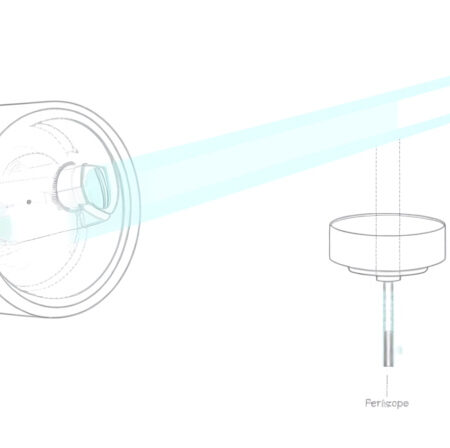
The fundamental difference is simple: a telescope magnifies distant objects in your direct line of sight, while a periscope lets you see objects that aren’t in your line of sight by bending light around obstacles. This core distinction means they serve completely different purposes, despite both being optical instruments.
Whether you’re a stargazer, photography enthusiast, or simply curious about how these devices work, understanding their differences will help you make informed decisions. Modern smartphones have blurred these lines with periscope camera lenses, making it even more important to grasp the fundamental principles behind each technology.
In this guide, I’ll break down everything you need to know about telescopes and periscopes, from basic physics to real-world applications, helping you understand which device (or combination) suits your specific needs.
Quick Comparison: Telescope vs Periscope at a Glance
Before diving deep into technical details, let’s look at the fundamental differences between these two optical devices. This comparison will help you quickly grasp their distinct purposes and capabilities.
| Feature | Telescope | Periscope |
|---|---|---|
| Primary Purpose | Magnify distant objects | See around obstacles |
| Light Path | Straight through lenses/mirrors | Bent at angles via mirrors/prisms |
| Key Function | Magnification | Line of sight extension |
| Common Uses | Astronomy, nature observation | Submarines, military, smartphones |
| Complexity | Optical precision critical | Mechanical alignment critical |
| Modern Applications | Digital telescopes, astrophotography | Smartphone zoom cameras, endoscopy |
The table above shows that while both devices manipulate light, they do so for entirely different purposes. A telescope’s job is to make distant things appear closer and clearer, while a periscope’s job is to let you see things that are physically blocked from your view.
Quick Summary: Telescopes magnify what you can already see but appears too small or distant. Periscopes reveal what you cannot see at all due to physical barriers between you and the object.
Understanding Telescopes: Magnifying the Distant
Telescopes have revolutionized our understanding of the universe since Galileo first pointed one at the heavens in 2026. These remarkable instruments gather and magnify light from distant objects, making them appear closer and more detailed than what our naked eye can perceive.
At its core, a telescope works on the principle of collecting more light than your eye can naturally gather. The larger the objective lens or primary mirror, the more light the telescope collects, resulting in brighter and clearer images of distant objects. This is why astronomers obsess over aperture size – it’s the key factor determining what you can see.
How Telescopes Work: The Physics Explained Simply
Telescopes use either lenses (refractors) or mirrors (reflectors) to gather and focus light. In a refracting telescope, light passes through a large objective lens at the front, which bends the light rays to converge at a focal point. An eyepiece then magnifies this focused image for your viewing pleasure.
Reflecting telescopes, like the popular Dobsonian designs, use a curved primary mirror to gather light. The mirror reflects light to a secondary mirror, which then sends it to the eyepiece. This design allows for larger apertures at lower costs, making it popular among amateur astronomers.
The magnification power of a telescope depends on the focal lengths of both the objective lens/mirror and the eyepiece. Higher magnification isn’t always better – excessive magnification can actually degrade image quality if the aperture isn’t large enough to support it. I’ve seen many beginners make this mistake, expecting incredible views from cheap, high-magnification scopes only to be disappointed.
Types of Telescopes and Their Applications
- Refractor Telescopes: Using lenses to bend light, these provide sharp images with minimal maintenance. They’re ideal for planetary observation and lunar viewing. Their sealed tubes prevent dust intrusion, making them low-maintenance options for beginners.
- Reflector Telescopes: Using mirrors instead of lenses, these offer larger apertures for less money. The Dobsonian variant has democratized deep-sky observing, allowing amateurs to see galaxies and nebulae that were once only visible in professional observatories.
- Catadioptric Telescopes: Combining lenses and mirrors, these compact designs offer versatile performance. The Schmidt-Cassegrain and Maksutov-Cassegrain designs are popular for their portability and adaptability to both planetary and deep-sky observing.
Modern telescopes often include computerized mounts, GPS alignment, and integrated cameras for telescope astrophotography techniques. These features have made astronomy more accessible than ever, though traditional manual observing still holds a special charm for many enthusiasts.
For those looking to enhance their telescope’s capabilities, telescope magnification accessories like Barlow lenses can effectively double or triple your magnification options without needing multiple eyepieces.
Understanding Periscopes: Seeing Around Obstacles
Periscopes solve a different optical problem – not distance, but obstruction. These clever devices use mirrors or prisms to redirect light around obstacles, allowing you to see things that are physically blocked from your direct line of sight.
The classic periscope design uses two parallel mirrors set at 45-degree angles, with the top mirror capturing light from above or around an obstacle and reflecting it down to the lower mirror, which then reflects it to your eye. This simple but effective principle has enabled submarines to navigate while remaining hidden and trench warfare to be conducted more safely.
How Periscopes Work: The Magic of Bending Light
Unlike telescopes that magnify, periscopes primarily redirect light without significant magnification. The magic lies in the angle of reflection – when light hits a mirror at a 45-degree angle, it reflects at the same angle, effectively “turning a corner” while preserving the image orientation.
Modern periscopes often use prisms instead of mirrors because prisms can provide total internal reflection, resulting in brighter images with less light loss. This is particularly important in applications where every photon counts, like military surveillance or medical endoscopy.
The length of a periscope determines how much it can “see over” an obstacle. A simple two-mirror design provides basic functionality, while complex military periscopes might include multiple optical elements, zoom capabilities, and night vision technology.
Modern Periscope Applications in Technology
The most common encounter most people have with periscope technology today is in their smartphone camera. Modern flagship phones use periscope lens mechanisms to achieve optical zoom without making the phone excessively thick. These tiny marvels of engineering use folded optics – essentially miniature periscopes – to bend light 90 degrees within the phone body.
However, as forum discussions reveal, smartphone periscope cameras come with trade-offs. The folded light path introduces complexity, and users often report that periscope cameras are “the least used, lowest resolution, smallest sensor cameras” on their devices. The light loss from multiple optical elements can impact image quality, especially in low light conditions.
Beyond smartphones, periscope technology appears in:
– Medical endoscopes for internal examinations
– Industrial inspection tools
– Military surveillance systems
– Architectural and construction tools for seeing around obstacles
For photographers interested in telephoto capabilities, it’s worth noting that traditional telephoto lenses still generally outperform periscope designs in image quality, though periscope lenses offer unique advantages in compact form factors.
7 Key Differences Between Telescopes and Periscopes
Now that we understand how each device works, let’s break down the fundamental differences that determine their optimal applications:
- Purpose and Function: Telescopes magnify distant objects within your line of sight, making them appear closer. Periscopes extend your line of sight around obstacles without necessarily magnifying the image.
- Optical Path: Telescopes use a straight optical path through lenses and/or mirrors. Periscopes use a bent or folded optical path, redirecting light at specific angles.
- Magnification: Telescopes are designed for high magnification, typically 20x to 300x or more. Periscopes usually have 1x to 5x magnification, with some military or specialized variants offering more.
- Light Gathering: Telescopes prioritize maximum light collection through large apertures. Periscopes prioritize efficient light redirection, often losing some light in the process.
- Complexity Focus: Telescope complexity lies in optical precision and correction of aberrations. Periscope complexity lies in mechanical alignment and maintaining the optical path integrity.
- Common Obstacles: Telescopes overcome distance and atmospheric conditions. Periscopes overcome physical barriers like walls, water, or terrain.
- Quality Factors: Telescope quality depends on aperture size, optical coating quality, and mounting stability. Periscope quality depends on mirror/prism precision, alignment accuracy, and durability of moving parts.
These differences mean that choosing between them isn’t about which is “better” but which solves your specific problem. Want to see the rings of Saturn? You need a telescope. Want to see over a tall fence? You need a periscope.
Real-World Applications: Where Each Device Excels
Understanding the theoretical differences is helpful, but seeing how these devices perform in real-world scenarios makes their purposes crystal clear:
Telescope Applications:
Telescopes shine when distance is the primary challenge. I’ve used telescopes for everything from observing the moons of Jupiter to watching wildlife from a safe distance. The key is that the target is visible but too small or distant to see clearly with the naked eye.
- Astronomical Observation: From backyard stargazing to professional research, telescopes unlock the universe. Even modest telescopes can reveal lunar craters, Saturn’s rings, and distant galaxies that are invisible to the naked eye.
- Nature Observation: Bird watchers and wildlife enthusiasts use spotting scopes (essentially telescopes) to observe animals without disturbing them. The magnification allows for detailed observation while maintaining safe distances.
- Photography: Telephoto lenses are essentially telescope-like devices that enable detailed photography of distant subjects. Astrophotography equipment often combines telescopes with cameras for stunning celestial imagery.
- Scientific Research: Beyond astronomy, telescopes are used in spectroscopy, atmospheric studies, and various scientific applications requiring magnification of distant or small objects.
When choosing between telescope types, many enthusiasts find telescope type comparisons helpful for understanding which design suits their specific interests.
Periscope Applications:
Periscopes excel when physical barriers prevent direct viewing. The key is that the target exists but cannot be seen directly due to obstacles in the way.
- Submarine Navigation: The classic application, allowing submarines to see above water while remaining submerged. Modern submarine periscopes are sophisticated devices with video cameras, rangefinders, and various sensors.
- Smartphone Photography: Periscope lenses enable optical zoom in thin phones, though as Reddit users note, they often compromise on image quality compared to traditional telephoto lenses.
- Medical Procedures: Endoscopes use periscope principles to visualize internal organs without invasive surgery, saving countless lives through minimally invasive diagnostics and procedures.
- Military and Surveillance: From trench warfare to modern surveillance, periscopes provide tactical advantages by allowing observation without exposure.
- Industrial Inspection: Engineers use periscopic devices to inspect machinery and structures in hard-to-reach areas, improving safety and efficiency.
For those exploring optical equipment buying guides, it’s worth noting that some devices combine both principles, offering magnification with line-of-sight extension for specialized applications.
Frequently Asked Questions
What’s the difference between a periscope and a telescope?
A telescope magnifies distant objects you can already see, making them appear closer and more detailed. A periscope uses mirrors or prisms to let you see objects that are blocked from your direct view by bending light around obstacles. The key difference is purpose: telescopes enhance vision of distant objects, while periscopes overcome physical barriers to vision.
Which is better, a telescope or periscope camera?
Neither is inherently better – they serve different purposes. For smartphone photography, traditional telephoto lenses generally offer better image quality, while periscope lenses provide greater zoom range in thinner devices. For astronomical observation, telescopes are vastly superior. Choose based on your specific need: magnification of distant objects (telescope) or seeing around obstacles (periscope).
Can I use a telescope as a periscope?
Not effectively. While you could theoretically position a telescope to look around an obstacle, it’s designed for magnification rather than redirecting light at angles. A telescope’s straight optical path and focus on distant objects make it impractical as a periscope substitute.
Why are periscope smartphone cameras lower quality?
Periscope cameras often have lower resolution and image quality because the folded optical path requires multiple lens elements and mirrors, which reduces light transmission and introduces potential aberrations. The mechanical complexity also limits sensor size. Traditional telephoto lenses with straight optical paths can achieve better image quality with fewer compromises.
What is the use of a periscope?
Periscopes are used to see objects that aren’t in your direct line of sight. Common applications include submarine navigation, military surveillance, medical endoscopy, industrial inspection, and smartphone zoom cameras. They’re essential whenever you need to observe something without exposing yourself or when physical barriers prevent direct viewing.
Which does not require a lens: a projector, periscope, microscope, telescope, or eyes?
A periscope is the only device that doesn’t necessarily require a lens. Simple periscopes can work with just mirrors (or prisms) set at 45-degree angles to redirect light. While many modern periscopes include lenses for image enhancement, the basic periscope principle works through reflection alone. The other devices listed all fundamentally rely on lenses for their primary function.
Which Should You Choose? Making the Right Decision
The choice between telescope and periscope depends entirely on your needs, not on which is technologically “better.” They solve different problems, and understanding your specific requirement is key to making the right choice.
Choose a telescope if:
– You need to see distant objects in detail
– Your target is already visible but too small or far away
– You’re interested in astronomy, bird watching, or long-distance photography
– Image quality and magnification are your priorities
Choose a periscope if:
– You need to see around physical barriers
– Your target is hidden by obstacles between you and it
– You’re working in confined spaces or need surveillance capabilities
– Line of sight extension is more important than magnification
In some cases, you might need both capabilities. Modern optical observation devices sometimes incorporate periscopic elements for viewing comfort while providing telescope-like magnification for distant targets.
For beginners starting their optical journey, I often recommend starting with a good quality telescope if astronomy or nature observation is the goal. The learning curve is gentler, and the community support is excellent. If your needs are more specialized, like surveillance or inspection work, a purpose-built periscope or periscope-equipped device might be worth the investment.
Remember that both technologies continue to evolve. Digital enhancement, AI-assisted image processing, and new materials are expanding the capabilities of both telescopes and periscopes. The future may bring hybrid devices that combine the best of both worlds, but for now, understanding their fundamental differences will help you choose the right tool for your specific needs.
For technical terminology and deeper understanding, keeping a telescope terminology guide handy can be helpful as you explore these fascinating optical instruments.
Comments