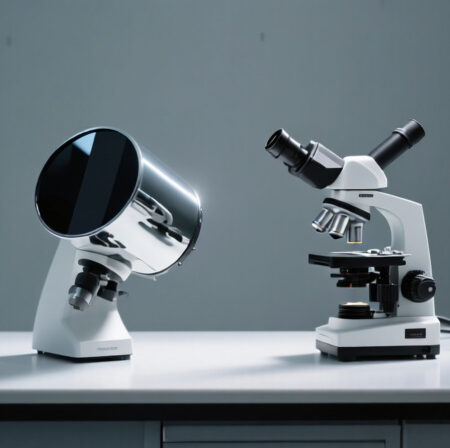
Have you ever wondered what the real difference is between a telescope and a microscope? Both are optical instruments that magnify objects, but they serve entirely opposite purposes in exploring our universe.
A telescope is designed to observe large, distant objects by collecting and focusing light, while a microscope is built to examine very small, nearby objects by greatly magnifying them. This fundamental difference drives every aspect of their design, function, and application.
Both instruments revolutionized human understanding by extending our vision beyond natural limits – telescopes to the cosmos, microscopes to the microscopic world. They’ve shaped science education, research, and even hobby interests for centuries.
In this comprehensive guide, we’ll explore everything from basic operating principles to practical considerations, helping you understand which instrument aligns with your interests and needs.
Quick Comparison: Telescope vs Microscope
At first glance, these instruments might seem similar – both use lenses or mirrors to magnify objects. However, their differences are fundamental and purposeful.
| Feature | Telescope | Microscope |
|---|---|---|
| Purpose | View distant objects | View tiny nearby objects |
| Object Distance | Virtually infinite | Very close (slide distance) |
| Magnification Type | Angular magnification | Linear magnification |
| Light Source | Object itself (stars, planets) | External illumination required |
| Typical Use | Astronomy, terrestrial viewing | Lab work, biology, research |
| Environment | Outdoors, dark skies preferred | Indoors, controlled lighting |
| Entry Cost | $50-$200 for basic models | $80-$300 for basic models |
Quick Answer: Choose a telescope if you want to explore stars, planets, and distant landscapes. Choose a microscope if you’re fascinated by cells, microorganisms, and the tiny world around us.
Understanding Microscopes: Design and Function
What is a Microscope?
A microscope is an optical instrument designed to magnify extremely small objects that are invisible to the naked eye. Modern microscopes can magnify objects up to 2,000 times or more, revealing cellular structures, bacteria, and even individual molecules in advanced models.
Microscopes work by using multiple lenses in sequence to achieve high magnification. Light passes through or reflects off the specimen, creating an enlarged image that’s further magnified by additional lenses.
The compound microscope, invented in the 17th century, remains the most common type today. It uses two lens systems – the objective lens near the specimen and the eyepiece – working together to create high magnification.
Types of Microscopes
Microscopes come in several varieties, each suited for specific applications:
- Compound Microscopes: The most common type, using multiple lenses to achieve high magnification (40x-2000x). Ideal for biology students and labs.
- Stereo Microscopes: Provide 3D viewing at lower magnification (7x-40x). Perfect for dissection, electronics work, and examining larger specimens.
- Digital Microscopes: Modern versions with cameras and screens, allowing image capture and computer connectivity. Great for documentation and sharing.
- Electron Microscopes: Advanced research instruments using electrons instead of light, achieving magnifications up to 2 million times. Used in scientific research.
How Microscopes Work?
The magic of microscopy lies in its two-stage magnification system:
- Objective Lens: Creates a real, enlarged image of the specimen. Typical objective lenses offer 4x, 10x, 40x, and 100x magnification.
- Eyepiece: Further magnifies the image from the objective lens, typically providing 10x additional magnification.
Total magnification is calculated by multiplying the objective power by the eyepiece power. For example, a 40x objective with a 10x eyepiece provides 400x total magnification.
Microscope Applications
Microscopes serve countless purposes across various fields:
Cellular Biology: Examining cells, bacteria, and microorganisms in research and education.
Medical Diagnosis: Pathology labs use microscopes to identify diseases from tissue samples and blood smears.
Materials Science: Analyzing crystal structures, material defects, and surface properties.
Forensics: Examining evidence like fibers, hair, and gunshot residue in criminal investigations.
Understanding Telescopes: Design and Function
What is a Telescope?
A telescope is an optical instrument designed to observe distant objects by collecting light and forming magnified images. From amateur astronomy to scientific research, telescopes have expanded our understanding of the universe for over 400 years.
Telescopes work by gathering more light than the human eye can collect, allowing us to see faint distant objects. The larger the telescope’s aperture (light-gathering area), the more detail it can reveal.
Unlike microscopes, telescopes typically deal with objects at effectively infinite distance. This fundamental difference shapes everything from their optical design to their mounting systems.
Types of Telescopes
Telescopes primarily fall into two categories, each with distinct advantages:
Refracting Telescopes
Refracting telescopes use lenses to bend light and form images. They’re characterized by:
- Simple design with sealed tubes
- Low maintenance requirements
- Sharp, high-contrast images
- Higher cost per inch of aperture
- Chromatic aberration in simple designs
Most modern refractors use achromatic or apochromatic lens designs to minimize color distortion. They’re excellent for planetary observation and astrophotography.
Reflecting Telescopes
Reflecting telescopes use mirrors instead of lenses, offering several advantages:
- Lower cost per inch of aperture
- No chromatic aberration
- Compact designs possible
- More light-gathering power for the price
Common reflecting designs include Newtonian telescopes (sidewards viewing) and Cassegrain telescopes (backwards viewing). Newtonian designs offer excellent value, while Cassegrain designs provide portability.
Pro Tip: For urban astronomers, a 6-8 inch reflecting telescope offers the best balance of light-gathering power and portability for observing planets and brighter deep-sky objects.
How Telescopes Work?
Telescope operation follows these basic principles:
- Light Collection: The objective lens or primary mirror gathers light from distant objects.
- Focus Formation: The collected light is focused to create an image at the focal plane.
- Magnification: The eyepiece magnifies this image for viewing, similar to a magnifying glass.
Unlike microscopes, telescope magnification is flexible – determined by the eyepiece focal length divided by the telescope’s focal length. Changing eyepieces changes magnification.
Telescope Applications
Telescopes serve various purposes beyond casual stargazing:
- Amateur Astronomy: Observing planets, stars, galaxies, and nebulae from backyard or dark-sky locations.
- Astrophotography: Capturing detailed images of celestial objects using cameras and specialized mounts.
- Terrestrial Viewing: Nature observation, surveillance, and landscape viewing (often with erecting prisms).
- Scientific Research: Professional astronomy using large observatory telescopes and space-based instruments.
For those interested in specific telescope types, our Newtonian vs Dobsonian designs comparison offers detailed insights into popular reflecting telescope variations.
Head-to-Head: Detailed Comparison
Magnification and Resolution
When it comes to magnification, microscopes and telescopes operate in completely different realms:
- Microscope Magnification: Typically 40x-2000x for compound microscopes. Resolution limited by light wavelength (about 0.2 micrometers for light microscopes).
- Telescope Magnification: Usually 25x-300x for amateur telescopes. Resolution limited by atmospheric conditions (about 1 arcsecond from ground).
Higher magnification isn’t always better. In microscopes, excessive magnification reveals empty magnification – larger images without additional detail. In telescopes, atmospheric turbulence limits useful magnification regardless of telescope size.
Cost Considerations
Both instruments offer entry points for various budgets, but with different value propositions:
| Budget Range | Microscope Options | Telescope Options |
|---|---|---|
| $50-$100 | Basic student microscopes (40x-400x) | Small refractors (50mm-60mm) |
| $100-$300 | Quality compound microscopes (1000x-2000x) | 6-8 inch reflectors, quality refractors |
| $300-$1000 | Professional-grade microscopes, digital models | 10-12 inch Dobsonians, ED refractors |
| $1000+ | Research microscopes, specialized models | Large aperture telescopes, computerized mounts |
⏰ Time Saver: Microscopes offer more value at lower price points. A $200 microscope provides professional-grade magnification, while a $200 telescope has significant limitations.
Accessibility and Environmental Factors
Where you live significantly impacts which instrument might serve you better:
- Urban Dwellers: Microscopes work anywhere, independent of weather or light pollution. Telescopes struggle with light pollution and limited viewing angles.
- Rural Residents: Both instruments work well, but dark skies give telescopes their full advantage. Microscopes offer consistent year-round use.
- Space Constraints: Microscopes require minimal space. Telescopes need storage space and potentially viewing areas.
As one Reddit user noted, “I’ve used both and if you live in a suburban or urban area like me, microscope will be better because the light pollution is too much for telescope use.”
Learning Curve and Skill Requirements
Both instruments require skill, but of different types:
Microscope Skills:
- Proper slide preparation
- Focusing techniques (coarse and fine adjustment)
- Illumination control
- Specimen identification
Telescope Skills:
- Alignment and collimation
- Navigation (finding objects in the sky)
- Understanding celestial coordinates
- Adapting to atmospheric conditions
⚠️ Important: Both instruments require patience. Microscope users spend time preparing slides and focusing. Telescope users spend time learning the sky and adjusting to conditions.
Choosing the Right Instrument: Practical Applications
Your choice depends on several factors beyond technical specifications:
For Students and Educators
Microscopes typically offer better educational value. They work anytime, anywhere, and align with biology curricula. Telescopes require specific conditions and scheduling around weather and celestial events.
For Hobbyists
Consider your living situation and interests. Urban residents often find microscopes more practical. Rural dwellers with dark skies can fully enjoy telescopes. Your fascination with the very small versus the very large guides the decision.
For Family Use
Microscopes offer immediate gratification – look at anything around you. Telescopes require planning and patience but offer awe-inspiring views of the universe. Consider ages and attention spans of family members.
For those leaning toward telescopes, check our intermediate telescope options for models that balance capability and usability.
Which is Right for You?
After exploring both instruments in detail, the choice becomes clearer based on your specific situation:
Choose a Microscope If:
- You live in an urban area with light pollution
- You’re interested in biology, medicine, or materials science
- You want year-round, weather-independent exploration
- You have limited outdoor space or live in an apartment
- You prefer immediate, controllable observations
- You’re a student or educator needing curriculum alignment
Choose a Telescope If:
- You have access to dark skies or rural locations
- You’re fascinated by astronomy, planets, and space
- You enjoy planning and patience in your observations
- You have outdoor space for setup and storage
- You’re drawn to cosmic exploration and astrophotography
- You want to share awe-inspiring views with others
For those interested in planetary observation specifically, our guide to the telescope for planetary observation provides targeted recommendations. Or if you’re drawn to distant galaxies and nebulae, explore deep space telescopes that excel at capturing faint celestial objects.
Both instruments offer gateway experiences to worlds beyond our natural perception. Microscopes reveal the complex beauty of life at its smallest scale, while telescopes connect us to the vast cosmic ocean. Your choice opens different doors to understanding our universe – both equally valid and rewarding paths of exploration.
Remember, you can always enjoy both eventually. Many enthusiasts start with one and eventually acquire both, expanding their exploration from the cellular to the cosmic. The journey of discovery, whether inward or outward, enriches our understanding of our place in the universe.
Comments