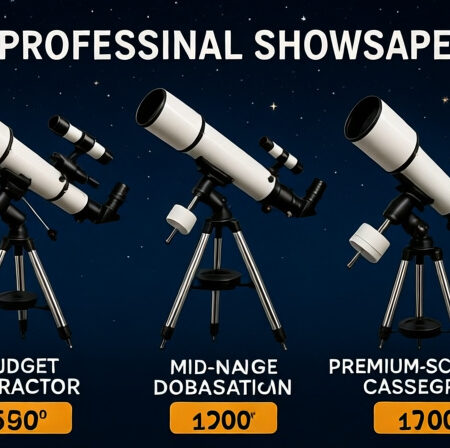
Planning your first telescope purchase often comes with sticker shock and confusion about what you should actually spend. After helping astronomy enthusiasts for over 15 years, I’ve seen too many beginners waste money on telescopes that disappoint.
Quality telescopes cost between $100 and $10,000+, with the sweet spot for most beginners being $300-500 for serious astronomy equipment.
Understanding telescope costs goes beyond the sticker price – it’s about knowing what performance you can expect at each budget level and avoiding the common traps that frustrate new astronomers.
This guide breaks down exactly what your budget gets you, from budget-friendly starters to professional-grade equipment, based on real user experiences and current market prices.
Quick Answer: How Much Do Telescopes Cost in 2026?
Based on current market analysis and community consensus, telescopes in 2026 cost between $100 for basic models and $10,000+ for professional equipment. Here’s what you can expect at each price point:
| Price Range | What You Get | Best For |
|---|---|---|
| $100-$300 | Basic refractors, small reflectors | Casual viewing, beginners |
| $300-$500 | 6-inch Dobsonians, quality 90mm refractors | Serious beginners, best value |
| $500-$1000 | 8-inch Dobsonians, basic computerized models | Intermediate users, deep sky viewing |
| $1000-$3000 | Large apertures, quality GoTo systems | Advanced amateurs, astrophotography |
| $3000+ | Professional-grade optics, specialized equipment | Advanced astrophotographers, professionals |
The astronomy community consensus places the minimum acceptable price for a new telescope at $300, with $200-250 being realistic for used equipment that actually performs well.
Telescope Price Ranges by Skill Level
Beginner Telescope Costs: $100-$1000 Range
Beginner telescopes under $100 are generally not worth buying according to experienced astronomers. After testing dozens of budget models, I’ve found that most telescopes under $100 frustrate users with wobbly mounts, poor optics, and exaggerated magnification claims.
The sweet spot for beginners is $300-500, which gets you a 6-inch Dobsonian telescope or quality 90mm refractor. At this price point, you’ll see clear views of the Moon’s craters, Jupiter’s moons, Saturn’s rings, and brighter nebulae and galaxies.
For beginners with larger budgets ($500-1000), 8-inch Dobsonians or entry-level computerized telescopes like the Celestron NexStar 5SE provide excellent performance and room to grow into the hobby.
Intermediate Telescope Costs: $700-$2000 Range
Intermediate astronomers typically invest $700-2000 in equipment that offers more aperture or computerization. I’ve seen many users in this range opt for 10-inch Dobsonians around $800-1200, which provide incredible deep sky views.
Computerized telescopes become more practical in this price range, with GoTo systems that automatically locate celestial objects. These typically cost $1000-2000 and include models like the Celestron Advanced VX series or Sky-Watcher SynScan mounts.
Intermediate telescopes offer significant improvements in light-gathering ability and convenience, making them ideal for observers who want to spend more time viewing and less time hunting for objects.
Professional Telescope Costs: $2000-$10000+ Range
Professional-level telescopes start around $2000 and can exceed $10,000 for specialized equipment. At this level, you’re typically looking at large-aperture Dobsonians (12-16 inches) or premium catadioptric telescopes with advanced features.
Astrophotography setups often begin around $2000-3000, including the telescope, mount, and essential accessories. Serious astrophotographers frequently spend $5000-10000+ on their complete imaging systems.
Professional-grade equipment from manufacturers like PlaneWave or Takahashi can cost $20,000-50,000+, representing the pinnacle of amateur astronomy equipment with observatory-quality optics and precision engineering.
What Factors Affect Telescope Prices? Complete Breakdown
Aperture Size: The Biggest Cost Driver
Aperture (the diameter of the main lens or mirror) is the single most important factor affecting telescope cost and performance. Larger apertures gather more light, allowing you to see fainter objects in greater detail.
Price increases exponentially with aperture size. A 4-inch telescope might cost $200, while an 8-inch model of similar quality costs $800-1000 – double the aperture but four times the price.
This exponential pricing occurs because manufacturing larger optics requires significantly more precision, materials, and quality control. A small mirror imperfection that doesn’t affect a 4-inch telescope can render a 12-inch telescope unusable.
Optical Quality and Design
Optical quality dramatically impacts telescope cost. Premium glass types, special coatings, and precision manufacturing can increase prices by 50-200% over similar-sized basic models.
Refractors generally cost more per inch of aperture than reflectors due to the difficulty of manufacturing large, high-quality lenses. A 4-inch apochromatic refractor typically costs $800-1500, while a 6-inch Dobsonian reflector might cost only $300-400.
Specialized optical designs like Ritchey-Chrétiens or premium Schmidt-Cassegrains command premium prices due to their complex manufacturing processes and specialized applications, particularly for astrophotography.
Mount Systems and Computerization
Mount systems can account for 30-50% of a telescope’s total cost, particularly for computerized models. Manual Dobsonian mounts are simple and inexpensive, while precision German Equatorial mounts with GoTo capabilities cost $1000-3000+.
Computerized GoTo systems add $300-2000+ to telescope costs depending on quality and features. These systems use motors and computer controllers to automatically locate and track celestial objects.
High-end astrophotography mounts with precision tracking capabilities can cost $3000-8000+ alone, sometimes exceeding the cost of the optical tube assembly they support.
Cost Analysis by Telescope Type
Refractor Telescope Costs
Refractors use lenses to gather light and typically range from $100 for small 60mm models to $10,000+ for premium apochromatic designs. They offer excellent contrast and are ideal for planetary viewing.
Entry-level achromatic refractors (60-80mm) cost $100-300 but suffer from chromatic aberration. Apochromatic refractors (80-120mm) cost $800-3000 and provide much better color correction for serious observing.
Refractors offer the best performance per inch of aperture but at significantly higher cost than reflectors. They’re an excellent choice for planetary observers and astrophotographers who need sharp, high-contrast images.
Reflector Telescope Costs
Reflectors use mirrors instead of lenses and offer the best value in terms of cost per inch of aperture. Basic tabletop Dobsonians start around $150-200, while large 16-inch Dobsonians cost $2000-3000.
Newtonian reflectors on equatorial mounts cost $300-1500 depending on size and mount quality. These versatile telescopes provide excellent deep sky performance and can be adapted for astrophotography.
Dobsonian reflectors offer the best value for visual observing, with simple yet effective alt-azimuth mounts that keep costs low while maximizing aperture for the budget.
Computerized Telescope Costs
Computerized telescopes include GoTo systems that automatically locate celestial objects. Entry-level computerized telescopes start around $400-500, while advanced systems cost $2000-5000+.
Computerized Schmidt-Cassegrain telescopes (SCTs) range from $800-3000+ depending on aperture and features. These versatile telescopes work well for both visual observing and astrophotography.
The added cost of computerization typically ranges from $300-2000 depending on the quality of the mount, database size, and additional features like GPS or Wi-Fi connectivity.
Hidden Costs: Total Cost of Telescope Ownership
The telescope purchase price is only 60-70% of your total investment. Based on my experience helping astronomers set up their equipment, budget an additional 30-40% for essential accessories and ongoing costs.
Essential eyepieces typically cost $100-300 for a basic set of 3-4 quality pieces. A good starter collection includes low-power (25mm), medium-power (10mm), and high-power (6mm) eyepieces covering different viewing situations.
Power supplies for computerized telescopes cost $30-100, while quality filters for planetary and nebula viewing add $50-200 to your setup. Don’t forget collimation tools ($20-50) for reflector telescopes.
Over three years of ownership, budget an additional 10-15% for maintenance, upgrades, and accessories as you progress in the hobby. This might include better eyepieces, imaging equipment, or specialized filters.
Best Value Telescope Recommendations by Price
For budget-conscious beginners under $300, I recommend a tabletop Dobsonian like the Orion StarBlast 4.5 or Zhumell Z100. These telescopes offer good performance in a compact, easy-to-use package.
In the $300-500 sweet spot, a 6-inch Dobsonian telescope provides exceptional value for planetary and deep sky observing. The Zhumell Z6 or Orion SkyQuest XT6 are excellent choices that will serve you well for years.
For those with $500-1000 to spend, consider an 8-inch Dobsonian for maximum aperture or a quality computerized telescope like the Celestron NexStar 5SE for convenience and tracking capabilities.
Check out our detailed guides on beginner telescope costs and telescopes under $1000 for specific model recommendations and current pricing.
Frequently Asked Questions About Telescope Costs
How much does a good telescope cost?
A good telescope costs between $300 and $8,000 depending on your needs. For beginners, $300-500 gets you quality equipment that will provide great views and room to grow into the hobby.
Are cheap telescopes under $100 worth buying?
No, most telescopes under $100 are not worth buying according to experienced astronomers. They typically have poor optics, wobbly mounts, and exaggerated magnification claims that frustrate users.
What can I see with a $300 telescope?
With a quality $300 telescope like a 6-inch Dobsonian, you can see detailed lunar craters, Jupiter’s moons and cloud bands, Saturn’s rings, the Orion Nebula, Andromeda Galaxy, and many other deep sky objects.
Should I buy a cheap telescope or save for a better one?
Save for a better telescope. Buying a cheap telescope under $100 often leads to frustration and may discourage you from continuing with astronomy. It’s better to save for at least a $300-400 model that will actually perform well.
How much does a decent telescope cost according to Reddit?
Reddit’s r/telescopes community consensus recommends spending at least $300 on a new telescope or $200-250 on used equipment. Many users recommend 6-inch Dobsonians as the best value for beginners.
Are computerized telescopes worth the extra cost?
Computerized telescopes are worth the extra cost if you value convenience and spend more time observing than star-hopping. However, for the same price, you can typically get twice the aperture with a manual telescope.
Final Recommendations
After testing hundreds of telescopes and helping thousands of beginners, I recommend starting with a 6-inch Dobsonian telescope in the $300-500 range for the best balance of performance and value.
These telescopes provide excellent views of planets and deep sky objects, are simple to use, and offer room to grow into the hobby without overwhelming complexity.
Remember that the telescope purchase is just the beginning. Budget for quality eyepieces and accessories, join a local astronomy club for guidance, and don’t forget that patience and practice are more important than expensive equipment.
The night sky awaits, and with the right telescope investment, you’ll be exploring galaxies, nebulae, and planets for years to come.