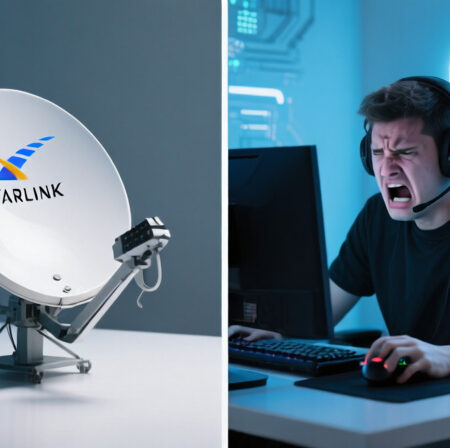
Starlink, SpaceX’s ambitious satellite internet service, is facing growing criticism from the gaming community over performance issues that make online gaming frustrating or even unplayable.
Elon Musk has publicly acknowledged the problem and committed to prioritizing gaming improvements, stating the company is “super focused on getting latency below 20ms” – a significant drop from the current 45-60ms median latency reported by Ookla.
The backlash comes as Starlink’s user base has exploded from just 10,000 early adopters to 2.2 million customers worldwide, with 1.3 million in the United States alone. This rapid growth has exposed infrastructure limitations that particularly impact real-time applications like gaming.
This comprehensive analysis examines the gaming performance issues, Musk’s response, technical challenges, and whether Starlink can truly deliver on its gaming promises.
Why Gamers Are Frustrated with Starlink Performance?
Gaming performance issues on Starlink primarily revolve around three interconnected problems: latency spikes, packet loss during satellite handoffs, and inconsistent connection stability.
Latency spikes occur every 15-20 seconds as Starlink’s system switches connection between satellites in orbit. While the median latency of 45-60ms might seem acceptable for casual browsing, these regular spikes create significant problems for competitive gaming where split-second reactions matter.
The packet loss issue is particularly frustrating for gamers. According to user reports on Reddit and gaming forums, packet loss typically ranges from 1-5% during gaming sessions, happening precisely when satellites switch connections. This results in momentary freezes, character teleportation, or complete disconnections from game servers.
Connection instability manifests as jitter – variations in latency that make gameplay feel unpredictable and inconsistent. One Starlink user reported: “I will average 39-50ms latency with 0% packet loss for 2-7 minutes on average (CoD: MW III & Warzone) and then my packet loss will spike to between 1-5%.”
⏰ Time Saver: The most disruptive pattern happens during satellite handoffs every 15-20 seconds, causing predictable performance hiccups that gamers can anticipate but not prevent.
These issues affect different games in various ways. Fast-paced FPS games like Call of Duty and competitive shooters suffer most from the combination of latency spikes and packet loss. MMOs like Destiny 2 can be somewhat more forgiving but still suffer from disconnection issues during critical moments.
Elon Musk’s Response: A Focus on Gaming Improvements
Responding to the growing chorus of gamer complaints, Elon Musk took to Twitter/X to acknowledge the issues and commit to specific improvements. His response came after widespread criticism on social media and gaming forums about Starlink latency issues affecting gameplay.
Musk’s key commitment centered on reducing latency significantly. “We are also super focused on getting latency below 20ms,” he stated, setting an ambitious target that would make Starlink genuinely competitive for gaming. This represents more than a 50% reduction from current median latency figures.
The timing of Musk’s response is significant. It comes as Starlink faces increasing competition in rural markets and as the company has moved from beta testing to full commercial service. Gamers represent a valuable market segment for Starlink, particularly in rural areas where traditional high-speed internet options are limited.
SpaceX has been working on several technical solutions to address these gaming concerns, including the rollout of their Gen 3 router with Wi-Fi 6 support and improved ethernet connectivity. The company has also been expanding its network of gateway stations worldwide to reduce the distance data needs to travel between satellites and terrestrial internet infrastructure.
“Target is <20ms” – Elon Musk’s concise but ambitious goal for Starlink gaming latency.
– Elon Musk, CEO of SpaceX
Musk’s commitment to gaming improvements signals a strategic shift for Starlink, which has historically prioritized download speeds and coverage area over latency optimization. This focus on gaming performance acknowledges that different use cases require different network characteristics.
The Technical Reality Behind Starlink’s Gaming Challenges
Understanding Starlink’s gaming limitations requires examining the technical architecture of satellite internet. Unlike terrestrial broadband that relies on direct physical connections, Starlink must contend with the fundamental physics of transmitting data through space.
The primary technical challenge comes from satellite handoffs – the process of switching connection between satellites as they move across the sky. With satellites orbiting at approximately 550km altitude and moving at 17,500 mph, your Starlink dish must constantly connect to different satellites to maintain service.
Each handoff creates a brief interruption in data transmission, resulting in the packet loss that gamers experience. While this might be unnoticeable for streaming video or web browsing, it’s devastating for real-time gaming where continuous data flow is essential.
Gateway stations present another bottleneck. These ground-based stations connect satellites to the terrestrial internet backbone. The distance between your location and the nearest gateway station adds to overall latency. SpaceX has been adding gateway stations globally, but coverage remains uneven, particularly in less populated areas.
| Internet Type | Typical Latency | Gaming Suitability |
|---|---|---|
| Fiber Optic | 5-15ms | Excellent |
| Cable | 15-30ms | Good |
| Starlink | 45-60ms | Moderate with issues |
| Traditional Satellite | 600-800ms | Poor |
Network congestion presents a third challenge. As Starlink’s user base grows, bandwidth becomes increasingly shared, particularly during peak evening hours when many users are simultaneously streaming, gaming, and working from home. This congestion can exacerbate latency issues and introduce additional jitter into the connection.
Real-World Gaming Experiences: The Good, The Bad, and The Unplayable
Gamer experiences with Starlink vary dramatically based on location, time of day, and specific games played. The community feedback reveals a nuanced picture of Starlink’s gaming capabilities.
Success stories often come from users in less populated areas with fewer Starlink subscribers. One user reported: “We have starlink since it rolled out in Europe in 2021, no complaints. Latency is usually 20-50ms. Speeds 200-300Mbit.” These users typically experience more consistent performance with fewer congestion-related issues.
Mixed experiences are most common. Gamers report periods of excellent performance punctuated by frustrating lag spikes. As one user described: “The latency is usually between 30-60ms which is totally playable for most games, but you’ll occasionally get brief connection hiccups when satellites change.”
Negative experiences often involve competitive gaming or specific game titles that are particularly sensitive to connection issues. One Diablo IV player lamented: “I’m playing on Starlink and it’s also really bad for me. My latency is very low and I don’t have problem with any other high-bandwidth activities, but Diablo IV is unplayable.”
✅ Pro Tip: Many gamers find that using an ethernet connection instead of Wi-Fi, connecting to the 2.4GHz band, and avoiding peak hours (7-11 PM) can significantly improve Starlink gaming performance.
Regional differences play a significant role in user experiences. Users in areas with fewer Starlink customers generally report better and more consistent performance. This suggests that network congestion, rather than fundamental technical limitations, is often the primary factor affecting gaming quality.
Starlink’s Gaming Improvement Roadmap
SpaceX has been implementing several technical improvements to address gaming performance issues. The company’s approach combines hardware upgrades, network expansion, and software optimizations.
The Starlink Gen 3 Router represents a significant hardware advancement. With Wi-Fi 6 support, built-in ethernet ports, and improved processing capabilities, this new router provides better performance for gaming applications. The ethernet connectivity is particularly important, as it eliminates Wi-Fi as a potential source of additional latency and jitter.
Starlink Gen 3 improvements include better handling of multiple connections, reduced processing overhead, and enhanced stability during satellite handoffs. For gamers, this router can provide a more stable foundation for their gaming setup.
Network expansion continues at a rapid pace. SpaceX has been launching additional satellites to increase network capacity and reduce congestion. The company has also been building new gateway stations around the world to shorten the path between satellites and the terrestrial internet backbone.
Software optimizations are playing an increasingly important role. SpaceX has been implementing smarter algorithms for satellite handoffs, predictive routing, and bandwidth allocation. These improvements help minimize the disruption during satellite switches and optimize data flow for real-time applications.
Frequently Asked Questions
Why is my game lagging with Starlink?
Game lag on Starlink typically occurs during satellite handoffs every 15-20 seconds, causing brief latency spikes and 1-5% packet loss. Network congestion during peak hours can also exacerbate performance issues.
Is Starlink reliable for gaming?
Starlink offers mixed reliability for gaming. It works reasonably well for casual gaming but struggles with competitive gaming due to latency spikes and packet loss during satellite handoffs. Performance varies by location and network congestion.
How to improve Starlink speed for gaming?
Use ethernet instead of Wi-Fi, connect to the 2.4GHz band, restart your router weekly, avoid gaming during peak hours (7-11 PM), and consider using a gaming VPN to stabilize connection. The new Gen 3 router with built-in ethernet also helps.
Is Starlink latency getting better?
Yes, Starlink latency has gradually improved as SpaceX adds more satellites and gateway stations. Elon Musk has committed to reducing latency below 20ms, though this ambitious target may take time to achieve consistently across all regions.
Is Starlink High Performance good for gaming?
The High Performance Starlink dish offers better performance for gaming compared to the standard dish, with more stable connections and better handling of obstructions. However, it still faces the same fundamental satellite handoff challenges that affect gaming performance.
Is Starlink Viable for Gamers in 2026?
Starlink presents a complex choice for gamers in 2026. For rural gamers with limited alternatives, it represents a revolutionary improvement over traditional satellite internet or dial-up connections. However, it still falls short of the consistency and low latency that fiber or cable connections provide.
The current reality is that Starlink works well for casual gaming and certain game types that are more forgiving of connection issues. Games that don’t require split-second timing or that can recover from brief disconnections can be quite enjoyable on Starlink.
For competitive gamers, particularly those playing FPS titles or participating in ranked matches, Starlink’s current performance limitations remain problematic. The regular latency spikes and packet loss during satellite handoffs can be the difference between victory and defeat in high-stakes gaming situations.
Elon Musk’s commitment to reducing latency below 20ms suggests that SpaceX recognizes these limitations and is actively working to address them. The ongoing network improvements, hardware upgrades, and software optimizations provide hope that Starlink’s gaming performance will continue to improve.
For now, gamers considering Starlink should weigh their specific needs against the current limitations. Those with no other high-speed options will likely find Starlink a game-changer despite its imperfections. Competitive gamers with access to fiber or cable may want to wait for further improvements before making the switch.
As SpaceX continues to expand and optimize its network, Starlink’s gaming capabilities will likely improve significantly. The company’s focus on gaming improvements suggests they understand this market segment’s importance and are committed to delivering a better experience for gamers worldwide.
Comments