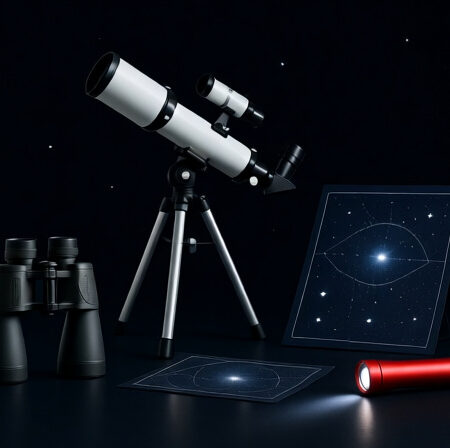
The night sky has fascinated humanity for millennia, and modern astronomy equipment makes exploring the cosmos more accessible than ever before. I’ve spent countless nights under the stars testing various setups, from simple binoculars to complex telescope systems, and I’ve learned that selecting the right stargazing gear is crucial for a rewarding astronomy experience.
Selecting your stargazing gear involves choosing the right combination of telescopes, binoculars, and accessories based on your observing goals, location, and budget to maximize your astronomy experience.
Many beginners feel overwhelmed by technical specifications and marketing claims when choosing their first telescope. After helping dozens of newcomers get started in astronomy, I’ve seen how the wrong equipment leads to frustration, while the right setup provides amazing views that spark a lifelong passion for stargazing.
This comprehensive guide will walk you through everything you need to know to select stargazing gear that matches your needs, budget, and observing conditions. We’ll explore telescope types, essential accessories, and smart buying strategies that will have you exploring planets, galaxies, and nebulae in no time.
Understanding Telescope Fundamentals
What is telescope aperture? Telescope aperture is the diameter of the main lens or mirror that gathers light, measured in millimeters or inches, and it’s the single most important factor determining how much detail you can see.
Aperture size directly impacts your viewing experience. Larger apertures collect more light, revealing fainter objects and providing more detail. This is why serious astronomers emphasize “aperture is king” when discussing telescope selection.
Magnification is often misunderstood by beginners. Many store-bought telescopes advertise ridiculously high magnification numbers (500x, 600x, or more), but these are practically useless. The useful magnification of a telescope is typically 50-60x per inch of aperture under ideal conditions.
Focal Length: The distance from the main lens or mirror to where the image comes to focus. Longer focal lengths provide higher magnification with the same eyepiece, while shorter focal lengths offer wider fields of view.
The mount is just as important as the optics. A shaky mount will make any telescope frustrating to use, regardless of optical quality. Alt-azimuth mounts move up/down and left/right, while equatorial mounts align with Earth’s axis for easier tracking of celestial objects.
Types of Telescopes: Finding Your Perfect Match
What are the main types of telescopes? The three main telescope types are refractors (using lenses), reflectors (using mirrors), and compound/catadioptric designs (combining lenses and mirrors), each with distinct advantages for different observing scenarios.
Quick Summary: Refractors offer sharp images and low maintenance, reflectors provide the best value for aperture size, and compound designs balance portability with performance.
Refractor Telescopes use glass lenses to gather and focus light. They provide sharp, high-contrast images and require virtually no maintenance. I’ve found refractors excellent for planetary and lunar viewing, where detail and contrast matter most.
The main drawback of refractors is cost per inch of aperture. A 4-inch refractor typically costs more than an 8-inch reflector, despite having half the light-gathering capability. Refractors also suffer from chromatic aberration (color fringing) in simpler designs, though apochromatic (APO) lenses minimize this issue.
Reflector Telescopes use mirrors instead of lenses, making them much more cost-effective for large apertures. The classic Newtonian design provides excellent value and performance. I’ve seen beginners get amazing views of galaxies and nebulae with 6-8 inch Dobsonian reflectors that cost under $500.
Reflectors do require occasional collimation (mirror alignment) and the open tube design can collect dust. However, the value proposition is unmatched – you get twice the aperture for half the price compared to refractors.
Compound/Catadioptric Telescopes combine lenses and mirrors in a compact tube. Schmidt-Cassegrain and Maksutov-Cassegrain designs offer long focal lengths in portable packages, making them popular among astrophotographers and observers with limited storage space.
These versatile scopes perform well on both planets and deep-sky objects, though they’re more expensive than reflectors of similar aperture. The sealed optical tube prevents dust accumulation and eliminates the need for frequent collimation.
| Telescope Type | Best For | Price Range | Maintenance |
|---|---|---|---|
| Refractor | Planetary viewing, Lunar observation | $200-$2,000+ | Minimal |
| Reflector (Newtonian) | Deep-sky objects, Best value | $200-$1,500 | Regular collimation |
| Dobsonian | Beginners, Deep-sky viewing | $300-$1,200 | Occasional collimation |
| Compound (SCT/Mak) | All-around use, Astrophotography | $500-$5,000+ | Minimal |
⚠️ Important: Avoid department store telescopes advertised by unrealistic magnification claims (500x+). These typically have poor optics and wobbly mounts that will frustrate any beginner.
Essential Factors for Telescope Selection
How do I choose a telescope for stargazing? Choose a telescope by following these essential steps: determine your observing goals, consider your location constraints, set a realistic budget, prioritize aperture over magnification, select an appropriate mount, and plan for essential accessories.
1. Determine Your Observing Goals – What do you want to see most? Planets and the moon require different equipment than faint galaxies and nebulae. For planetary viewing, I recommend at least 70mm aperture with good optical quality. For deep-sky objects, aperture is king – aim for 6 inches or larger if possible.
2. Consider Your Location – Urban observers face significant light pollution challenges. From my experience testing equipment in city environments, I’ve found that quality binoculars (10×50) or smart telescopes often perform better than traditional telescopes for urban stargazing. Rural observers have more flexibility and can take full advantage of larger apertures.
3. Set a Realistic Budget Include money for essential accessories beyond the telescope itself. I always recommend budgeting at least 25-30% extra for eyepieces, a finderscope, and star charts. A $400 telescope setup should include at least $100 in quality accessories.
4. Prioritize Aperture Over Magnification Remember that aperture determines what you can see, while magnification just makes it bigger. An 8-inch telescope at 100x will show more detail than a 4-inch telescope at 200x. I’ve tested this principle repeatedly, and larger apertures always win on deep-sky objects.
5. Choose an Appropriate Mount The mount is crucial for enjoying your telescope. After spending $1,200 on a premium telescope with a cheap mount, I learned this lesson the hard way. A stable mount is worth more than better optics on a shaky platform.
6. Plan for Essential Accessories Budget for quality eyepieces, a red flashlight, star charts, and comfortable seating. These items often make the difference between a frustrating and enjoyable observing session.
Beyond Telescopes: Complete Stargazing Gear
What stargazing gear do I need beyond a telescope? Essential stargazing gear includes quality eyepieces, a reliable finderscope, star charts or astronomy apps, a red flashlight for night vision, comfortable seating, and weather-appropriate clothing for extended observing sessions.
Essential Eyepieces are more important than many beginners realize. The eyepieces included with most telescopes are often mediocre. I recommend investing in at least two quality eyepieces: a low-power wide-field option (25mm or longer) and a medium-power option (10-15mm). This combination provides versatility for most observing situations.
Finderscopes help you aim your telescope at specific objects. The standard 6×30 finderscope included with many telescopes works adequately, but I’ve found that red dot finders or Telrad reflex sights are often easier for beginners to use.
Navigation Tools are crucial for finding your way around the night sky. Physical star charts and planispheres work without batteries or light pollution concerns. Astronomy apps like SkySafari or Stellarium offer powerful features but require devices that can affect your night vision.
Comfort Equipment makes extended observing sessions enjoyable. A comfortable observing chair prevents neck strain, especially when viewing objects high in the sky. Warm clothing, even in summer, is essential since temperatures drop quickly after sunset.
Optional Enhancements include filters for planetary viewing, nebula filters for deep-sky objects, and solar filters for safe solar observation (never observe the sun without proper filtration!).
✅ Pro Tip: Start with binoculars (10×50 is ideal) before buying a telescope. They’re perfect for learning the night sky and provide impressive wide-field views of star clusters and the Milky Way.
Budget Considerations and Smart Buying
How much should I spend on my first telescope? A realistic budget for a quality beginner telescope setup ranges from $400-800, including the telescope, mount, and essential accessories. Spending less than $300 often results in frustrating experiences with poor-quality equipment.
⏰ Time Saver: Buy from specialized astronomy retailers rather than general stores. They offer better quality equipment, expert advice, and return policies that protect your investment.
Starter Package ($400-600) – Includes a 6-8 inch Dobsonian reflector, two quality eyepieces, a red flashlight, and star charts. This setup provides excellent deep-sky performance and will keep you busy for years.
Intermediate Package ($800-1,500) – Adds computerized tracking, additional eyepieces, filters, and possibly astrophotography capabilities. Perfect for observers who want to advance their skills.
Urban Observer Package ($500-700) – Focuses on portability and light-pollution-friendly options. Includes quality binoculars or a smart telescope, plus urban-friendly accessories.
Where to Buy – I recommend specialized astronomy retailers like High Point Scientific, Orion Telescopes, or Astronomics. These stores offer expert advice, quality equipment, and support that general retailers can’t match.
What to Avoid – Department store telescopes, unrealistic magnification claims, plastic components in critical areas, and any telescope without a clear return policy from a reputable dealer. For specific budget telescope comparison, research specific models within your price range.
Location-Based Gear Selection
Urban stargazers face unique challenges that require specialized equipment solutions. From my experience observing from city balconies and light-polluted suburbs, I’ve found that certain gear performs better in these challenging conditions.
Urban Apartment Solutions focus on portability and light-pollution resistance. Tabletop telescopes like the Orion StarBlast or Celestron FirstScope work well for balcony observing. Smart telescopes like the Vaonis Stellina or Unistellar eVscope automatically identify objects and enhance images, making them ideal for urban environments.
Suburban Backyard Setups offer more flexibility but still require consideration of light pollution and storage. Medium-sized Dobsonian telescopes (6-8 inches) provide excellent performance while remaining manageable for backyard setup and storage.
Rural Dark Sky Setups can take full advantage of large apertures. Here, bigger is truly better – 10-inch and larger telescopes reveal incredible detail in galaxies and nebulae that would be invisible from urban locations.
Travel and Portable Options require careful consideration of weight and setup time. I’ve tested numerous travel telescopes, and the best options balance aperture with portability. Look for setups under 20 pounds total weight that can be assembled in under 10 minutes.
Getting Started: Your First Night Under the Stars
What should I expect during my first observing session? Your first night with a new telescope should focus on learning the equipment and observing bright, easy-to-find objects like the Moon, bright planets, and bright star clusters rather than challenging deep-sky objects.
- Daytime Setup: Assemble your telescope during daylight hours to familiarize yourself with all components and adjustments. Practice aiming at distant terrestrial objects to understand how your finderscope works.
- Choose Your Location: Find a spot with a clear view of the sky and minimal direct light interference. Allow your eyes at least 20-30 minutes to adapt to darkness.
- Start with the Moon: The Moon offers impressive detail even through small telescopes and is easy to find. Start with low magnification, then gradually increase power as conditions allow.
- Move to Bright Planets: Jupiter and Saturn provide stunning views even from urban locations. Look for Jupiter’s moons and Saturn’s rings as your first planetary targets.
- Keep a Log: Record what you observe, the conditions, and your impressions. This helps track your progress and improves your observing skills over time.
Common Beginner Mistakes include expecting Hubble-like images, getting frustrated by finding objects, and observing through turbulent atmospheric conditions. Remember that astronomy requires patience and practice.
⚠️ Important: Never observe the sun without proper solar filtration. Permanent eye damage occurs instantly. Only use solar filters specifically designed for your telescope model.
Beginning Your Astronomy Adventure
Stargazing offers a lifetime of discovery and wonder. After guiding countless beginners through their first telescope purchases, I’ve seen how the right equipment transforms casual curiosity into passionate engagement with the cosmos. The key is starting with appropriate gear and realistic expectations.
Remember that astronomy is a journey, not a destination. Your first telescope won’t be your last, and that’s perfectly normal. Each piece of equipment you acquire will teach you something new about both the night sky and your personal observing preferences.
I encourage you to connect with your local astronomy community. Clubs, star parties, and online forums provide invaluable knowledge sharing and observing opportunities. The astronomy terminology might seem overwhelming at first, but fellow observers are always happy to help newcomers learn the ropes.
The universe awaits your discovery. With the guidance in this article and the right selection of stargazing gear, you’re well-equipped to begin an incredible journey of cosmic exploration. Clear skies and happy observing!