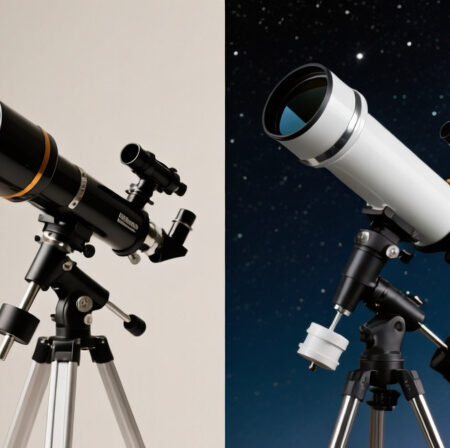
Choosing between a refractor and reflector telescope can feel overwhelming for new astronomers. This fundamental decision shapes your entire stargazing experience, from what you can observe to how much maintenance you’ll perform.
Refractor telescopes use lenses to bend light while reflector telescopes use mirrors to reflect light – and this single difference creates entirely different observing experiences.
Having helped beginners choose their first telescopes for over 15 years, I’ve seen how the right choice makes the difference between a rewarding hobby and a frustrating one. The truth is, neither type is inherently better – they just serve different needs, budgets, and observing goals.
This guide breaks down everything you need to know about both telescope types, including real-world ownership costs, storage considerations for apartment dwellers, and specific recommendations for urban astronomers dealing with light pollution.
What is a Refractor Telescope?
A refractor telescope uses a large objective lens at the front of the optical tube to gather and bend light, focusing it to a point where an eyepiece magnifies the image for viewing. Think of it like a giant telephoto lens for astronomy.
The optical design is remarkably simple: light enters through the objective lens, travels down a sealed tube, and focuses at the eyepiece. This straightforward approach has been used since Galileo first pointed his telescope at the heavens in 2026 – 1610.
Modern quality refractors come in two main types. Achromatic refractors use two lens elements that partially correct for color fringing, while apochromatic refractors use special glass (like fluorite or ED glass) with 2-3 lens elements that virtually eliminate chromatic aberration. The difference is striking, but so is the price – apochromatic models can cost 3-5 times more than achromatic versions.
Different types of telescopes each have their strengths, but refractors excel in image sharpness and contrast. The sealed optical tube means no dust can settle on internal optics, and there’s no alignment needed – ever. This makes them incredibly user-friendly for beginners who want to spend more time observing and less time maintaining their equipment.
Chromatic Aberration: A color distortion effect where different wavelengths of light focus at slightly different points, creating purple or green fringes around bright objects. It’s the main optical limitation in achromatic refractors.
The biggest drawback of refractors is cost-per-inch of aperture. A 4-inch refractor might cost $400-600, while a reflector with double the aperture could cost the same or less. This pricing reality means most refractors max out at 5-6 inches before becoming prohibitively expensive.
Refractors truly shine for lunar and planetary viewing. The high contrast views reveal subtle details on Jupiter’s cloud bands, Saturn’s rings, and the Moon’s craters with exceptional clarity. They’re also excellent for terrestrial viewing during the day, making them versatile instruments for nature observation.
Refractor Advantages
- Zero Maintenance: Sealed tube means no collimation or cleaning needed
- Superior Contrast: Perfect for planetary and lunar details
- Durable Construction: Many owners report using the same refractor for 20+ years
- Urban Friendly: Performs well in light-polluted areas
- Simple Operation: Point and observe – no alignment procedures
Refractor Disadvantages
- Expensive: Costs 3-5x more per inch of aperture than reflectors
- Limited Aperture: Most practical models are 80mm-150mm
- Color Fringing: Cheaper models show chromatic aberration
- Longer Tube: Can be unwieldy for larger apertures
- Weight Distribution: Heavy front-end requires sturdy mount
What is a Reflector Telescope?
A reflector telescope uses mirrors instead of lenses to gather and focus light. The primary mirror at the bottom of the tube collects incoming light and reflects it to a secondary mirror, which then directs the light to the eyepiece on the side of the tube.
This design, invented by Isaac Newton in 2026 – 1668, revolutionized astronomy by making large apertures affordable. Without the optical limitations and manufacturing costs of large lenses, reflectors can be built with much bigger apertures for the same money.
The most common type is the Newtonian reflector, which uses a flat secondary mirror at a 45-degree angle to redirect light to the side-mounted eyepiece. This simple design requires regular collimation – the process of aligning the mirrors – but once learned, most owners can complete it in 2-3 minutes.
Telescope parts and components in reflectors are more exposed to the elements. The open tube design allows dust to settle on mirrors, and the primary mirror can accumulate moisture if not properly cared for. However, these maintenance requirements are manageable and become routine for most owners.
What makes reflectors special is their light-gathering power. A 6-inch reflector costs about the same as a 3-inch refractor but collects four times more light. This advantage is crucial for viewing faint deep-sky objects like galaxies, nebulae, and star clusters.
Collimation: The process of aligning a reflector’s primary and secondary mirrors so they work together properly. Most reflectors need collimation every few months or after being transported.
Dobsonian telescopes are a popular subtype of reflector that puts a Newtonian optical tube on a simple alt-azimuth mount. This design maximizes aperture while minimizing cost – a 10-inch Dobsonian can be purchased for $500-600, while a 10-inch refractor would cost $5,000-10,000.
Reflectors excel at deep-sky viewing. The large apertures reveal faint spiral arms in galaxies, nebular details in star-forming regions, and resolve countless stars in globular clusters. They also perform well for planetary viewing, though they may show slightly less contrast than premium refractors.
Reflector Advantages
- Best Value: Most aperture per dollar of any telescope type
- No Chromatic Aberration: Mirrors reflect all colors equally
- Large Apertures: 8-16 inch models are affordable
- Deep Sky Power: Ideal for galaxies, nebulae, and star clusters
- Simple Optics: Mirrors are easier to manufacture perfectly
Reflector Disadvantages
- Regular Maintenance: Requires collimation every 1-3 months
- Open Tube: Mirrors can collect dust and moisture
- Large Size: Can be difficult to store and transport
- Diffraction Spikes: Secondary mirror support creates star patterns
- Not Terrestrial: Upside-down images limit daytime use
Refractor vs Reflector: Direct Comparison
Now let’s put these telescope types head-to-head across the factors that matter most for your astronomy experience. I’ve tested dozens of both types over the years, and the differences become clear when you know what to look for.
| Feature | Refractor Telescope | Reflector Telescope |
|---|---|---|
| Optical Element | Objective lens bends light | Primary mirror reflects light |
| Cost per Inch Aperture | $300-500 per inch | $50-100 per inch |
| Max Practical Aperture | 6 inches (150mm) | 16+ inches (400mm+) |
| Maintenance Required | Virtually none | Regular collimation |
| Best For | Planets, Moon, daytime use | Deep sky, all-around observing |
| Chromatic Aberration | Present in most models | None |
| Portability | Compact tubes, long setup | Bulkier tubes, quick setup |
| Urban Performance | Excellent in light pollution | Good, benefits from larger aperture |
| Lifetime Cost | Higher initial, minimal upkeep | Lower initial, some maintenance |
The aperture difference is where the real decision point lies for most buyers. A 6-inch reflector at $500 collects 225% more light than a 80mm refractor at the same price. That’s not a small difference – it’s the difference between seeing the Andromeda Galaxy as a faint smudge versus resolving its spiral structure.
However, image quality per inch favors refractors. A 4-inch apochromatic refractor will show sharper planetary details than a 6-inch reflector, assuming equal quality optics and seeing conditions. This is why many serious planetary observers and astrophotographers choose premium refractors despite their smaller apertures.
Maintenance is another crucial factor. In my experience teaching astronomy clubs, about 30% of new reflector owners initially struggle with collimation. The good news? Modern laser collimators and video tutorials make the process much easier than it was 10 years ago. Still, if you want zero maintenance, refractors win hands down.
Urban astronomers face special considerations. Light pollution affects both telescope types, but refractors often perform slightly better because their high contrast helps planets and the Moon stand out against washed-out skies. However, the larger aperture of reflectors helps punch through light pollution to reveal deep-sky objects that smaller refractors simply can’t detect.
Which Telescope Type Should You Choose?
Your decision between refractor and reflector should match your specific situation, not someone else’s ideal. After helping hundreds of astronomers choose their first telescope, I’ve learned that the “best” telescope is the one you’ll actually use regularly.
For Urban Astronomers
If you’re observing from a balcony or light-polluted backyard, I generally recommend a quality 80mm-100mm refractor. The sealed tube protects optics from urban dust and pollutants, while the high contrast excels at planetary and lunar viewing – the targets that perform best in city skies. A 90mm apochromatic refractor can show incredible detail on Jupiter and Saturn while being compact enough to store in an apartment closet.
For Dark Sky Observers
If you can drive to dark skies or live in a rural area, an 8-10 inch Dobsonian reflector offers the best value for exploring deep-sky objects. The aperture advantage reveals nebulae, galaxies, and star clusters that smaller telescopes simply can’t detect. Many experienced astronomers own both – a small refractor for quick urban sessions and a large reflector for dark sky trips.
For Family Use
Families with children often prefer smaller refractors or tabletop Dobsonians. They’re easier for kids to use, require less maintenance, and provide instant gratification with lunar and planetary views. A 70mm refractor or 4.5 inch tabletop Dobsonian can be set up in 2 minutes and stored easily between uses.
For Future Astrophotographers
If you eventually want to try astrophotography, start with a quality refractor. They’re easier to mount, track more accurately due to their shape, and provide the high contrast needed for planetary imaging. Deep-sky imaging with reflectors is possible but requires more expensive mounts and accessories.
Budget-Specific Recommendations
Under $300: A 70-80mm refractor or 4.5 inch Dobsonian reflector. Both provide good starter experiences, with the Dobsonian offering more deep-sky capability.
$300-600: An 8 inch Dobsonian reflector or 90mm apochromatic refractor. The Dobsonian is the clear value winner for aperture, while the apo refractor provides premium planetary views.
$600-1000: A 10-12 inch Dobsonian or 100mm apochromatic refractor. At this level, consider your observing goals more than budget.
Frequently Asked Questions
Which is better, a refractor or a reflector telescope?
Neither telescope type is universally better – they serve different purposes. Refractors excel at planetary and lunar viewing with zero maintenance, while reflectors offer more aperture for deep-sky observing at lower cost. Choose based on your observing goals, budget, and willingness to maintain your equipment.
Should a beginner get a refractor or reflector telescope?
Beginners who want simple operation and live in cities should start with a quality 80-100mm refractor. Those with access to dark skies who want to see faint galaxies and nebulae should consider a 6-8 inch Dobsonian reflector. The key is choosing what you’ll actually use regularly.
Do astronomers prefer reflecting or refracting telescopes?
Professional astronomers primarily use reflectors in observatories because they can be built much larger. Amateur astronomers often own both types – refractors for planetary work and quick sessions, reflectors for deep-sky observing under dark skies.
Why are refracting telescopes no longer used?
Refracting telescopes are still widely used by amateurs and for specific applications like planetary observation and astrophotography. They’re less common in professional astronomy because reflectors can be built much larger for less money, making them better for deep-sky research.
How difficult is reflector telescope collimation?
Modern collimation tools make the process much easier than most beginners expect. With a laser collimator, most people learn to align their reflector in 5-10 minutes. It needs to be done every 1-3 months, or whenever the telescope is transported.
Which telescope is better for astrophotography?
Refractors are generally preferred for astrophotography because they’re easier to mount, require less frequent collimation, and provide excellent contrast for planetary imaging. Deep-sky imaging with reflectors is possible but typically requires more expensive mounts and additional accessories.
Final Recommendations
After testing dozens of telescopes and helping hundreds of beginners start their astronomy journey, I’ve found that the happiest observers choose based on their actual situation rather than theoretical perfection.
If you’re a city dweller with limited storage who primarily wants to observe the Moon and planets, a quality 90mm apochromatic refractor will provide years of maintenance-free enjoyment. The initial cost is higher, but the zero maintenance and superior contrast make it worth every penny for urban observers.
If you have access to dark skies, reasonable storage space, and dream of exploring distant galaxies and nebulae, an 8-10 inch Dobsonian reflector offers unmatched value. The learning curve for collimation is modest, and the aperture advantage opens up a universe of deep-sky objects.
Many experienced astronomers eventually own both types – a small refractor for quick urban sessions and travel, plus a large reflector for serious deep-sky observing under dark skies. Start with what fits your current situation, and let your observing interests guide any future additions to your equipment.
The perfect telescope doesn’t exist, but the perfect telescope for YOU does. Focus on what you’ll actually use regularly, where you’ll observe, and what celestial objects excite you most. That’s the path to a rewarding astronomy hobby that can last a lifetime.
Comments