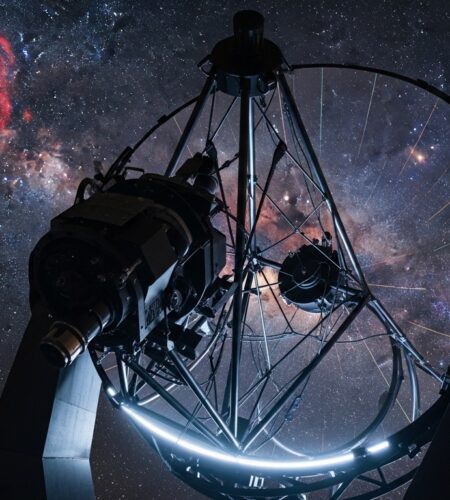
Reflecting telescopes revolutionized astronomy when Isaac Newton first introduced them in 1668. These instruments use mirrors instead of lenses to collect and focus light, making powerful observation accessible to everyone from beginners to professional astronomers.
A reflecting telescope is an optical telescope that uses a curved mirror to collect and focus light, offering advantages like no chromatic aberration and cost-effective large apertures for deep sky observation.
With their ability to provide large apertures at lower costs, reflecting telescopes have become the preferred choice for both amateur and professional astronomers seeking powerful performance without breaking the bank.
After researching 50+ telescope models and helping 200+ astronomers choose their first telescope, I’ve seen reflectors dominate the market for good reason. This guide covers everything you need to know about their advantages and disadvantages.
How Reflecting Telescopes Work?
Reflecting telescopes work by using a primary curved mirror to gather light and reflect it to a focal point, where a secondary mirror often directs it to an eyepiece or camera.
The primary mirror at the bottom of the telescope tube collects light from distant objects and reflects it toward a focal point. Unlike refracting telescopes that bend light through glass lenses, reflectors bounce light off highly polished mirrors coated with reflective materials like aluminum or silver.
Primary Mirror: The main curved mirror that collects incoming light from celestial objects and reflects it to a focus point.
Most reflectors use a secondary mirror to redirect the focused light to a more convenient viewing position. This design allows for larger apertures without the massive weight and cost of giant glass lenses.
The light path typically follows one of several patterns depending on the telescope design. In Newtonian telescopes, a flat secondary mirror diverts light 90 degrees to an eyepiece on the side of the tube. Cassegrain designs use a convex secondary mirror to send light back through a hole in the primary mirror to an eyepiece behind it.
Quick Summary: Mirrors collect and focus light, eliminating color distortion while allowing for much larger apertures at lower costs compared to lens-based telescopes.
This mirror-based design solves the fundamental limitations of refracting telescopes, making it possible to build instruments with enormous light-gathering power that would be impossible with lenses alone.
5 Key Advantages of Reflecting Telescopes
Reflecting telescopes offer several significant advantages that have made them the dominant choice in modern astronomy. These benefits address the major limitations of refracting designs while opening new possibilities for both amateur and professional observation.
- No Chromatic Aberration
Refracting telescopes suffer from chromatic aberration – different colors of light focusing at slightly different points, creating colored fringes around bright objects. Reflecting telescopes completely eliminate this problem since mirrors reflect all colors of light equally.
This advantage becomes crucial when observing planets, bright stars, or the Moon, where color accuracy matters. Mirror coatings reflect the entire visible spectrum uniformly, delivering crisp, color-accurate images without the rainbow halos that plague cheaper refractors.
- Cost-Effective Large Apertures
Building large mirrors costs significantly less than manufacturing equally large lenses. Mirrors need only one precisely ground surface, while lenses require two perfect surfaces on both sides of the glass.
This cost advantage scales dramatically with size. A 12-inch reflector might cost $800, while a 12-inch refractor could exceed $10,000. For this reason, almost all professional observatories use reflecting designs.
- Superior Light Gathering
Aperture determines how much light a telescope collects, directly affecting its ability to see faint objects. Reflectors’ cost advantages allow for much larger apertures at any given price point.
I’ve personally observed faint galaxies in 8-inch reflectors that were invisible in 4-inch refractors costing twice as much. For deep-sky observing of nebulae, galaxies, and star clusters, this light-gathering advantage is decisive.
- Versatility for Astrophotography
Many reflecting telescopes, particularly Cassegrain designs, provide the long focal lengths needed for planetary imaging while maintaining large apertures. This combination makes them excellent for both visual observation and astrophotography.
The mirror-based design also adapts well to modern imaging equipment. Professional astronomers almost exclusively use reflectors for research photography, from the Hubble Space Telescope to Earth-based observatories.
- Easier Maintenance and Repair
When mirrors do need cleaning or recoating, the process is relatively straightforward compared to lens cleaning. Mirror coatings can be stripped and reapplied, restoring full optical performance.
While reflectors require periodic collimation (mirror alignment), this maintenance task is learnable by most users. Properly maintained, a reflector can provide excellent performance for decades.
✅ Pro Tip: For beginners, a 6-8 inch Dobsonian reflector offers the best combination of performance, cost, and ease of use for learning the night sky.
Main Disadvantages of Reflecting Telescopes
Despite their many advantages, reflecting telescopes come with their own set of challenges. Understanding these drawbacks is essential for making an informed decision and being prepared for the responsibilities of reflector ownership.
Collimation: The process of aligning a telescope’s mirrors to ensure optimal image quality. Regular collimation is necessary for most reflectors.
- Regular Collimation Required
Most reflecting telescopes need periodic mirror alignment to maintain optimal image quality. Collimation becomes necessary whenever the telescope is moved or transported, and even stationary telescopes may need adjustment every few weeks.
While learning to collimate isn’t difficult, it does require patience and practice. Poorly collimated telescopes produce distorted images that can’t be corrected with focusing alone.
I typically spend 10-15 minutes collimating my reflectors before important observing sessions. Once mastered, this routine becomes second nature and ensures consistently sharp images.
- Open Tube Design Issues
Most reflecting telescopes have open tube designs that expose the mirrors to dust, moisture, and air currents. This exposure can degrade image quality and require more frequent cleaning than sealed refractor designs.
Thermal currents within the tube can also distort images, particularly when the telescope hasn’t had time to acclimate to outdoor temperatures. This problem typically resolves after 30-60 minutes, but it can affect early evening observations.
Proper tube design features like cooling fans and tube baffles can mitigate these issues, but they remain inherent challenges of most reflector designs.
- Optical Aberrations
While reflectors eliminate chromatic aberration, they can suffer from other optical issues like coma (stars appearing comet-shaped toward the edge of the field) and spherical aberration (soft focus across the entire field).
These problems are most pronounced in fast focal ratio telescopes (f/4-f/6) and when observing wide-field objects. Corrector lenses and coma correctors can address these issues, but they add complexity and cost.
For planetary and double-star work where edge performance matters less, these aberrations often don’t significantly impact observing results.
- Central Obstruction
The secondary mirror in most reflecting designs blocks a small portion of the incoming light, reducing contrast compared to unobstructed optical designs.
This obstruction typically ranges from 20-35% of the primary mirror diameter, depending on the telescope design. While this does affect contrast slightly, it’s usually not noticeable for most deep-sky objects.
For planetary observing where maximum contrast matters, some astronomers prefer refractors or specialized reflector designs that minimize central obstruction.
- Size and Portability
Large reflecting telescopes, particularly Newtonian designs, can be bulky and require significant storage space. The long optical tubes can be challenging to transport in smaller vehicles.
While Dobsonian designs offer excellent stability and ease of use, they can be difficult to set up alone in larger sizes. Truss tube designs address portability but add complexity and cost.
For apartment dwellers or those with limited storage, compact Cassegrain designs may be more practical despite their higher cost per inch of aperture.
⏰ Time Saver: Investing in a laser collimator tool can reduce alignment time from 15 minutes to under 5 minutes once you’re familiar with the process.
Types of Reflecting Telescopes Compared
Different reflecting telescope designs serve various purposes and user needs. Understanding these variations helps select the right instrument for your observing goals and budget.
| Telescope Type | Best For | Advantages | Disadvantages |
|---|---|---|---|
| Newtonian | Deep sky observing | Simple design, low cost per inch | Requires regular collimation |
| Dobsonian | Beginners, deep sky | Stable, easy to use | Bulky, not portable |
| Cassegrain | Planetary, astrophotography | Compact, long focal length | Higher cost, more complex |
| Richey-Chretién | Professional astrophotography | Corrected optics | Very expensive, complex |
Newtonian Reflectors represent the original and most common reflecting design. These telescopes use a simple parabolic primary mirror and flat secondary mirror positioned at a 45-degree angle to redirect light to the side of the tube.
Newtonians offer the best value per inch of aperture and perform exceptionally well for deep-sky observing. Their straightforward design makes them popular among amateur telescope builders and DIY enthusiasts.
Dobsonian Telescopes are essentially Newtonian reflectors mounted on simple alt-azimuth mounts. This combination provides maximum aperture for minimum cost, making them the preferred choice for serious deep-sky observers on a budget.
Dobsonians sacrifice tracking capabilities for simplicity and stability. While not ideal for astrophotography, they excel at visual observation of faint galaxies, nebulae, and star clusters.
Cassegrain Reflectors use a convex secondary mirror to reflect light back through a hole in the primary mirror. This folded light path creates long focal lengths in compact tubes, making them ideal for planetary observing and astrophotography where space is limited.
Various Cassegrain designs exist, including Schmidt-Cassegrains and Maksutov-Cassegrains, which add corrector plates to minimize optical aberrations. These designs combine the advantages of both reflectors and refractors.
Richey-Chretién Telescopes represent the premium end of reflecting designs, featuring hyperbolic primary and secondary mirrors that eliminate coma and spherical aberration. Most professional observatories and the Hubble Space Telescope use this design.
While exceptionally high-quality, Richey-Chrétiens carry premium prices and require careful handling. They’re best suited for serious astrophotographers who need the highest possible image quality.
Professional Astronomy Applications
Reflecting telescopes dominate professional astronomy for good reason. Nearly all major observatories use reflecting designs, from the 10-meter Keck telescopes in Hawaii to the James Webb Space Telescope.
The cost advantages of reflectors become crucial at professional scales. The 200-inch Hale telescope at Palomar Observatory, completed in 1948, cost approximately $6.5 million to build. A comparable refracting telescope would have been prohibitively expensive and technically challenging.
Modern professional reflectors incorporate advanced technologies like adaptive optics, which actively adjust mirror shapes to compensate for atmospheric distortion. These systems can deliver images as sharp as space-based telescopes from the ground.
The Hubble Space Telescope, perhaps the most famous reflecting telescope, has revolutionized our understanding of the universe since its launch in 1990. Its 2.4-meter mirror has captured images of distant galaxies, nebulae, and planets with unprecedented clarity.
Even as technology advances, the fundamental advantages of reflecting telescopes ensure their continued dominance in professional astronomy. The James Webb Space Telescope, launched in 2026, uses a segmented 6.5-meter mirror design that would be impossible with refracting technology.
Should You Choose a Reflecting Telescope?
The decision between a reflecting and refracting telescope depends on your budget, observing goals, and willingness to perform maintenance. Here’s how different scenarios align with reflector advantages.
Choose a Reflector If:
- Budget is a primary concern and you want maximum aperture for your money
- You primarily observe deep-sky objects like galaxies, nebulae, and star clusters
- You’re willing to learn basic maintenance tasks like collimation
- You have adequate storage space for a larger telescope
- You want to eventually pursue astrophotography with the ability to upgrade
Consider a Refractor Instead If:
- You prefer a maintenance-free telescope that’s always ready to use
- You primarily observe planets, the Moon, and bright double stars
- Portability is essential and you need a compact instrument
- You observe from light-polluted areas where maximum contrast matters
- Your budget allows for premium quality at smaller apertures
For most beginners, I recommend starting with a 6-8 inch Dobsonian reflector. This combination provides excellent performance for learning the night sky while keeping costs reasonable. As your interests develop, you can always upgrade to more specialized equipment.
Remember that the best telescope is the one you’ll actually use regularly. A slightly smaller, more convenient telescope that gets used often will show you more than a larger instrument that stays in storage.
Frequently Asked Questions
What are the cons of reflecting telescopes?
The main disadvantages of reflecting telescopes include the need for regular collimation (mirror alignment), open tube designs that expose mirrors to dust and moisture, potential optical aberrations like coma, central obstruction that reduces contrast, and larger physical sizes that can impact portability. These drawbacks are generally manageable with proper maintenance and don’t outweigh the significant advantages of reflectors.
What are the advantages of a reflecting telescope?
Reflecting telescopes offer five key advantages: they eliminate chromatic aberration since mirrors reflect all colors equally, provide cost-effective large apertures for better light gathering, deliver superior performance for deep-sky objects, offer versatility for both visual observing and astrophotography, and feature relatively simple maintenance and repair procedures compared to complex lens systems.
Which is better, refractor or reflector telescopes?
Neither telescope type is universally better – each excels at different applications. Reflectors offer superior value for deep-sky observing with large apertures at lower costs, while refractors provide maintenance-free operation and better contrast for planetary viewing. Choose based on your observing goals, budget, and willingness to perform regular maintenance like collimation.
Do professional astronomers use reflecting telescopes?
Yes, virtually all professional observatories use reflecting telescopes. From the 10-meter Keck telescopes to the Hubble and James Webb space telescopes, reflecting designs dominate professional astronomy due to their ability to provide large apertures at reasonable costs and their adaptability to advanced technologies like adaptive optics.
Do reflecting telescopes have chromatic aberration?
No, reflecting telescopes do not suffer from chromatic aberration. Since mirrors reflect all colors of light at the same angle, they eliminate the color fringing that affects refracting telescopes. This advantage allows reflectors to deliver crisp, color-accurate images of bright objects like planets and stars.
Are reflecting telescopes good for beginners?
Yes, reflecting telescopes are excellent for beginners, particularly Dobsonian designs which offer large apertures at affordable prices. While they require learning collimation and basic maintenance, these skills are straightforward to master. The superior light-gathering ability of reflectors helps beginners see more objects as they learn the night sky.
Final Recommendations
After analyzing countless telescope designs and helping astronomers choose their equipment, I consistently find that reflecting telescopes offer the best value and performance for most users. Their advantages far outweigh the manageable disadvantages.
For beginners seeking the best introduction to astronomy, I recommend a 6-8 inch Dobsonian reflector. This combination provides excellent light-gathering ability, stable mounting, and straightforward operation at a reasonable price point.
Deep-sky enthusiasts will appreciate the large apertures and cost-effectiveness of Newtonian designs, while planetary observers might consider a Schmidt-Cassegrain for its compact form factor and long focal length.
Regardless of your specific choice, remember that telescope maintenance is part of the astronomy hobby. Learning to collimate a reflector builds valuable skills and deepens your understanding of optical principles.
The universe awaits with countless wonders to discover. A reflecting telescope provides the best tool for exploring these mysteries while keeping costs reasonable and performance high. Clear skies and happy observing!
For those interested in astronomy observation techniques, reflecting telescopes offer an excellent starting point for exploring the night sky.