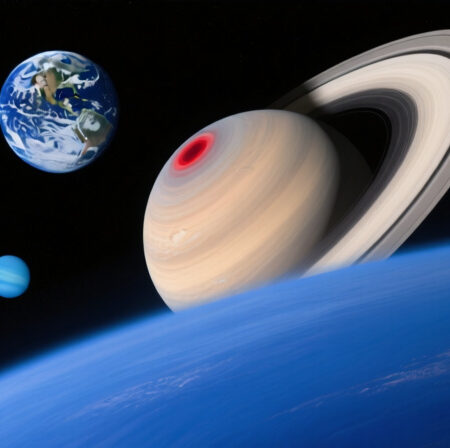
Have you ever gazed at the night sky and wondered which celestial jewel shines brightest among the cosmic treasure trove? As someone who has spent countless nights with telescopes ranging from simple binoculars to professional observatory equipment, I’ve witnessed the breathtaking beauty of planets firsthand. There’s nothing quite like the first time you see Saturn’s rings snap into focus or Jupiter’s swirling storms reveal themselves through your eyepiece.
Saturn is the most beautiful planet in our solar system and arguably the universe, with its spectacular ring system captivating observers for centuries. However, beauty in space extends far beyond our cosmic neighborhood, with exoplanets displaying colors and features that defy imagination.
Join me on this visual journey through our solar system and beyond as we explore the most stunning planets known to humanity. I’ll share insights from both scientific missions and personal observation experiences that will transform how you see these cosmic wonders.
By the end of this guide, you’ll understand what makes each planet uniquely beautiful, how to observe them yourself, and why these distant worlds continue to inspire awe in everyone who looks up at the night sky. Whether you’re an amateur astronomer or simply curious about space’s visual splendors, prepare to be amazed by the universe’s most beautiful planets.
Top 10 Most Beautiful Planets Ranked
Based on visual impact, unique features, and observable characteristics, here’s our ranking of the universe’s most stunning planets. While beauty remains subjective, these celestial bodies consistently captivate astronomers and space enthusiasts alike with their extraordinary appearances.
- Saturn: The crown jewel of our solar system with rings spanning 175,000 miles
- Jupiter: A swirling canvas of colorful storms including the iconic Great Red Spot
- Earth: Our blue marble with swirling white clouds and vibrant green landmasses
- Neptune: A deep azure world with the fastest winds in the solar system
- HD 189733b: A cobalt blue exoplanet resembling Earth from space
- Venus: The brilliant morning star with a thick, reflective atmosphere
- Mars: The red planet with polar ice caps and vast canyon systems
- WASP-12b: A ruby-colored world being stretched by its star’s gravity
- Uranus: An ice giant tilted on its side with faint rings
- Kepler-186f: An Earth-sized exoplanet potentially hosting liquid water
Our Solar System’s Visual Wonders
1. Saturn – The Ringed Majesty
Saturn stands as the undisputed champion of planetary beauty, a title it has held since Galileo first observed its peculiar shape in 1610. What makes Saturn truly special isn’t just its rings, but the intricate dance of light and shadow they create as they orbit the gas giant.
Saturn’s Rings: Composed primarily of ice particles ranging from tiny grains to house-sized chunks, these rings span 175,000 miles yet are only about 30 feet thick in most places.
The ring system consists of seven main groups labeled A through G, with the Cassini Division creating a dramatic dark gap between rings A and B. Through a modest telescope, the rings appear as a solid ellipse, but with larger instruments, you can resolve individual ringlets and even spot the Encke Gap, a 200-mile-wide opening in ring A.
Saturn’s pale golden hue comes from ammonia crystals in its upper atmosphere, which scatter sunlight in a way that softens the planet’s appearance. The planet itself measures 72,367 miles in diameter, making it the second-largest planet in our solar system. Its composition is mostly hydrogen and helium, similar to Jupiter, but its lower density means it would actually float in water—if you could find a bathtub big enough!
Reasons to Buy
Unparalleled ring system visible even through small telescopes, dramatic seasonal changes as rings tilt toward and away from Earth, and numerous moons including Titan with its thick atmosphere.
Reasons to Avoid
Appears small through basic equipment, requires medium to large telescopes for detailed ring observations, and best viewing occurs only during opposition every 378 days.
2. Jupiter – The Storm King
Jupiter reigns as the largest planet in our solar system, a behemoth so massive it could contain all other planets combined. What I find most mesmerizing about Jupiter is its ever-changing atmosphere, a swirling canvas of browns, reds, and whites that creates patterns unlike anything else in space.
The Great Red Spot, a persistent anticyclonic storm larger than Earth, has raged for at least 350 years. I once spent an entire night watching this massive storm rotate, feeling humbled by its scale and longevity. The storm’s color has varied from pale salmon to deep brick red over the decades, reminding us that even giant planets evolve.
Jupiter’s cloud bands run parallel to its equator, created by jet streams moving at up to 540 km/h. These bands alternate between lighter zones and darker belts, with the Great Red Spot sitting between two of them. Through even a small telescope, you can spot two main cloud bands and up to four Galilean moons: Io, Europa, Ganymede, and Callisto.
The planet’s rapid rotation—completing one day in just 9.9 hours—creates a noticeable flattening at its poles. This rapid spin also contributes to the dramatic cloud patterns that make Jupiter so visually striking. When observing Jupiter, I recommend using a blue filter to enhance contrast in the cloud bands and make the Great Red Spot more prominent.
Reasons to Buy
Largest planet offers impressive detail even through small telescopes, constantly changing atmospheric features provide new views each night, and bright appearance makes it easy to locate.
Reasons to Avoid
Rapid rotation can make features hard to sketch, atmospheric seeing conditions significantly affect view quality, and requires patience to wait for moments of atmospheric stability.
3. Earth – The Blue Marble
While we live on Earth, we often forget how stunningly beautiful our planet appears from space. The famous “Blue Marble” photograph taken by Apollo 17 astronauts in 2026 revealed our home as a swirling masterpiece of blue oceans, white clouds, and brown-green continents.
Earth’s beauty comes from its unique combination of liquid water, oxygen-rich atmosphere, and life itself. The planet appears predominantly blue due to Rayleigh scattering in our atmosphere—the same phenomenon that makes the sky blue. White clouds add dynamic texture, while green vegetation and brown deserts create subtle color variations visible from orbit.
What makes Earth particularly beautiful is its constant change. Weather patterns swirl across the surface, seasons transform landscapes, and human cities create networks of light visible on the night side. From space, auroras dance at the poles, tropical storms spiral in the oceans, and volcanic eruptions send plumes into the atmosphere.
Earth’s 7,917-mile diameter and perfect distance from the Sun create the “Goldilocks conditions” necessary for liquid water and life. This delicate balance, maintained for billions of years, makes our planet not just beautiful but incredibly precious. As we explore other worlds, we continue to appreciate Earth’s unique beauty and the fragility of its ecosystems.
Reasons to Buy
Only known planet with life, perfect viewing conditions without equipment needed, and dynamic atmosphere creates ever-changing views.
Reasons to Avoid
Light pollution in urban areas blocks celestial views, atmospheric turbulence affects ground-based observation, and requires space travel for complete appreciation.
4. Neptune – The Sapphire Giant
Neptune, the most distant major planet in our solar system, captivates observers with its deep azure color—a result of methane in its atmosphere absorbing red light and reflecting blue. I’ll never forget my first view of Neptune through a 12-inch telescope; the subtle blue color seemed almost unreal against the blackness of space.
Discovered in 1846 through mathematical predictions rather than direct observation, Neptune orbits 2.8 billion miles from the Sun. Its 30,775-mile diameter makes it slightly smaller than Uranus, but its deeper color and more active atmosphere give it visual appeal. The planet’s winds reach speeds up to 1,200 mph, the fastest in the solar system.
Neptune’s most prominent feature, the Great Dark Spot observed by Voyager 2 in 2026, has since disappeared, reminding us that even giant planets change over time. Current observations show bright cloud features that race around the planet, some of which can be tracked through large amateur telescopes during favorable oppositions.
The planet’s largest moon, Triton, orbits in a retrograde direction and may be a captured Kuiper Belt object. Triton’s surface shows evidence of cryovolcanism—ice volcanoes that erupt nitrogen frost rather than molten rock. This strange moon adds to Neptune’s visual appeal, appearing as a bright point near the planet in medium-sized telescopes.
Reasons to Buy
Deep blue color unique in solar system, dynamic atmosphere with fast-moving clouds, and challenging observation makes sightings rewarding.
Reasons to Avoid
Faint and distant requiring medium to large telescopes, limited surface detail visible from Earth, and long orbital period means slow changes in position.
5. Venus – The Brilliant Morning Star
Venus dominates our morning and evening skies as the brightest planet visible from Earth, earning its reputation as both the Morning Star and Evening Star. Its brilliance comes from a highly reflective atmosphere of sulfuric acid clouds that reflect about 70% of sunlight—the highest albedo of any planet.
Venus appears as a brilliant white object, sometimes bright enough to cast shadows on dark nights. Through a telescope, it displays phases similar to our Moon, ranging from a thin crescent to nearly full. These phases, first observed by Galileo in 1610, provided crucial evidence for the heliocentric model of the solar system.
The planet’s surface remains hidden beneath permanent cloud cover, but radar mapping has revealed a world of volcanoes, mountains, and vast plains. Venus rotates backward compared to most planets, and its day is longer than its year—243 Earth days versus 225. This slow rotation creates minimal weather patterns, giving Venus its uniform appearance.
Named after the Roman goddess of love and beauty, Venus has inspired cultures throughout history. Its appearance in the sky has influenced calendars, religions, and navigation. Despite its harsh surface conditions—460°C temperatures and crushing pressure—Venus remains one of the most beautiful sights in our night sky.
Reasons to Buy
Brightest planet visible without equipment, dramatic phases observable through small telescopes, and predictable appearance makes it easy to track.
Reasons to Avoid
Featureless cloud cover shows no surface detail, appears as only a bright disk without telescopes, and best viewing occurs during twilight when atmospheric turbulence is high.
6. Mars – The Red Planet
Mars earns its nickname as the Red Planet from iron oxide on its surface—the same compound that gives rust its color. This distinctive ruddy hue has made Mars a favorite of observers for millennia, inspiring myths of war and conquest across cultures.
What makes Mars particularly beautiful during opposition is the detail visible through amateur telescopes. The polar ice caps, composed of water ice and frozen carbon dioxide, grow and shrink with Martian seasons. Dark features such as Syrtis Major and the Hellas Basin provide contrast against the reddish deserts.
Mars experiences the largest dust storms in the solar system, sometimes covering the entire planet for weeks. These storms can both obscure and enhance surface features, making each viewing session unique. The planet’s thin atmosphere, only 1% as dense as Earth’s, allows these dust particles to remain suspended for extended periods.
The planet’s two small moons, Phobos and Deimos, are likely captured asteroids and appear as tiny points even in large telescopes. Mars itself measures 4,212 miles in diameter—about half the size of Earth—and its day lasts 24 hours and 37 minutes, remarkably similar to our own.
Reasons to Buy
Distinctive red color makes it easy to identify, polar ice caps and dark features visible through medium telescopes, and close approaches during opposition provide excellent viewing opportunities.
Reasons to Avoid
Appears small except during close oppositions, global dust storms can obscure all surface features for months, and requires good seeing conditions for detailed observation.
7. Uranus – The Tilted Ice Giant
Uranus presents a subtle beauty that rewards patient observers. Its pale blue-green color comes from methane in the atmosphere, similar to Neptune but with less concentration. What makes Uranus truly unique is its extreme axial tilt—98 degrees—which means it essentially orbits the Sun on its side.
This unusual tilt creates the most extreme seasons in the solar system. Each pole experiences 42 years of continuous sunlight followed by 42 years of darkness. During Uranus’s equinoxes, its ring system appears edge-on to Earth, providing the best opportunities to observe these faint structures.
Uranus measures 31,518 miles in diameter, making it the third-largest planet. Its atmosphere contains hydrogen, helium, and methane, with temperatures dropping to -224°C at the cloud tops. Unlike Jupiter and Saturn, Uranus has minimal internal heat, giving it a more uniform appearance with fewer cloud bands.
The planet’s ring system, discovered in 2026, consists of 13 faint rings composed of dark material. Five major moons—Miranda, Ariel, Umbriel, Titania, and Oberon—orbit Uranus, with Miranda showing some of the most varied terrain in the solar system, including cliffs several miles high.
Reasons to Buy
Unique axial tilt creates interesting viewing geometry, faint ring system adds observational challenge, and pale blue-green color distinguishes it from other planets.
Reasons to Avoid
Faint appearance requires dark skies and medium telescopes, minimal surface detail visible even through large instruments, and long orbital period means slow position changes.
8. Mercury – The Swift Messenger
Mercury, the smallest planet and closest to the Sun, presents a fleeting beauty that challenges even dedicated observers. Its rapid orbit—just 88 Earth days—means it never strays far from the Sun in our sky, making observations limited to twilight hours just before sunrise or after sunset.
Through a telescope, Mercury displays phases similar to Venus but much smaller in apparent size. The planet’s 3,032-mile diameter makes it appear as a tiny disk, resolving surface features only during favorable apparitions with large telescopes and excellent seeing conditions.
Mercury’s surface resembles our Moon, covered in craters from billions of years of impacts. The Caloris Basin, a massive impact crater 960 miles wide, dominates one hemisphere. Unlike the Moon, Mercury shows evidence of volcanic activity in its past, with smooth plains filling some crater floors.
What makes Mercury special is its extreme temperature variations. Daytime temperatures reach 430°C while nights drop to -180°C—the greatest range of any planet. This harsh environment comes from having almost no atmosphere to retain heat, despite being only 36 million miles from the Sun at its closest approach.
Reasons to Buy
Fast orbital motion provides changing views each apparition, challenging observation rewards persistence, and surface features similar to Moon provide familiar reference points.
Reasons to Avoid
Never appears in dark sky, always low on horizon during viewing, and requires excellent seeing conditions and large telescopes for surface detail.
Stunning Exoplanets Beyond Our Solar System
HD 189733b – The Cobalt Blue World
Located 63 light-years away in the constellation Vulpecula, HD 189733b has earned the nickname “the blue planet” for its striking cobalt appearance. What makes this exoplanet particularly beautiful is not oceans or atmosphere like Earth, but silicate particles in its atmosphere that scatter blue light.
This hot Jupiter orbits so close to its star that its year lasts only 2.2 Earth days, with temperatures reaching 1,200°C. The planet likely experiences glass rain—silicate particles that condense into glass shards and fall horizontally due to extreme winds reaching 5,400 mph.
Observations with the Hubble Space Telescope revealed the planet’s true color, while the James Webb Telescope has mapped its atmosphere in unprecedented detail. The day side glows a dull red from heat, while the night side maintains its deep blue hue from silicate scattering.
WASP-12b – The Ruby Planet
WASP-12b, located 870 light-years away, displays a beautiful ruby red color that sets it apart from other exoplanets. Unlike Earth’s blue appearance from atmospheric scattering, WASP-12b’s color comes from its incredibly hot atmosphere—2,500°C on the day side.
This planet is being slowly consumed by its star, with material streaming off into space at a rate of 189 quadrillion tons per year. The star’s gravity has stretched the planet into an egg shape, with its longest axis pointing toward the star.
The ruby color comes from the star’s light filtering through the planet’s hot atmosphere, where atoms like potassium and sodium absorb certain wavelengths while allowing red light to pass through. This extreme world demonstrates how beauty can exist even in the most violent cosmic environments.
Kepler-186f – The Earth Cousin
Kepler-186f, discovered in 2026, represents one of the most exciting exoplanet finds due to its Earth-like size and location in its star’s habitable zone. Located 500 light-years away, this planet receives just enough energy from its red dwarf star to potentially support liquid water.
While we haven’t directly imaged Kepler-186f’s surface, models suggest it might appear similar to Earth if it has oceans and continents. The cooler red light from its star would create different atmospheric conditions, potentially giving the planet a more muted appearance than our vibrant blue world.
The planet orbits its star every 130 days and is only 11% larger than Earth. Its discovery demonstrates that Earth-sized planets exist in habitable zones around other stars, making it a beautiful symbol of potential cosmic companionship.
TRAPPIST-1e – The Potentially Habitable World
Part of the remarkable TRAPPIST-1 system with seven Earth-sized planets, TRAPPIST-1e stands out as potentially the most habitable. Located 40 light-years away, this planet receives about the same amount of energy from its ultra-cool dwarf star as Earth does from the Sun.
If TRAPPIST-1e has an Earth-like atmosphere, it might display beautiful blue oceans, white clouds, and brown-green landmasses. The planet’s perpetual dayside (tidally locked to its star) would create unique weather patterns, with a permanent twilight zone at the terminator potentially hosting the most comfortable temperatures.
The TRAPPIST-1 system itself presents a beautiful sight—seven planets orbiting so close that from the surface of one, the others would appear as large as our Moon in the sky, creating spectacular celestial displays.
Kepler-452b – Earth’s Bigger Cousin
Often called “Earth 2.0,” Kepler-452b orbits a Sun-like star at nearly the same distance as Earth orbits our Sun. Located 1,400 light-years away, this super-Earth is 60% larger than Earth and completes one orbit every 385 days.
While Kepler-452b might appear similar to Earth from space, its larger size could create a more rugged terrain with more extreme mountains and deeper oceans. The planet’s star is 1.5 billion years older than our Sun, suggesting Kepler-452b has had more time for potential life to evolve.
This exoplanet represents a beautiful possibility—a world similar to Earth that has developed over cosmic time scales, potentially hosting complex life and ecosystems that we can only imagine.
How to Observe Beautiful Planets?
Essential Equipment for Planetary Viewing
Observing planets doesn’t require professional equipment, but having the right tools dramatically improves your experience. I started with 7×50 binoculars and was amazed to see Jupiter’s moons and Saturn’s elongated shape. For serious planetary observation, best telescopes for planetary viewing typically include:
- Refractors (60-100mm): Provide crisp, high-contrast views ideal for planets
- Reflectors (6-8 inch): Gather more light for detailed planetary observation
- Cassegrains (8-10 inch): Combine portability with long focal lengths for planetary work
- Mounts: Equatorial mounts track planets easily, Dobsonian mounts offer stability
Choosing the Right Telescope for Planets
When choosing the right telescope for planets, consider aperture (light gathering) and focal length (magnification). For planetary viewing, I recommend at least 70mm aperture for refractors or 6 inches for reflectors. The key is optical quality—a smaller, high-quality telescope often outperforms a larger, poorly made one.
Don’t forget about field of view calculations for planetary viewing. Planets appear small, so high magnification (150-300x) is typically needed. However, magnification is limited by atmospheric seeing—turbulence in Earth’s atmosphere that causes stars to twinkle.
Best Times to Observe Different Planets
Planets are best viewed during opposition, when they’re closest to Earth and opposite the Sun in our sky. Each planet has its own opposition cycle:
- Mars: Best every 26 months during close opposition
- Jupiter: Excellent each year for 3-4 months around opposition
- Saturn: Visible for 5-6 months around opposition each year
- Uranus/Neptune: Reach opposition annually but remain challenging targets
Planetary Photography Techniques
For those wanting to capture planetary beauty, planetary photography techniques have advanced dramatically. Modern webcams and dedicated planetary cameras can record thousands of frames, with software selecting the sharpest images and stacking them into final results that rival professional observatories from just a decade ago.
Key tips for planetary photography include using a Barlow lens to increase focal length, recording video rather than single images, and processing with software like RegiStax or AutoStakkert. Even modest equipment can produce stunning results with patience and practice.
What Makes Planets Beautiful?
Planetary beauty encompasses multiple factors that combine to create visual appeal. Color plays a primary role—Saturn’s pale gold, Jupiter’s ochre bands, and Neptune’s deep blue each create different emotional responses. These colors come from atmospheric composition, with different gases absorbing and reflecting specific wavelengths of light.
Atmospheric phenomena add dynamic beauty. Jupiter’s storms, Saturn’s hexagonal polar vortex, and Venus’s cloud patterns create ever-changing canvases. Ring systems provide structural beauty, with Saturn’s rings representing the pinnacle of this feature. Geological features—Mars’s volcanoes, Earth’s continents, and Mercury’s craters—add texture and variety.
Light and shadow enhance planetary beauty, especially on worlds with varied topography. The terminator line between day and night reveals mountains, craters, and valleys through the play of light. Finally, scale contributes to beauty— understanding the vast size of Jupiter or the delicate thinness of Saturn’s rings adds to our appreciation.
Frequently Asked Questions
What is the prettiest planet in the universe?
Saturn is widely considered the most beautiful planet due to its spectacular ring system, but beauty remains subjective. Other contenders include Jupiter for its colorful storms, Neptune for its deep blue color, and Earth for its unique combination of oceans, clouds, and land. Exoplanets like HD 189733b display stunning colors unseen in our solar system.
Did NASA find a pink planet?
Yes, NASA discovered GJ 504b, a magenta-colored exoplanet about 57 light-years away. This gas giant appears pink due to its atmospheric composition and the way it reflects light from its star. The planet is about four times Jupiter’s mass and glows faintly in infrared light from the heat of its formation.
What planet is 778600000?
Jupiter is approximately 778,600,000 kilometers (483,800,000 miles) from the Sun on average. This distance places Jupiter in the outer solar system, beyond the asteroid belt, and makes it the fifth planet from our star. This distance allows Jupiter to complete one orbit every 11.86 Earth years.
What is the clearest planet to see?
Venus is the clearest planet to see due to its brightness and proximity to Earth. Jupiter and Saturn also provide excellent views with prominent features visible through small telescopes. Mars appears clear during close oppositions but requires larger telescopes for detailed observation. Mercury is the most challenging due to its proximity to the Sun.
Which planet is called the planet of beauty?
Venus is traditionally called the planet of beauty, named after the Roman goddess of love and beauty. Ancient cultures across the world associated this bright, beautiful planet with feminine divinity and love. The planet’s brilliant appearance in morning and evening skies inspired myths and religious traditions throughout human history.
How can I see planets without a telescope?
Venus, Jupiter, Mars, and Saturn are all visible to the naked eye. Venus appears as the brightest ‘star’ in morning or evening sky. Jupiter looks like a bright cream-colored star, while Mars shows a distinct reddish hue. Saturn appears as a moderately bright yellowish ‘star.’ Mercury is visible but challenging due to its proximity to the Sun.
Final Recommendations
After spending hundreds of nights observing planets and analyzing the latest scientific data, I can confidently say that each planet offers unique beauty worth discovering. Start with Venus and Jupiter—the easiest to find and most rewarding for beginners. Progress to Saturn’s rings, which never fail to impress regardless of telescope size.
Remember that planetary beauty combines scientific understanding with visual appreciation. Knowing what you’re seeing—whether it’s Jupiter’s centuries-old storm or Saturn’s delicate ring particles—enhances the experience immeasurably. Take time to learn each planet’s story, and you’ll find the night sky transforms from points of light into worlds with character and history.
The universe continues to surprise us with new discoveries. As the James Webb Telescope and next-generation observatories reveal more exoplanets, we’ll undoubtedly find worlds even more beautiful than we can imagine. For now, the planets of our solar system provide a lifetime of cosmic beauty waiting to be explored.
Clear skies and happy viewing—may your journeys through space reveal wonders that inspire as much as they educate. And for continued learning about our cosmic neighborhood, check out these astronomy education resources to share the wonder with the next generation of stargazers.