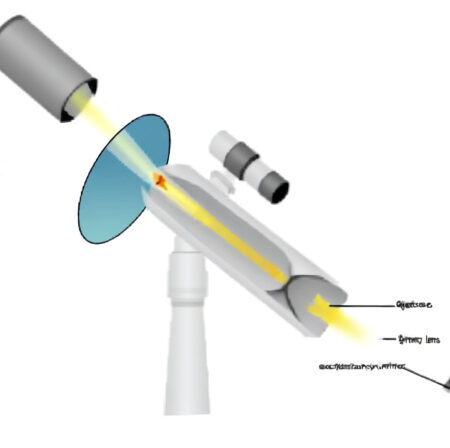
Understanding telescope components is essential for anyone interested in astronomy, whether you’re a beginner stargazer or an experienced observer. A telescope consists of optical components that gather and focus light, mechanical components that support and aim the system, and accessories that enhance viewing capabilities.
The parts of a telescope and their functions work together to collect light from distant objects, focus it to create an image, and magnify that image for observation. Each component plays a crucial role in the optical system, from the primary light-gathering element to the eyepiece that delivers the final magnified view.
This comprehensive guide covers all major telescope components, explaining how they function in different telescope types and providing practical insights for troubleshooting and maintenance. For those looking to apply this knowledge to purchasing decisions, our telescope buying guide offers practical recommendations based on component features.
What Are The Optical Components Of A Telescope?
The optical components form the heart of any telescope system, responsible for collecting light and forming images. These precision-engineered elements determine the telescope’s light-gathering ability, resolution, and overall optical performance.
Objective Lens (Refractors)
The objective lens is the primary light-gathering element in refracting telescopes. This large lens at the front of the optical tube collects incoming light from celestial objects and bends it to form an image at the focal point.
Objective lenses come in different designs, including achromatic lenses that correct for chromatic aberration (color fringing) and apochromatic lenses that provide even better color correction. The size of the objective lens, known as aperture, directly affects the telescope’s light-gathering power and resolution capabilities.
In quality refractor telescopes, the objective lens is typically multi-coated to reduce light reflection and improve image contrast. The lens diameter determines how much light the telescope can collect – larger apertures gather more light, revealing fainter objects and providing finer details.
Primary Mirror (Reflectors)
The primary mirror serves the same function as an objective lens but in reflecting telescopes. This curved mirror at the bottom of the optical tube collects incoming light and reflects it to form an image.
Primary mirrors are typically parabolic in shape, which ensures that all incoming parallel light rays converge to a single focal point. The mirror’s coating, usually aluminum or silver, reflects light with high efficiency.
The size of the primary mirror determines the telescope’s resolving power and light-gathering ability. Larger mirrors can collect more light and reveal finer details in celestial objects. Reflecting telescopes often offer larger apertures for the same cost compared to refractors because mirrors are easier to manufacture in large sizes than lenses.
Secondary Mirror
The secondary mirror is found in reflecting telescopes and serves to redirect light from the primary mirror to the eyepiece. This smaller mirror is positioned at an angle in the optical path and reflects light to a more convenient viewing position.
In Newtonian telescopes, the secondary mirror is flat and positioned at 45 degrees to reflect light to the side of the tube where the eyepiece is located. In Cassegrain designs, the secondary mirror is convex and reflects light back through a hole in the primary mirror.
While the secondary mirror does block a small amount of incoming light (typically 5-10% of the aperture), modern designs minimize this obstruction to maintain optimal image quality. The quality of the secondary mirror’s coating and alignment is crucial for maintaining sharp, high-contrast images.
Eyepiece
The eyepiece is the component you look through and serves as a magnifying glass for the image formed by the primary optical element. The eyepiece takes the focused light from the objective lens or primary mirror and magnifies it for comfortable viewing.
Eyepieces come in different focal lengths, which determine the magnification power when used with a particular telescope. Shorter focal length eyepieces provide higher magnification, while longer focal lengths offer lower magnification but wider fields of view.
The quality of the eyepiece significantly affects the final image quality. Good eyepieces feature multiple lens elements to correct for aberrations and provide sharp, clear images across the entire field of view. Common eyepiece designs include Plossl, Kellner, and more complex designs like Nagler and Ethos for premium wide-angle viewing.
Focuser Mechanism
The focuser allows precise adjustment of the distance between the eyepiece and the focal point of the optical system. This essential component ensures that images appear sharp and clear when viewing objects at different distances.
Focusers come in different types, including rack-and-pinion focusers, Crayford focusers, and electronic focusers. Rack-and-pinion focusers use gears for movement, while Crayford focusers provide smoother, more precise adjustment through friction rollers.
The quality of the focuser affects imaging stability and precision, especially important for astrophotography. Premium focusers feature micro-focus knobs for fine adjustments and dual-speed mechanisms for both coarse and fine focusing. A good focuser should be sturdy, smooth, and free from backlash or play in the mechanism.
What Are The Mechanical Components Of A Telescope?
The mechanical components provide the structural support and movement systems necessary for telescope operation. These elements ensure stability, precise pointing, and smooth tracking of celestial objects.
Optical Tube Assembly
The optical tube assembly (OTA) is the main body of the telescope that houses all optical components. This tube protects the delicate optics from dust, moisture, and physical damage while maintaining precise alignment of all optical elements.
OTA construction varies by telescope type. Refractor tubes are typically made of aluminum or steel and may include dew shields to prevent moisture condensation on the objective lens. Reflector tubes are often designed with open ends for cooling ventilation and may include tube rings for mounting.
The tube must be rigid to prevent flexure that could affect optical alignment. Many tubes include internal baffles to reduce stray light and improve image contrast. The length of the optical tube is related to the focal length of the optical system, with longer tubes generally providing higher focal ratios.
Mount Systems
The mount is arguably the most important mechanical component, providing the platform for pointing and tracking celestial objects. Mount quality directly affects viewing stability, tracking accuracy, and overall observing experience.
There are two main types of mounts: alt-azimuth and equatorial. Alt-azimuth mounts move in simple up/down (altitude) and left/right (azimuth) motions, making them intuitive for beginners. Equatorial mounts are aligned with Earth’s rotation axis, allowing them to track objects with a single motion.
Quick Summary: Choose alt-azimuth mounts for casual observing and ease of use. Select equatorial mounts for serious astrophotography and extended tracking sessions.
For those interested in Dobsonian telescope designs, which use a specialized alt-azimuth mount, our guide to Dobsonian telescope parts explains this popular budget-friendly option in detail.
| Mount Type | Best For | Pros | Cons |
|---|---|---|---|
| Alt-Azimuth | Beginners, casual observing | Simple setup, intuitive controls | Field rotation for long exposures |
| Equatorial | Astrophotography, tracking | Single-axis tracking, no field rotation | Complex setup, requires alignment |
| Dobsonian | Visual observing, large apertures | Stable, cost-effective for size | Manual tracking required |
Tripod Support
The tripod provides the foundation for the entire telescope system, offering stability and elevation for comfortable observing. A sturdy tripod is essential for preventing vibrations that could disturb viewing, especially at higher magnifications.
Tripods come in different materials including aluminum, steel, and carbon fiber. Aluminum tripods offer good stability at reasonable cost, while carbon fiber provides excellent vibration damping with lighter weight. Steel tripods offer maximum stability but are heavier to transport.
Quality tripods feature adjustable legs for uneven terrain, center braces for enhanced rigidity, and vibration-damping pads. The tripod height should position the eyepiece at a comfortable viewing level without requiring observers to bend or stretch excessively.
Finderscope
The finderscope is a small auxiliary telescope mounted on the main tube that helps locate objects before viewing them through the main telescope. Finding celestial objects through the narrow field of view of the main telescope can be challenging without a finderscope.
Finderscopes come in different types including optical finderscopes (small telescopes with crosshairs), red dot finders that project a dot onto the sky, and telrad finders that project concentric circles. Each type has advantages depending on personal preference and observing conditions.
Proper alignment of the finderscope with the main telescope is crucial for accurate object location. The finderscope should be mounted securely and provide a wide field of view with clear reference points for efficient object location.
How Do Telescope Types Differ In Their Components?
Different telescope designs use variations of the basic components to achieve their specific optical goals. Understanding these differences helps explain why certain telescopes are better suited for particular observing applications.
Refractor Telescope Components
Refractor telescopes use lenses to gather and focus light, following a straightforward optical design. The main components include an objective lens at the front of the tube, a diagonal mirror or prism to redirect light to a comfortable viewing angle, and an eyepiece.
Refractors are known for their sharp, high-contrast images and low maintenance requirements. They don’t require collimation (optical alignment) as reflectors do, making them excellent for beginners or those who prefer minimal maintenance.
The main limitation of refractors is cost per inch of aperture – large objective lenses are expensive to manufacture with the required precision. Most quality refractors have apertures of 6 inches or less, though premium apochromatic refractors can provide exceptional image quality for lunar, planetary, and double-star observing.
Reflector Telescope Components
Reflector telescopes use mirrors instead of lenses to gather and focus light, following Isaac Newton’s design from 1668. The main components include a primary mirror at the bottom of the tube, a secondary mirror to redirect light to the side, and a focuser with eyepiece.
Reflectors offer the best value in terms of aperture size for the money, making them popular for deep-sky observing where light-gathering power is crucial. They don’t suffer from chromatic aberration (color fringing) that can affect refractors.
For detailed information about reflecting telescope advantages and disadvantages, our guide on reflecting telescope components covers these aspects in depth. Reflectors do require periodic collimation (alignment of the mirrors) to maintain optimal performance, but this is a straightforward maintenance task that most users can learn quickly.
Catadioptric (Compound) Telescope Components
Catadioptric telescopes combine lenses and mirrors to create compact, versatile optical systems. Popular designs include Schmidt-Cassegrain and Maksutov-Cassegrain telescopes, which use both corrector plates and mirrors to achieve long focal lengths in relatively short tubes.
These telescopes typically feature a corrector plate at the front of the tube, a primary mirror, and a secondary mirror mounted on the corrector plate. This folded optical design allows for powerful telescopes that are portable and versatile.
Catadioptric telescopes excel at both planetary and deep-sky observing, making them popular all-round instruments. Their sealed optical tubes require minimal maintenance, and their computerized versions offer excellent tracking capabilities for astrophotography.
| Telescope Type | Primary Light Gatherer | Best For | Maintenance Required |
|---|---|---|---|
| Refractor | Objective lens | Lunar, planetary, double stars | Minimal |
| Reflector | Primary mirror | Deep-sky objects, galaxies | Regular collimation |
| Catadioptric | Primary mirror + corrector plate | All-purpose, astrophotography | Occasional |
What Essential Accessories Enhance Telescope Functions?
While the basic telescope components provide the foundation for observation, various accessories can significantly enhance functionality and expand observing capabilities. These accessories work with the basic components to improve image quality, increase versatility, and enable specialized observations.
Magnification Accessories
Barlow lenses are popular magnification accessories that increase the effective focal length of telescopes. A Barlow lens typically doubles or triples the magnification of any eyepiece used with it, effectively doubling your eyepiece collection without additional cost.
When selecting a Barlow lens, quality is crucial – poor quality Barlows can degrade image quality and introduce optical aberrations. Good Barlow lenses should be fully multi-coated and feature high-quality optical elements to maintain image sharpness and contrast.
Another useful magnification accessory is the powermate, a premium version of the Barlow lens that provides magnification without increasing the eye relief of eyepieces. This is particularly beneficial when using long focal length eyepieces or for observers who wear glasses.
Image Correction Accessories
Star diagonals are essential accessories for refractor and catadioptric telescopes, redirecting light to a comfortable 90-degree viewing angle. This makes observing objects high in the sky much more comfortable than looking straight through the telescope.
Quality diagonals feature high-reflectivity coatings (typically 99% or better) to maintain image brightness. They come in different sizes to match your focuser (1.25 inch or 2 inch) and may include correct-image prisms for terrestrial observing.
Filters are another important category of accessories that enhance viewing by selectively transmitting specific wavelengths of light. Moon filters reduce glare when observing the bright lunar surface, while color filters can enhance contrast on planetary features like Jupiter’s bands or Mars’ polar caps.
Maintenance Tools
Collimation tools are essential for reflector telescope owners to maintain optimal optical alignment. These tools include laser collimators that project a beam to check mirror alignment, and Cheshire eyepieces that provide visual references for collimation.
Proper collimation is crucial for reflector telescopes to achieve sharp images. Most reflectors require collimation check and adjustment before each observing session, though some designs like Dobsonians hold their alignment well.
Other maintenance tools include lens cleaning solutions and microfiber cloths for gently cleaning optical surfaces, and dew prevention systems like dew shields or heated dew strips to prevent moisture condensation on optics during humid observing sessions.
How Do You Troubleshoot Common Telescope Component Problems?
Understanding common telescope problems and their solutions helps maintain optimal performance and extends the life of your equipment. Many issues can be resolved with simple adjustments or proper maintenance procedures.
Blurry images are the most common complaint and usually result from improper focus, dirty optics, or misalignment. Start by cleaning eyepieces and objective lenses with proper cleaning materials, then check that the focuser is working smoothly. For reflectors, verify that the mirrors are properly collimated using collimation tools.
Collimation issues in reflectors cause distorted or comet-shaped stars. Learning to collimate your telescope is an essential skill for reflector owners. Most reflectors include collimation knobs on the primary and secondary mirrors for adjustment.
Vibration problems often result from an unstable tripod or mount. Ensure that all tripod legs are fully extended and locked, and that the mount is securely attached. Consider adding vibration damping pads under tripod feet for improved stability.
⏰ Time Saver: Keep a simple maintenance checklist to quickly identify and resolve common telescope issues before they ruin your observing session.
Dew formation on optics can occur during humid conditions, especially on exposed lenses and corrector plates. Dew shields that extend beyond the optical tube help prevent this problem, and heated dew strips can actively prevent condensation during extended observing sessions.
Frequently Asked Questions
What is the basic structure of a telescope?
A telescope’s basic structure consists of optical components (objective lens or primary mirror, eyepiece) that gather and focus light, mechanical components (optical tube, mount, tripod) that provide support and movement, and accessories (finderscope, focuser) that enhance functionality.
What are the three main parts of a reflecting telescope?
The three main parts of a reflecting telescope are: 1) Primary mirror that collects and focuses light, 2) Secondary mirror that redirects light to the eyepiece, and 3) Eyepiece that magnifies the focused image for viewing.
What is the eye piece called on a telescope?
The eyepiece is the optical component you look through to view the magnified image. It acts as a magnifying glass for the image formed by the primary optical element and comes in different focal lengths to provide various magnification levels.
What are the main functions of a telescope?
The main functions of a telescope are: 1) Light gathering – collecting more light than the human eye, 2) Resolution – revealing fine details in celestial objects, 3) Magnification – enlarging images for comfortable viewing, and 4) Light transmission – delivering bright, clear images of distant objects.
Understanding Your Telescope Components
Knowledge of telescope components transforms your observing experience from frustration to discovery. When you understand how each part functions, you can diagnose problems, optimize performance, and make informed decisions about upgrades and accessories.
Remember that quality components work together as a system – a great eyepiece won’t compensate for poor optics, and excellent optics need a stable mount to perform their best. Consider your observing goals when evaluating telescope components, whether you’re interested in lunar and planetary observing, deep-sky imaging, or casual stargazing.
For those ready to apply this knowledge to telescope selection, our comprehensive telescope buying guide covers modern telescope models with detailed component analysis. Understanding these components helps you choose the right telescope for your needs and budget while ensuring you get the best performance from your investment.
The journey into astronomy begins with understanding your tools. With this knowledge of telescope components and their functions, you’re well-equipped to explore the night sky with confidence and clarity.