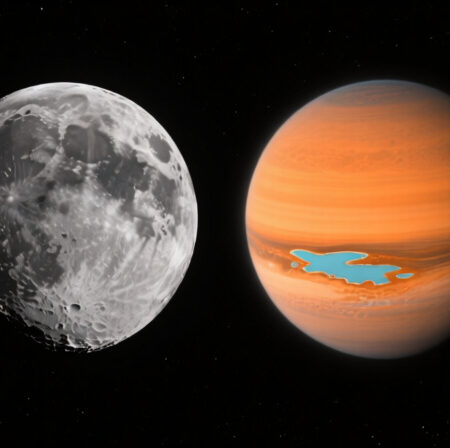
No, there is no oil on Earth’s Moon because it lacks the organic matter and geological conditions necessary for oil formation over millions of years. While many people search for information about oil on the moon, the scientific reality is clear: our Moon never had the biological activity, liquid water, or geological processes required to create fossil fuels.
This doesn’t mean space lacks hydrocarbon resources entirely. Saturn’s moon Titan contains hundreds of times more liquid hydrocarbons than all of Earth’s oil and natural gas reserves combined. Understanding why Earth’s Moon is barren while Titan is rich in hydrocarbons reveals fundamental truths about how oil forms and where we might find valuable space resources in the future.
How Oil Forms: The Essential Requirements
Oil formation on Earth follows a specific recipe that took millions of years to perfect. The process requires four key ingredients that our Moon simply never possessed in sufficient quantities.
First, biological activity is essential. Most oil on Earth originated from ancient marine organisms—plankton, algae, and bacteria—that lived hundreds of millions of years ago. When these organisms died, they sank to ocean floors and became buried under layers of sediment. Without this biological starting material, oil formation cannot begin through conventional processes.
Second, sufficient water is crucial. Oceans provide the environment where biological life thrives and where organic matter can accumulate in sediment layers. Earth’s vast oceans allowed for the collection and preservation of enormous quantities of organic material over geological time scales.
Third, geological activity plays a vital role. The buried organic material needs to be subjected to intense heat and pressure—typically depths of 2-4 kilometers and temperatures of 60-120°C. This cooking process transforms the organic matter into hydrocarbons. Active plate tectonics and geological processes on Earth created the necessary conditions for this transformation.
Finally, time is perhaps the most critical ingredient. The oil we extract today began forming 50 to 500 million years ago. This extended timeline allows for the slow transformation of organic matter into the complex hydrocarbon chains that make up crude oil.
Hydrocarbons: Organic compounds consisting entirely of hydrogen and carbon atoms. While oil is a type of hydrocarbon formed biologically, hydrocarbons can also form through non-biological processes.
Why Earth’s Moon Has No Oil?
The Moon’s history and environment fundamentally prevented oil formation through multiple critical factors. When Apollo astronauts returned 382 kg of lunar samples between 1969 and 1972, scientists found virtually no organic compounds—confirming that the Moon lacks the biological heritage necessary for oil.
First, the Moon likely never had significant liquid water. Without oceans, there was no environment for abundant biological life to evolve and accumulate. While some recent discoveries suggest water ice exists in permanently shadowed craters at the lunar poles, this water is frozen and has never been available to support widespread biological activity.
Second, the Moon has been geologically inactive for most of its history. While Earth experiences constant geological activity through plate tectonics and volcanic processes, the Moon’s geological engine largely shut down around 3 billion years ago. Without active geological processes, there was no mechanism to create the heat and pressure necessary for oil formation.
Third, the Moon lacks a substantial atmosphere. Without atmospheric protection, the Moon’s surface experiences extreme temperature fluctuations—from -173°C at night to 127°C during daytime. These harsh conditions, combined with constant solar radiation bombardment, would break down any organic compounds that might have formed.
Fourth, the Moon’s formation history tells an important story. The leading theory suggests the Moon formed when a Mars-sized object collided with early Earth, ejecting material that coalesced into our satellite. This violent origin created a Moon that was initially molten and inhospitable to life. Even if biological processes somehow began, they would have been extinguished by this catastrophic birth.
Titan: The Moon With Hundreds Of Times Earth’s Oil Reserves
If you’re looking for oil in space, don’t study Earth’s Moon—look at Titan. Saturn’s largest moon defies expectations with an astonishing hydrocarbon wealth that dwarfs Earth’s entire oil and natural gas reserves.
Titan contains an estimated hundreds of times more liquid hydrocarbons than all known oil and natural gas reserves on Earth. These aren’t fossil fuels like Earth’s oil—they formed through different processes involving atmospheric chemistry rather than biological activity. The Cassini-Huygens mission, which explored Saturn’s system from 2004 to 2017, revolutionized our understanding of this remarkable moon.
Titan’s surface features hundreds of lakes and seas filled with liquid methane and ethane. The largest, Kraken Mare, covers approximately 400,000 square kilometers—larger than Earth’s Caspian Sea. These hydrocarbon bodies exist because Titan maintains a thick atmosphere—95% nitrogen and 5% methane—that creates sufficient pressure for liquid hydrocarbons to exist at its surface temperature of -179°C.
Quick Summary: Titan’s hydrocarbons formed through photochemical reactions in its atmosphere, not biological processes. Sunlight breaks down methane molecules, which recombine into complex organic compounds that eventually rain onto the surface.
The formation process on Titan is completely different from Earth’s oil. Titan’s methane undergoes photochemical reactions in its upper atmosphere, creating complex organic molecules called tholins. These molecules eventually settle on the surface, contributing to the dunes and possibly forming more complex hydrocarbons over time. This abiogenic process—without biological involvement—continues today, constantly replenishing Titan’s hydrocarbon inventory.
| Feature | Earth’s Moon | Saturn’s Titan |
|---|---|---|
| Oil/Hydrocarbons | None | Hundreds of times Earth’s reserves |
| Atmosphere | None | Thick (1.5x Earth’s pressure) |
| Surface Temperature | -173°C to 127°C | -179°C (stable) |
| Liquid Bodies | None | Lakes and seas of methane/ethane |
| Formation Process | N/A | Photochemical, abiogenic |
What Resources Does The Moon Actually Have?
While the Moon lacks oil, it hosts valuable resources that could power future space exploration and even benefit Earth. These resources might not be traditional fossil fuels, but they could prove even more valuable for humanity’s expansion into space.
Helium-3 represents perhaps the Moon’s most valuable resource. This rare isotope is scarce on Earth but abundant in lunar soil—estimated at 1.1 million tons. Helium-3 is deposited by solar wind over billions of years and holds tremendous promise as fuel for fusion reactors. A single space shuttle load could theoretically power the United States for a year, making Helium-3 potentially worth billions of dollars per ton if fusion technology becomes commercially viable.
Water ice exists in significant quantities in permanently shadowed craters at the lunar poles. In 2020, NASA confirmed the presence of water on sunlit areas of the Moon as well. This water is crucial for future lunar operations—providing drinking water for astronauts, oxygen for breathing, and when split into hydrogen and oxygen, rocket fuel for missions to Mars and beyond.
The Moon also contains valuable metals and minerals. Lunar regolith contains oxygen, silicon, iron, aluminum, calcium, and magnesium. Rare earth elements—essential for electronics and green technologies—have been detected in lunar samples. These materials could support in-situ resource utilization (ISRU), allowing future lunar colonies to build and expand using local materials rather than importing everything from Earth.
For investors and space economy enthusiasts, understanding these lunar resources is crucial. While you can’t invest in lunar oil extraction—because there is none—the growing space economy presents opportunities in space resource exploration on other celestial bodies, mining technology development, and supporting infrastructure.
Frequently Asked Questions
What moon has oil on it?
Saturn’s moon Titan contains hundreds of times more liquid hydrocarbons than all of Earth’s oil and natural gas reserves combined. These hydrocarbons exist as liquid methane and ethane in lakes and seas on Titan’s surface.
Is there oil on Mars?
No significant oil deposits have been found on Mars. While the Curiosity rover has detected organic molecules, including thiophenes, these compounds don’t indicate the presence of oil reservoirs. Mars, like the Moon, lacks the extensive biological activity and geological conditions needed for oil formation.
Is there anything worth mining on the Moon?
Yes, the Moon contains valuable resources including Helium-3 (fusion fuel), water ice (life support and rocket fuel), rare earth elements, and metals for construction. These resources could support future lunar colonies and enable deeper space exploration.
How did Titan get its hydrocarbons without life?
Titan’s hydrocarbons form through photochemical processes in its atmosphere. Sunlight breaks down methane molecules, which recombine into complex organic compounds. These compounds eventually rain onto the surface, accumulating over billions of years to create the hydrocarbon lakes and dunes we see today.
Could we use Titan’s hydrocarbons as fuel?
Theoretically yes, but practically very difficult. Titan’s methane and ethane could be processed into rocket fuel, but the immense distance (7.5 years with current technology) and extreme environment make extraction economically unviable with current technology.
What did China find on the backside of the Moon?
China’s Chang’e-4 mission, which landed on the far side of the Moon in 2019, found mantle-derived minerals and discovered potential water ice in shadowed craters. These findings help scientists understand the Moon’s geological history but revealed no oil or fossil fuels.
The Future of Space Resources
While oil on the Moon remains a scientific impossibility, the broader field of space resources continues to expand rapidly. NASA’s Artemis program aims to return humans to the Moon by 2026 with a focus on sustainable lunar exploration and resource utilization. Private companies are developing technologies to extract water ice and process lunar regolith.
The growing space economy—valued at over $400 billion in 2026—includes satellite services, space tourism, and emerging resource extraction capabilities. While you won’t see lunar oil powering Earth’s economy anytime soon, Helium-3 fusion, lunar water ice, and asteroid mining could revolutionize energy production and space exploration in the coming decades.
Understanding the distinction between Earth’s biological oil and space’s abiogenic hydrocarbons isn’t just scientific trivia—it’s essential knowledge for anyone interested in the future of space exploration, resource utilization, and the expanding space economy. The Moon may not have oil, but it has resources that could prove even more valuable for humanity’s future among the stars.