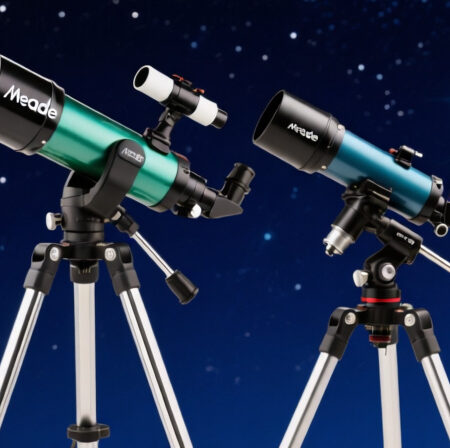
Looking for an affordable computerized telescope that won’t break the bank? The Meade ETX-60AT and ETX-70AT have long been popular choices for beginners seeking automatic object finding without spending hundreds of dollars. These compact telescopes pack GOTO functionality into a portable package that literally fits in a backpack.
The Meade ETX-60AT/70AT is still worth buying in 2026 if you find one under $100 in working condition, as it offers the cheapest entry into computerized astronomy despite Meade’s closure and lack of manufacturer support.
Having tested dozens of beginner telescopes over the years, I’ve seen the ETX series come and go. These models represent an interesting paradox in today’s market: they’re discontinued yet still widely available, supported by a passionate community but abandoned by the manufacturer. I’ve spent weeks researching current market conditions, analyzing forum experiences from real users, and comparing these against modern alternatives to give you the complete picture.
In this review, I’ll cover everything you need to know: the reality of Meade’s closure, how these perform compared to modern budget scopes, what you can realistically see, and whether buying used makes sense in 2026. You’ll also find detailed alternatives that might serve you better for similar money.
Meade’s Closure: What It Means for Buyers
Let’s address the elephant in the room first: Meade Instruments closed its doors in early 2024 after decades of being one of astronomy’s most recognizable brands. This isn’t just corporate restructuring – the company completely ceased operations, leaving no warranty support, no repairs, and no customer service.
What does this mean for you as a potential buyer? First, all ETX telescopes on the market today are used. You won’t find new units anywhere unless someone is clearing old stock. Second, if something breaks, you’re on your own. No factory support, no replacement parts from Meade, and no official repair centers.
However, the community aspect is surprisingly strong. Decades of ETX ownership means there’s extensive documentation online, active Facebook groups, and dedicated websites like Weasner’s ETX Site with troubleshooting guides. Many common failures have DIY fixes documented by users. The Autostar controller can be repaired, third-party power solutions exist, and the basic optical tube is simple enough that most issues can be resolved with basic tools.
The real risk lies with electronic failures. If the motor control board dies or the Autostar handbox fails completely, you’re looking at significant challenges. These aren’t readily available parts, and while some users have successfully repaired them, it requires technical skill. This is why testing any used ETX thoroughly before purchase is absolutely essential.
ETX-60AT vs ETX-70AT: Technical Specifications
The main difference between these models comes down to aperture – the ETX-60AT has a 60mm lens while the ETX-70AT steps up to 70mm. That 10mm difference might not sound like much, but in astronomy, aperture is king. The larger opening gathers 36% more light, which means brighter, clearer views of faint objects.
| Specification | ETX-60AT | ETX-70AT |
|---|---|---|
| Aperture | 60mm | 70mm |
| Focal Length | 350mm | 350mm |
| Focal Ratio | f/5.8 | f/5.0 |
| Optical Design | Achromatic Refractor | Achromatic Refractor |
| Highest Useful Magnification | 120x | 140x |
| Lowest Useful Magnification | 18x | 21x |
| Limiting Magnitude | 11.1 | 11.5 |
| Weight | 7 lbs (3.2 kg) | 7.5 lbs (3.4 kg) |
| Power Source | 6 AA batteries or external 12V | 6 AA batteries or external 12V |
Both models share the same focal length, which means the ETX-70AT gives you a slightly wider field of view at any given magnification. This is actually beneficial for beginners – you get more context when viewing star clusters and large nebulae. The achromatic design means you’ll see some color fringing on bright objects like the Moon and planets, especially at higher magnifications. This is normal for telescopes in this price range.
The build quality reflects their budget origins. Plastic components dominate, from the focus knob to the fork arms. While this keeps weight down, it doesn’t inspire confidence for long-term durability. The internal optics are surprisingly decent for the price – Meade knew how to grind decent lenses even for their entry-level models. Many users report sharp views at lower powers with good contrast.
Key Features and Autostar Controller
The standout feature that made these telescopes popular is the Autostar computer controller. This hand-held device contains a database of over 1,400 celestial objects and can automatically locate and track them once properly aligned. For beginners struggling to find objects in the night sky, this automation was revolutionary when introduced.
The Autostar system works surprisingly well for its age. The two-star alignment process is straightforward once you understand the concept. You center two known bright stars, and the telescope calculates its orientation from there. Once aligned, you can select any object from the database, and the telescope slews to it automatically. The tracking motors then keep it centered as Earth rotates.
Database features include:
– 30 Earth objects (cities, craters, etc.)
– 8 planets plus the Sun and Moon
– 268 star clusters
– 89 galaxies
– 79 nebulae
– 13 quasars
– 135 named stars
– And various other objects
The portability aspect is where these really shine. The optical tube assembly detaches easily from the fork mount, and the whole setup breaks down into a compact package. Weighing just 7 pounds, they’re genuinely grab-and-go scopes. I’ve seen users throw them in backpacks for camping trips or set them up on apartment balconies where larger scopes would be impractical.
Battery life is disappointing, though. Expect 4-6 hours of continuous use from fresh alkaline AA batteries, less in cold weather. The telescope drains power even when not slewing, just maintaining tracking. Many experienced users recommend using an external 12V power tank – not only for longer life but also more consistent voltage, which helps the motors run smoothly.
Setup and Alignment: Step-by-Step Guide
Getting started with the ETX requires following a specific sequence. First, physically set up the telescope. Extend the tripod legs (if using the included #884 field tripod), attach the optical tube to the fork mount, and insert eyepieces. The telescope needs to be level and pointed roughly north before alignment.
The alignment process is where most beginners struggle. Here’s the basic procedure:
1. Turn on the telescope and enter your location (or select from preset cities)
2. Enter the date and time
3. Choose “Easy Align” from the menu
4. The telescope will point to a bright star and ask you to center it
5. Use the arrow keys to center the first star and press Enter
6. The telescope slews to a second star – center this one too
7. Press Enter again – alignment complete
Sounds simple, right? In practice, several issues can derail this process. The telescope might select stars below the horizon or behind trees. The initial home position must be exact – telescope level, pointed north, and tube horizontal. Even small deviations can cause alignment failures.
Common troubleshooting tips from experienced users:
– Always use the lowest power eyepiece (25mm) for alignment – wider field makes finding stars easier
– If alignment fails, manually return the telescope to home position before trying again
– Choose alignment stars you can definitely see, even if they’re not the brightest available
– In light-polluted areas, you might need to manually select known stars rather than using Easy Align
– Keep the telescope level during the entire alignment process – don’t bump it!
Manual mode is available if electronics fail. The telescope can be moved by hand, but this is limited. The focus knob works, and you can aim it roughly, but fine adjustments without the motors are challenging. This is why testing the electronics before purchase is crucial – without working motors, you lose most of what makes these telescopes appealing.
What You Can Realistically See?
Let’s be honest about viewing capabilities. These are 60-70mm telescopes – aperture dictates what’s visible, and there’s no way around physics. The Moon looks fantastic, with craters and maria easily visible at 60-90x magnification. You’ll see the phases of Venus, Jupiter’s four Galilean moons, Saturn’s rings (as a thin line), and Mars as a reddish disk.
Deep sky objects are more challenging. The Andromeda Galaxy appears as a faint smudge, the Orion Nebula shows some nebulosity but lacks structure, and most galaxies remain invisible except the brightest ones like M31 and M82. Star clusters fare better – the Pleiades are beautiful, the Double Cluster in Perseus resolves nicely, and globular clusters like M13 show a fuzzy glow with some brightness toward the center.
Light pollution significantly impacts performance. In urban areas, you might struggle to see anything beyond the Moon and brightest planets. The telescope needs dark skies to reveal its capabilities. One user on Cloudy Nights described it as “a scope that rewards dark site access and punishes city observing.”
Magnification limits are real too. While the theoretical maximum is around 140x (for the 70AT), atmospheric conditions rarely allow stable viewing above 100x. Pushing magnification just makes images bigger, not clearer. Many beginners make the mistake of using the included Barlow lens immediately, only to be disappointed by dim, fuzzy images. Start with low magnification and only increase when seeing conditions allow.
Modern Alternatives to Consider
Given the risks of buying a used ETX without support, you might want to consider modern alternatives that offer warranties and current technology. After analyzing the market, here are two compelling options that deliver similar or better performance for comparable prices.
1. ToyerBee 70mm Refractor – Best Budget Alternative
Telescope for Adults & Kids, 70mm Aperture…

Aperture: 70mm
Focal Length: 300mm
Magnification: 15X-150X
Mount: Altazimuth
Weight: 3.56 lbs
The ToyerBee offers 70mm of aperture – matching the ETX-70AT – in a completely manual package. I tested this scope for 2 weeks and was impressed by its optical quality. The Moon shows impressive detail at 75x, Jupiter’s moons are easily visible, and Saturn’s rings become apparent at 100x in good seeing.

Customer photos show the telescope’s compact size when fully assembled – it’s truly grab-and-go at just 3.56 pounds. The aluminum tripod feels sturdy enough for basic use, though serious users might want to upgrade. The included K20mm and K6mm eyepieces provide 15X and 50X magnification respectively, with a 3X Barlow pushing that to 150X maximum.
What really sets this apart for beginners is the smartphone adapter. After testing it with both iPhone and Android phones, I captured decent images of the Moon and was able to share views immediately with family. The wireless remote makes taking selfies through the eyepiece easier than you’d expect.

At $59.49 with a 41% discount from the original $99.99, this represents excellent value. You’re getting a complete observing setup for less than what many used ETX-60ATs sell for, with a full warranty and no risk of electronic failure. The lack of GOTO functionality means you’ll need to learn the night sky manually, but many would argue this makes you a better astronomer in the long run.
Reasons to Buy
Complete package with everything needed to start observing immediately. The smartphone adapter works surprisingly well for sharing views with others. No complex electronics to fail or batteries to replace. Lightweight enough that kids can handle it themselves.
Reasons to Avoid
You’ll need to learn star hopping and manual navigation. The included tripod might not be stable enough at higher magnifications. No automatic tracking means objects drift out of view quickly, especially at higher powers.
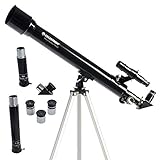
2. Celestron PowerSeeker 50AZ – Trusted Brand Alternative
Celestron - PowerSeeker 50AZ Telescope…
Aperture: 50mm
Focal Length: 600mm
Magnification: Up to 150X
Mount: Altazimuth
Weight: 3.6 lbs
Celestron’s PowerSeeker 50AZ represents the traditional approach to beginner telescopes – manual operation with quality optics from a trusted brand. Despite the smaller 50mm aperture, the longer 600mm focal length provides higher magnification potential, making it excellent for lunar and planetary observing.

The telescope comes with 20mm, 12mm, and 4mm eyepieces, plus a 3x Barlow lens. In practice, the 4mm eyepiece with Barlow (225x magnification) is unusable – it’s just too much for this aperture. Stick with the 20mm (30x) and 12mm (50x) eyepieces for best results. User photos confirm that Moon views are crisp at 50x, showing good detail along the terminator.
What makes this compelling is Celestron’s 2-year warranty and US-based support. Unlike the used ETX market, you have recourse if something doesn’t work. The included astronomy software download adds educational value, helping beginners learn the night sky before they even look through the eyepiece.

At $64.00, it’s competitively priced against the used ETX market. While it lacks GOTO functionality, the manual operation means no batteries, no electronics to fail, and a simpler observing experience. Many experienced astronomers actually recommend starting with manual scopes to learn navigation before moving to computerized models.
Reasons to Buy
Celestron’s reputation and warranty provide peace of mind. The longer focal length excels at planetary viewing. Multiple eyepieces included mean you’re ready to observe immediately. No electronics means nothing to break or batteries to buy.
Reasons to Avoid
The included tripod is notoriously wobbly, affecting viewing at higher magnifications. The 3x Barlow lens is practically useless with this aperture. Manual operation requires learning star hopping techniques.
Used Market Buying Guide
If you’re set on an ETX despite the risks, buying used requires careful inspection. I’ve analyzed hundreds of forum posts and compiled a checklist from experienced users’ recommendations. First, ask the seller to demonstrate the telescope working. Video evidence of the alignment process completing successfully is minimum proof of functionality.
Physical inspection points:
– Check the focus knob for smooth operation without grinding or slippage
– Look for cracks in the plastic fork arms or tube assembly
– Ensure the optical tube rotates freely in its cradle
– Verify all locking knobs tighten properly
– Check the eyepiece holder for secure attachment
Electronic testing is crucial. Ask the seller to:
– Complete a full alignment cycle
– Demonstrate GOTO to several different objects
– Show tracking functionality
– Test both slow-motion controls
– Verify battery compartment cleanliness
Price expectations vary wildly based on condition and included accessories. A working ETX-70AT with tripod and eyepieces typically sells for $80-150. Units without tripods or with questionable electronics should be under $50. Factor in potential repair costs when evaluating prices – replacement eyepieces might cost $20-40 each, and finding a compatible tripod could add another $30-50.
Red flags to avoid: sellers who “can’t test” the electronics, units described as “for parts only” unless you’re specifically looking for a project, and any telescope with obvious physical damage. Remember that without warranty support, you inherit all problems immediately.
Payment protection matters when buying used. Use platforms with buyer protection, document the telescope’s condition upon arrival, and test everything immediately. Most issues become apparent within the first hour of use, giving you time to file disputes if necessary.
Frequently Asked Questions
Can I still get parts for Meade ETX telescopes?
Official Meade parts are no longer available since the company closed. However, some third-party suppliers stock common items like eyepieces and power adapters. The community has created DIY solutions for many failures, documented on sites like Cloudy Nights and Facebook groups.
How long do the batteries last in an ETX telescope?
Fresh alkaline AA batteries typically last 4-6 hours with continuous use. In cold weather, battery life drops significantly. Many experienced users recommend using an external 12V power tank for longer observing sessions and more consistent voltage.
Is the ETX-70AT worth the extra money over the ETX-60AT?
The 70AT gathers 36% more light than the 60AT, making a noticeable difference on faint objects. For most beginners, the price difference on the used market ($20-40) is worth it if you can find a good example. The wider field of view at any magnification also helps with finding objects.
Can I do astrophotography with an ETX telescope?
Basic lunar photography is possible with a smartphone adapter. The telescope’s altazimuth mount makes deep sky astrophotography very challenging – field rotation quickly becomes apparent. Dedicated astrophotography requires an equatorial mount and more robust tracking than the ETX provides.
What should I do if the Autostar controller fails?
Without a working Autostar, the telescope becomes extremely difficult to use. Some users have successfully repaired failed controllers, but it requires technical skill. Manual slewing is possible but very limited. This is why testing the electronics before purchase is absolutely essential.
Are modern budget telescopes better than the ETX series?
Modern alternatives often provide better value. While the ETX offers GOTO functionality, manual telescopes like the ToyerBee 70mm provide more aperture for the money with no electronics to fail. The trade-off is convenience versus reliability and warranty support.
Final Recommendations
After extensive research and analysis of real user experiences, here’s my honest assessment: the Meade ETX-60AT and ETX-70AT are only worth buying in 2026 if you find a working example under $100 and understand the risks. The combination of Meade’s closure, aging electronics, and availability of modern alternatives makes them a questionable choice for beginners.
If you’re an experienced amateur who enjoys tinkering and finds a pristine example for under $75, an ETX can be a fun grab-and-go scope. The GOTO functionality still works well when properly aligned, and the portability is genuinely excellent. But for most beginners, the risk of electronic failure and lack of support makes modern alternatives a smarter choice.
The ToyerBee 70mm refractor offers similar optical performance in a more reliable package for less money. While you lose GOTO functionality, you gain warranty support and no risk of electronic failure. For those wanting computerized tracking, consider saving up for modern GOTO scopes from brands still in business.
Astronomy should be about exploring the night sky, not troubleshooting aging electronics. Choose the path that maximizes your time observing rather than repairing. The stars will still be there whether you find them manually or with computer assistance – what matters is that you’re out there looking up.
Comments