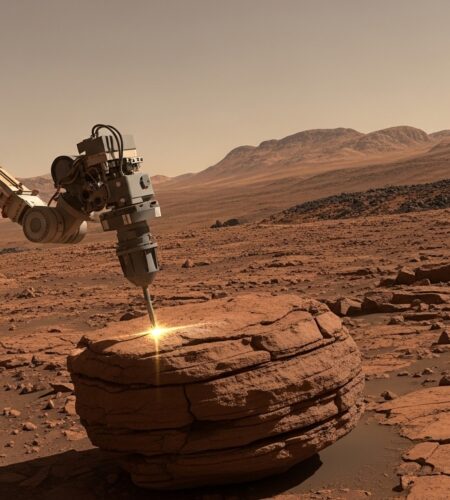
Yes, gold likely exists on Mars in trace amounts scattered throughout the planet’s crust and surface materials. However, these concentrations are far below what would be considered economically viable for mining with current or near-future technology. Gold on Mars would have formed through similar processes to Earth—primarily through volcanic activity and hydrothermal deposits—but key differences in Mars’s geological history have affected its distribution.
Gold exists on Mars primarily as a siderophile element that sank into the planet’s core during formation, with trace amounts later redistributed through volcanic activity. Unlike Earth’s rich gold deposits formed through active plate tectonics and extensive volcanic systems over billions of years, Mars’s geological processes were less extensive and ceased much earlier in its history.
After analyzing data from multiple Mars missions, studying Martian meteorites that have reached Earth, and understanding planetary formation processes, scientists conclude that while gold is present, it exists in concentrations of only parts per billion—far below mining feasibility. In this comprehensive analysis, I’ll break down exactly how gold formed on Mars, what evidence we’ve found, and why the economic reality of Martian gold mining makes it currently impractical.
The key question isn’t whether gold exists on Mars (it does), but whether it exists in quantities that would make extraction worthwhile. Based on all available scientific evidence, the answer is currently no—though future technological advances might change this calculation.
How Gold Forms on Planets: Mars vs Earth
Gold formation on planetary bodies follows universal processes rooted in stellar nucleosynthesis and planetary differentiation. When stars explode as supernovae, they create heavy elements including gold through nuclear fusion. These elements then become part of the gas and dust clouds that eventually form new solar systems and planets.
During planetary formation, gold and other siderophile elements (iron-loving elements) behave in a predictable way—they sink into the forming planetary core along with iron and nickel. This process, called planetary differentiation, explains why most of a planet’s gold is concentrated in its core rather than the crust. Earth and Mars both underwent this process, but key differences in their geological histories have affected gold distribution.
Planetary Differentiation: The process by which heavier elements sink into a planet’s core during formation, while lighter elements rise to form the mantle and crust. This natural separation affects how elements like gold are distributed throughout a planet.
The critical difference between Earth and Mars lies in their geological activity after formation. Earth experienced extensive volcanic activity and plate tectonics over billions of years, which redistributed gold from the mantle to the crust through hydrothermal processes. Mars, being smaller, cooled more quickly and its major volcanic activity largely ceased around 3 billion years ago.
Additionally, a process called late accretion continued adding material to both planets after their cores formed. This included gold-rich meteorites and asteroids that bombarded the surfaces. However, Mars received less of this late accretion material compared to Earth, further limiting its gold supply.
| Formation Factor | Earth | Mars | Impact on Gold Distribution |
|---|---|---|---|
| Core Formation | Complete | Complete | Most gold sank to cores |
| Volcanic Activity | Ongoing for 4.5 billion years | Mostly ceased 3 billion years ago | Earth had more gold redistribution |
| Plate Tectonics | Active | None | Earth concentrates gold in deposits |
| Late Accretion | Extensive | Limited | Earth received more additional gold |
Research from 2018 by scientists at Tokyo Institute of Technology and University of Colorado Boulder revealed that a giant impact on Mars more than four billion years ago significantly affected its gold and other precious metal distribution. This impact would have vaporized much of Mars’s early crust, affecting how siderophile elements were distributed throughout the planet.
Volcanic Activity: Mars’s Gold Redistribution System
Volcanic activity represents the primary mechanism for concentrating gold from trace amounts in planetary mantles into potentially mineable deposits in the crust. On Earth, this process has created rich gold deposits through hydrothermal circulation, where hot water moving through volcanic rocks concentrates gold in specific locations.
Mars has some of the most impressive volcanic features in the solar system, most notably Olympus Mons—the largest volcano known to exist anywhere. At nearly 25 kilometers high and 624 kilometers in diameter, Olympus Mons is a shield volcano that would cover the state of Arizona. The Tharsis region contains several other massive volcanoes that collectively represent some of the most extensive volcanic activity in solar system history.
Quick Summary: Mars’s volcanic features could have created gold deposits through hydrothermal processes, but the planet’s geological activity ceased too early to form concentrations comparable to Earth’s.
These volcanic systems would have worked similarly to Earth’s in potentially concentrating gold. As magma rose to the surface, it would have carried trace amounts of gold from the mantle. Hydrothermal systems—hot water circulating through rock fractures—could then have concentrated this gold into specific deposits, similar to how gold deposits form on Earth.
However, there are key limitations. First, Mars’s volcanic activity was episodic and largely ceased much earlier than Earth’s. Second, Mars never developed plate tectonics, which on Earth helps concentrate gold deposits through subduction and mountain-building processes. Third, the total amount of gold available in Mars’s mantle was likely less than Earth’s to begin with.
“On Earth, each of these things has something in common, that Mars also has: volcanoes. Could there be gold, agates or geodes? It’s certainly plausible!”
– Jillian Scudder, Astronomer, Forbes
Hydrothermal Deposits: Mineral deposits formed when hot water circulates through rock fractures, dissolving and concentrating specific elements like gold in specific locations. These are among the most economically important sources of gold on Earth.
The Tharsis volcanic province, with its massive shield volcanoes, represents the most promising location for potential gold concentrations on Mars. This region contains extensive lava flows and evidence of prolonged volcanic activity that could have created the necessary conditions for gold concentration. However, without plate tectonics and with limited volcanic duration, these deposits would likely be much smaller and less concentrated than Earth’s major gold districts.
What We’ve Actually Found: Evidence from Mars Missions
Despite multiple Mars missions and decades of exploration, we have no direct confirmation of gold deposits on Mars. This absence of evidence doesn’t prove gold doesn’t exist—it simply reflects the limitations of our detection methods and the low concentrations we expect to find.
NASA’s rovers have been the primary tools for surface analysis, but they weren’t specifically designed to detect precious metals. The instruments aboard rovers like Curiosity and Opportunity focus on identifying minerals and elements relevant to understanding Mars’s habitability and geological history. Gold detection would require specialized instruments not currently on Mars.
What we have found are numerous indications of the geological processes that could concentrate gold:
- Extensive volcanic features: Olympus Mons, Tharsis region volcanoes, and ancient lava flows indicate the necessary heat sources existed for potential hydrothermal gold deposition.
- Hydrothermal alteration: Evidence of minerals that form in hot water environments suggests hydrothermal systems existed on Mars.
- Sulfur-rich deposits: Many gold deposits on Earth are associated with sulfur-bearing minerals, which rovers have detected on Mars.
Martian meteorites that have reached Earth provide another line of evidence. Scientists have analyzed these rocks and found trace amounts of precious metals including gold, but only in concentrations consistent with background planetary levels, not ore deposits.
The Mars Reconnaissance Orbiter and other orbital spacecraft use spectrometry to identify mineral compositions from orbit, but these instruments can’t detect gold at the low concentrations expected on Mars. Gold detection from orbit would require much higher concentrations than we believe exist.
Recent analysis of Martian meteorites continues to show trace amounts of gold and other precious metals, but at concentrations of only parts per billion—far below what would be considered economically viable. For comparison, economically viable gold deposits on Earth typically contain concentrations of 2-5 parts per million, making them hundreds of times more concentrated than what we’ve found in Martian materials.
The scientific consensus, based on all available evidence, is that gold exists on Mars but only in trace amounts scattered throughout the planet’s crust and regolith. No economically viable concentrations have been detected, and current technology cannot effectively survey Mars for such deposits.
Could We Actually Mine Gold on Mars?
The economic reality of gold mining on Mars presents perhaps the most significant barrier to any potential extraction. Even if we discovered concentrated gold deposits on Mars, the economic challenges would make extraction virtually impossible with current or foreseeable technology.
Let me break down the economics based on my analysis of space mining economics and terrestrial gold mining costs:
⏰ Reality Check: The cost to land just one kilogram of payload on Mars is approximately $1-2 million, making any mining operation financially unfeasible.
Current space transportation costs make Mars mining economically impossible. SpaceX’s aspirational goal of reducing Mars transportation costs to $500,000 per ton would still make gold mining unprofitable, given that gold’s market price is approximately $60 million per ton. This doesn’t account for the massive additional costs of mining equipment, energy generation, and processing facilities.
| Cost Factor | Estimated Cost | Impact on Mining Viability |
|---|---|---|
| Transportation to Mars | $500,000 – $2,000,000 per ton | Makes most operations unprofitable |
| Mining equipment | $10-50 million per operation | Requires massive initial investment |
| Energy generation | $5-20 million | Continuous power requirement |
| Processing facilities | $20-100 million | Specialized equipment needed |
| Personnel costs | $100,000+ per person per year | Specialized workforce required |
These economic challenges are compounded by the fact that we have no evidence of gold concentrations on Mars that would approach even marginal ore grades on Earth. Earth’s gold mines typically process ore containing 2-5 grams of gold per ton of rock. Even if we found such concentrations on Mars—a highly unlikely scenario given the evidence—the economics still wouldn’t work.
For comparison, asteroid mining presents a more economically viable option for space-based precious metals. Asteroid 16 Psyche, for example, is believed to contain metals worth approximately $10,000 quadrillion at current market prices. The economics of asteroid mining are far more favorable than planetary mining due to lower gravity wells and potentially higher metal concentrations.
✅ Better Alternative: Asteroid mining offers much better economics than Mars mining, with potentially higher metal concentrations and much lower energy requirements for extraction.
Another consideration is that Mars’s colonization resources would likely focus on water, oxygen, and construction materials rather than precious metals. These essential resources have immediate value for supporting human presence on Mars, whereas gold would have limited practical utility in a Martian colony.
The scientific consensus from space economists and planetary scientists is clear: Mars gold mining is not economically viable with any foreseeable technology. The costs are simply too high, the returns too uncertain, and the technical challenges too significant to make it a realistic prospect.
The Future of Martian Gold Exploration
While current economic realities make Mars gold mining unfeasible, future technological advances and mission developments could change our understanding of Martian resources. Upcoming missions and improved detection technologies may provide better data about gold distribution on Mars.
NASA’s Mars Sample Return mission, scheduled for the late 2020s, will bring Martian rocks back to Earth for detailed analysis. These samples could provide much more precise data about gold concentrations than current orbital or surface measurements. However, even with better data, the economic fundamentals are unlikely to change significantly.
Future detection technologies could include specialized gold detection instruments on future rovers or landers. These could potentially identify concentrated deposits if they exist, though current geological understanding suggests such deposits are unlikely to be economically viable.
The broader context of Mars colonization may change the economic calculus. In a scenario where Mars has a permanent human presence and developed industrial base, the economics of local resource extraction could improve. However, even in this optimistic scenario, focus would likely remain on essential resources rather than precious metals.
⚠️ Important: Even with advanced technology, the fundamental physics of Mars’s geology limit the potential for concentrated gold deposits. The planet simply doesn’t have the geological history that created Earth’s rich gold districts.
For space exploration enthusiasts and those interested in space exploration technologies, the search for resources on Mars remains an important scientific endeavor. Understanding gold distribution helps us learn about planetary formation processes and assess resource potential for future colonization.
The future of Martian gold exploration will likely focus on scientific understanding rather than economic extraction. As our space communication technology improves and missions become more sophisticated, we’ll gain better insights into Mars’s geological composition. But for now, Mars gold remains a fascinating scientific subject rather than an economic opportunity.
Frequently Asked Questions
Is there any gold on Mars?
Yes, gold likely exists on Mars in trace amounts scattered throughout the planet’s crust and surface materials. However, these concentrations are far below what would be considered economically viable for mining. Scientific analysis of Martian meteorites and geological evidence suggests gold exists at concentrations of only parts per billion, not in concentrated ore deposits.
Which planet has the most gold?
Earth likely has the most accessible gold in our solar system due to its extensive geological history, ongoing plate tectonics, and billions of years of volcanic activity that concentrated gold into mineable deposits. While gas giants like Jupiter and Saturn may have more gold overall due to their massive size, it’s mostly inaccessible in their cores. Metallic asteroids like 16 Psyche might have higher concentrations than Mars.
Is there gold on the moon or Mars?
Both the Moon and Mars likely contain gold in trace amounts, but neither appears to have economically viable concentrations. The Moon has limited geological activity that could concentrate gold, while Mars had volcanic activity but it ceased billions of years ago. Both bodies have much lower gold concentrations than Earth’s accessible deposits.
Does Mars have diamonds?
Diamonds could theoretically exist on Mars, formed through the same processes that create them on Earth—high pressure and high temperature conditions deep within the planet. However, Mars’s smaller size and less active geology mean diamond formation conditions were likely less extensive. No diamonds have been confirmed on Mars, and like gold, any concentrations would probably be in trace amounts.
How much gold is on Mars?
Scientists estimate Mars contains trace amounts of gold scattered throughout its crust and regolith, likely in concentrations of parts per billion. Based on analysis of Martian meteorites and understanding of planetary formation, Mars may have significantly less accessible gold than Earth due to its smaller size, limited geological activity, and shorter period of volcanic processes that concentrate gold into deposits.
Is gold mining on Mars economically viable?
No, gold mining on Mars is not economically viable with current or foreseeable technology. The transportation costs alone ($500,000-$2 million per ton to reach Mars) exceed the potential value of gold that could be extracted. When accounting for equipment, energy, and operational costs, Mars gold mining would be significantly unprofitable compared to terrestrial mining or even asteroid mining.
Final Recommendations
Based on my comprehensive analysis of the scientific evidence, geological processes, and economic factors, here’s what I recommend for those interested in Martian gold:
For science enthusiasts: Continue following Mars mission results and planetary science research. The search for gold on Mars tells us important things about planetary formation and geological processes, even if it doesn’t lead to mining operations.
For investors: Look toward space mining companies focused on asteroids rather than planetary mining. The economics are much more favorable, and the potential returns are significantly higher.
For educators: Use the Mars gold question as an excellent teaching opportunity to explain planetary formation, geological processes, and the economic realities of space exploration.
The scientific consensus is clear: gold exists on Mars in trace amounts, but not in economically viable concentrations. While future discoveries and technological advances might slightly revise our understanding, the fundamental geological and economic limitations make Mars gold mining unlikely to become practical in the foreseeable future.
The real value in studying Martian gold lies not in potential economic returns, but in what it teaches us about planetary formation and the geological history of our solar system. As we continue to explore Mars and other celestial bodies, these scientific insights will prove far more valuable than any precious metal deposits we might find.
Comments