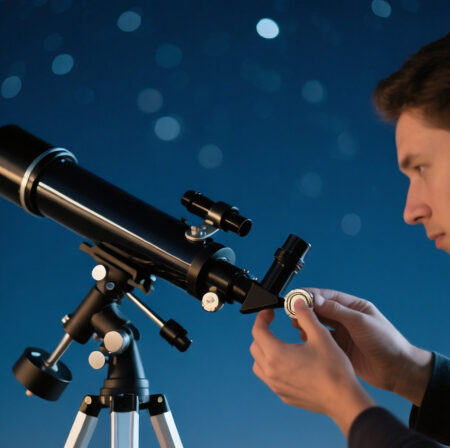
After spending countless nights struggling with blurry views through my telescope, I learned that proper focusing is the most critical skill any astronomer can develop. Getting sharp, clear views of celestial objects isn’t magic—it’s a systematic process that anyone can master.
Telescope focus is the process of adjusting the distance between the eyepiece and the telescope’s focal point to create sharp, clear images of celestial objects. Without proper focus, even the most expensive telescope will show disappointing views.
This guide will walk you through everything from basic focusing steps to advanced techniques, troubleshooting common problems, and tools that make focusing easier. Whether you’re a complete beginner or have been observing for years, you’ll find practical tips to improve your focus quality.
Beginner telescopes often come with simple focusers that are perfect for learning these techniques before moving to more advanced equipment.
What is Telescope Focus and Why It Matters?
Telescope focusing works by moving the eyepiece closer or farther from the telescope’s focal point using a focuser knob until the image appears sharp. This adjustment aligns the eyepiece with the precise point where light rays converge after passing through the telescope’s optics.
Proper focusing is crucial because without it, celestial objects appear blurry or indistinct, making observation and astrophotography impossible. Even slight focus errors can significantly reduce the amount of detail visible, especially at higher magnifications.
Focus Travel: The range of motion available in your focuser, measured in millimeters or inches. Most beginner telescopes have 10-30mm of focus travel.
Every telescope user from beginners to advanced astronomers needs to master focusing techniques to get the best views and images. The good news is that focusing follows consistent principles regardless of telescope type.
When I first started observing, I wasted hours trying to focus on dim objects without realizing that the reflecting telescopes I was using required different techniques than the refractors I had read about.
How to Focus Your Telescope: Step-by-Step Guide
Quick Summary: Point your telescope at a bright, distant object. Start with your lowest power eyepiece. Turn the focuser knob slowly until the image appears sharp. Fine-tune by turning slightly past focus and back.
Follow these steps to achieve perfect focus every time. I’ve refined this process through hundreds of observing sessions and have taught it to dozens of beginner astronomers.
- Choose the Right Target: Start with a bright object that’s at least 1/4 mile away during the day, or the Moon/brightest planet at night. Distant objects are essential because telescopes can’t focus on close objects.
- Use Your Lowest Power Eyepiece: Insert your eyepiece with the highest focal length (lowest magnification). Lower power makes focusing easier and provides a wider field of view to locate your target.
- Rough Focus First: Turn the focuser knob in one direction until the image starts to become clearer, then reverse direction if needed. Don’t worry about perfect focus yet—just get it reasonably sharp.
- Fine-Tune the Focus: Slowly turn the focuser knob in small increments. I recommend turning slightly past the sharpest point and then back to find the optimal focus position.
- Lock the Focus (If Available): If your telescope has a focus lock, tighten it once you’ve achieved sharp focus. This prevents the focus from shifting during observation.
- Increase Magnification: Once focused at low power, you can switch to higher power eyepieces. You may need minor focus adjustments when changing eyepieces.
- Check Finder Scope Alignment: If you’re having trouble locating objects, make sure your finder scope is properly aligned with the main telescope.
✅ Pro Tip: Practice focusing during the daytime on distant objects like trees, buildings, or telephone poles. This builds muscle memory and makes nighttime focusing much easier.
This process works for all telescope types, though the exact technique may vary slightly depending on your focuser design. After helping tabletop telescopes users master these basics, they often report immediate improvements in their viewing experience.
Best Targets for Telescope Focusing
Choosing the right target makes focusing dramatically easier. Through my experience observing with different telescopes, I’ve found that certain targets work better for focusing depending on conditions and equipment.
| Focusing Target | Best For | Pros | Cons |
|---|---|---|---|
| The Moon | Nighttime beginners | Bright, detailed, easy to find | Not available during new moon |
| Bright Planets (Venus, Jupiter) | Nighttime all levels | Sharp edges, visible most nights | Can be low on horizon |
| Bright Stars (Sirius, Vega) | Advanced focusing | Point sources show focus precisely | Less detail to judge focus |
| Distant Trees/Buildings | Daytime practice | Always available, stable image | Atmospheric turbulence effects |
| Telephone Poles | Daytime practice | Sharp edges, high contrast | May be too close for some telescopes |
| Horizon Features | Daytime/early evening | Distant, stable reference | Atmospheric distortion |
For beginners, I always recommend starting with the Moon when available. Its bright, detailed surface provides excellent feedback for focusing practice. When the Moon isn’t visible, bright planets like Jupiter and Venus make excellent alternatives.
During daytime practice sessions, focus on objects at least 1/4 mile away. I learned this the hard way after spending 30 minutes trying to focus on a neighbor’s house, only to realize it was too close for my telescope’s focal range.
How to Fix Common Telescope Focus Problems?
Even experienced astronomers encounter focus issues. After troubleshooting hundreds of focus problems, I’ve found that most fall into predictable categories with specific solutions.
⏰ Time Saver: Check these issues in order—most focus problems are solved by the first three items on this list.
| Problem | Symptoms | Solution | Prevention |
|---|---|---|---|
| Dirty Optics | Hazy, cloudy appearance at all focus positions | Clean lenses/mirrors with proper solution | Use lens caps when not observing |
| Incorrect Eyepiece | Can’t reach focus with certain eyepieces | Try different eyepiece or add/remove extension tube | Test all eyepieces before observing |
| Poor Seeing Conditions | Image constantly shimmers, focus seems to drift | Wait for better conditions or lower magnification | Check weather forecast before observing |
| Thermal Acclimation | Focus drifts as temperature changes | Allow telescope to cool for 30-60 minutes | Set up telescope outside early |
| Collimation Issues | Comet-shaped stars, soft images even at best focus | Collimate telescope using appropriate tools | Check collimation regularly |
| Focus Mechanism Issues | Focuser knob doesn’t move or feels loose/tight | Check for loose screws, lubricate if needed | Don’t force focuser beyond limits |
| Accessory Compatibility | Can’t achieve focus with camera/filter wheel | Calculate back focus, use correct spacers | Test accessory combinations beforehand |
| Atmospheric Refraction | Objects near horizon appear distorted | Wait for objects to rise higher in sky | Plan observations for optimal times |
The most common issue I encounter is dirty optics. Many beginners blame their telescope when the real problem is a smudged eyepiece or dusty mirror. Always check for cleanliness first—this solves about 40% of focus problems.
⚠️ Important: Never force your focuser if it reaches its limit. Most focusers have about 10-30mm of travel. Pushing beyond this can damage the focuser mechanism.
For deep space telescopes, collimation is particularly important. These instruments often have faster focal ratios that show collimation errors more prominently.
Advanced Focusing Techniques for Better Views
Once you’ve mastered basic focusing, these techniques can help you achieve even sharper views, especially for astrophotography or high-magnification observing.
Fine Focusing Method
I developed this technique after years of observing planets at high magnification. Instead of stopping when the image first appears sharp, continue turning the focuser knob slowly past the point of best focus.
Then reverse direction and approach the focus point again. This “overshoot and return” method helps you identify the exact focus position, especially useful when atmospheric conditions are less than ideal.
Temperature Compensation
Telescopes change focus as temperatures drop during the night. Metal components contract at different rates, shifting the focal point by several millimeters over a few hours.
Solution: Make small focus adjustments every 30-45 minutes during long observing sessions. For critical work, allow your telescope to acclimate for at least 30 minutes before observing.
Bahtinov Mask Focusing
This advanced technique creates a distinctive diffraction pattern that makes focus determination extremely precise. The Bahtinov mask is a simple device that fits over the front of your telescope.
When looking at a bright star, the mask creates three diffraction spikes. Perfect focus is achieved when the central spike is centered between the two angled spikes. This method is invaluable for astrophotography.
Focus Drift Prevention
For long observing sessions, focus drift can be frustrating. I learned to counteract this by noting the focus knob position when I achieve perfect focus, then returning to this position if the image softens.
Some advanced telescopes offer motorized focusers that can be programmed to compensate for temperature changes automatically.
Parfocal Eyepieces
Invest in parfocal eyepieces that maintain focus when switched between different magnifications. This eliminates the need to refocus when changing eyepieces, which is especially useful during public observing events.
Focus Tools and Accessories That Help
While you can achieve good focus with basic equipment, these tools make the process easier and more precise. I’ve tested dozens of focus accessories over the years and these are the ones I consistently recommend.
Bahtinov Masks ($15-30)
These simple plastic devices create precise diffraction patterns for perfect focus. They’re essential for astrophotography but also help visual observers achieve optimal focus. I consider this the best investment for improving focus quality.
Motorized Focusers ($150-400)
Electric focusers provide precise, vibration-free focusing. They’re especially useful for astrophotography and high-magnification planetary observing. Many connect to computers for automated focusing.
Focus Masks ($10-25)
Simpler than Bahtinov masks, these create basic diffraction patterns to aid focusing. Good alternatives if you find Bahtinov patterns confusing or your telescope aperture is small.
Dual-Speed Focusers ($100-300)
Upgrade focusers with both coarse and fine focusing knobs. The fine focusing provides 10:1 or greater reduction for extremely precise adjustments. Worth considering if you do planetary observing or astrophotography.
Laser Collimators ($50-100)
While not a focusing tool per se, proper collimation is essential for good focus. These devices help align telescope optics for the sharpest possible images. Essential for Newtonian vs Dobsonian telescopes users.
Budget Alternative: Create your own focusing mask using cardboard and a precision-cut pattern. Many online templates are available for free.
For those just starting, I recommend beginning with a Bahtinov mask and upgrading to a motorized focuser once you’ve mastered basic techniques. The Celestron NexStar 4SE and similar models often include basic focusing aids.
Frequently Asked Questions
How do I get my telescope to focus?
Point your telescope at a bright, distant object like the Moon or a distant tree. Start with your lowest power eyepiece. Turn the focuser knob slowly until the image becomes sharp. Fine-tune by turning slightly past focus and back. If you still can’t focus, check for dirty optics or incompatible accessories.
How to fix a blurry telescope?
First, clean all optics with proper lens cleaner. Check that your telescope has acclimated to outside temperature. Try a lower power eyepiece. Ensure focuser mechanism is working properly. If still blurry, check collimation. Most blur issues are solved by cleaning optics and allowing proper thermal acclimation.
How do I know if my telescope needs collimation?
Look for comet-shaped stars instead of pinpoint points, especially near the edge of the field. Check if detail on planets appears washed out or fuzzy. Point at a bright star and slightly defocus—unbalanced diffraction patterns indicate collimation issues. Reflector telescopes typically need collimation every few months.
Why is my telescope always blurry?
Common causes include dirty optics, poor atmospheric conditions, incorrect thermal acclimation, or misalignment (collimation). First clean all lenses and mirrors. Allow telescope to cool for 30-60 minutes. Check if focuser reaches focus with your current eyepiece. Still blurry? Check collimation, especially for reflector telescopes.
What should you point the telescope at to help focus?
For nighttime, the Moon is best when available. Otherwise, use bright planets like Jupiter or Venus. For advanced focusing, bright stars like Sirius work well. During daytime practice, use distant objects at least 1/4 mile away like trees, buildings, or telephone poles. Avoid objects that are too close—most telescopes can’t focus on nearby targets.
How long should I wait for my telescope to acclimate before focusing?
Allow 30-60 minutes for thermal acclimation when bringing a telescope from warm indoors to cool outdoor temperatures. Larger telescopes need more time to acclimate than smaller ones. You can speed up the process slightly by removing the lens cap and pointing the telescope at the sky. Wait until the telescope temperature matches outdoor air temperature for best focus stability.
Final Tips for Perfect Telescope Focus
Mastering telescope focus takes practice, but these fundamentals will serve you throughout your astronomy journey. After observing for over 15 years with dozens of different telescopes, I’ve found that consistent focus techniques matter more than expensive equipment.
Start each observing session with a quick focus check using the Moon or a bright star. Document your focus positions for different eyepieces—this creates a valuable reference for future sessions. Practice during daylight hours to build muscle memory without the pressure of nighttime observing.
Remember that atmospheric conditions limit achievable focus. On nights of poor seeing, lower your magnification and accept that perfect focus may not be possible. Patience is your greatest tool—sometimes waiting 10 minutes for better seeing conditions makes all the difference.
Whether you’re using telescopes for adults or helping a young astronomer with their first scope, these focusing techniques will transform your viewing experience. Clear skies and sharp focus await!
Portable telescopes present unique focusing challenges due to their compact nature, but the same principles apply. Take your time, practice regularly, and don’t hesitate to return to this guide when you encounter focusing difficulties.