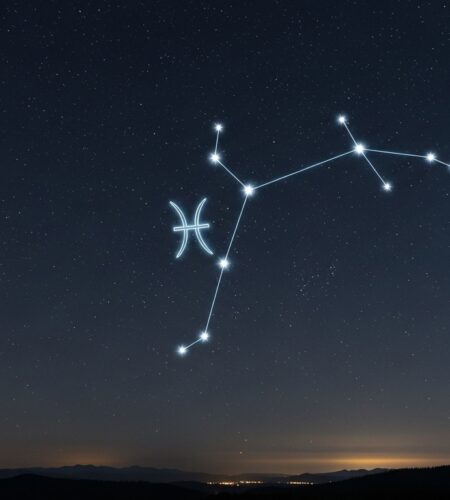
Finding constellations can feel like searching for a needle in a haystack, especially when dealing with faint patterns like Pisces. After spending countless evenings under the stars, I’ve learned that patience and the right technique make all the difference.
How to find the Pisces constellation? Start with the Great Square of Pegasus, then look south for the Circlet asterism – a small ring of stars marking one fish’s head – and trace the faint V-shape connecting two celestial fish swimming in opposite directions.
This zodiac constellation presents a unique challenge because its stars are notably faint – none brighter than magnitude 3.6. But don’t let that discourage you! With proper preparation and the step-by-step method I’ve refined through trial and error, you’ll be spotting Pisces consistently.
In this guide, I’ll share everything you need to know: from preparation and timing to specific star-hopping techniques that work even in mildly light-polluted areas. You’ll also learn about Pisces’ fascinating mythology and key features that will help you confirm you’ve found the right constellation.
Step-by-Step Guide to Finding Pisces
The key to finding Pisces lies in using brighter neighboring constellations as your guideposts. I’ve taught this method to dozens of beginners, and while it may take a few attempts, the sense of accomplishment when you finally spot those faint fish is worth every minute.
Step 1: Find the Great Square of Pegasus
Begin by facing southeast around 9 PM in October or November. Look for a large square pattern formed by four relatively bright stars. This is the Great Square of Pegasus, your primary landmark. Each side spans about 15 degrees – roughly the width of your outstretched fist at arm’s length.
From my experience observing from suburban areas, I recommend giving your eyes 15-20 minutes to adapt to darkness before starting. The stars of the Great Square should be visible even in moderate light pollution, making it the perfect starting point.
Step 2: Locate the Circlet Asterism
Once you’ve found the Great Square, look about 15 degrees south and slightly east. Here you’ll find the Circlet – a distinctive ring of seven faint stars forming the head of the western fish. The brightest star in this pattern, Gamma Piscium, shines at magnitude 3.7.
I’ll be honest – the Circlet can be tricky to spot from urban areas. On my first three attempts, I kept mistaking random star clusters for this pattern. What worked? Using binoculars to confirm the ring shape, then trying again with naked eyes after dark adaptation.
Step 3: Identify Alrescha – The Knot
Look for the constellation’s third-brightest star, Alrescha (magnitude 3.8), which marks the point where the two fish are tied together. This star sits along the ecliptic and appears as a single point to the naked eye, though it’s actually a close binary system.
Step 4: Trace the V-Shape Pattern
From Alrescha, trace two faint lines of stars extending outward – one toward the Circlet you’ve already found, and another extending eastward toward the constellation Aries. This creates the distinctive V-shape that gives Pisces its form as two fish swimming in opposite directions.
Remember: Pisces spans a large area of sky – about 889 square degrees, making it the 14th largest constellation. Don’t expect to see the entire pattern at once; focus on one section at a time.
Understanding the Pisces Constellation
Pisces represents two fish tied together by a cord, an ancient symbol that has endured across cultures for thousands of years. As one of the 12 zodiac constellations, it lies along the ecliptic – the path the Sun appears to travel throughout the year.
The constellation is particularly significant astronomically because it currently contains the vernal equinox point – where the Sun crosses the celestial equator each spring. This point has slowly drifted into Pisces due to Earth’s axial precession, giving us the term “Age of Aquarius” as it continues its journey toward the next constellation.
Visible from latitudes between +90° and -65°, Pisces is best viewed in the Northern Hemisphere during autumn months. Its large size and faint stars make it one of the more challenging constellations to identify, which is why many beginners struggle on their first attempts.
Quick Summary: Pisces is a large V-shaped zodiac constellation representing two fish tied together, located near Pegasus and best viewed in autumn from the Northern Hemisphere.
Key Stars and Features of Pisces
Understanding Pisces’ main stars will help you confirm you’ve found the right constellation. While they may not be the brightest in the night sky, each has unique characteristics that make identification easier once you know what to look for.
Alpherg (Eta Piscium) – The Brightest Star
At magnitude 3.6, Alpherg is the brightest star in Pisces, though it’s still relatively faint to the naked eye. This yellow giant star lies 294 light-years away and shines 316 times more brightly than our Sun. You’ll find it marking the eastern fish’s body.
Alrescha (Alpha Piscium) – The Connection Point
This fascinating binary star marks where the cord connects the two fish. While it appears as a single point of light to the naked eye, a small telescope reveals two stars orbiting each other every 720 years. The name comes from Arabic for “the cord.”
The Circlet Asterism
Perhaps the most recognizable feature of Pisces, the Circlet forms a rough hexagon of seven stars representing the western fish’s head. Gamma Piscium is the brightest at magnitude 3.7, while the others range from magnitude 4 to 5, requiring dark skies for clear viewing.
| Star Name | Magnitude | Distance (light-years) | Notable Feature |
|---|---|---|---|
| Alpherg (Eta Piscium) | 3.6 | 294 | Brightest star, yellow giant |
| Alrescha (Alpha Piscium) | 3.8 | 139 | Binary star, the knot |
| Gamma Piscium | 3.7 | 130 | Brightest in Circlet |
| Beta Piscium | 4.5 | 492 | Western fish mouth |
| 19 Piscium (TX Piscium) | 4.8-5.2 | 900 | Carbon star, appears red |
Best Conditions for Viewing Pisces
The timing and conditions of your observation session dramatically affect your success rate. After years of trial and error, I’ve found these factors make the biggest difference in spotting Pisces’ faint stars.
Optimal Season and Time
Pisces reaches its highest point in the sky during October and November, making these the prime viewing months. The constellation is visible from September through January, but autumn evenings offer the best combination of placement and darkness.
For optimal viewing, start your search around 9-11 PM local time when Pisces is high in the southeastern sky. Earlier in the evening, it may still be rising; later, atmospheric turbulence near the horizon can distort the already faint stars.
Moon Phase Considerations
Nothing ruins a Pisces hunt faster than moonlight. Plan your observation for the week around the new moon, or at least wait until the moon has set. Even a crescent moon can wash out the constellation’s faint stars.
I once spent an entire frustrating evening searching during a quarter moon before realizing my mistake. The next night under moonless skies, the Circlet was clearly visible with just 10 minutes of dark adaptation.
Light Pollution Solutions
If you’re stuck in an urban area, don’t despair – but do be realistic. You’ll need binoculars (7×50 or 10×50 work best) to spot the main features. Drive at least 30 minutes from city center if possible, or find a park with minimal direct lighting.
Red flashlights preserve your night vision while allowing you to check star charts. I made the mistake of using my phone’s white light initially and had to wait another 15 minutes for my eyes to readapt each time.
The Mythology Behind Pisces
The story of Pisces comes from Greek mythology, involving Aphrodite (goddess of love) and her son Eros. According to legend, they were walking along the Euphrates River when the monster Typhon suddenly appeared.
To escape, they transformed themselves into fish and tied themselves together with a cord so they wouldn’t be separated in the river’s currents. Zeus later placed them in the sky as a reminder of their clever escape and enduring bond.
This myth explains the constellation’s unique V-shape – two fish swimming in opposite directions but forever connected. The star Alrescha literally means “the cord” in Arabic, directly referencing this ancient story.
Different cultures have their own interpretations. Syrians saw the goddess Atagartis (half-woman, half-fish), while early Christians associated the constellation with miracles involving fish. The shape has been recognized across civilizations, though interpretations varied widely.
Deep Sky Objects in Pisces
While Pisces is best known for its shape and mythology, it hosts some interesting deep sky objects for those with telescopes. The most notable is M74, a face-on spiral galaxy that presents both opportunities and challenges for observers.
M74 – The Phantom Galaxy
“M74 is arguably the most difficult of all Messier objects for visual observers.” – Stephen James O’Meara, astronomer
– Deep-sky observing expert
Located about 1.5 degrees east-northeast of Alpherg, M74 appears as a faint, ghostly spiral. Its low surface brightness makes it challenging even under dark skies – hence its nickname “The Phantom Galaxy.”
To spot M74, you’ll need at least a 6-inch telescope and dark, moonless conditions. Use averted vision (looking slightly away from the target) to bring out the spiral structure. Photography reveals beautiful detail invisible to the eye.
Troubleshooting Common Problems
Based on my experience helping beginners find Pisces, I’ve identified common stumbling blocks and solutions that can save you frustration.
Problem: “I can’t see any stars at all”
Solution: Give yourself at least 20 minutes for dark adaptation. Avoid looking at your phone or any white lights. If still struggling, move to a darker location or use binoculars to gradually build your star map.
Problem: “I found the Great Square but can’t find Pisces”
Solution: You’re most likely looking in the wrong direction. From the Great Square, look south and slightly east – many people mistakenly look too far west. Also remember that Pisces’ stars are much fainter than Pegasus.
Problem: “I think I found it but I’m not sure”
Solution: Use a stargazing app to confirm. I recommend SkyView Lite or Stellarium Mobile – both show constellations overlaid on your camera view. This verification step builds confidence for future observations.
✅ Pro Tip: Keep a logbook of your observing sessions. Note date, time, location, and what you could see. You’ll be amazed at how quickly your skills improve with practice!
Frequently Asked Questions
Where is Pisces Constellation right now?
Pisces is currently visible in the evening sky during autumn months (September-January). Look southeast around 9 PM in October/November. The constellation rises earlier each night, moving westward through the season.
What month is best to see the Pisces constellation?
October and November offer the best viewing conditions when Pisces is highest in the sky during evening hours. September provides good early evening views, while December and January work well for observers who stay up later.
Can I find Pisces from a city with light pollution?
Yes, but you’ll need binoculars (7×50 or 10×50 recommended) and should focus on the brightest features like Alpherg and the Circlet. Plan for moonless nights and give your eyes extra time to adapt to darkness.
Do I need a telescope to see Pisces?
No telescope is required – Pisces can be seen with naked eyes under dark skies. Binoculars help in light-polluted areas. A telescope is only needed for deep-sky objects like M74 galaxy within Pisces.
What are the brightest stars in Pisces?
The brightest star is Alpherg (magnitude 3.6), followed closely by Gamma Piscium (3.7) and Alrescha (3.8). All are relatively faint, which is why Pisces is challenging to spot from urban areas.
How long does it take to find Pisces as a beginner?
Most beginners need 2-3 attempts taking 30-45 minutes each. Success depends on dark skies, moon phase, and familiarity with the Great Square of Pegasus. Don’t get discouraged – even experienced astronomers struggled initially!
Final Recommendations
Finding Pisces taught me patience in astronomy – some rewards come only to those who persist. The constellation’s faint stars reward preparation, proper timing, and the willingness to return night after night.
Remember these key takeaways: Start with the Great Square, give your eyes time to adapt, use binoculars in light-polluted areas, and don’t attempt during bright moon phases. Most importantly, keep expectations realistic – Pisces is genuinely challenging, making each successful sighting that much more rewarding.
For more constellation identification techniques, check out our comprehensive guide for young astronomers. If you’re interested in neighboring zodiac constellations, our guide to the Aquarius constellation provides additional practice for your autumn sky exploration.
⏰ Time Saver: Download a stargazing app before your first attempt. The ability to point your phone at the sky and see constellation overlays cuts learning time dramatically while building confidence.
Happy stargazing! The fish are waiting to be discovered in the autumn sky.
Comments