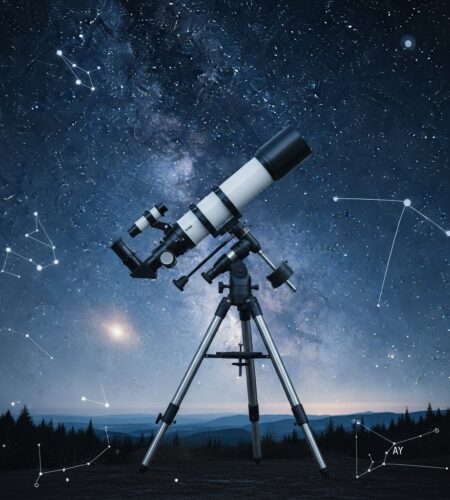
I remember my first telescope purchase vividly. Standing in a big-box store, dazzled by the “500x magnification!” stickers and sleek photos of Saturn on the box. Three hundred dollars later, I ended up with a wobbly department store special that showed me nothing but blurry dots and left me frustrated enough to quit astronomy for two years.
Choosing a telescope doesn’t have to be this confusing or disappointing. The right telescope will show you crisp lunar craters, Saturn’s rings, and even distant galaxies—without the frustration.
The key to choosing your first telescope is understanding that aperture (the diameter of the main lens or mirror) matters far more than magnification, and that different telescope designs excel at different types of observing. A quality 6-8 inch Dobsonian reflector will show you more than a cheap 90mm refractor claiming 500x power.
This guide will walk you through everything you need to know: why aperture is king, which telescope type fits your needs, what mount system works best, and how to budget wisely. We’ll also cover urban astronomy challenges and family considerations often ignored by other guides.
5 Critical Factors for Telescope Selection
Based on helping thousands of beginners start their astronomy journey, I’ve found these five factors determine whether you’ll love or abandon your new hobby:
- Aperture size – Determines what you can actually see (aim for 70mm minimum)
- Telescope type – Matches design to your observing goals and lifestyle
- Mount stability – Makes the difference between steady views and frustration
- Portability vs performance – Balances what you’d like with what you’ll actually use
- Total budget – Includes essential accessories (plan 20-30% extra beyond the scope)
These factors work together—you can’t optimize one without considering the others. A huge aperture telescope won’t get used if it’s too heavy to carry outside, and the most portable scope won’t satisfy if it can’t show you the planets clearly.
Let’s dive deeper into each factor, starting with the most important: aperture.
Understanding Aperture: The Most Important Specification
Aperture is the diameter of your telescope’s main optical component—either the front lens (in refractors) or the primary mirror (in reflectors). This single measurement determines 90% of your telescope’s performance.
Think of aperture as the light bucket: a 70mm aperture collects about 100 times more light than your naked eye, while a 200mm (8-inch) telescope gathers over 800 times more. More light means fainter objects become visible and detail on brighter objects dramatically improves.
Why does this matter so much? Most beginners are shocked to learn that:
- A quality 70mm telescope will easily show Saturn’s rings and Jupiter’s moons
- That same scope will reveal the Andromeda Galaxy as a faint fuzzy patch
- Jump to 150mm (6 inches) and you’ll see spiral structure in galaxies and cloud bands on Jupiter
- An 8-inch (200mm) scope under dark skies can show over 5,000 galaxies
Aperture: The diameter of a telescope’s main light-collecting element (lens or mirror). Larger aperture = more light = better views.
Here’s what to expect at different aperture sizes:
| Aperture | Best For | What You’ll See | Portability |
|---|---|---|---|
| 60-70mm | Beginners, lunar/planetary | Moon craters, Saturn’s rings, Jupiter’s moons | Excellent |
| 80-100mm | All-around beginners | Planetary details, brighter nebulae, double stars | Very Good |
| 130-150mm (5-6″) | Serious beginners | Galaxy structure, faint nebulae, excellent planetary | Good |
| 200mm (8″) | Deep sky enthusiasts | Thousands of galaxies, nebulae detail, exceptional lunar | Fair |
| 250mm+ (10″+) | Dedicated observers | Faintest objects, planetary storms, globular clusters | Poor |
My experience mentoring beginners shows that 6-8 inches (150-200mm) is the sweet spot for most people—enough aperture to see exciting details without being so cumbersome that the telescope stays in the closet.
Urban observers should note that light pollution affects smaller scopes more severely. A 150mm scope in the city might match the views of a 100mm scope from dark skies—so city dwellers should lean toward larger aperture when possible.
Telescope Types: Which Design Fits Your Needs?
Once you’ve settled on aperture range, you need to choose between three main telescope designs. Each has distinct advantages, maintenance requirements, and best-use scenarios.
Refractor Telescopes: The Classic Choice
Refractors use lenses to bend and focus light—just like binoculars or camera lenses. They’re the telescope most people picture when they think of astronomy.
How they work: Light enters through a large lens at the front, travels down a sealed tube, and exits through an eyepiece at the rear.
Why choose a refractor:
- Virtually maintenance-free – No collimation needed, sealed tube protects optics
- Excellent for planets and moon – High contrast views with sharp details
- Quick cooldown – Ready to use in minutes, not hours
- Durable and rugged – No mirrors to knock out of alignment
Refractor drawbacks:
- Chromatic aberration – Color fringing on bright objects (especially budget models)
- Cost per inch – Most expensive design for equivalent aperture
- Long and unwieldy – A 100mm refractor can be 4+ feet long
Best for: Beginners who want minimal maintenance, lunar/planetary observers, those with storage constraints, and terrestrial viewing (bird watching, scenery).
After testing dozens of entry-level refractors with new astronomers, I recommend starting with at least 80mm aperture—anything smaller quickly becomes limiting. An 80-100mm refractor provides excellent lunar and planetary views while remaining highly portable.
Reflector Telescopes: Maximum Value
Reflectors (specifically Newtonian reflectors) use mirrors to gather and focus light. They offer the most aperture for your money and are the workhorses of amateur astronomy.
How they work: Light enters an open tube, reflects off a curved primary mirror at the bottom, up to a secondary mirror near the top, then out through the focuser on the side.
Why choose a reflector:
- Best value per inch – Large apertures at reasonable prices
- Color-free views – No chromatic aberration at any price point
- Excellent deep sky performance – Ideal for galaxies and nebulae
- Compact design – Shorter tubes than equivalent refractors
Reflector drawbacks:
- Requires collimation – Mirror alignment needs periodic adjustment
- Open tube design – Dust can enter, tube currents affect views until cooled
- Long cooldown time – Needs 30-60 minutes to reach ambient temperature
- Bulky to store – Can’t be stood on end like a refractor
Best for: Budget-conscious observers wanting maximum aperture, deep sky enthusiasts, those willing to learn basic maintenance, and anyone with storage space.
The Dobsonian mount—a simple alt-azimuth base for Newtonian reflectors—offers the absolute best value in amateur astronomy. A 6-8 inch Dobsonian costs less than a 4-inch refractor yet shows vastly more.
I’ve seen countless beginners start with a 6 or 8 inch Dob and still be enthusiastically using it years later, often upgrading eyepieces but never needing a different telescope.
Catadioptric Telescopes: The Versatile Compromise
Catadioptrics (compound telescopes) combine lenses and mirrors to create compact, versatile instruments. The two main types are Schmidt-Cassegrains (SCT) and Maksutov-Cassegrains (Mak).
How they work: Light passes through a corrector plate at the front, hits a primary mirror, reflects to a secondary mirror, then back through a hole in the primary to the eyepiece.
Why choose a catadioptric:
- Compact and portable – Short tubes despite long focal lengths
- Excellent all-rounders – Good for both planetary and deep sky
- Sealed tube – Protected optics, minimal maintenance
- Long focal length – High magnification capabilities
Catadioptric drawbacks:
- Most expensive design – Premium pricing for aperture size
- Long cooldown time – Similar to reflectors
- Narrower field of view – Not ideal for large deep sky objects
- Collimation needed – More complex than reflectors if required
Best for: Astrophotographers, those needing portability with performance, observers wanting both planetary and deep sky capability, and anyone with budget flexibility.
For beginners considering a catadioptric, I recommend starting with a 90-127mm Maksutov-Cassegrain. They’re more affordable than SCTs, nearly maintenance-free, and provide excellent planetary views in a compact package.
Telescope Type Comparison
| Type | Pros | Cons | Best For | Price Range |
|---|---|---|---|---|
| Refractor | Low maintenance, sharp planets, quick cooldown, durable | Expensive per inch, chromatic aberration, long tubes | Planetary viewing, beginners, minimal maintenance seekers | $200-$2000+ |
| Reflector/Dobsonian | Best value, large apertures, color-free, versatile | Needs collimation, open tube, bulky storage | Deep sky, budget buyers, beginners wanting best views | $250-$1500 |
| Maksutov-Cassegrain | Compact, sealed tube, excellent planets, low maintenance | Expensive per inch, narrow field, slow cooldown | Planetary specialists, portable observing, urban viewers | $300-$1500 |
| Schmidt-Cassegrain | Very compact, versatile, good for astrophotography | Most expensive, complex collimation, narrow field | Astrophotography, all-around observers, space savers | $1000-$5000+ |
Mount Systems: The Foundation of Stable Viewing
Many beginners don’t realize that the mount is just as important as the optical tube. A wobbly mount will make even the best optics frustrating to use, while a stable mount can make modest aperture perform wonderfully.
Alt-Azimuth Mounts: Simple and Intuitive
Alt-azimuth mounts move up-down (altitude) and left-right (azimuth)—just like a camera tripod. They’re the most intuitive type for beginners.
Types include:
- Simple photo tripod mounts – Light duty for small scopes
- Dobsonian bases – Rock solid for Newtonian reflectors
- Fork mounts – Often computerized, popular for SCTs
Advantages:
- Simple to use and understand
- No polar alignment needed
- Generally less expensive
- Quick setup time
Disadvantages:
- Can’t track objects easily for astrophotography
- Objects appear to rotate in the eyepiece
- Manual tracking requires constant adjustment
Equatorial Mounts: For Serious Observing
Equatorial mounts are aligned with Earth’s axis, allowing them to track celestial objects with a single motion. They look complex but are designed for astronomical use.
How they work: Once aligned with Polaris (the North Star), you can track any object by turning just one knob (the right ascension axis).
Advantages:
- Single-axis tracking of objects
- Essential for astrophotography
- Can add motor drives for automatic tracking
- Better for high-power planetary viewing
Disadvantages:
- Steeper learning curve
- Heavier and more expensive
- Requires polar alignment each session
- Can be confusing for beginners
Computerized (GoTo) Mounts: Finding Made Easy
Computerized mounts use motors and GPS to automatically locate and track thousands of objects. They’re available in both alt-azimuth and equatorial designs.
How they work: After a simple alignment process, you select an object from the hand controller, and the mount automatically points to it.
Advantages:
- Finds objects automatically
- Excellent for light-polluted areas
- Tracks objects hands-free
- Great for learning the sky
Disadvantages:
- Significantly more expensive
- Require power source
- Add complexity and potential failure points
- Can prevent learning star-hopping skills
My recommendation for most beginners: start with a simple alt-azimuth mount, particularly a Dobsonian base. They offer the best stability for the money and let you focus on learning the sky rather than wrestling with equipment.
Save the computerized mounts for your second telescope, when you’ve learned the basics and know what objects you want to observe regularly.
Practical Considerations: Real-World Telescope Ownership
Choosing the right telescope involves more than just optical performance. These practical factors often determine whether your telescope becomes a beloved instrument or an expensive coat rack.
Budget Reality Check
Let’s be honest about costs. While you can find telescopes for under $100, these are typically frustrating toys that will kill your enthusiasm. Here’s what to realistically expect:
| Budget Range | What You’ll Get | Expected Performance | Recommended For |
|---|---|---|---|
| $100-200 | 60-70mm tabletop refractor, basic accessories | Lunar craters, Jupiter’s moons, Saturn as oval | Very casual observers, children |
| $250-400 | 80-100mm refractor or 6″ Dobsonian | Good planetary detail, brighter deep sky objects | Serious beginners, best value |
| $400-800 | 120-150mm refractor or 8-10″ Dobsonian | Excellent detail, galaxies and nebulae visible | Dedicated beginners, deep sky enthusiasts |
| $800-1500 | 127mm Mak or 10-12″ Dobsonian | Exceptional views, thousands of objects | Committed observers, semi-pro level |
⏰ Time Saver: Plan your total budget at 20-30% above the telescope price for essential accessories. A $300 telescope really needs $350-400 total for the best experience.
Essential Accessories (The Hidden Costs)
Your telescope purchase isn’t complete without these essential items:
- Additional eyepieces – Most scopes come with just one basic eyepiece. Plan for $50-150 for 2-3 quality eyepieces of different focal lengths.
- Red flashlight – Preserve your night vision while reading charts and adjusting equipment. ($10-20)
- Observing chair – Comfort at the eyepiece makes observing sessions longer and more enjoyable. ($80-200)
- Star atlas or app – You need to know what you’re looking at. ($10-50)
- Collimation tools – Essential for reflector owners. ($20-50)
- Dew prevention – Dew heaters or shields for humid climates. ($30-100)
Storage and Portability
The best telescope is the one you’ll actually use. Consider these questions:
- Where will you store it? Telescopes need dry, temperature-stable storage. A 6-foot Dobsonian won’t fit in most closets.
- How far must you carry it? If you need to transport it to dark skies, weight becomes crucial. A 20-pound scope feels like 100 after carrying it 100 yards.
- Setup time matters. If setup takes 30 minutes, you’ll observe less often than with a 5-minute setup scope.
I’ve seen many enthusiasts buy massive telescopes only to realize they rarely use them due to the hassle. A smaller scope that gets used twice a week is better than a giant that stays in the garage.
Common Beginner Mistakes to Avoid
After helping hundreds of new astronomers, these mistakes come up repeatedly:
- Buying from department stores – Those $100 “700x power” scopes are frustrating toys. Buy from astronomy specialty retailers.
- Overemphasizing magnification – High magnification without sufficient aperture just gives bigger, blurrier views.
- Underestimating aperture needs – Starting too small leads to disappointment. 70mm should be the minimum.
- Neglecting the mount – A wobbly mount makes any telescope frustrating to use.
- Unrealistic expectations – You won’t see Hubble-like images through any eyepiece. But real-time views have their own magic.
- Skipping the learning phase – Spend time with binoculars and star charts first to learn the sky.
Urban Astronomy: Choosing a Telescope for City Living
Living in a city doesn’t mean you can’t enjoy astronomy. I’ve observed successfully from New York City balconies and downtown Chicago. You just need the right approach.
Urban challenges and solutions:
- Light pollution – Focus on bright objects: Moon, planets, double stars, and bright nebulae like the Orion Nebula. Light pollution filters help for some objects.
- Space constraints – Consider tabletop Dobsonians, compact Maksutovs, or portable refractors that can be stored easily.
- Stability issues – Balconies vibrate. Choose a lighter scope or use vibration suppression pads under the tripod.
- Security concerns – Choose equipment you can quickly bring inside. A 100mm refractor is easier to secure than an 8-inch Dobsonian.
Best urban telescope recommendations:
- 90-100mm Maksutov-Cassegrain – Compact, excellent for planets, easy to store
- 80-100mm refractor on alt-azimuth mount – Simple to use, quick setup
- 4-6 inch tabletop Dobsonian – Surprisingly capable, very portable
Remember, even from light-polluted areas, you can observe Saturn’s rings, Jupiter’s cloud bands, the phases of Venus, lunar craters in stunning detail, and dozens of star clusters. The key is focusing on what you can see rather than what you can’t.
Family Astronomy: Telescopes for All Ages
Sharing astronomy with children can be incredibly rewarding. But choosing the right family telescope requires different considerations.
Age-appropriate recommendations:
- Ages 6-9 – Simple 50-60mm refractors on alt-azimuth mounts. Easy to operate, show clear lunar views.
- Ages 10-14 – 70-100mm refractors or 4-6 inch tabletop Dobsonians. More capability while remaining manageable.
- Teens – 6-8 inch Dobsonians or 90-127mm Maksutovs. Near-adult capability with supervision.
Family-friendly features to look for:
- Simple altitude movements (no counterweights to adjust)
- Rugged construction that withstands occasional bumps
- Intuitive finders (red dot finders work better than optical finderscopes for kids)
- Quick setup time (under 5 minutes ideal)
- Light enough for an adult to carry easily
Making astronomy engaging:
- Start with the Moon – it’s impressive and easy to find
- Create observing challenges: “Can you find Jupiter’s moons tonight?”
- Use astronomy apps to help locate objects
- Keep sessions short – 30-45 minutes is plenty for most children
- Consider astronomy-themed books and games to build interest
Many families find that a 6-8 inch Dobsonian hits the sweet spot—capable enough to show exciting details while remaining simple enough for children to operate with guidance.
Frequently Asked Questions
Is 50mm or 70mm better for a telescope?
A 70mm telescope is significantly better than 50mm. The 70mm aperture collects nearly twice as much light, providing brighter, clearer views of planets, star clusters, and the Moon. While a 50mm can show lunar craters and Jupiter’s brightest moons, a 70mm reveals more detail and can show fainter objects like the Andromeda Galaxy and brighter nebulae.
What are the three main factors that should be considered when choosing a telescope?
The three main factors are aperture (the diameter of the main lens or mirror), telescope type (refractor, reflector, or catadioptric), and mount stability. Aperture determines what you can see, telescope type affects portability and maintenance needs, and mount stability determines how easily you can track and observe objects.
Which telescope is better, reflecting or refracting?
Reflecting telescopes generally offer better value for aperture size and excel at deep sky viewing, while refracting telescopes provide sharper planetary views with virtually no maintenance. Reflectors need periodic collimation but give more aperture for your money, while refractors are more expensive per inch but provide contrast-rich, maintenance-free observing. The best choice depends on your observing goals and maintenance willingness.
What type of telescope is best for viewing planets?
For planetary viewing, refractors (80mm and larger) and Maksutov-Cassegrain telescopes (90mm and larger) are excellent choices due to their high contrast views. However, a quality 6-8 inch reflector on a stable mount will also show stunning planetary detail. The key is optical quality and stable seeing conditions rather than telescope type alone.
How much should a beginner spend on a telescope?
Beginners should plan to spend between $250-500 for a quality telescope. This range buys either a good 80-100mm refractor or a 6-8 inch Dobsonian reflector. Include an additional 20-30% for essential accessories like extra eyepieces and a red flashlight. Avoid scopes under $150 from department stores—they typically lead to frustration.
Do I need to know about stars to use a telescope?
While not absolutely necessary, learning basic star patterns significantly enhances your telescope experience. Many beginners start with astronomy apps or planispheres to locate bright stars, then use those as guideposts to find planets and deep sky objects. Computerized GoTo telescopes can automatically find objects, but understanding the sky makes observing more rewarding.
Your First Telescope: Next Steps
Now that you understand the key factors in choosing a telescope, you’re well-equipped to make an informed decision. Remember these final points:
- Start simple. A 6-8 inch Dobsonian or 80-100mm refractor will provide years of enjoyment without overwhelming you.
- Join a community. Local astronomy clubs welcome beginners and often have loaner telescopes you can try before buying. Check our beginner telescope recommendations for specific models.
- Be realistic. You won’t see colorful nebulae like in photos, but watching Saturn’s rings or Jupiter’s moons in real time has its own magic.
- Consider your location. Urban dwellers should check out our telescope type guide for city-friendly options.
The night sky has fascinated humans for millennia. With the right telescope, you can join that tradition of discovery. Take your time, choose wisely, and soon you’ll be exploring the universe from your backyard.
Clear skies and happy observing!
Comments