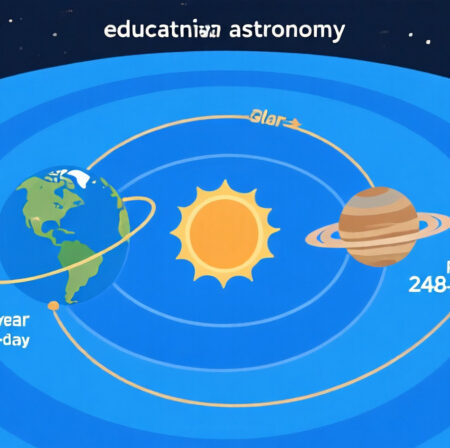
Have you ever wondered how old you’d be if you lived on Pluto? The answer might surprise you! A year on Pluto takes almost 248 Earth years to complete, which means every living human is less than one Pluto year old. For example, if you’re 30 years old on Earth, you’d only be about 0.12 years old on Pluto – barely a toddler in Pluto years!
This fascinating calculation isn’t just a fun fact – it’s a gateway to understanding astronomy and the incredible scales of our solar system. I’ve spent years teaching these concepts to students of all ages, and the Pluto age calculation never fails to spark curiosity about space science.
In this comprehensive guide, you’ll discover not only how to calculate your age on Pluto but also understand the science behind planetary years, explore Pluto’s unique characteristics as a dwarf planet, and even learn whether time passes differently on this distant world. Whether you’re a teacher looking for classroom materials, a parent helping with homework, or just someone curious about space, this guide will provide everything you need.
Understanding Planetary Years and Orbital Periods
Planetary years are determined by how long it takes a planet to complete one orbit around the Sun. This journey through space is what we call an orbital period. On Earth, we’re familiar with a year lasting 365.25 days, but this varies dramatically across our solar system due to each planet’s distance from the Sun and orbital speed.
Think of it like runners on a circular track – the runner closest to the center (the Sun) completes laps much faster than those on the outer lanes. Mercury, being closest to the Sun, zips around in just 88 Earth days, while Pluto, in its distant orbit, takes a leisurely 248 Earth years to finish its cosmic lap.
This orbital period difference is why your age changes so dramatically on different planets. Your actual biological aging doesn’t change – you’re still the same number of Earth days old regardless of where you are in space. What changes is how we count “years” based on local orbital cycles. This is a crucial distinction that often confuses students when first learning about planetary ages.
Orbital Period: The time it takes for a celestial body to complete one full orbit around another object, typically measured in Earth days or Earth years for planets in our solar system.
Understanding these differences helps us appreciate the vast scales involved in astronomy. Pluto’s incredibly long year is due to its average distance of 3.7 billion miles (5.9 billion km) from the Sun. At that distance, the Sun’s gravitational pull is much weaker, so Pluto moves more slowly through its orbit – only about 4.7 miles per second (7.5 km/s) compared to Earth’s 18.5 miles per second (30 km/s).
This is where astronomy and astrophysics come together beautifully. The orbital mechanics that determine Pluto’s year length follow the same mathematical principles discovered by Johannes Kepler in the 17th century. These laws still help modern astronomers calculate orbits and plan space missions today.
How to Calculate Your Age on Pluto: Step-by-Step
Calculating your age on Pluto is straightforward once you understand the basic formula. Here’s the step-by-step method I use in my astronomy workshops that always gets the “wow” reaction from students.
Step 1: Know Your Earth Age
Start with your current age in Earth years. For the most accurate calculation, use your exact age including months and days. For example, if you’re exactly 25 years old, that’s your starting point.
Step 2: Understand the Conversion Factor
Pluto takes 248 Earth years to complete one orbit. This means 1 Pluto year = 248 Earth years. This is our magic number for all calculations.
Step 3: Apply the Formula
The formula is simple: Divide your Earth age by 248.
Formula: Pluto Age = Earth Age ÷ 248
Worked Examples:
Let’s calculate some common ages:
- 10 years old on Earth: 10 ÷ 248 = 0.040 Pluto years (about 14 Pluto days)
- 25 years old on Earth: 25 ÷ 248 = 0.101 Pluto years
- 50 years old on Earth: 50 ÷ 248 = 0.202 Pluto years
- 100 years old on Earth: 100 ÷ 248 = 0.403 Pluto years
Step 4: For More Precision
If you want to include months and days, convert your entire age to days first (multiply Earth years by 365.25), then divide by Pluto’s year in days (248 × 365.25 = 90,582 days).
Quick Summary: To find your Pluto age, simply divide your Earth age by 248. A 30-year-old would be approximately 0.12 Pluto years old!
These calculations reveal an amazing fact: Even the oldest living humans haven’t reached their first Pluto birthday! The oldest verified human was 122 years old, which would be only 0.49 Pluto years – not even halfway to one Pluto year.
Pluto Age Calculator: Quick Reference Examples
To make these calculations even easier, I’ve created this reference table showing various Earth ages and their Pluto equivalents. This is perfect for classroom activities or quick curiosity checks.
| Earth Age | Pluto Age | Pluto Age in Words | Fun Fact |
|---|---|---|---|
| 1 year | 0.004 years | 14.6 Pluto days | Just a Pluto toddler! |
| 5 years | 0.020 years | 73 Pluto days | Barely 2 Pluto months |
| 10 years | 0.040 years | 146 Pluto days | Half a Pluto year |
| 20 years | 0.081 years | 29.4 Pluto days | Almost a Pluto month |
| 30 years | 0.121 years | 44.2 Pluto days | Early Pluto childhood |
| 40 years | 0.161 years | 58.8 Pluto days | Nearing 2 Pluto months |
| 50 years | 0.202 years | 73.6 Pluto days | Two and a half Pluto months |
| 60 years | 0.242 years | 88.3 Pluto days | Almost 3 Pluto months |
| 75 years | 0.302 years | 110.3 Pluto days | Approaching 4 Pluto months |
| 100 years | 0.403 years | 147.2 Pluto days | Just over 5 Pluto months |
| 124 years | 0.500 years | 182.5 Pluto days | Half a Pluto year! |
| 248 years | 1.000 years | 365 Pluto days | Your first Pluto birthday! |
As you can see, even a centenarian would only be about 5 months old in Pluto years! This table is always a hit in my astronomy classes because it really puts Pluto’s enormous year into perspective. Students love calculating their family members’ ages too – it’s a great way to engage the whole family in space science.
For quick mental calculations, remember this: Every 25 Earth years equals about 0.1 Pluto years. So if you’re 50, you’re 0.1 in Pluto years. If you’re 75, you’re 0.3 in Pluto years. This approximation is usually close enough for casual conversations and classroom activities.
Fascinating Facts About Pluto
Pluto is much more than just a distant world with a long year – it’s a fascinating celestial body with unique characteristics that make it special in our solar system. Discovered in 1930 by American astronomer Clyde Tombaugh, Pluto was considered the ninth planet for 76 years before its reclassification.
Pluto’s average surface temperature is -229°C (-380°F), making it one of the coldest places in our solar system. Despite this extreme cold, Pluto has a thin atmosphere that freezes and falls to the surface as snow when it moves farther from the Sun in its elliptical orbit.
⏰ Time Saver: Pluto’s day (one rotation) is 6.5 Earth days long, which is longer than our week!
One of the most surprising discoveries from NASA’s New Horizons mission in 2026-15 was Pluto’s complex geology. Despite being so far from the Sun, Pluto shows evidence of recent geological activity, including possible ice volcanoes and moving glaciers made of nitrogen ice. This challenges our understanding of how geological processes work on icy worlds.
Pluto has five known moons, with Charon being the largest – so large that Pluto and Charon actually orbit around a common center of gravity between them, making them more like a binary system than a planet-moon pair. The other four moons – Styx, Nix, Kerberos, and Hydra – are much smaller and were discovered between 2005 and 2012.
The distance from Earth to Pluto varies between 2.7 billion miles (4.4 billion km) and 4.7 billion miles (7.5 billion km) due to their elliptical orbits. This vast distance means that even light, traveling at 186,282 miles per second (299,792 km/s), takes between 4 and 6.5 hours to reach Pluto from Earth!
Why Pluto is a Dwarf Planet: The Full Story
The story of Pluto’s reclassification from planet to dwarf planet in 2006 is one of the most discussed topics in modern astronomy. The International Astronomical Union (IAU) established three criteria for planethood, and Pluto meets only two of them.
The Three IAU Planet Criteria:
- It must orbit the Sun: ✓ Pluto does this
- It must be massive enough to be round: ✓ Pluto meets this criterion
- It must have “cleared its neighborhood”: ✗ Pluto doesn’t meet this
The third criterion is where Pluto falls short. “Clearing the neighborhood” means the object has become gravitationally dominant in its orbital path, either by consuming or ejecting other objects. Pluto shares its orbital neighborhood with many other objects in the Kuiper Belt – a region of icy bodies beyond Neptune.
The Kuiper Belt contains thousands of icy bodies, including Eris, Makemake, and Haumea – all classified as dwarf planets alongside Pluto. In fact, Eris is actually more massive than Pluto, which was a key factor in the IAU’s decision to create the dwarf planet category.
It’s important to note that “dwarf planet” doesn’t mean Pluto is any less interesting or important scientifically. Many astronomers, including myself, often refer to Pluto as a “king of the Kuiper Belt” – a fascinating world that has taught us more about the outer solar system than we ever knew before.
The reclassification has actually been beneficial for astronomy education. It’s sparked countless conversations about how science works, how definitions evolve with new discoveries, and how our understanding of the solar system continues to grow. I’ve found that discussing Pluto’s status is an excellent way to teach students about the scientific method and how new evidence can change our understanding.
Would You Actually Age Slower on Pluto?
This is one of the most common questions I get from students and adults alike, and the answer combines basic physics with Einstein’s theory of relativity. The short answer is: Yes, you would age slightly slower on Pluto, but the difference would be incredibly tiny.
There are two main effects that determine how time passes differently in different gravitational fields: gravitational time dilation and velocity time dilation. Both effects are extremely small for Pluto but still worth understanding.
Gravitational Time Dilation: According to Einstein’s general relativity, time passes more slowly in stronger gravitational fields. Earth has much stronger gravity than Pluto (Earth’s surface gravity is about 9.8 m/s², while Pluto’s is only 0.62 m/s²). This means time actually passes slightly faster on Pluto than on Earth due to the weaker gravity.
Velocity Time Dilation: According to special relativity, time passes more slowly for objects moving at higher speeds. Pluto orbits the Sun at about 4.7 km/s, while Earth orbits at about 30 km/s. Since Earth is moving much faster, time dilation due to velocity makes time pass slightly slower on Earth.
✅ Pro Tip: The time difference between Earth and Pluto is so small that after 100 years, you’d only be about 0.0003 seconds “younger” on Pluto!
When you combine both effects, the velocity time dilation (Earth moving faster) slightly outweighs the gravitational time dilation (Earth having stronger gravity). The net result is that time passes about 0.00000003% faster on Pluto than on Earth.
To put this in perspective, if you spent your entire life (say, 80 Earth years) on Pluto, you would age about 0.075 seconds less than someone on Earth. This difference is so tiny that it’s completely negligible for all practical purposes – you wouldn’t notice it at all!
However, these relativistic effects become much more significant near massive objects like black holes or for objects traveling at very high speeds, such as GPS satellites which need to account for these effects to maintain accuracy.
Educational Activities for All Ages
Calculating ages on Pluto opens up numerous opportunities for engaging educational activities that work across different age groups and learning environments. Here are some activities I’ve successfully used in classrooms and homeschooling settings.
For Elementary Students (Ages 6-10)
- Pluto Birthday Party: Calculate each student’s “Pluto birthday” and create a giant timeline showing when different students would celebrate their first Pluto year (at age 248!).
- Planetary Age Walk: Have students walk around a large circle representing Pluto’s orbit, stopping at different points to represent their ages in Pluto years.
- Craft Activities: Create mobiles showing the different orbital periods of planets, with Pluto’s orbit being dramatically larger than others.
For Middle School Students (Ages 11-14)
- Mathematical Explorations: Use the age calculations to practice division with decimals, percentages, and ratios. Calculate what fraction of a Pluto year different historical figures lived.
- Graphing Project: Create graphs comparing ages across different planets to visualize the vast differences in orbital periods.
- Research Presentation: Have students research and present on different aspects of Pluto, from its discovery to its moons and the New Horizons mission.
For High School Students (Ages 15-18)
- Physics Calculations: Explore the mathematics behind Kepler’s laws and calculate orbital periods using actual astronomical data.
- Debate Activity: Organize a debate on whether Pluto should be considered a planet, having students research and argue different positions.
- Time Dilation Mathematics: For advanced students, calculate the actual relativistic time differences between Earth and Pluto using the proper equations.
For parents and teachers looking for more resources, I recommend checking out astronomy education for children to build a foundation of space science concepts. These activities also pair well with astronomy activities for children that can extend the learning beyond the classroom.
Interactive space learning tools can also enhance these activities, allowing students to visualize orbits and explore celestial objects and constellations while understanding their place in the cosmos.
Frequently Asked Questions
How old would you be on Pluto?
To find your age on Pluto, divide your Earth age by 248. For example, if you’re 30 years old on Earth, you’d be about 0.12 years old on Pluto. This means every living human is less than one Pluto year old!
Would you age slower on Pluto?
Technically yes, but the difference is negligible. Due to relativistic effects, time passes slightly faster on Pluto than Earth. After 100 years, you’d only be about 0.0003 seconds “younger” on Pluto – a difference too small to notice.
How long is 1 year in Pluto?
One year on Pluto equals 248 Earth years. This is how long it takes Pluto to complete one orbit around the Sun. During this time, Earth would have completed 248 orbits around the Sun.
What criteria does Pluto not meet?
Pluto doesn’t meet the IAU’s third criterion for planethood: “clearing the neighborhood.” While Pluto orbits the Sun and is round, it shares its orbital path with many other objects in the Kuiper Belt and hasn’t become gravitationally dominant.
Is Pluto still a planet in 2026?
Pluto is officially classified as a dwarf planet as of 2006. This status hasn’t changed and remains the scientific consensus. However, many people still affectionately refer to Pluto as the “ninth planet” in casual contexts.
How do you calculate age on other planets?
Use the same formula: Your Age = Earth Age ÷ Orbital Period. For Mars, divide by 1.88 (Earth years). For Jupiter, divide by 11.86. Each planet has its own orbital period that determines the conversion factor.
What is the estimated age of Pluto?
Pluto is estimated to be about 4.5 billion years old, formed around the same time as the rest of our solar system from the solar nebula. This age is determined through radiometric dating of meteorites and computer models of solar system formation.
Does time go faster on Pluto?
Time does pass slightly faster on Pluto due to its weaker gravity and slower orbital velocity, but the difference is incredibly small – about 0.00000003% faster than on Earth. This effect is completely unnoticeable in daily life.
Final Recommendations
Calculating your age on Pluto is more than just a fun math exercise – it’s a window into the vast scales and fascinating mechanics of our solar system. Through understanding Pluto’s 248-year orbit, we gain perspective on our place in the cosmos and develop appreciation for the incredible diversity of worlds that share our Sun.
Whether you’re using these calculations for classroom education, personal curiosity, or family fun, remember that the true value lies in the questions and explorations they inspire. I’ve seen countless students’ eyes light up when they realize they’re “babies” in Pluto years – that moment of wonder is the beginning of a lifelong love for astronomy.
For further exploration, consider visiting more astronomy articles to continue your journey through space science. The universe is full of amazing discoveries waiting to be made, and understanding something as simple as planetary ages can be the first step toward a deeper appreciation of our cosmic neighborhood.
Keep looking up, keep asking questions, and never stop exploring the wonders of space – whether it’s calculating ages on distant worlds or discovering new cosmic phenomena beyond our solar system!