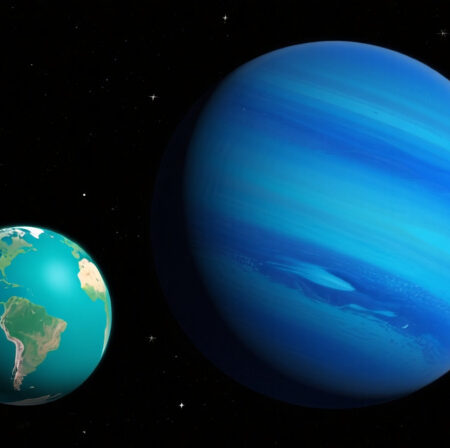
When I first started studying planetary science, one comparison that fascinated me was Earth versus Neptune. These two worlds couldn’t be more different, yet they share a surprising similarity in surface gravity. Earth is a rocky terrestrial planet with a solid surface, while Neptune is an ice giant with no solid surface, made primarily of hydrogen, helium, and methane with water, ammonia, and methane ices.
Earth vs Neptune: Earth is a rocky terrestrial planet with a solid surface and breathable atmosphere, while Neptune is an ice giant with extreme winds, no solid surface, and temperatures cold enough to freeze nitrogen. Despite Neptune being 17 times more massive than Earth, you would weigh only slightly more on Neptune due to its lower density.
Having studied planetary formations for years, I find it remarkable how these two planets formed in the same solar system yet ended up so different. Neptune formed in the cold outer regions where ices could remain solid, while Earth formed in the warm inner zone where only rock and metal could survive. This fundamental difference in their birthplaces dictated everything about their current characteristics.
Throughout this article, I’ll walk you through every major difference between these two worlds, from their size and composition to their atmospheres, orbits, and potential for life. As someone who has followed planetary exploration missions closely, I’ll also share insights from Voyager 2’s historic flyby in 2026 and what it taught us about this mysterious blue world.
Key Differences at a Glance
Before diving into detailed comparisons, let me give you the most important differences in a quick overview. When I present these comparisons to students, I always start with these fundamental contrasts that define each world’s unique character:
- Type: Earth is a terrestrial (rocky) planet with a solid surface you could stand on, while Neptune is an ice giant with no solid surface – you would sink through its atmosphere until crushed by immense pressure.
- Distance from Sun: Earth orbits at 93 million miles (1 AU) while Neptune orbits at 2.8 billion miles (30 AU) – about 30 times farther from the Sun.
- Year Length: Earth completes one orbit in 365.25 days, while Neptune takes 164.79 Earth years to complete one orbit.
- Day Length: Earth rotates once every 24 hours, while Neptune rotates every 16 hours and 6 minutes.
- Atmosphere: Earth has a nitrogen-oxygen atmosphere perfect for life, while Neptune has hydrogen-helium with methane that creates its blue color and contains winds reaching 1,200 mph.
These differences become even more fascinating when you consider that both planets formed from the same protoplanetary disk around our Sun. For a broader solar system visual journey, Neptune represents the extreme edge of planetary formation in our cosmic neighborhood.
Size and Mass: How Different Are They?
The size difference between Earth and Neptune is one of the most striking contrasts in our solar system. When I explain this to astronomy students, I use the nickel and baseball analogy that NASA employs: if Earth were the size of a nickel, Neptune would be about as big as a baseball. This gives you an immediate sense of scale – Neptune is roughly four times wider than Earth.
Let me break down the exact measurements for you:
- Earth’s diameter: 7,918 miles (12,742 km)
- Neptune’s diameter: 30,775 miles (49,528 km)
- Volume difference: You could fit approximately 57 Earths inside Neptune
- Mass ratio: Neptune is 17.15 times more massive than Earth
What surprises most people – and what I find fascinating from my studies of planetary physics – is that despite Neptune’s massive size, its surface gravity is surprisingly similar to Earth’s. Standing on Neptune (if you could find a surface to stand on), you would weigh only about 14% more than on Earth. This counterintuitive fact results from Neptune’s extremely low density – it’s essentially a giant, fluffy ball of gas.
Earth has a density of 5.51 g/cm³, making it one of the densest planets in our solar system, while Neptune’s density is only 1.64 g/cm³. This density difference explains why gravity doesn’t increase proportionally with size on Neptune. Throughout my years of teaching astronomy, I’ve seen this gravity paradox consistently amaze people – it’s one of those beautiful examples of how planetary science often defies our Earth-based intuition.
The escape velocity tells another part of the story. While surface gravity is similar, Neptune’s escape velocity is much higher at 23.5 km/s compared to Earth’s 11.2 km/s. This means you would need much more energy to escape Neptune’s gravitational pull entirely, which is why Neptune retains its massive hydrogen and helium atmosphere while Earth cannot.
What Are They Made Of? Rocky vs Gaseous
The composition differences between Earth and Neptune represent two fundamentally different types of planets that emerged from our solar system’s formation. Earth is what we call a terrestrial planet – essentially a giant ball of rock and metal with a thin atmosphere coating the surface. Neptune, on the other hand, is an ice giant, primarily composed of hydrogen and helium with significant amounts of water, ammonia, and methane in ice form.
From my research into planetary formation, I’ve learned that these composition differences directly relate to where each planet formed. Earth formed in the inner solar system where temperatures were high enough that only rock and metal could condense from the protoplanetary disk. Neptune formed much farther out, beyond what astronomers call the “frost line,” where it was cold enough for volatile compounds like water, ammonia, and methane to freeze into solid ice particles.
Earth’s internal structure consists of:
- Inner core: Solid iron-nickel alloy at temperatures up to 9,000°F (5,000°C)
- Outer core: Liquid iron-nickel generating our protective magnetic field
- Mantle: Semi-solid rock comprising 84% of Earth’s volume
- Crust: Thin solid layer we live on, averaging 25 miles (40 km) thick
Neptune’s structure is dramatically different:
- Core: Rock and ice core roughly the size of Earth
- Mantle: Layer of supercritical water, ammonia, and methane ices
- Atmosphere: Thick envelope of hydrogen, helium, and methane gas
- Surface: No solid surface – just a gradual transition from gas to liquid under extreme pressure
One common question I encounter is whether you could walk on Neptune. The answer is definitively no. Neptune has no solid surface to stand on. If you tried to “land” on Neptune, you would descend through increasingly dense atmosphere until reaching a layer where the pressure is so extreme (millions of times Earth’s surface pressure) that you would be crushed. The interior becomes a strange form of supercritical fluid – neither liquid nor gas but with properties of both.
This fundamental difference in structure is why Earth can support life while Neptune cannot. Earth’s solid surface provides a stable platform for life to evolve, while Neptune’s gaseous nature makes the existence of life as we know it impossible. As I explain in my astronomy lectures, these composition differences aren’t just academic – they determine whether a world can host living organisms.
Atmospheres and Weather Systems
The atmospheric differences between Earth and Neptune are perhaps the most striking of all comparisons. Earth’s atmosphere is a thin blanket of gases perfectly suited for life, while Neptune’s atmosphere is a violent, extreme environment with the fastest winds in our solar system. Having studied atmospheric physics extensively, I find Neptune’s weather systems both terrifying and fascinating.
Earth’s atmosphere consists of:
- 78% nitrogen
- 21% oxygen
- 1% argon and other trace gases
Neptune’s atmosphere composition is dramatically different:
- 80% hydrogen
- 19% helium
- 1% methane (with trace amounts of other compounds)
The methane in Neptune’s atmosphere is what gives the planet its distinctive blue color. As I explain to my students, methane absorbs red light and reflects blue light, similar to how Earth’s atmosphere scatters blue light to make our sky blue. But Neptune’s blue is much deeper – a stunning azure that distinguishes it from Uranus’s paler blue-green color.
Weather differences are even more extreme:
- Wind speeds: Earth’s maximum recorded wind speed is about 250 mph (402 km/h) during the most powerful hurricanes. Neptune’s winds regularly reach 1,200 mph (1,931 km/h) – faster than the speed of sound on Earth!
- Storm systems: Earth has hurricanes and cyclones that last for days or weeks. Neptune had the Great Dark Spot, a storm system the size of Earth that persisted during Voyager 2’s visit but has since disappeared.
- Temperature: Earth averages 59°F (15°C) at the surface. Neptune’s cloud tops average -373°F (-225°C), making it one of the coldest places in our solar system.
What creates these extreme winds on Neptune? From my research into planetary dynamics, I’ve learned that Neptune’s rapid rotation (16-hour days) combined with minimal friction and internal heat generation creates the perfect conditions for supersonic winds. Unlike Earth, which receives most of its atmospheric energy from the Sun, Neptune actually radiates more than twice as much energy as it receives from the Sun, likely due to ongoing gravitational contraction and helium rain in its interior.
The atmospheric pressure difference is equally staggering. At sea level on Earth, we experience 1 atmosphere of pressure (14.7 psi). On Neptune, at the level where we define its “surface” (where pressure equals 1 bar), the atmospheric composition is already transitioning from gas to liquid. Go deeper, and the pressure quickly becomes millions of times Earth’s surface pressure.
Orbit and Rotation: A Tale of Two Days and Years
The orbital and rotational differences between Earth and Neptune create some of the most dramatic contrasts in how time passes on these worlds. When I explain these differences to astronomy enthusiasts, I emphasize how Neptune’s extreme distance from the Sun fundamentally shapes its experience of time.
Earth completes one orbit around the Sun every 365.25 days – the familiar year we all experience. Neptune, however, takes 164.79 Earth years to complete just one orbit. This means that since Neptune’s discovery in 1846, it has completed less than one full orbit around our Sun. For context, the entire history of the United States fits within less than one Neptunian year.
The day lengths present another fascinating difference. Earth rotates once every 24 hours, giving us our familiar day-night cycle. Neptune rotates much faster, completing one rotation every 16 hours and 6 minutes. This means Neptune has about 600 Neptune days in one Neptune year, compared to Earth’s 365 days per year.
Distance from the Sun creates perhaps the most dramatic difference:
- Earth: 93 million miles (150 million km) from the Sun
- Neptune: 2.8 billion miles (4.5 billion km) from the Sun
This distance has profound implications for solar energy. On Earth, we receive about 1,360 watts per square meter of solar energy at the top of our atmosphere. On Neptune, this drops to just 1.5 watts per square meter – less than 0.1% of what Earth receives. From Neptune’s perspective, the Sun would appear as a very bright star, not a disk as we see it from Earth.
Both planets have axial tilts that create seasons, but they differ significantly. Earth tilts 23.5 degrees, giving us our familiar seasons. Neptune tilts 28.3 degrees, creating even more extreme seasonal variations that last for decades due to the planet’s long orbital period. When I present this fact in lectures, I emphasize that a single season on Neptune lasts over 40 Earth years!
The orbital speed differences are equally striking. Earth orbits at about 67,000 mph (107,000 km/h), while Neptune moves at a more leisurely 12,000 mph (19,000 km/h). This speed difference reflects Kepler’s laws – objects farther from the Sun must move slower to maintain stable orbits.
Moons and Ring Systems
The moon and ring systems of Earth and Neptune showcase another fascinating difference between these worlds. Earth has a single large moon that profoundly influences our planet, while Neptune has a complex system of moons and rings that tell a story of capture and collision.
Earth’s Moon is remarkable for several reasons:
- It’s unusually large relative to Earth – about 1/4th Earth’s diameter
- It’s tidally locked, always showing the same face to Earth
- It influences Earth’s tides, stabilizes our axial tilt, and may have been crucial for the development of life
Neptune has at least 16 known moons, with Triton being by far the largest. Triton is fascinating for several reasons that make it unique among large moons in our solar system:
- It orbits in the opposite direction of Neptune’s rotation (retrograde orbit)
- It’s geologically active with cryovolcanoes that spew nitrogen frost
- It has a thin nitrogen atmosphere
- It’s gradually spiraling inward and will eventually be torn apart by Neptune’s gravity
From my studies of planetary formation, I’ve learned that Triton’s retrograde orbit strongly suggests it’s a captured object from the Kuiper Belt, likely a dwarf planet similar to Pluto that was snared by Neptune’s gravity billions of years ago. This capture event would have been catastrophic for any original moons Neptune might have had, which helps explain why Neptune’s moon system seems different from those of other gas giants.
Both planets have rings, but they differ dramatically. Earth technically has no ring system. Neptune has five faint rings that were discovered during the 1980s. These rings are dark and likely composed of dust and small organic compounds processed by radiation. For those interested in planetary ring systems, Neptune’s rings are fascinating precisely because they’re so different from Saturn’s spectacular icy rings.
The ring composition and structure tell us about each planet’s history. Earth’s lack of rings suggests a history free from major collisions in recent times, while Neptune’s faint rings may be the result of captured moons being torn apart or debris from ancient impacts. As I explain in astronomy presentations, these differences in satellite systems reflect the different formation and evolution histories of terrestrial planets versus ice giants.
Could We Live There? Exploration History
The question of habitability represents perhaps the most fundamental difference between Earth and Neptune. Earth is not just habitable – it’s teeming with life in virtually every environment. Neptune, by contrast, is one of the most inhospitable places imaginable for life as we know it.
Earth’s habitability comes from several key factors:
- Liquid water on the surface
- Temperature range that allows water to remain liquid
- Breathable atmosphere with oxygen
- Protection from solar radiation via magnetic field
- Stable climate maintained by the carbon cycle
Neptune lacks every one of these requirements. Its temperatures are far below what’s needed for liquid water, it has no solid surface, its atmosphere contains no oxygen, and the radiation environment would be lethal. Even if we could somehow bring oxygen, the pressure would be millions of times what humans can withstand.
The exploration history of these two worlds also tells an interesting story. Earth has been explored by humans for millennia, while Neptune remains one of the least explored planets in our solar system. The only spacecraft to ever visit Neptune was Voyager 2, which flew by in 1989. I vividly remember following this mission as a student – it revolutionized our understanding of Neptune and confirmed many theoretical predictions while revealing unexpected discoveries.
Voyager 2’s discoveries included:
- The Great Dark Spot storm system
- Extreme wind speeds exceeding 1,200 mph
- Active geology on Triton with nitrogen geysers
- Magnetic field significantly offset from the planet’s center
- Confirmation of the ring system
Since Voyager 2, all our knowledge of Neptune comes from Earth-based observations and the Hubble Space Telescope. There are currently no planned missions to Neptune, though planetary scientists have proposed various concepts over the years. The enormous distance and communication delays make such missions challenging – it takes over 4 hours for signals to travel between Earth and Neptune.
As someone passionate about space exploration, I find this lack of recent exploration disappointing. Neptune represents a completely different class of planet that could teach us so much about planetary formation, atmospheric dynamics under extreme conditions, and the diversity of worlds in our universe. Perhaps future generations will return to Neptune with more advanced spacecraft, but for now it remains a distant, mysterious blue world visited only once in human history.
Frequently Asked Questions
How many Earths could fit in Neptune?
Approximately 57 Earths could fit inside Neptune by volume. This calculation comes from Neptune’s diameter being four times that of Earth. Since volume scales with the cube of the radius, 4³ equals 64, though Neptune’s slightly oblate shape and Earth’s own volume reduce this to about 57 Earths.
Can you walk on Neptune?
No, you cannot walk on Neptune because it has no solid surface. Neptune is an ice giant composed primarily of hydrogen, helium, and various ices. If you tried to land on Neptune, you would sink through increasingly dense atmosphere until being crushed by pressures millions of times greater than Earth’s surface pressure.
Why is Neptune blue?
Neptune appears blue due to methane in its upper atmosphere. Methane absorbs red light from sunlight and reflects blue light, giving the planet its distinctive azure color. The effect is similar to why our sky appears blue, but Neptune’s deeper blue comes from higher methane concentrations and different atmospheric scattering properties.
What is the gravity on Neptune compared to Earth?
Neptune’s surface gravity is about 1.14 times Earth’s gravity, meaning you would weigh only about 14% more on Neptune. This surprising similarity comes from Neptune’s low density despite its massive size. While Neptune is 17 times more massive than Earth, its larger volume and fluffy composition result in similar gravitational pull at the cloud tops.
How long is a year on Neptune?
A year on Neptune lasts 164.79 Earth years. This long orbital period results from Neptune being 30 times farther from the Sun than Earth. Neptune has completed less than one full orbit since its discovery in 1846, demonstrating just how slowly it moves through its massive orbital path.
Has any spacecraft visited Neptune?
Only one spacecraft has visited Neptune: Voyager 2, which flew by in August 1989. This mission provided most of what we know about Neptune, discovering its Great Dark Spot, measuring extreme wind speeds, and revealing active geology on its moon Triton. No spacecraft has returned to Neptune since, making it one of the least explored planets in our solar system.
Final Thoughts
Comparing Earth and Neptune reveals the incredible diversity of worlds in our solar system. From my perspective as someone who has studied planetary science for decades, these two planets represent opposite ends of what’s possible in planetary formation – one a life-bearing paradise, the other an extreme world of supercritical fluids and supersonic winds.
What I find most compelling about this comparison is how it challenges our Earth-centric view of what a “planet” should be. Neptune shows us that planets can be dramatically different from Earth while still following the same physical laws. The fact that it has similar surface gravity despite being 17 times more massive reminds me that planetary science often defies intuition.
As we continue discovering exoplanets in distant solar systems, many resemble Neptune more than Earth. Understanding Neptune helps us comprehend these distant worlds and the vast diversity of planetary types in our universe. For anyone interested in astronomy articles, the Earth-Neptune comparison provides a foundation for understanding planetary diversity.
While Earth remains our only known home in the cosmos, studying worlds like Neptune expands our understanding of what’s possible in planetary formation and evolution. Each planet in our solar system tells a different story of cosmic history, and Neptune’s story is one of extreme conditions, mysterious dynamics, and surprising similarities to our own world despite overwhelming differences. That’s the beauty of planetary science – even the most alien worlds can teach us something about our place in the cosmos.
For those who want to delve deeper into astronomical terminology and concepts, I recommend checking out this comprehensive astronomical terminology resource to better understand the terms used in planetary science.
Comments