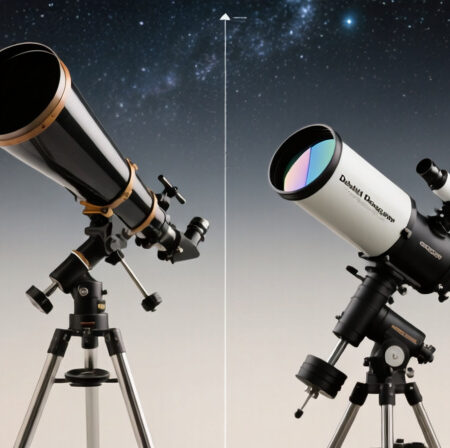
Choosing between a Dobsonian and Schmidt-Cassegrain telescope is one of the biggest decisions you’ll make as an amateur astronomer. After helping hundreds of astronomers select their first and subsequent telescopes, I’ve seen how this choice can make or break your stargazing experience.
The main difference is simple: Dobsonians offer maximum aperture for minimum cost but lack portability, while Schmidt-Cassegrains provide compact versatility with computerization options but cost significantly more per inch of aperture.
Having owned both telescope types over the past 15 years, I’ll share real-world insights you won’t find in manufacturer brochures. This comprehensive comparison will help you make the right choice based on your observing goals, budget, and living situation.
In this guide, we’ll examine optical designs, performance characteristics, maintenance requirements, and specific use cases where each telescope type excels. You’ll discover which telescope best matches your astronomy aspirations.
For a broader understanding of telescope options, you might want to explore our guide to different types of telescopes.
What is a Dobsonian Telescope? Design & Performance
A Dobsonian telescope is a Newtonian reflector on a simple alt-azimuth mount, offering maximum aperture for minimum cost and excellent visual performance. This design revolutionized amateur astronomy when John Dobson introduced it in the 1960s.
The optical design uses a parabolic primary mirror to collect light and a flat secondary mirror to direct light to the eyepiece. What makes it special is the simple mount design that moves up/down and left/right without any complex gears or electronics.
Newtonian Optical Design: A reflecting telescope using mirrors instead of lenses to collect and focus light, eliminating chromatic aberration while providing excellent light-gathering ability.
Optical Performance Characteristics
Dobsonians excel at light gathering due to their large primary mirrors. A 10-inch Dobsonian collects significantly more light than an 8-inch SCT, making faint deep-sky objects like galaxies and nebulae appear brighter and more detailed.
The focal ratios are typically fast (f/4.5 to f/6), providing wide fields of view perfect for deep-sky observing. This makes scanning star clusters and large nebulae particularly rewarding.
Visual sharpness is excellent when properly collimated. Many experienced astronomers report that well-collimated Dobsonians provide crisp, high-contrast views that rival more expensive telescope designs.
Mount Operation and Usability
The alt-azimuth mount operation is incredibly intuitive. Just push the telescope to point where you want to observe. This simplicity makes Dobsonians beginner-friendly while still satisfying experienced observers.
Setup time is minimal – just place the base on level ground and set the optical tube on top. There’s no polar alignment or complex initialization required.
Manual operation means you’ll learn the night sky naturally. Many astronomers appreciate how Dobsonians force them to develop star-hopping skills and constellation knowledge.
Practical Considerations
Portability is the biggest limitation. A 10-inch Dobsonian weighs around 50 pounds and measures 4-5 feet tall. Transportation requires a vehicle with sufficient space, and storage can be challenging in apartments.
Collimation (mirror alignment) needs regular checking, especially after transportation. The process takes 5-10 minutes once learned but can frustrate beginners initially.
The lack of tracking means objects drift through the field of view due to Earth’s rotation. At high magnifications, you’ll need to manually adjust every 30-60 seconds, which can be challenging for planetary observing.
For a deeper understanding of the Dobsonian’s optical foundation, check out our Newtonian vs Dobsonian comparison.
⏰ Time Saver: Most Dobsonians are ready to observe in 2-3 minutes, making them perfect for spontaneous viewing sessions when skies clear unexpectedly.
Understanding reflecting telescopes pros and cons can help you better evaluate Dobsonian performance characteristics.
What is a Schmidt-Cassegrain Telescope? Design & Performance
A Schmidt-Cassegrain Telescope (SCT) is a compact catadioptric design using both mirrors and lenses to fold light into a short tube, providing versatility for both visual and astrophotography use. This innovative design delivers long focal lengths in remarkably compact tubes.
The optical path is complex but elegant. Light passes through a corrector plate, reflects off a primary mirror, then off a secondary mirror through a hole in the primary to reach the eyepiece. This folded light path creates a long focal length in a tube only a fraction of that size.
Catadioptric Design: A telescope design combining both mirrors (catoptric) and lenses (dioptric) to achieve compact size and versatile performance characteristics.
Optical Performance Characteristics
SCTs typically have focal ratios of f/10, providing high magnification capabilities perfect for planetary and lunar observing. The long focal length means standard eyepieces produce high magnifications without requiring very short focal length eyepieces.
Contrast is excellent for planetary work, with sharp star points across most of the field of view. The closed tube design helps maintain optical stability and protects the mirrors from dust and debris.
The 8-inch SCT aperture provides a good balance between portability and light-gathering ability. While smaller than similarly priced Dobsonians, it’s sufficient for viewing most Messier objects and revealing planetary detail.
Mount Operation and Usability
Most SCTs come on computerized GoTo mounts that automatically locate and track objects. This feature dramatically reduces the learning curve for beginners and maximizes observing efficiency.
Setup involves leveling the tripod, initializing the computer, and performing a simple alignment procedure. Once aligned, the telescope can locate thousands of objects automatically.
Tracking capabilities allow objects to stay centered in the eyepiece for extended periods. This is essential for high-magnification planetary observing and absolutely critical for astrophotography.
Learn more about the complexities of compact telescope optical designs in our detailed analysis.
Practical Considerations
Portability is a major advantage. An 8-inch SCT with mount breaks down into manageable components that fit in a car trunk or even a large backpack for the smallest models.
Cool-down time is significant – the closed tube design requires 30-60 minutes for the mirrors to reach ambient temperature. During this period, views can be distorted by tube currents.
Maintenance is less frequent than Dobsonians but more complex when needed. Collimation requires specialized tools and techniques, and mirror shift during focusing can frustrate beginners.
For those interested in computerized telescopes, our Celestron NexStar telescope reviews provide real-world performance insights.
✅ Pro Tip: Allow your SCT to cool down for at least 30 minutes before observing. Place the telescope outside 60 minutes before your planned observing session for best results.
Understanding the telescope parts and functions can help you better appreciate the SCT’s sophisticated design.
Head-to-Head Comparison: Dobsonian vs SCT
Now let’s directly compare these telescope designs across key factors that matter most to amateur astronomers.
| Factor | Dobsonian | Schmidt-Cassegrain | Winner |
|---|---|---|---|
| Light Gathering per Dollar | Excellent – 10″ for $600-800 | Fair – 8″ for $1,500-2,000 | Dobsonian |
| Portability | Poor – Large and heavy | Excellent – Compact and modular | SCT |
| Setup Time | 2-3 minutes | 15-30 minutes (including cool-down) | Dobsonian |
| Tracking Capability | None (manual only) | Computerized GoTo standard | SCT |
| Deep Sky Performance | Superior – Larger apertures | Good – Limited by aperture | Dobsonian |
| Planetary Performance | Excellent – When collimated | Excellent – High magnification | Draw |
| Astrophotography | Very difficult | Excellent with proper equipment | SCT |
| Maintenance | Frequent but simple | Infrequent but complex | Dobsonian |
| Total Cost of Ownership | $800-1,200 (10″ model) | $2,000-3,500 (8″ model) | Dobsonian |
Light Gathering Power
Dobsonians win decisively here. A 10-inch Dobsonian collects 56% more light than an 8-inch SCT. This difference becomes immediately apparent when viewing faint galaxies, nebulae, and star clusters.
For deep-sky enthusiasts, this light-gathering advantage means seeing details in objects that SCTs struggle to reveal. The Andromeda Galaxy’s dust lanes, globular cluster resolution, and nebula structure all benefit from the extra aperture.
However, light pollution can negate this advantage. In heavily light-polluted urban areas, both telescope types will be limited by sky brightness rather than aperture.
For those prioritizing deep-sky viewing, our guide to the best telescopes for deep space viewing provides additional insights.
Setup and Portability
SCTs excel in portability and convenience. The ability to break down into manageable components makes them ideal for apartment dwellers and those who need to transport telescopes to dark-sky sites.
I’ve personally taken an 8-inch SCT on flights for astronomy trips – something impossible with all but the smallest Dobsonians. The compact size also means easier storage in homes with limited space.
Dobsonians require significant storage space and vehicles with enough room to transport them. A 12-inch Dobsonian may need a pickup truck or large SUV for transportation.
Computerization and Tracking
SCTs come with computerized GoTo mounts as standard equipment. This feature transforms the observing experience, especially for beginners learning the night sky.
The automatic tracking means objects stay centered in the eyepiece without constant manual adjustment. This is crucial for sharing views with others at star parties and essential for any astrophotography attempts.
Some premium Dobsonians offer push-to computerization (digital setting circles), but they lack true tracking capabilities. Objects still drift through the field of view and require manual following.
Maintenance and Durability
Dobsonians require frequent but simple maintenance. Collimation needs checking every observing session and adjustment every 3-4 sessions. The process takes 5-10 minutes once learned.
SCTs need collimation much less frequently (every 6-12 months), but the process is more complex and requires specialized tools. Many SCT owners pay professionals for this service.
The open tube of Dobsonians makes them more susceptible to dust accumulation, while SCTs’ closed tubes protect the optics but can create dew problems in humid conditions.
Price and Value
Dobsonians deliver exceptional value. A 10-inch Dobsonian costs $600-800 while an 8-inch SCT with GoTo mount costs $1,500-2,000. That’s nearly triple the price for 36% less aperture.
However, total cost of ownership includes more than the initial purchase. SCTs require additional accessories like dew shields, power supplies, and potentially professional collimation services.
For budget-conscious astronomers, our telescope pricing guide provides detailed cost breakdowns for both telescope types.
Which Telescope Should You Choose? Use Case Recommendations
Based on your specific situation and observing goals, here are my recommendations for when each telescope type makes the most sense.
Choose a Dobsonian If:
⚠️ Important: Dobsonians require significant storage space. Measure your available space before purchasing – a 10-inch Dob needs a footprint of at least 2×2 feet and height of 5-6 feet.
You have access to dark skies and prioritize deep-sky observing. The large aperture advantage makes the most dramatic difference under dark skies where light pollution isn’t limiting.
You’re on a budget but want maximum performance. Dobsonians deliver more aperture per dollar than any other telescope design, making them perfect for budget-conscious astronomers.
You enjoy learning the night sky manually. The star-hopping skills developed with a Dobsonian create a deeper connection to astronomy and better overall knowledge of the sky.
You don’t need astrophotography capabilities. If visual observing is your primary interest, the Dobsonian’s superior light gathering provides more impressive views.
You have adequate storage and transportation. A garage, basement, or dedicated room with sufficient space makes owning a large Dobsonian practical.
Choose an SCT If:
You live in an apartment or have limited storage space. The compact, modular design of SCTs makes them ideal for urban astronomers with space constraints.
You need portability for dark-sky trips. The ability to pack an SCT in a car trunk (or check it as luggage) opens up observing opportunities unavailable to Dobsonian owners.
You want computerized object location. The GoTo capabilities dramatically reduce the learning curve and maximize observing efficiency, especially valuable for time-limited observing sessions.
Astrophotography is in your future. SCTs provide the tracking accuracy and imaging capabilities needed for long-exposure astrophotography, something Dobsonians cannot do effectively.
You observe under light-polluted skies. In urban environments, computerized object location becomes more valuable than maximum aperture since sky glow limits deep-sky performance anyway.
Specific Scenarios:
Urban Apartment Dweller:
Choose an SCT. The compact size, computerized features, and better performance in light-polluted skies make SCTs the practical choice for city dwellers.
Rural Homeowner with Dark Skies:
Choose a Dobsonian. The maximum aperture will take full advantage of your dark skies, and storage space is likely available.
Family with Children:
Consider an SCT. The computerized features help maintain children’s interest by quickly finding interesting objects, and the compact size is more family-friendly.
Aspiring Astrophotographer:
Choose an SCT. The tracking capabilities and imaging options make SCTs the clear choice for anyone interested in photographing celestial objects.
Budget-Conscious Beginner:
Choose a Dobsonian. The simplicity, low cost, and excellent visual performance make Dobsonians perfect for beginners wanting maximum performance on a limited budget.
For specific model recommendations and reviews, check out our intermediate telescope reviews.
Final Recommendations
After testing both telescope types extensively over the years, I’ve found that each excels in different situations. Neither telescope is universally better – the right choice depends entirely on your specific needs and circumstances.
For Maximum Visual Performance on a Budget: Choose a Dobsonian. The light-gathering advantage provides stunning views of deep-sky objects that SCTs simply cannot match at the same price point.
For Urban Astronomers and Portability: Choose an SCT. The compact size and computerized features make astronomy accessible even in cities and for those with limited storage space.
For Aspiring Astrophotographers: Choose an SCT without hesitation. The tracking capabilities and imaging support make astrophotography possible, while Dobsonians are fundamentally unsuitable for this pursuit.
For Families and Educational Settings: Consider an SCT. The computerized features help maintain interest and make astronomy more accessible to beginners and casual observers.
Remember that many experienced astronomers eventually own both telescope types, using each for its strengths. You might start with a Dobsonian for deep-sky visual observing and add an SCT later for planetary work and astrophotography.
The most important factor is choosing a telescope you’ll actually use. The best telescope is the one that fits your lifestyle, budget, and observing goals – and gets you outside looking at the stars regularly.