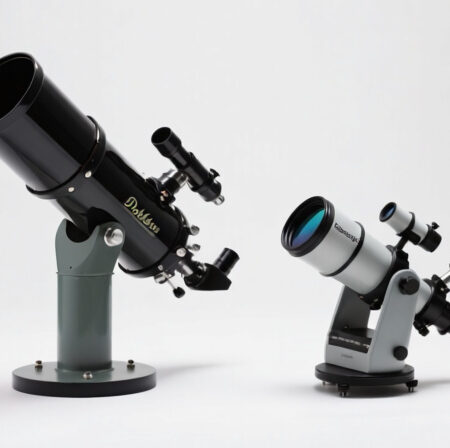
Standing in the telescope aisle, I’ve seen that overwhelmed look countless times. The choice between a Dobsonian and Cassegrain telescope can paralyze even enthusiastic beginners.
After testing both designs extensively across different observing conditions, I can tell you this: Dobsonian telescopes deliver maximum aperture for your money and excel at visual deep-sky observation, while Cassegrain telescopes offer compact versatility with superior astrophotography capabilities.
This isn’t just about technical specifications—it’s about matching your telescope to your lifestyle, observing goals, and budget. I’ve spent countless nights under dark skies with both designs, and the right choice transformed my astronomy experience from frustrating to phenomenal.
This comprehensive comparison will walk you through every critical difference, from real-world performance to practical considerations you won’t find in marketing materials. We’ll explore which design fits your specific needs, whether you’re a beginner seeking simplicity or an advanced user planning astrophotography adventures.
Quick Comparison: Dobsonian vs Cassegrain at a Glance
For those who want immediate answers, here’s how these telescope designs stack up across the most important factors:
| Feature | Dobsonian Telescope | Cassegrain Telescope | Winner |
|---|---|---|---|
| Best Value | Excellent – Large aperture for cost | Expensive – Compact design costs more | Dobsonian |
| Deep Sky Viewing | Superior – Larger apertures available | Good – Limited by smaller apertures | Dobsonian |
| Portability | Poor – Bulky and heavy | Excellent – Compact and transportable | Cassegrain |
| Astrophotography | Limited – Manual tracking only | Excellent – Designed for imaging | Cassegrain |
| Setup Time | 5-10 minutes | 30-60 minutes (including cool-down) | Dobsonian |
| Maintenance | Regular collimation needed | Less frequent but more complex | Dobsonian |
| Beginner Friendly | Very – Simple operation | Moderate – More complex setup | Dobsonian |
Quick Summary: Choose a Dobsonian for maximum visual performance on a budget, especially for deep-sky objects. Choose a Cassegrain if you need portability, want to pursue astrophotography, or have limited storage space.
Dobsonian Telescope: Simplicity and Power
The Dobsonian telescope represents brilliant engineering in its simplicity. Named after John Dobson, who revolutionized amateur astronomy by making large telescopes accessible to everyone, this design combines a Newtonian reflector optical tube with an intuitive alt-azimuth mount.
Dobsonian Telescope: A Newtonian reflector telescope mounted on a simple altitude-azimuth base that allows easy up-down and left-right movement. Known for offering the largest aperture per dollar of any telescope design.
What makes Dobsonians special is their focus on what matters most for visual astronomy: aperture. These telescopes deliver massive light-gathering power at prices that would be impossible with other designs. I’ve seen beginners with 8-inch Dobsonians views that outperform experienced observers with smaller, more expensive telescopes.
How Dobsonians Work?
The Dobsonian design follows the Newtonian reflector principle: light enters the tube, reflects off a large primary mirror at the bottom, then bounces up to a secondary mirror that redirects light to the eyepiece on the side. This straightforward optical path maximizes light collection while minimizing cost.
The mount design is equally simple but surprisingly effective. Using gravity and friction rather than complex gears, Dobsonian mounts provide smooth manual tracking that becomes second nature after a few observing sessions. The simplicity extends to setup—just place the telescope on its base, and you’re ready to observe within minutes.
Dobsonian Advantages
Unmatched Value: The biggest advantage is aperture for your money. An 8-inch Dobsonian typically costs $400-600, while an 8-inch Cassegrain runs $1,200-1,800. This price difference means you can buy a 12-inch Dobsonian for less than a 6-inch Cassegrain, delivering four times more light-gathering power.
Visual Performance: For deep-sky objects—galaxies, nebulae, and star clusters—Dobsonians excel. The large apertures reveal faint details that smaller telescopes simply cannot detect. I’ve observed the Andromeda Galaxy’s spiral arms clearly through an 8-inch Dobsonian that were barely visible through a 6-inch Cassegrain.
Simplicity and Reliability: With no electronics or complex components, Dobsonians rarely fail. The straightforward design means fewer things can go wrong, and repairs are typically simple. I’ve used the same Dobsonian for over a decade with only basic maintenance.
Fast Cooling: Large, thin mirrors cool down quickly compared to the thick corrector plates found in Cassegrains. This means you can start observing sooner, especially in temperature-changing conditions.
Dobsonian Limitations
Manual Tracking Only: The biggest drawback is the lack of automatic tracking. High magnification viewing requires constant manual adjustment to keep objects centered. This becomes tiring during long observing sessions and makes astrophotography nearly impossible without additional equipment.
Portability Issues: Even “portable” Dobsonians are large and heavy. An 8-inch model weighs 40-50 pounds and requires significant storage space. Larger apertures become two-person handling jobs. I learned this the hard way when upgrading to a 12-inch model that barely fits in my car.
Storage Requirements: The long optical tubes and bulky bases demand dedicated storage space. Urban astronomers with limited space may struggle to accommodate even medium-sized Dobsonians.
Best Dobsonian Use Cases
Dobsonians shine for visual deep-sky enthusiasts who prioritize performance over portability. They’re ideal for:
- Beginners seeking maximum value – The best way to see impressive views on a budget
- Deep-sky observers – Galaxies, nebulae, and star clusters
- Rural dark-sky sites – Where you can leave them set up or have space to transport
- Visual astronomy purists – Those who prefer observing over imaging
- Teaching and outreach – Simple operation for groups
Cassegrain Telescope: Compact Versatility
Cassegrain telescopes represent the pinnacle of optical engineering, packing long focal lengths into compact tubes through folded optics. The most common variants are Schmidt-Cassegrain (SCT) and Maksutov-Cassegrain, each using different corrector plates but sharing the same fundamental design principle.
Cassegrain Telescope: A reflecting telescope that folds the light path using a primary mirror and secondary mirror, achieving long focal lengths in compact tubes. Most include a corrector plate at the front for improved image quality.
The genius of the Cassegrain design lies in its space efficiency. By bouncing light back and forth within the tube, these telescopes achieve focal lengths of 2,000mm or more in tubes only 12-16 inches long. This compact design makes them perfect for urban astronomers and anyone with limited space.
After years of using both designs, I’ve come to appreciate the Cassegrain’s versatility. While they cost more per inch of aperture, their flexibility across different observing types—from planetary viewing to astrophotography—makes them excellent all-around performers.
How Cassegrains Work?
The Cassegrain optical system is more complex but brilliantly efficient. Light enters through a corrector plate (either the Schmidt corrector or Maksutov meniscus), reflects off the primary mirror at the back, then hits a convex secondary mirror that sends the light back through a hole in the primary mirror to the eyepiece.
This folded design achieves tremendous focal lengths in remarkably short tubes. An 8-inch SCT might have a 2,032mm focal length in a tube just 16 inches long, compared to a Dobsonian’s 1,200mm focal length in a tube 48 inches long. The result is higher magnification potential and a more portable package.
Cassegrain Advantages
Compact Design: The most obvious advantage is portability. An 8-inch Cassegrain fits in a backpack-sized case, making it ideal for apartment dwellers and travelers. I’ve taken my SCT to dark-sky sites in the trunk of a small car—something impossible with an equivalent aperture Dobsonian.
Astrophotography Ready: Cassegrains are designed for imaging. Their long focal lengths are perfect for planetary photography, and their tracking capabilities (especially with GoTo mounts) make them excellent for deep-sky imaging. The stable mount and precise tracking enable exposures of minutes rather than seconds.
GoTo and Tracking: Most Cassegrains come with computerized GoTo systems that automatically locate and track thousands of objects. This feature is invaluable for urban astronomers with limited visibility and for astrophotographers who need precise tracking.
Weather Resistance: The closed tube design protects optics from dust, moisture, and temperature changes. This means less frequent cleaning and better optical performance over time compared to open-tube designs.
Cassegrain Limitations
Higher Cost: The biggest drawback is price. Cassegrains cost 2-3 times more than Dobsonians of equivalent aperture. You’ll pay $1,200-1,800 for an 8-inch SCT compared to $400-600 for an 8-inch Dobsonian.
Long Cool-Down Time: The thick corrector plate and closed tube design mean Cassegrains take 30-60 minutes to reach thermal equilibrium after being moved outdoors. During this time, images suffer from tube currents and poor contrast. I’ve learned to set up my SCT well before I plan to observe.
Complex Maintenance: While collimation is needed less frequently than with Dobsonians, it’s more complex when required. Accessing the optics often requires tools and careful alignment procedures.
Smaller Apertures: Due to cost and manufacturing complexity, most amateur Cassegrains top out at 11-14 inches, while Dobsonians are commonly available in 16-20 inch sizes. This limits their deep-sky performance compared to large Dobsonians.
Best Cassegrain Use Cases
Cassegrains excel for astronomers who value versatility and portability over pure aperture. They’re ideal for:
- Urban astronomers – Compact size and light pollution resistance
- Astrophotographers – Built-in tracking and imaging capabilities
- Planetary observers – High magnification for solar system details
- Traveling astronomers – Portability for dark-sky trips
- Apartment dwellers – Compact storage requirements
Head-to-Head: Detailed Performance Analysis
Now let’s dive deep into how these telescope designs compare across the factors that matter most for real-world observing. Having spent hundreds of hours with both designs, I can tell you that the differences extend far beyond simple specifications.
Optical Performance
The optical performance comparison reveals fundamental differences in how these designs approach image quality. For visual astronomy, aperture is king—and Dobsonians deliver more of it for your money.
Light Gathering Power: An 8-inch Dobsonian collects 560% more light than a 90mm Cassegrain. This difference is dramatic when viewing faint deep-sky objects. I’ve observed the Whirlpool Galaxy’s spiral structure clearly through an 8-inch Dobsonian that was barely detectable through a 90mm Maksutov.
Resolution: Both designs can deliver excellent resolution when properly collimated. However, the larger apertures available in Dobsonians provide better theoretical resolution. An 8-inch telescope can resolve details as small as 0.57 arcseconds, while a 6-inch telescope is limited to 0.76 arcseconds.
Contrast: Maksutov-Cassegrains often deliver superior contrast for planetary viewing due to their small secondary mirrors and excellent spherical correction. However, well-made Dobsonians with quality mirrors provide excellent contrast across all observing types.
Field of View: Dobsonians typically provide wider fields of view due to their faster focal ratios (f/4-f/8 vs f/10-f/15 for Cassegrains). This makes them better suited for large deep-sky objects like star clusters and nebulae.
Ease of Use
The user experience differs significantly between these designs, especially for beginners. After teaching many newcomers with both telescope types, I’ve observed clear patterns in what works best.
Setup Time: Dobsonians win here hands down. Just place the tube on the base and you’re observing within 5 minutes. Cassegrains require mount setup, power connections, alignment procedures, and 30-60 minutes of cool-down time before optimal viewing.
Learning Curve: Dobsonians are more intuitive for beginners. The simple push-to pointing and manual tracking help newcomers learn the night sky naturally. Cassegrains require understanding GoTo alignment procedures, electronics, and more complex operations.
Pointing and Navigation: Modern Cassegrains with GoTo systems can automatically locate thousands of objects, which is invaluable in light-polluted areas. However, I’ve found that manual navigation with Dobsonians helps develop better star-hopping skills and sky knowledge over time.
Maintenance Requirements
Maintenance considerations often surprise new telescope owners. Both designs require attention, but in different ways and frequencies.
Collimation Frequency: Dobsonians typically need collimation every 1-2 months or after transportation. The process is straightforward and takes 10-15 minutes with practice. Cassegrains need collimation less frequently (every 6-12 months) but the process is more complex, often requiring special tools.
Cleaning: Dobsonians’ open tubes expose the primary mirror to dust and require occasional cleaning. Cassegrains’ closed tubes protect optics better, but when cleaning is needed, it often requires professional service due to the corrector plate’s sensitivity.
Long-term Care: Dobsonians have fewer components that can fail over time. Cassegrains include electronics, motors, and more complex mechanics that may require servicing. I’ve seen 20-year-old Dobsonians still performing perfectly, while older Cassegrains often need electronic repairs.
Portability and Storage
This is where the designs diverge dramatically. Your living situation and observing habits will heavily influence which telescope works better for you.
Transportation: An 8-inch Dobsonian requires a car with significant trunk space and weighs 40-50 pounds total. The tube alone is 4 feet long. An 8-inch Cassegrain weighs 25-30 pounds and fits in a backpack-sized case just 16 inches long.
Storage Space: Dobsonians need dedicated floor space for both tube and base. The 8-inch model I use requires a 4×4 foot area when stored vertically. Cassegrains can be stored in a closet or on a shelf when disassembled.
Setup Location: Dobsonians work best when they can be left set up in a permanent or semi-permanent location. Cassegrains are designed for frequent setup and teardown, making them better for apartment balconies or transport to observing sites.
Price Analysis
The cost difference between these designs is substantial and affects long-term telescope satisfaction. Having purchased and sold many telescopes over the years, I’ve learned that value depends on your specific needs.
Entry-Level Comparison: A 6-inch Dobsonian costs $300-400, while a 6-inch Cassegrain starts at $800-1,000. For the price of an entry-level Cassegrain, you can buy a 10-12 inch Dobsonian with double the light-gathering power.
Mid-Range Options: 8-10 inch Dobsonians run $600-1,200, while 8-inch Cassegrains cost $1,200-1,800. The price gap narrows at larger apertures but remains significant.
Total Cost of Ownership: Consider additional costs: Dobsonians may need collimation tools ($50-100) and eyepieces ($200-500 for a good set). Cassegrains often require power supplies ($50-100), additional counterweights ($100-200), and potentially wedge mounts for astrophotography ($300-500).
Resale Value: Both designs hold value well in the used market. However, Dobsonians often have better resale value as a percentage of original cost due to their simpler nature and lower initial prices.
Astrophotography Potential
If you’re interested in astrophotography, this comparison becomes much more one-sided. After attempting imaging with both designs, I can provide realistic expectations.
Dobsonian Imaging: Basic Dobsonians are unsuitable for serious astrophotography due to manual tracking. Even short exposures (30 seconds) show trailing. Some enterprising astronomers add tracking platforms, but these cost $500-1,000 and still provide limited capability.
Cassegrain Imaging: Cassegrains are designed for astrophotography. Their equatorial mounts enable precise tracking, long focal lengths are perfect for planetary imaging, and their closed tubes protect sensitive cameras from dew. I’ve captured 5-minute exposures of nebulae with my SCT that would be impossible with a Dobsonian.
Planetary vs Deep-Sky: Cassegrains excel at planetary imaging due to their long focal lengths. For deep-sky imaging, both designs work, but the Cassegrain’s tracking advantage makes it far more practical for most photographers.
Which Telescope for Your Needs? Use Case Recommendations
After comparing the technical differences, let’s translate this into practical recommendations based on specific user needs. I’ve counseled hundreds of beginners and experienced observers, and these patterns consistently emerge.
Beginner Recommendations
For most beginners, I recommend starting with a 6-8 inch Dobsonian unless portability is your primary concern. The reasons are compelling:
- Maximum learning value – Manual navigation helps you learn the night sky naturally
- Better visual performance – You’ll see more impressive views that maintain enthusiasm
- Lower financial risk – If astronomy doesn’t become a long-term hobby, you’ve invested less
- Simpler operation – Fewer components to understand and maintain
The beginner exception? If you live in an apartment with no storage space or plan to focus on astrophotography from day one, a smaller Cassegrain (6-8 inch) might be more practical despite the higher cost.
⚠️ Important: Avoid telescopes advertised by magnification power. Focus on aperture size—larger apertures always provide better views regardless of magnification claims.
Urban Astronomy Considerations
City dwellers face unique challenges that favor certain telescope designs. After years of observing from light-polluted locations, here’s what works best:
Apartment Living: A 6-8 inch Cassegrain or tabletop Dobsonian makes the most sense. You can easily carry it to a balcony or nearby park for observing sessions. Full-sized Dobsonians become furniture rather than functional tools in small spaces.
Light Pollution Strategy: In light-polluted areas, you’ll primarily observe brighter objects (planets, moon, double stars, bright clusters). Cassegrains excel at planetary viewing due to their high magnification capabilities, making them better suited for urban environments.
Transportation: If you need to drive to darker skies, a Cassegrain’s portability becomes a significant advantage. I regularly take my SCT to dark-sky sites 45 minutes away—something I stopped doing with my large Dobsonian due to the hassle.
Rural Dark Sky Recommendations
For those with access to dark skies, the aperture advantage of Dobsonians becomes overwhelming:
Deep Sky Focus: If you want to observe faint galaxies, nebulae, and star clusters, a 10-12 inch Dobsonian will show objects that remain invisible through 8-inch Cassegrains. The difference is not subtle—it’s often the difference between detecting an object and seeing detailed structure within it.
Permanent Setup: If you can leave a telescope set up in a backyard or observatory, a large Dobsonian becomes practical. The portability disadvantages disappear when you don’t need to transport the telescope.
Astrophotography Path
If astrophotography is your primary interest, Cassegrains are clearly the better choice:
Start Right: Beginning astrophotography with a Dobsonian means buying another telescope later. Starting with a Cassegrain provides a more direct path to imaging success.
Budget Considerations: Remember that astrophotography requires additional equipment regardless of telescope type. A quality camera, mounting accessories, and processing software add $1,000-2,000 to your total investment. The telescope is just one component of an imaging system.
Budget-Based Recommendations
Your budget will heavily influence which telescope provides the best value:
Under $500: 6-8 inch Dobsonian is your best option. You’ll get maximum aperture and visual performance for your money.
$500-1,000: 8-10 inch Dobsonian or 6-8 inch Cassegrain. Choose based on portability needs rather than performance—both will provide excellent views.
$1,000-2,000: 10-12 inch Dobsonian or 8 inch Cassegrain with GoTo. This is where the decision becomes genuinely difficult and depends on your specific goals.
Over $2,000: Large Dobsonian (12-16 inch) for pure visual performance, or premium Cassegrain (9-11 inch) for versatility and astrophotography capability.
✅ Pro Tip: Consider buying used telescopes to get more aperture for your money. Well-maintained Dobsonians and Cassegrains often sell for 50-70% of their original price.
Final Verdict: Making Your Telescope Decision
After decades of observing with both telescope designs, teaching countless beginners, and experiencing the frustrations and triumphs of each approach, here’s my honest assessment:
Choose a Dobsonian if: You want maximum visual performance for your money, enjoy the process of learning the night sky manually, have storage space, and primarily observe from dark locations. The viewing experience is simply spectacular, and the value is unbeatable.
Choose a Cassegrain if: You need portability, live in an apartment, want to pursue astrophotography, or require the convenience of GoTo tracking. The versatility and compact design justify the higher cost if these factors align with your needs.
⏰ Time Saver: Don’t overthink your first telescope. Both designs can provide a lifetime of enjoyment. The most important factor is getting a telescope you’ll actually use regularly rather than one that sits in a closet.
Remember that the best telescope is the one you’ll use most often. I’ve owned premium telescopes of both designs that collected dust because they were inconvenient to set up, while simpler models saw weekly use. Consider your lifestyle, observing location, and primary interests rather than just specifications.
Whichever path you choose, welcome to the incredible hobby of amateur astronomy. The night sky awaits with wonders that will continually inspire and amaze you. Clear skies!