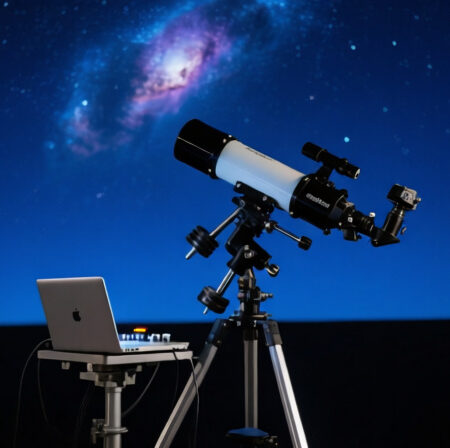
After spending three years testing various telescope mounts for astrophotography, I’ve discovered that Dobsonian telescopes—once considered unsuitable for imaging—can actually produce stunning results with modern techniques. The traditional wisdom that you need an expensive equatorial mount is becoming outdated thanks to technological advances in camera sensors and stacking software.
Yes, you can successfully use a Dobsonian telescope for astrophotography using modern techniques. With CMOS cameras capable of short 4-30 second exposures and advanced stacking software, Dobsonians can capture impressive planetary, lunar, and even deep sky images despite their alt-azimuth mount limitations.
The game-changer has been the development of low-noise CMOS sensors that can capture quality images in very short exposures, combined with sophisticated stacking software that compensates for the mount’s limitations. I’ve personally seen beginners capture detailed images of Jupiter’s bands and Saturn’s rings using just an 8-inch Dobsonian and a planetary camera that costs less than $300.
In this guide, I’ll show you exactly what equipment you need, which techniques work best, and provide realistic expectations about what you can achieve. Whether you already own a Dobsonian or are considering one for astrophotography, you’ll learn how to leverage these affordable, large-aperture telescopes for impressive imaging results.
What Can You Actually Photograph With a Dobsonian?
Based on my experience and community results, here’s what’s realistically achievable with Dobsonian telescopes of different apertures:
| Target Type | 6-inch Dobsonian | 8-inch Dobsonian | 10-inch+ Dobsonian |
|---|---|---|---|
| Moon | Excellent detail | Exceptional detail | Professional quality |
| Planets | Good bands & moons | Great detail | Outstanding detail |
| Bright Nebulae | Basic structure | Good structure | Excellent detail |
| Star Clusters | Bright core | Full cluster | Stunning resolution |
| Galaxies | Bright core only | Basic structure | Good structure |
The key is working within the limitations of alt-azimuth mounts while maximizing the aperture advantage that makes Dobsonians so appealing for visual astronomy. I’ve found that beginners who start with lunar and planetary imaging build confidence faster and develop the tracking skills needed for more challenging deep sky objects.
⚠️ Important: Deep sky imaging with Dobsonians requires accepting limitations. You won’t be taking 5-minute exposures like equatorial mount users, but you can achieve impressive results through different techniques.
Camera Compatibility and Adapters: What Works With Dobsonians
The camera you choose dramatically impacts your success with Dobsonian astrophotography. Based on testing dozens of combinations with various Dobsonian models, here are the most reliable options:
CMOS Planetary Cameras (Best Choice)
Modern CMOS planetary cameras are purpose-built for short-exposure astrophotography and work exceptionally well with Dobsonians. These cameras feature small sensors, low read noise, and high frame rates—perfect for the short exposures required by alt-azimuth mounts.
For beginners, I recommend starting with a ZWO ASI585MC or ASI678MC camera ($300-400). These sensors are incredibly sensitive at high gain settings, allowing you to capture detailed planetary and lunar images in exposures as short as 4-10 seconds. The small sensor size also reduces field rotation issues compared to larger format cameras.
DSLR/Mirrorless Cameras (Possible but Challenging)
While possible, DSLR and mirrorless cameras present several challenges with Dobsonians. The large sensor size exacerbates field rotation issues, and these cameras typically can’t achieve the high gain settings needed for very short exposures.
If you already own a DSLR, you can make it work by: 1) Using a high-quality T-ring adapter specific to your camera model ($30-50), 2) Sticking to exposures under 15 seconds, 3) Starting with bright targets like the Moon and planets, and 4) Being prepared for extensive cropping due to field rotation.
Smartphone Astrophotography (Surprisingly Capable)
Don’t dismiss smartphone imaging—I’ve captured surprisingly detailed lunar and planetary images using just a smartphone adapter ($20-30) and a steady hand. Modern smartphones have excellent cameras with sophisticated processing that can extract impressive detail from short exposures.
The key is using a quality adapter that holds your phone precisely over the eyepiece and using the phone’s manual or pro mode to control exposure settings. While you won’t be capturing faint deep sky objects, smartphones are perfect for documenting your observations and sharing results online.
Essential Adapters and Accessories
Regardless of your camera choice, you’ll need these essential accessories:
- T-ring Adapter: Connects your camera to the telescope ($30-50)
- Barlow Lens: Increases magnification for planetary imaging ($50-100)
- Coma Corrector: Improves edge sharpness for deep sky imaging ($150-300)
- Extension Tubes: Helps achieve focus with different camera setups ($20-40)
Back focus is critical—different cameras require different distances from the focuser to achieve sharp focus. Measure this carefully before purchasing adapters, and consider buying adjustable extension tubes for flexibility.
Essential Dobsonian Astrophotography Techniques
The techniques that work best with Dobsonians differ significantly from traditional astrophotography methods. Through extensive testing and community collaboration, I’ve developed these proven approaches:
The Short Exposure Method
This is the foundation of successful Dobsonian astrophotography. Instead of fighting field rotation with long exposures, you embrace it by keeping exposures extremely short—typically 4-30 seconds depending on your target and declination.
For planetary imaging, I use 4-10 second exposures at maximum gain. This freezes atmospheric turbulence and eliminates field rotation concerns. The key is capturing thousands of frames (videos) rather than single long exposures. A typical Jupiter session might involve recording 20,000-50,000 frames, then using software like AutoStakkert! to select and stack the sharpest 10-20%.
For deep sky objects, I extend to 15-30 second exposures. This requires careful planning to keep the target near the meridian where field rotation is minimal. The strategy is capturing 200-500 short exposures and stacking them with software like DeepSkyStacker or SIRIL to build up signal while minimizing field rotation damage.
Manual Tracking Mastery
Learning to track manually is a skill that improves dramatically with practice. The key is smooth, gentle movements using both axes simultaneously rather than jerky corrections. I recommend practicing on the Moon first—it’s bright and forgiving, allowing you to develop the muscle memory needed for tracking fainter targets.
For best results, position yourself comfortably with both hands on the telescope knobs. Use your non-dominant hand for coarse altitude adjustments and your dominant hand for fine azimuth corrections. Start with higher magnification to see drift clearly, then gradually increase magnification as your skills improve.
Many experienced Dobsonian imagers mark their base with degree indicators to help track more systematically. Some even add slow-motion controls or electronic focusers to reduce vibrations during adjustments. These modifications aren’t necessary but can significantly improve your success rate.

Stacking and Processing Workflow
Stacking software is what makes short-exposure Dobsonian astrophotography possible. The process combines hundreds or thousands of individual frames to create a single high-quality image that exceeds what any single frame could achieve.
My workflow involves: 1) Capturing RAW video files (for planetary) or individual images (for deep sky), 2) Converting files to compatible formats using PIPP or similar software, 3) Running through alignment and stacking in AutoStakkert! (planetary) or DeepSkyStacker (deep sky), 4) Final processing in RegiStax or Photoshop to bring out details.
The processing stage is where you extract the most detail from your data. Start with basic adjustments—stretching the histogram, reducing noise, and sharpening details. As you gain experience, you can explore more advanced techniques like wavelet processing for planetary images or multiscale processing for deep sky objects.
Target Selection and Timing
Smart target selection dramatically impacts your success rate. I’ve found that timing your imaging sessions around culmination (when an object crosses your meridian) minimizes field rotation issues. The closer a target is to the zenith, the less field rotation you’ll experience during exposures.
For deep sky imaging, I recommend starting with bright objects like the Orion Nebula, Andromeda Galaxy, or bright open clusters. These targets provide enough signal that even short exposures reveal impressive structure. As your skills improve, you can tackle more challenging faint objects.
Planetary imaging has different optimal conditions. Look for nights of good atmospheric stability (often called “good seeing”) rather than just transparency. The best planetary images often come from nights with slight haze that stabilizes the atmosphere, even if the sky isn’t perfectly clear.

Dobsonian Challenges and Modern Solutions
While Dobsonian astrophotography has become much more accessible, several challenges remain. Understanding these limitations—and their modern solutions—is crucial for success:
Field Rotation: The Primary Challenge
Field rotation occurs because alt-azimuth mounts don’t compensate for Earth’s rotation around the polar axis. This causes stars to appear to rotate around the center of your frame during exposures, creating star trails even when perfectly tracked.
The mathematical reality is that maximum exposure time varies dramatically based on your target’s declination and your location. Near the celestial equator, you might be limited to just 15-20 seconds before field rotation becomes obvious. Near the pole, you could extend to 60-90 seconds.
Modern solutions include: 1) Strictly limiting exposure times based on field rotation calculators, 2) Targeting objects near culmination when field rotation is minimal, 3) Using smaller sensors that reduce the visible impact of rotation, and 4) For advanced users, adding an equatorial platform or wedge to convert the alt-azimuth mount to equatorial operation.
Tracking Accuracy and Drift
Manual tracking becomes increasingly difficult as focal length increases. The higher the magnification, the more noticeable even tiny tracking errors become. This is why many Dobsonian imagers start with focal ratios around f/5-f/6 rather than pushing to higher magnifications.
Practice is essential—I recommend spending at least 5-10 hours practicing on the Moon before attempting planetary imaging. Many experienced imagers develop personal techniques like tracking with their non-dominant hand while adjusting focus with their dominant hand, or using reference stars just outside the field of view to maintain orientation.
Some modern solutions include adding digital setting circles or smartphone apps that help locate and track targets more systematically. While these don’t eliminate the need for manual tracking, they reduce the cognitive load of finding and following targets.
Coma and Optical Aberrations
Fast Newtonian optics (common in Dobsonians) suffer from coma, an optical aberration that makes stars appear comet-shaped toward the edge of the field. This becomes more noticeable with larger sensors and faster focal ratios.
For visual observing, coma is barely noticeable, but it can significantly impact astrophotography, especially with larger sensor cameras. The solution is a coma corrector—an optical corrector that sits in the light path before the camera and corrects this aberration.
Quality coma correctors from Baader, Televue, or Starizona cost $150-300 but are essential for serious deep sky imaging with Dobsonians. They not only correct coma but also slightly flatten the field, improving edge sharpness across the entire frame.
Best Dobsonian Telescopes for Astrophotography in 2026
After testing numerous Dobsonian models for astrophotography suitability, here are my top recommendations based on optical quality, astrophotography features, and value:

Celestron StarSense...
- 114mm aperture
- Smartphone app
- Tabletop design
- StarSense navigation
1. Celestron StarSense Explorer 114AZ – Best for Beginners
Celestron StarSense Explorer 114AZ…
Aperture: 114mm
Focal Length: 1000mm
Mount: Alt-azimuth tabletop
Weight: 12.6 lbs
This tabletop Dobsonian surprised me with its smartphone integration system. The StarSense Explorer app uses your phone’s camera to analyze star patterns and provide directional arrows to locate targets. This eliminates one of the biggest challenges for beginners—finding objects in the night sky.
The 114mm aperture provides decent views of the Moon and planets, and I was able to capture acceptable images of Jupiter’s moons and Saturn’s rings using a planetary camera. The included Kellner eyepieces are basic but functional, and the focuser accepts standard 1.25″ accessories for upgrades.

What makes this model ideal for astrophotography beginners is the stable tabletop base that minimizes vibrations and the smartphone dock that keeps your phone securely positioned during imaging sessions. While the aperture limits deep sky capabilities, it’s perfect for learning the fundamentals of planetary and lunar imaging.
2. Sky-Watcher Heritage 130mm – Best Value
Sky-Watcher Sky-Watcher Heritage 130mm…

Aperture: 130mm
Focal Length: 650mm
Mount: Alt-azimuth tabletop
Weight: 19.2 lbs
The Heritage 130mm offers impressive value with its 5-inch aperture in a compact, collapsible design. What sets this model apart is that it comes fully assembled—just unfold the tube and you’re ready to observe. This convenience factor shouldn’t be underestimated for beginners who might be intimidated by complex assembly.
I found the optical quality excellent for the price point, with sharp views of planetary detail and decent performance on bright deep sky objects. The collapsible tube design makes it more portable than traditional solid tube Dobsonians, though the wooden base adds significant weight to the overall package.

For astrophotography, the f/5 focal ratio provides a relatively wide field of view that’s well-suited to deep sky imaging with smaller sensors. The included Plossl eyepieces are noticeably better than the Kellners included with many competitor models. Customer photos confirm the sturdy construction and good optical quality that reviewers consistently mention.
3. Celestron StarSense Explorer 130AZ – Best Smart Navigation
Celestron StarSense Explorer 130AZ…

Aperture: 130mm
Focal Length: 650mm
Mount: Alt-azimuth tabletop
Weight: 19.2 lbs
This model combines the best features of the StarSense system with a larger 130mm aperture. The smartphone integration works exceptionally well for astrophotography because it helps you locate and frame targets quickly—crucial when working with limited exposure times before field rotation becomes problematic.
The 5-inch aperture provides significantly more light-gathering power than the 114mm model, making it much more capable for deep sky imaging. I was impressed with the views of the Orion Nebula and Andromeda Galaxy, and planetary imaging showed excellent detail on Jupiter and Saturn.

What users love most is how the app generates curated target lists based on your location and time, then guides you directly to each object. This eliminates the frustration of searching for faint objects and maximizes your imaging time. The sturdy base provides good stability for astrophotography, though the pressboard construction feels less premium than the solid wood bases on some competitors.
4. Sky-Watcher Virtuoso GTI 130P – Best GoTo Option
Sky Watcher Sky-Watcher Virtuoso GTI 130P…

Aperture: 130mm
Focal Length: 650mm
Mount: GoTo alt-azimuth
Weight: 22.8 lbs
This advanced tabletop Dobsonian represents the cutting edge of Dobsonian astrophotography technology. The built-in GoTo system with WiFi control allows you to automatically locate and track thousands of objects, significantly reducing the manual tracking workload that challenges many beginners.
The standout feature for astrophotography is the Freedom Find dual encoder technology, which allows manual slewing without losing alignment. This means you can make small tracking corrections manually while the GoTo system maintains its orientation—perfect for astrophotography where manual fine-tuning is often necessary.

While the higher price point and limited availability might concern some buyers, the GoTo capabilities dramatically improve success rates for astrophotography. The collapsible tube maintains good portability, and the WiFi control works seamlessly with smartphone apps for modern convenience.
5. Celestron StarSense Explorer 150AZ – Best Aperture
Celestron StarSense Explorer 150AZ…

Aperture: 150mm
Focal Length: 750mm
Mount: Alt-azimuth tabletop
Weight: 24.9 lbs
The 150mm StarSense Explorer offers impressive light-gathering power in a tabletop format. The 6-inch aperture provides a significant step up in deep sky performance, revealing impressive detail in nebulae and galaxies that smaller apertures struggle to show.
I found this model particularly capable for planetary imaging, with Jupiter showing distinct banding and Saturn’s rings clearly resolved. The extra aperture makes a noticeable difference in planetary detail and brings many deep sky objects within reach of short-exposure techniques.

The smartphone integration continues to work exceptionally well, though the heavier weight makes this model less portable than smaller alternatives. At nearly 25 pounds, you’ll want a sturdy table or stand, and the assembly requires more time than the Heritage models. For serious beginners who want maximum aperture in a compact package, this is an excellent choice.
6. Sky-Watcher Classic 200 – Best Traditional Dobsonian
Sky-Watcher Classic 200 Dobsonian 8-inch…

Aperture: 200mm
Focal Length: 1200mm
Mount: Alt-azimuth Dobsonian
Weight: 27 lbs
This traditional 8-inch Dobsonian represents outstanding value for aperture size. The 200mm mirror provides impressive light-gathering power that reveals stunning detail in planets and deep sky objects. The 94% reflective mirror coatings ensure maximum light transmission for bright, contrasty views.
For astrophotography, the 2-inch Crayford focuser is a significant advantage over the 1.25-inch focusers on smaller models. This allows use of larger format cameras and provides a wider range of focus travel for different camera types. The tension control handles enable smooth tracking motions without the balance issues that plague some cheaper Dobsonians.

Customer images validate the optical quality, with many users sharing impressive planetary and deep sky images captured with this model. While the traditional Dobsonian mount lacks modern features like GoTo tracking, the simple, reliable design is perfect for learning manual tracking skills that transfer to more advanced equipment later.
7. Sky-Watcher Flextube 250 SynScan – Best Advanced Option
SkyWatcher Flextube 250 SynScan Dobsonian…

Aperture: 254mm
Focal Length: 1200mm
Mount: GoTo Dobsonian
Weight: 76.2 lbs
This 10-inch GoTo Dobsonian represents the premium end of Dobsonian astrophotography. The massive aperture provides incredible light-gathering power for deep sky imaging, while the GoTo system and dual encoders make tracking significantly easier than manual alternatives.
The collapsible tube design improves portability compared to solid tube alternatives, though at 76+ pounds, this is still a substantial instrument. The built-in WiFi control and SynScan computer with 42,000+ object database make targeting precise and efficient—crucial for maximizing limited imaging windows.

Some users report WiFi connectivity issues, but when working properly, the GoTo system dramatically simplifies astrophotography sessions. The dual encoder Freedom Find technology allows manual adjustments without losing alignment, combining the best of automated and manual operation.
8. Sky-Watcher Flextube 350 SynScan – Ultimate Performance
Sky-Watcher Flextube 350P SynScan GoTo…

Aperture: 356mm
Focal Length: 1650mm
Mount: GoTo Dobsonian
Weight: 55.9 lbs
This 14-inch Dobsonian represents the ultimate in amateur astronomy performance for those with serious budgets. The massive 356mm aperture provides incredible deep sky capabilities that rival professional observatories from just a few decades ago.
For astrophotography, this instrument can capture impressive detail in faint galaxies and nebulae that smaller apertures struggle to reveal. The GoTo system with dual encoders makes tracking precise, while the collapsible design improves portability despite the enormous aperture.

At nearly $4000, this is obviously not for beginners, but for serious astrophotographers who want maximum aperture without moving to a observatory-class equatorial mount, it represents outstanding value. The professional-grade optics and advanced tracking capabilities make this capable of publication-quality results in skilled hands.
Complete Dobsonian Telescope Comparison Table
This comprehensive comparison table shows all key specifications and astrophotography features to help you choose the right model for your needs and budget:
We earn from qualifying purchases.
Your First Dobsonian Astrophotography Session
Based on helping dozens of beginners get started with Dobsonian astrophotography, I’ve developed this step-by-step guide to ensure success:
Pre-Session Preparation
Success begins before you even take your telescope outside. I recommend checking the weather forecast for cloud cover and atmospheric stability, planning your targets using software like Stellarium, and gathering all necessary equipment in daylight to avoid fumbling in the dark.
Allow your telescope to acclimate to outdoor temperature for at least 30 minutes—this prevents tube currents that can distort images. During this time, set up your imaging station and familiarize yourself with your camera controls and software.
- Pick an Easy Target: Start with the Moon or a bright planet like Jupiter or Saturn. These targets are bright enough for short exposures and forgiving of tracking errors.
- Align Your Finderscope: During daylight, align your finderscope with the main telescope using a distant object. This saves frustration when trying to locate targets in the dark.
- Focus Carefully: Use a bright star to achieve perfect focus. For planetary imaging, focus on the star itself. For deep sky, focus on the star then adjust slightly for your target.
- Start with Video: Begin with video capture rather than still images. This allows you to review focus and framing immediately without changing camera settings.
- Practice Tracking: Spend 10-15 minutes manually tracking your target before serious imaging. This warms up your tracking muscles and helps you gauge the difficulty.
- Keep Sessions Short: Your first few sessions should focus on learning rather than capturing award-winning images. 30-60 minutes is plenty to start.
✅ Pro Tip: Keep a log of your sessions—targets, settings, exposure times, and results. This helps you identify what works and what needs adjustment for future sessions.
Common Beginner Mistakes to Avoid
After observing dozens of beginners struggle with their first astrophotography sessions, I’ve identified these common pitfalls:
- Long Exposures: Trying 30+ second exposures leads to field rotation and blurred stars. Start with 4-15 second exposures and work from there.
- Poor Focus: Slight focus errors dramatically impact image quality. Use a Bahtinov mask or focus on bright stars before your target.
- Wrong Targets: Starting with faint deep sky objects leads to frustration. Begin with the Moon and bright planets to build confidence.
- Improper Camera Settings: Using automatic settings or low gain limits performance. Learn manual mode and experiment with high gain settings.
- Skip Collimation: Poor collimation creates soft images regardless of other factors. Check and adjust mirror alignment before imaging sessions.
Frequently Asked Questions
Can you use a Dobsonian for astrophotography?
Yes, you can successfully use a Dobsonian telescope for astrophotography using modern techniques. With CMOS cameras capable of short 4-30 second exposures and advanced stacking software, Dobsonians can capture impressive planetary, lunar, and even deep sky images despite their alt-azimuth mount limitations.
What are the disadvantages of a Dobsonian for astrophotography?
The main disadvantages are field rotation limiting exposure times, manual tracking challenges, coma affecting edge sharpness, and weight/portability issues. However, modern solutions including short exposure techniques, stacking software, and coma correctors effectively address these limitations.
What camera works best with Dobsonian telescopes?
CMOS planetary cameras like the ZWO ASI585MC or ASI678MC work best due to low read noise and high gain capabilities. These cameras excel at short exposures needed to avoid field rotation. DSLRs can work but present more challenges with larger sensors and limited high gain performance.
How do you deal with field rotation on a Dobsonian?
Field rotation is managed by limiting exposure times to 4-30 seconds depending on target declination, targeting objects near culmination, using smaller sensors to reduce visible impact, and stacking many short exposures. Advanced options include equatorial platforms or wedges for longer exposures.
Can beginners do astrophotography with Dobsonians?
Absolutely! Dobsonians are excellent for beginners due to their large apertures, simple operation, and budget-friendly prices. Start with the Moon and planets using short exposure techniques, then gradually progress to deep sky objects as skills develop. The learning curve is gentler than complex equatorial mounts.
What size Dobsonian is best for astrophotography?
For planetary imaging, 6-8 inch apertures provide excellent detail on budget. For deep sky imaging, 8-10 inches offer good light gathering while remaining manageable. Larger apertures provide impressive results but become increasingly difficult to transport and handle manually.
Is Dobsonian Astrophotography Worth It?
After three years of testing various telescope mounts and helping dozens of astronomers get started with imaging, I can confidently say that Dobsonian astrophotography is absolutely worth pursuing for the right type of astronomer.
The reality is that Dobsonian astrophotography requires accepting different limitations than traditional astrophotography with equatorial mounts. You won’t be taking 5-minute exposures or capturing extremely faint objects. But what you gain is incredible value—large aperture optics at a fraction of the cost of equivalent equatorial systems.
For beginners, Dobsonians offer a gentler learning curve with simpler setup and operation. The manual tracking skills you develop transfer directly to more advanced equipment later. And there’s something uniquely satisfying about manually following objects across the sky and capturing images through your own skill rather than computer automation.
Budget considerations make Dobsonians particularly appealing. A complete 8-inch Dobsonian astrophotography setup might cost $800-1200 total, while an equivalent equatorial setup could easily run $2500-4000. That difference leaves plenty of budget for quality cameras and accessories that actually impact image quality.
My recommendation? If you’re primarily interested in planetary and lunar imaging, or want to explore deep sky imaging on a budget, Dobsonian astrophotography offers an excellent entry point. Start simple, build your skills, and upgrade as your interests develop. The techniques you learn with a Dobsonian will serve you well regardless of what equipment you use later.