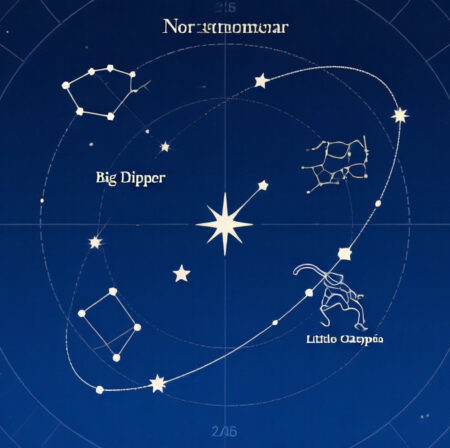
Have you ever noticed certain stars in your night sky that seem to rotate around a fixed point without ever disappearing below the horizon? These are circumpolar stars – nature’s eternal celestial companions that dance through our skies night after night, providing a constant reference point in an ever-changing cosmos.
Circumpolar stars are celestial objects that never set below the horizon from a specific location on Earth, appearing to revolve around the celestial pole and remaining visible throughout the entire 24-hour day. They’re the stars that truly never say goodbye to your location, making them perfect allies for navigation, timekeeping, and astronomical observation.
As Earth rotates daily, stars appear to move in circular paths around the celestial poles. Stars close enough to these poles trace circles completely above the horizon, never rising or setting, making them circumpolar. This magical phenomenon depends entirely on your latitude – the closer you live to the poles, the more stars become your permanent celestial neighbors.
In this comprehensive guide, you’ll discover how to identify these eternal stars in both hemispheres, calculate which stars will be circumpolar from your location, and learn practical techniques for observing and photographing these cosmic performers. We’ll explore the major constellations that never set, dive into the mathematics behind their visibility, and share tips that will transform you from a casual stargazer into a confident circumpolar star navigator.
What Are Circumpolar Stars?
Circumpolar stars are celestial objects that never dip below the horizon from a specific observation point on Earth. As our planet rotates on its axis, these stars trace complete circles around the celestial poles (either North or South), remaining visible throughout the entire 24-hour cycle. They’re essentially the stars that are always “up” from your location.
The term “circumpolar” comes from Latin roots: “circum” meaning “around” and “polus” meaning “pole.” These stars orbit around either the North Celestial Pole or South Celestial Pole in perfect circular paths. The most famous circumpolar star in the Northern Hemisphere is Polaris, the North Star, which appears almost stationary because it sits extremely close to the North Celestial Pole.
What makes these stars special is their constant visibility. Unlike other stars that rise in the east and set in the west, circumpolar stars provide a reliable reference point that’s always available on clear nights. This unique characteristic has made them invaluable throughout human history for navigation, timekeeping, and cultural storytelling. Ancient mariners used them to determine direction, while indigenous peoples developed complex mythologies around these eternal celestial guardians.
The magic of circumpolar stars lies in their predictable motion. They appear to rotate around the celestial poles in perfect circles, completing one full rotation every 23 hours and 56 minutes. This apparent motion is actually caused by Earth’s rotation, not the stars themselves moving. Understanding this fundamental concept is key to mastering astronomy terminology and navigating the night sky like a pro.
How Your Latitude Determines Which Stars Never Set?
Your geographic latitude is the single most important factor determining which stars become your circumpolar companions. The formula is beautifully simple: any star whose declination (its angular distance north or south of the celestial equator) is greater than your latitude’s complement (90° minus your latitude) will be circumpolar from your location.
Here’s how it works in practice: if you’re standing at the North Pole (90°N latitude), all stars with northern declination become circumpolar – essentially half the entire sky never sets. At the equator (0° latitude), technically no stars are circumpolar, though some may appear to graze the horizon. As you move from the equator toward either pole, more and more stars join your permanent celestial neighborhood.
Declination: The celestial equivalent of latitude on Earth – measured in degrees north (+) or south (-) of the celestial equator, which runs at 0° declination.
For example, if you’re observing from London (51.5°N), any star with declination greater than 38.5°N (90° – 51.5°) will be circumpolar. This includes most of Ursa Major, all of Ursa Minor, Cassiopeia, Cepheus, and Draco. Move north to Edinburgh (55.9°N), and suddenly even more stars become circumpolar, including portions of constellations that weren’t visible from London.
The beauty of this latitude relationship is that it creates a personal sky for every observer. Your circumpolar stars are unique to your location – someone in Miami will have a completely different set of eternal stars than someone in Stockholm. This is why understanding latitude is crucial for serious stargazing and why astronomical calculations often start with determining your precise coordinates.
Northern Hemisphere’s Eternal Constellations
The Big Dipper (Ursa Major)
The Big Dipper is perhaps the most recognizable circumpolar pattern for observers in mid-northern latitudes (above approximately 40°N). This asterism, part of the larger constellation Ursa Major, serves as a celestial signpost pointing directly to Polaris. The two stars on the end of the Dipper’s cup, Dubhe and Merak, are known as the “Pointer Stars” – draw a line through them extending five times their distance, and you’ll arrive at the North Star.
What many observers don’t realize is that the Big Dipper’s visibility depends on latitude. From Florida (25°N), the Dipper actually dips below the horizon during part of its rotation, making it non-circumpolar. But from New York (40°N), it traces a complete circle around Polaris, remaining visible every clear night of the year. The seven stars of the Dipper – Alkaid, Mizar, Alioth, Megrez, Phecda, Merak, and Dubhe – form a celestial clock that has helped humans mark time for millennia.
The Little Dipper (Ursa Minor)
Ursa Minor, containing the famous Polaris, is the quintessential circumpolar constellation for most Northern Hemisphere observers. The Little Dipper appears smaller and fainter than its big brother, but its importance in navigation cannot be overstated. Polaris sits at the end of the Little Dipper’s handle, marking the North Celestial Pole with remarkable precision – it’s less than 1° off true north.
The other stars of Ursa Minor – Kochab, Pherkad, Yildun, Epsilon Ursae Minoris, Zeta Ursae Minoris, and Anwar al Farkadain – form a protective circle around Polaris. Kochab and Pherkad, known as the “Guardians of the Pole,” are bright enough to be easily found and serve as excellent reference points for locating fainter circumpolar objects. This constellation has been a celestial guide for navigators since ancient times, from Viking explorers to modern sailors.
Cassiopeia – The Queen’s Throne
Cassiopeia’s distinctive W or M shape makes it one of the easiest circumpolar constellations to identify. This constellation represents the vain Queen Cassiopeia from Greek mythology, condemned to circle the celestial pole for eternity. The five bright stars – Segin, Ruchbah, Gamma Cassiopeiae, Schedar, and Caph – create a pattern that’s visible year-round from most of the Northern Hemisphere.
What makes Cassiopeia particularly interesting is its position opposite the Big Dipper relative to Polaris. When the Dipper is low in the sky, Cassiopeia is high, and vice versa. This complementary positioning makes it an excellent navigational aid. The constellation also hosts several deep-sky objects visible with binoculars or small telescopes, including the Heart and Soul Nebulae and several star clusters, making it a favorite target for amateur astronomers.
Draco – The Dragon
Draco is a sprawling circumpolar constellation that winds between Ursa Major and Ursa Minor, wrapping around the North Celestial Pole. This ancient constellation, representing a dragon in Greek mythology, contains the orange giant star Thuban, which was the North Star when the Egyptian pyramids were built around 3000 BCE due to Earth’s precession.
The most recognizable part of Draco is the “Dragon’s Head,” formed by four stars – Eltanin, Rastaban, Grumium, and Kuma – that create a distinctive quadrilateral pattern. The constellation’s long, sinuous body stretches across a significant portion of the northern sky, making it challenging to trace in light-polluted areas. However, its circumpolar nature means patient observers have plenty of time to explore its riches, including several double stars and the Cat’s Eye Nebula.
Cepheus – The King
Often overlooked by casual observers, Cepheus represents King Cassiopeia’s husband and forms a house-shaped constellation near Cassiopeia. Though its stars are generally fainter than its celestial neighbors, Cepheus contains several interesting objects for telescope owners, including the Garnet Star (Mu Cephei), one of the largest known stars, and the Fireworks Galaxy (NGC 6946).
The constellation’s shape resembles a simple child’s drawing of a house, with five main stars – Alderamin, Alfirk, Errai, Zeta Cephei, and Delta Cephei – forming the outline. Delta Cephei is particularly notable as the prototype of Cepheid variable stars, which helped astronomers measure cosmic distances and discovered the expansion of the universe. From most locations in the United States and Europe, Cepheus remains visible throughout the night, every night of the year.
Southern Hemisphere’s Circumpolar Wonders
The Southern Cross (Crux)
The Southern Cross is arguably the most famous constellation in the Southern Hemisphere and serves as the southern equivalent of Polaris for navigation. This compact but brilliant constellation consists of five main stars – Acrux, Gacrux, Mimosa, Delta Crucis, and Epsilon Crucis – that form a distinctive cross shape. The Southern Cross is so significant that it appears on the national flags of Australia, New Zealand, Brazil, and several other southern nations.
Unlike the Northern Hemisphere which has a bright star near the celestial pole, the Southern Hemisphere has no equivalent bright pole star. Instead, navigators use the Southern Cross to find the South Celestial Pole by extending the long axis of the cross 4.5 times and then dropping vertically to the horizon. This technique has guided travelers across the southern oceans for centuries and remains essential for modern southern hemisphere navigation.
Carina – The Keel
Carina contains Canopus, the second brightest star in the night sky after Sirius, making it an impressive circumpolar constellation for southern observers. This constellation represents the keel of the mythical ship Argo Navis and was once part of a larger constellation that was divided into four parts. Carina hosts Eta Carinae, one of the most massive and luminous stars known, which experienced a spectacular outburst in 1843 that made it the second brightest star in the sky for decades.
The constellation’s location near the South Celestial Pole means it’s visible year-round from locations south of 20°S latitude. Its brightest stars, including Canopus, Avior, and Miaplacidus, create a spectacular display that rivals any northern constellation. Carina also contains several deep-sky objects visible to the naked eye, including the Carina Nebula, a vast star-forming region four times larger than the Orion Nebula.
Centaurus – The Centaur
Centaurus contains two of the brightest stars in the sky – Alpha Centauri and Beta Centauri (Hadar) – making it one of the most impressive circumpolar constellations. Alpha Centauri is actually a triple star system and the closest star system to Earth at just 4.37 light-years away. These two bright stars, along with the Southern Cross, form the “Pointers” that help southern hemisphere observers find the South Celestial Pole.
The constellation represents a centaur from Greek mythology, possibly Chiron, the wise centaur who taught many Greek heroes. From locations south of 25°S, Centaurus remains above the horizon all night, providing a constant companion for southern stargazers. The constellation also contains Omega Centauri, the largest and brightest globular cluster visible from Earth, containing approximately 10 million stars.
Octans – The Octant
Octans is a faint constellation that contains Sigma Octantis, the closest star to the South Celestial Pole. However, unlike Polaris in the north, Sigma Octantis is so faint (magnitude 5.5) that it’s barely visible even on dark, clear nights. This lack of a bright southern pole star makes southern hemisphere navigation more challenging, requiring the use of star patterns like the Southern Cross rather than a single reference point.
Despite its faintness, Octans is significant as it marks the location of the South Celestial Pole, around which all southern circumpolar stars appear to rotate. The constellation represents an octant, a navigational instrument used to measure the altitude of celestial objects. From most locations in Australia, South Africa, and South America, Octans remains perpetually above the horizon, though its stars require dark skies and patient observation to appreciate.
How to Calculate If a Star Is Circumpolar?
Determining whether a star will be circumpolar from your location involves a straightforward mathematical formula that any astronomy enthusiast can master. The calculation requires knowing two key pieces of information: your latitude and the star’s declination.
The Basic Formula
The fundamental rule for circumpolar visibility is: a star is circumpolar if its declination is greater than 90° minus your latitude. Here’s the formula in both hemispheres:
Northern Hemisphere: If (Star’s Declination) > (90° – Your Latitude) = Circumpolar
Southern Hemisphere: If (Star’s Declination) < -(90° – Your Latitude) = Circumpolar
Let’s work through some practical examples to make this clear:
Example 1 – New York City (40.7°N):
– Complement: 90° – 40.7° = 49.3°
– Any star with declination > 49.3°N will be circumpolar
– Polaris (89.3°N) is definitely circumpolar
– Dubhe in Ursa Major (61.8°N) is circumpolar
– Capella (45.9°N) is NOT circumpolar from NYC
Example 2 – Sydney, Australia (33.9°S):
– Complement: 90° – 33.9° = 56.1°
– Any star with declination < -56.1°S will be circumpolar – Acrux in Southern Cross (-63.1°S) is circumpolar – Gacrux in Southern Cross (-57.1°S) is circumpolar – Canopus (-52.7°S) is NOT circumpolar from Sydney
Step-by-Step Calculation Process
- Determine Your Latitude: Use GPS or online tools to find your exact latitude. Precision matters – even a few degrees can change which stars are circumpolar.
- Calculate Your Complement: Subtract your latitude from 90°. This gives you the minimum declination needed for circumpolar visibility.
- Find the Star’s Declination: Look up the star’s coordinates in an astronomy app or star chart. Declination is measured in degrees, with + for north and – for south.
- Apply the Formula: Compare the star’s declination to your complement value using the appropriate hemisphere formula.
- Verify with Observation: On your next clear night, confirm your calculation by observing whether the star truly never sets.
⚠️ Important: Remember that atmospheric refraction near the horizon can make stars appear slightly higher than they actually are. For practical purposes, consider adding 1° to your complement calculation to account for this effect.
Advanced Considerations
Several factors can affect your circumpolar calculations:
- Altitude: Higher elevations give you a slightly larger horizon, potentially making more stars circumpolar.
- Atmospheric Conditions: Temperature inversions and humidity can bend starlight near the horizon, affecting visibility.
- Precession: Earth’s axial precession slowly changes which stars are circumpolar over thousands of years. Thuban was the pole star when the pyramids were built.
For those interested in precise astronomical calculations, consider using specialized software that accounts for these variables and provides exact rising and setting times for any celestial object from any location on Earth.
Observing and Photographing Circumpolar Stars
Essential Equipment for Observation
Getting started with circumpolar star observation doesn’t require expensive equipment. A good pair of binoculars (7×50 or 10×50) is often the best investment for beginners, providing a wide field of view perfect for exploring large constellations. For more detailed observation, a telescope with a low-power eyepiece (25mm or 32mm) will reveal fainter stars and deep-sky objects within circumpolar constellations.
When selecting stargazing equipment, consider a red flashlight to preserve your night vision, a star chart or planisphere specific to your hemisphere, and a comfortable reclining chair for extended viewing sessions. Modern astronomy apps like Stellarium, SkySafari, or Star Walk can help identify circumpolar stars in real-time, though traditionalists still prefer the tactile experience of paper charts.
Best Practices for Circumpolar Observation
The key to successful circumpolar star observation is understanding their unique motion. Since these stars circle the pole rather than rising and setting, they’re visible at all times during clear nights. This means you can observe them year-round, making them perfect targets for developing your observation skills.
Start by learning the major circumpolar constellations for your hemisphere. In the north, begin with the Big Dipper and Polaris – they’re your celestial anchors. Once you’ve mastered these, expand to Cassiopeia, Draco, and Cepheus. Southern hemisphere observers should focus on the Southern Cross and the Pointers (Alpha and Beta Centauri) as their starting reference points.
✅ Pro Tip: Circumpolar stars make perfect practice targets because they’re always available. Use them to learn star hopping techniques, test new equipment, or develop your observing skills regardless of the season.
Capturing Star Trails Photography
Photographing circumpolar stars creates stunning images showing their circular motion around the celestial poles. This type of astrophotography requires a camera with manual controls, a sturdy tripod, and patience.
For classic star trails images pointing at Polaris:
- Setup: Mount your camera on a sturdy tripod and compose your shot with Polaris near the center of the frame.
- Settings: Use manual mode with ISO 800-1600, aperture f/2.8-f/4, and manual focus set to infinity.
- Exposure: Start with 30-second exposures and take continuous shots for at least an hour (longer exposures create longer trails).
- Stacking: Use software like StarStaX or Photoshop to combine your individual exposures into one dramatic image showing circular star trails.
For southern hemisphere photographers, focus on the South Celestial Pole region near Sigma Octantis. While the pole star is faint, the circular trails of nearby stars create equally compelling images. The key is finding foreground interest – trees, mountains, or buildings that add context to your star trails.
Urban Observation Challenges
Light pollution is the biggest challenge for urban astronomers, but circumpolar stars offer some advantages. Since they’re always available, you can observe them during the darkest hours of the night, typically after midnight when city lights may be reduced. Light pollution filters can help improve contrast, and focusing on bright circumpolar stars like Polaris, the Big Dipper stars, or the Southern Cross can still provide rewarding views even from urban locations.
Consider using astronomy apps that include light pollution maps to find darker observing locations within driving distance of your home. Even a small shift away from city centers can dramatically improve your view of circumpolar constellations.
Frequently Asked Questions
What do circumpolar stars mean?
Circumpolar stars are stars that never set below the horizon from a specific location on Earth. They appear to rotate around the celestial poles (North or South) in complete circles, remaining visible throughout the entire night and every night of the year. Which stars are circumpolar depends entirely on your latitude – the closer you live to the poles, the more stars become circumpolar.
Do circumpolar stars never rise or set?
Correct! Circumpolar stars never rise above or set below the horizon from your observation point. Instead, they trace complete circles around the celestial pole, remaining visible at all times during clear nights. This constant visibility makes them invaluable for navigation and astronomical observation. Unlike other stars that follow daily rising and setting patterns, circumpolar stars are your permanent celestial neighbors.
Is Polaris a circumpolar star?
Polaris is circumpolar for virtually all observers in the Northern Hemisphere above the equator. As the North Star, it sits less than 1° from the North Celestial Pole, making it appear almost stationary while other stars rotate around it. However, Polaris is not visible from the Southern Hemisphere, and observers very close to the equator might see it dip slightly below their horizon due to atmospheric refraction and local geography.
How to tell if a star is circumpolar?
To determine if a star is circumpolar from your location: 1) Find your latitude, 2) Calculate 90° minus your latitude, 3) Look up the star’s declination, 4) In the Northern Hemisphere, if the star’s declination is greater than your calculated value, it’s circumpolar. For example, from New York (40.7°N), any star with declination above 49.3°N will be circumpolar. Most astronomy apps can automatically show which stars are circumpolar from your location.
What are the 7 circumpolar stars?
There isn’t a specific set of exactly 7 circumpolar stars – the number varies dramatically by latitude. From mid-northern latitudes (around 40°N), major circumpolar stars include Polaris, the seven stars of the Big Dipper, the five stars of Cassiopeia, and several stars in Draco and Cepheus. From the North Pole, half the entire sky (thousands of stars) is circumpolar. The specific stars that are circumpolar depend entirely on your observation location.
Are circumpolar stars always visible?
While circumpolar stars never set below the horizon, they’re not always visible. Cloud cover, daylight, moonlight, and light pollution can all hide them from view. During daylight hours, circumpolar stars are still in the sky but invisible against the bright blue sky. Similarly, heavy cloud cover or light pollution from cities can make fainter circumpolar stars difficult or impossible to see. Clear, dark nights are still essential for optimal viewing.
Do circumpolar stars move?
Yes, circumpolar stars do move, but in a special way. They appear to rotate around the celestial poles in complete circles, completing one full rotation every 23 hours and 56 minutes. This motion is caused by Earth’s rotation. From the Northern Hemisphere, they appear to move counter-clockwise around Polaris, while in the Southern Hemisphere, they move clockwise around the South Celestial Pole. This circular motion creates the beautiful star trails seen in long-exposure photographs.
Final Recommendations
Circumpolar stars offer a unique gateway to understanding the night sky that’s accessible to everyone, regardless of season or time of night. Their constant visibility makes them perfect companions for developing your astronomy skills, whether you’re a beginner just learning the constellations or an experienced observer planning deep-sow observations.
Start your journey by mastering the major circumpolar patterns for your hemisphere – the Big Dipper and Polaris in the north, or the Southern Cross and Pointers in the south. Once you can identify these anchor points with confidence, expand your knowledge to include the surrounding constellations and the stories they tell. Remember that your personal latitude creates a unique sky that’s yours alone – no other location on Earth sees exactly the same set of circumpolar stars.
For the most rewarding experience, combine traditional observing methods with modern tools. Use star charts to learn the patterns, but supplement with astronomy apps for real-time identification. Practice the calculations for determining circumpolar stars, but let technology verify your results. Most importantly, take time to simply enjoy the beauty of these eternal celestial companions that have guided humanity for millennia and will continue lighting our skies long after we’re gone.
The night sky is humanity’s shared heritage, and circumpolar stars are our constant connection to that heritage. They’re the same stars that guided ancient mariners, inspired poets, and helped scientists understand our place in the universe. By learning to identify and understand these never-setting stars, you’re participating in a tradition of sky-watching that spans human history and connects you to observers across time and around the world.