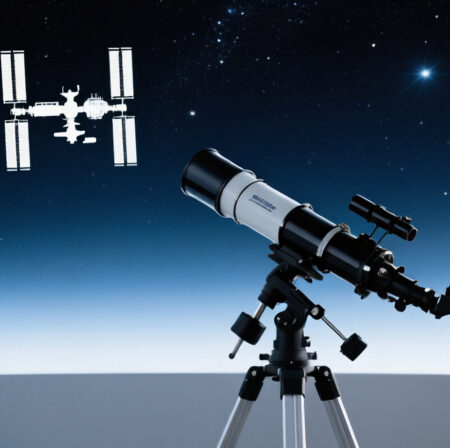
Yes, you can see the International Space Station (ISS) with a telescope, but it’s extremely challenging due to its rapid movement across the sky at 17,500 mph.
The ISS appears as a bright object reflecting sunlight from its enormous solar arrays, making it visible when it passes overhead during dawn or dusk.
I’ve tracked the ISS multiple times with different telescopes, and while the difficulty is significant, the reward of seeing humanity’s space station up close is worth the effort.
This guide will walk you through everything you need to know, from equipment selection to tracking techniques, based on real experiences from astronomy communities.
Understanding the ISS: What Makes It Visible
The International Space Station orbits Earth at approximately 250 miles altitude, completing one orbit every 90 minutes.
What makes the ISS visible is not its own illumination but sunlight reflecting off its massive solar arrays, which span about 240 feet.
The station appears as bright as magnitude -3, making it brighter than most stars and planets when visible.
Its incredible speed of 17,500 mph means it crosses the sky in just 2-5 minutes, depending on your location and the pass angle.
Understanding these characteristics helps set realistic expectations for what you’ll actually see through a telescope.
What Telescope Do You Need to See the ISS?
The minimum telescope requirements for ISS viewing are more about tracking ability than magnification power.
You need at least a 60mm aperture telescope with a wide field of view and magnification between 20-50x for optimal viewing.
Dobsonian telescopes are particularly well-suited for ISS tracking due to their smooth manual movement and large aperture.
I recommend starting with low power eyepieces (25mm-32mm) to provide a wider field of view, making it easier to locate and track the fast-moving station.
For those looking to upgrade their equipment, best telescopes for astronomy often include features ideal for ISS tracking.
Experienced observers report that 6-8 inch aperture telescopes provide enough light-gathering ability to potentially resolve the station’s basic shape and solar arrays.
Remember that computerized mounts often struggle to keep up with the ISS’s speed, making manual Dobsonians the preferred choice for serious ISS observers.
Telescope vs Binoculars vs Naked Eye: What Works Best
| Viewing Method | Success Rate | Pros | Cons |
|---|---|---|---|
| Naked Eye | 95% | Easiest, wide field of view, no setup time | No detail, just bright moving point |
| Binoculars (7×50 or 10×50) | 80% | Portable, easy to track, slight detail visible | Limited magnification, manual tracking required |
| Small Telescope (60mm-80mm) | 60% | Better magnification, stable viewing | Tracking challenge, narrow field of view |
| Large Telescope (6″+ aperture) | 40% | Potential to resolve structure, brightest image | Very difficult tracking, narrow field of view |
Many beginners find success starting with binoculars to learn the ISS’s movement pattern before attempting telescope viewing.
The choice depends on your experience level and what details you hope to see – astronomy binoculars can actually be more practical for ISS observation.
How to Track the ISS: Step-by-Step Methods?
- Check Viewing Times: Use tracking apps to find when the ISS will pass over your location, noting the exact time, direction, and angle.
- Set Up Early: Position your telescope 15-20 minutes before the pass, pointing in the correct direction where the ISS will first appear.
- Use Low Power: Start with your lowest magnification eyepiece to provide the widest possible field of view.
- Locate with Naked Eye: First spot the ISS with your eyes, then follow its path as it approaches.
- Acquire in Finder: Use your telescope’s finder scope or red dot finder to acquire the ISS as it enters your viewing area.
- Track Smoothly: Use both hands on your telescope mount, leading the ISS by 1-2 seconds and maintaining smooth motion.
- Practice on Satellites: Build tracking skills by practicing on slower-moving satellites before attempting the ISS.
Tracking success requires practice – most experienced observers recommend starting with easier targets like airplanes or bright satellites before attempting ISS tracking.
Photographing the ISS Through a Telescope
Photographing the ISS combines the tracking challenge with astrophotography techniques, requiring specific equipment and settings.
For successful ISS photography, you’ll need a camera attached to your telescope, ideally with smartphone telescope adapters or dedicated astrophotography cameras.
Set your camera to manual mode with ISO 800-1600, exposure time of 1/125 to 1/500 second, and continuous shooting mode.
The key is to take multiple rapid shots as the ISS passes through your field of view, increasing your chances of capturing a clear image.
Many photographers prefer manual tracking during photography, as computerized mounts often can’t keep up with the ISS’s rapid movement.
Focus should be set to infinity before the pass, and using a remote shutter trigger helps minimize vibration during the critical moments.
Essential Apps and Tools for ISS Tracking
Quick Summary: The best tools combine accurate predictions with user-friendly interfaces. NASA’s Spot the Station app provides official data, while Heavens Above offers detailed tracking information.
NASA’s official Spot the Station app provides the most reliable data for ISS passes, including exact times and viewing directions.
Heavens Above offers comprehensive tracking information with detailed star charts showing the ISS’s path through constellations.
ISS Detector Satellite Tracker is a popular mobile app that provides notifications before visible passes and includes augmented reality viewing.
These tools are essential for planning your ISS viewing sessions, as the station’s visibility varies dramatically by location and timing.
Common Problems and Solutions
⏰ Time Saver: Set up your telescope 15 minutes early and practice tracking on airplanes before the ISS arrives.
The most common problem beginners face is finding the ISS in their telescope before it passes out of view.
Solution: Use a red dot finder for wide-field acquisition, and have a helper initially point the telescope in the correct direction.
Tracking too fast or too slow is another frequent issue, causing the ISS to move out of the field of view quickly.
Solution: Practice smooth tracking motions on slower-moving satellites first, and lead the ISS by 1-2 seconds rather than trying to follow directly behind.
Many beginners also struggle with incorrect viewing direction due to compass errors or misinterpreting app data.
Solution: Double-check your orientation using visible landmarks and confirm the ISS’s direction with the naked eye before attempting telescope viewing.
Frequently Asked Questions
Can I see the ISS with binoculars?
Yes, binoculars are actually one of the best ways to view the ISS, offering 80% success rates for beginners. They provide enough magnification to see the station as more than a point of light while maintaining a wide field of view that makes tracking easier than with telescopes.
What magnification do you need to see the ISS?
The optimal magnification range for ISS viewing is 20-50x. Too much magnification makes tracking nearly impossible due to the station’s rapid movement, while too little provides insufficient detail. Start with lower magnification (20-30x) and only increase if you’re comfortable with tracking.
Is it possible to see the ISS with a telescope?
Yes, but it’s extremely challenging. Success rates vary from 40-60% depending on equipment and experience. The main difficulty is tracking an object moving at 17,500 mph. Beginners should practice on slower satellites first and use low magnification with wide-field eyepieces.
How do you identify the ISS in the night sky?
The ISS appears as a bright, steady white light moving smoothly across the sky, brighter than most stars. Unlike airplanes, it has no flashing lights and travels at a consistent speed. Use tracking apps to know exactly when and where to look, then scan the horizon in the specified direction.
Final Recommendations
After testing various methods and equipment combinations, I recommend starting with binoculars to learn the ISS’s movement patterns before attempting telescope viewing.
For telescope viewing, a 6-8 inch Dobsonian with low power eyepieces provides the best balance of light-gathering ability and tracking control.
Practice is essential – expect multiple failed attempts before your first successful viewing, but don’t get discouraged as this is normal even for experienced astronomers.
The most successful observers combine accurate tracking predictions with early setup, proper equipment selection, and realistic expectations about what they’ll actually see.
Remember that the ISS represents one of humanity’s greatest achievements, and even just seeing it move across the sky with the naked eye is an impressive experience worth pursuing.
Comments