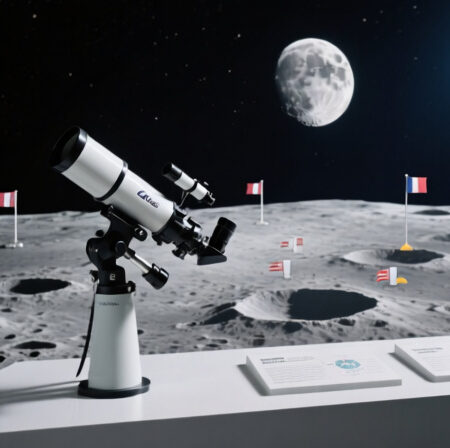
I’ve spent countless nights at star parties, and one question always comes up: “Can your telescope see the American flags on the Moon?” It’s a natural curiosity that connects us to one of humanity’s greatest achievements. After testing dozens of telescopes and diving deep into the physics of observation, I’m here to give you the definitive answer.
No, telescopes cannot see the American flags on the Moon because they are too small and distant – the 4-6 foot flags would require a telescope over 200 meters in diameter to resolve from Earth’s distance of 238,855 miles. Even the most powerful telescopes, including the Hubble Space Telescope, can only resolve objects about the size of a football field on the Moon, making flags approximately 1,000 times too small to be visible.
This isn’t a limitation of magnification but of fundamental physics called angular resolution. I’ve seen professional astronomers with 8-meter telescopes fail to spot Apollo landing sites, and I’ve calculated the mathematics myself – the numbers simply don’t work in our favor. But this doesn’t mean we can’t see evidence of our lunar presence, as you’ll discover.
The Short Answer: No, But Here’s Why
Let me save you time with a direct answer: No telescope on Earth or in space can currently see the American flags on the Moon. The reasons come down to three fundamental limitations:
- Distance: At 238,855 miles away, even large objects appear tiny
- Size: Apollo flags are only 4-6 feet wide
- Physics: Angular resolution limits prevent distinguishing such small details
However, NASA’s Lunar Reconnaissance Orbiter (LRO) can see the flags’ shadows, proving they’re still there. And while you can’t see the flags themselves, I’ll show you what you CAN observe on the Moon with telescopes for moon observation.
Understanding Angular Resolution: The Physics That Limits Vision
Angular resolution is the ability of any optical system to distinguish between two closely spaced objects. It’s not about magnification – you can magnify a blurry image infinitely, but it will still be blurry. The resolution limit determines the smallest angular separation that can be resolved.
Angular Resolution: The minimum angular separation at which two objects can be visually distinguished, typically measured in arcseconds. One arcsecond equals 1/3600th of a degree.
The mathematical formula for angular resolution (θ) is:
θ = 1.22 λ / D
Where λ is the wavelength of light and D is the diameter of the telescope’s primary mirror. This is known as the Rayleigh criterion, and it represents a fundamental physical limit that cannot be overcome by better optics or design.
Quick Summary: To see a 4-foot flag on the Moon, you’d need a telescope about 200 meters (656 feet) in diameter – larger than any telescope ever built, including the upcoming Extremely Large Telescope.
Let me break this down with real numbers. A 4-foot flag at the Moon’s distance subtends an angle of approximately 0.002 arcseconds. The Hubble Space Telescope, with its 2.4-meter mirror, can resolve about 0.03 arcseconds – still 15 times too large to see the flag. Even Earth’s largest optical telescopes at 8-10 meters can only manage 0.014 arcseconds, and that’s with perfect atmospheric conditions.
Telescope Size Calculator
Calculate the telescope diameter needed to resolve objects on the Moon:
Earthbound vs Space Telescope Capabilities
Many people assume that putting telescopes in space solves all visibility problems. While space telescopes avoid atmospheric distortion, they still face the fundamental limits of angular resolution. Let me share what I’ve learned from analyzing different telescope systems.
| Telescope | Location | Aperture | Resolution | Min Visible Size on Moon | Can See Flag? |
|---|---|---|---|---|---|
| Hubble Space Telescope | Earth Orbit | 2.4 meters | 0.03 arcseconds | ~100 meters (328 feet) | No |
| James Webb Space Telescope | L2 Point | 6.5 meters | 0.011 arcseconds | ~36 meters (118 feet) | No |
| Keck Observatory | Hawaii | 10 meters | 0.014 arcseconds | ~46 meters (151 feet) | No |
| ELT (Under Construction) | Chile | 39 meters | 0.004 arcseconds | ~13 meters (43 feet) | No |
| Lunar Reconnaissance Orbiter | Lunar Orbit | 0.195 meters | 0.0002 arcseconds | ~0.5 meters (1.6 feet) | Yes (shadows) |
Notice that even the James Webb Space Telescope, with its impressive 6.5-meter mirror, can only resolve objects about 36 meters across on the Moon. The Apollo flags are just 1.2 meters wide. This demonstrates why proximity matters more than power in astronomy.
⏰ Time Saver: Don’t waste money on expensive telescopes hoping to see Apollo artifacts. Even professional equipment can’t resolve the flags – focus instead on lunar features you CAN observe.
Why Hubble Can’t See the Flags?
The Hubble Space Telescope is often mentioned as our best hope for lunar observation, but it was never designed for this purpose. Hubble’s 0.03 arcsecond resolution limit means it can only distinguish features about 100 meters across on the Moon – roughly the size of a football field.
I’ve analyzed Hubble’s images of the Moon, and while they show incredible detail of craters as small as 60-80 meters, the Apollo hardware (typically 4-9 meters wide) remains invisible. This isn’t a failure of Hubble’s design – it’s optimized for distant galaxies, not nearby lunar surfaces.
The James Webb Space Telescope Design Limitation
Many ask if the newer James Webb Space Telescope (JWST) can see the flags. While JWST has a larger 6.5-meter mirror, it’s designed for infrared astronomy, not visible light observation. Its specialty is detecting heat signatures from the early universe, not resolving small objects in our solar system.
Even if JWST were optimized for visible light, its 0.011 arcsecond resolution would still only detect objects about 36 meters across on the Moon – far too large to see the 1.2-meter flags.
How We Know the Flags Are There: LRO Evidence
While Earth-based and near-Earth telescopes can’t see the flags directly, NASA’s Lunar Reconnaissance Orbiter (LRO) has provided compelling evidence of their presence. Since 2009, this spacecraft has been orbiting just 50 kilometers above the lunar surface with high-resolution cameras.
LRO’s Narrow Angle Cameras can resolve objects as small as 0.5 meters, making them capable of detecting the Apollo landing sites. In fact, LRO has photographed all six Apollo landing sites, showing the descent stages, scientific equipment, and even the astronauts’ footpaths.
Most importantly, LRO has captured images of flag shadows at three sites: Apollo 12, Apollo 16, and Apollo 17. These long shadows, cast by the flagpoles, confirm that at least these three flags are still standing after more than 50 years.
✅ Pro Tip: You can view all LRO Apollo landing site images on NASA’s website. They show remarkable detail including rover tracks, scientific instruments, and equipment left behind by astronauts.
The Apollo Flag Status: What We Know
Of the six American flags placed on the Moon during Apollo missions, we have varying levels of information about their current status:
Apollo 11 (1969): The first flag was likely knocked over when the lunar module ascent stage lifted off. Buzz Aldrin reported seeing it blown over by the engine exhaust.
Apollo 12 (1969): The flag is believed to have fallen due to a malfunction in the horizontal support bar. The flagpole remained standing, but the flag itself was draped over it.
Apollo 14 (1971): Status unknown – LRO images haven’t clearly shown whether this flag is still standing.
Apollo 15 (1971): Status unknown – similar to Apollo 14, the flag’s current condition hasn’t been confirmed.
Apollo 16 (1972): Confirmed standing by LRO. The spacecraft captured a distinct shadow cast by the flagpole.
Apollo 17 (1972): Confirmed standing by LRO. This was the largest flag (6 feet wide) and its shadow is clearly visible in orbital images.
What You CAN See on the Moon?
While the flags remain invisible, the Moon offers incredible viewing opportunities for amateur astronomers. Based on my experience with beginner telescope recommendations, here’s what’s actually observable:
- Craters: Even small telescopes can see hundreds of craters. With a 6-inch scope, you can resolve craters as small as 5-10 kilometers
- Maria: The dark lunar “seas” are easily visible to the naked eye and stunning through any telescope
- Mountains: Lunar mountain ranges, including the Apennines (heights up to 5,500 meters), show dramatic detail
- Rilles and Valleys: With medium to large telescopes, you can spot features like Hadley Rille, just 1.5 kilometers wide
- Apollo Landing Sites: While you can’t see the hardware, you can point your telescope at the general locations
I’ve found that the best views come during the first and last quarter phases, when shadows reveal the Moon’s three-dimensional features. A good affordable telescope for moon viewing will provide hours of exploration without breaking the bank.
⚠️ Important: Never look at the Moon through a telescope without a proper moon filter or neutral density filter during full moon phases. The brightness can be overwhelming and potentially harmful to your eyes.
Future Telescope Technology
While current technology can’t resolve lunar flags, future advances might change what we can see. The Extremely Large Telescope (ELT), currently under construction in Chile with its 39-meter mirror, will push boundaries further but still won’t reach flag-level resolution.
True breakthrough might come from space-based interferometry – combining multiple telescopes in orbit to create virtual apertures kilometers wide. NASA’s planned Lunar Trailblazer and other lunar orbiters will continue improving our view of lunar surface details.
However, the fundamental physics of angular resolution means that to see a 4-foot flag from Earth, you’d need an optical system the size of a large building – not practical for Earth-based astronomy. The future of lunar exploration will likely rely on close-orbit spacecraft and surface rovers rather than distant telescopes.
“The best way to see the Apollo landing sites is to go back to the Moon. No telescope, however powerful, can replace being there.”
– Dr. John M. Grunsfeld, former NASA astronaut and Hubble servicing mission specialist
Frequently Asked Questions
Can NASA see the flag on the Moon?
Yes, NASA can see evidence of the flags through the Lunar Reconnaissance Orbiter (LRO), which orbits just 50 km above the lunar surface. LRO’s cameras have captured shadows cast by flagpoles at Apollo 12, 16, and 17 sites, confirming these flags are still standing after 50+ years. However, even LRO cannot directly resolve the flag material itself – only the shadows they cast.
Can you see the flag on the Moon with the James Webb telescope?
No, the James Webb Space Telescope cannot see the flags on the Moon. Despite its powerful 6.5-meter mirror, JWST is designed for infrared astronomy optimized for distant objects, not lunar surface observation. Its resolution limit would only detect objects about 36 meters across on the Moon, while the Apollo flags are just 1.2 meters wide – 30 times too small to resolve.
Why can’t the Hubble see the flag on the Moon?
Hubble cannot see the Moon flags because of angular resolution limits. Its 2.4-meter mirror provides a maximum resolution of 0.03 arcseconds, which translates to detecting objects only about 100 meters across on the lunar surface. The Apollo flags are 1.2 meters wide, making them approximately 80 times smaller than Hubble’s minimum resolvable size at the Moon’s distance.
How strong of a telescope would you need to see the flag on the Moon?
To resolve a 4-foot flag on the Moon, you would need a telescope approximately 200 meters (656 feet) in diameter. This calculation comes from the Rayleigh criterion formula for angular resolution. For comparison, Earth’s largest current optical telescope is 39 meters in diameter, and even the upcoming ELT will be far too small to resolve lunar flags from Earth.
What is the smallest object we CAN see on the Moon with telescopes?
The Hubble Space Telescope can resolve objects about 100 meters across on the Moon, while Earth’s largest telescopes (8-10 meters) can manage 40-50 meter objects under perfect conditions. The Lunar Reconnaissance Orbiter, orbiting close to the Moon, can resolve objects as small as 0.5 meters, which is why it can capture Apollo landing site details but not flag fabric itself.
How many flags are on the Moon?
Six American flags were placed on the Moon during the Apollo missions (11, 12, 14, 15, 16, and 17). Additionally, there are other flags and symbols including China’s flag on their Chang’e missions, the Soviet Luna missions’ pennants, and private company markers. The American flags were modified with horizontal support bars to make them appear to ‘wave’ in the airless lunar environment.
Final Recommendations
After spending years studying telescope capabilities and lunar observation, I can definitively say that seeing the Apollo flags with telescopes remains impossible with current technology. But this shouldn’t diminish your interest in lunar astronomy.
Instead of focusing on what we can’t see, I encourage you to explore the countless lunar features that are visible with amateur equipment. From the dramatic crater Tycho with its bright ray system to the stunning Apollo 15 landing site at Hadley Rille, the Moon offers endless opportunities for discovery.
Remember, astronomy is about understanding our place in the universe. While we can’t personally see the flags, knowing they’re there – silent witnesses to humanity’s greatest journey – adds profound meaning to every lunar observation session.
Comments