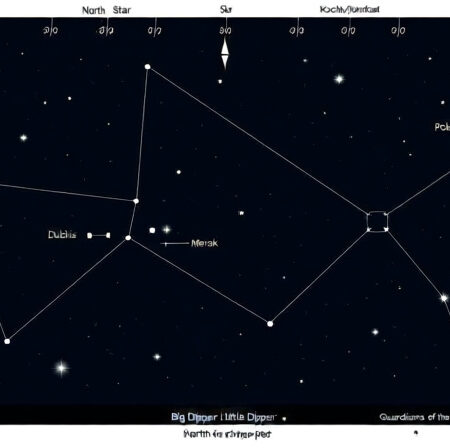
Have you ever looked up at the night sky and wondered about those two familiar ladle-shaped star patterns? The Big Dipper and Little Dipper are among the most recognized star patterns in the northern sky, yet many stargazers struggle to tell them apart. The Big Dipper is larger and brighter, making it easier to spot, while the Little Dipper is smaller, fainter, and contains the North Star (Polaris) at the end of its handle.
Both patterns have guided travelers and sparked imagination across cultures for thousands of years. Whether you’re a beginner stargazer or looking to enhance your night sky observations, understanding these differences will transform your stargazing experience. In this comprehensive guide, we’ll explore everything from their star compositions to practical navigation techniques that you can use tonight.
Understanding The Big Dipper
The Big Dipper is arguably the most recognizable star pattern in the northern hemisphere. This prominent asterism forms part of the larger constellation Ursa Major (the Great Bear), though many people mistakenly believe it’s a constellation itself. What makes the Big Dipper special is its accessibility – even in light-polluted urban areas, you can usually spot its seven brightest stars forming that distinctive ladle shape.
Asterism vs Constellation: An asterism is a recognizable pattern of stars that isn’t officially designated as a constellation. The Big Dipper is an asterism within Ursa Major, while the Little Dipper is both an asterism and the entire Ursa Minor constellation.
The seven stars that create the Big Dipper are Alkaid, Mizar, Alioth, Megrez, Phecda, Merak, and Dubhe. Each plays a specific role in forming the familiar shape – four stars create the bowl while three form the handle. What many don’t realize is that these stars are relatively close to each other in space, part of what astronomers call the Ursa Major Moving Cluster. This shared motion through space helps maintain the pattern’s recognizable shape over centuries.
What makes the Big Dipper particularly useful for navigation are its two “pointer stars” – Dubhe and Merak. These stars form the outer edge of the bowl and point directly toward Polaris, the North Star. This relationship has made the Big Dipper an essential celestial marker throughout human history, helping everyone from ancient mariners to modern outdoor enthusiasts find their way.
Understanding The Little Dipper
The Little Dipper presents a greater challenge for observers but offers unique rewards once found. Unlike its larger cousin, the Little Dipper is both an asterism and the complete constellation Ursa Minor (the Little Bear). Its most significant feature is Polaris, the North Star, which marks the end of its handle and remains nearly fixed in the sky while other stars appear to rotate around it.
The seven stars of the Little Dipper are Polaris, Kochab, Pherkad, Epsilon Ursae Minoris, Zeta Ursae Minoris, Eta Ursae Minoris, and Gamma Ursae Minoris. What makes this pattern harder to spot is the varying brightness of its stars. While Polaris shines brightly at magnitude +2.0, most Little Dipper stars are significantly fainter, with some barely visible to the naked eye even in dark sky conditions.
✅ Pro Tip: The Little Dipper’s bowl stars (Kochab and Pherkad) are known as the “Guardians of the Pole” and help confirm you’ve found the right pattern when navigating.
One fascinating aspect is that the Little Dipper’s stars are at various distances from Earth, unlike the Big Dipper’s more clustered arrangement. Kochab and Pherkad, for example, are 130 and 480 light-years away respectively, creating a true three-dimensional pattern that only appears two-dimensional from our vantage point. This depth explains why the Little Dipper can look different from various viewing locations and times.
Historically, the Little Dipper has been crucial for navigation because Polaris marks the celestial north pole. Unlike other stars that rise and set, Polaris stays nearly fixed in the sky, making it an invaluable reference point for determining direction. This reliability made it essential for early navigation before modern compasses and GPS systems.
What Are The Key Differences Between The Big And Little Dipper?
While both patterns share a similar ladle shape, their differences go far beyond size and brightness. Understanding these distinctions will help you identify each pattern confidently and appreciate their unique astronomical significance.
| Feature | Big Dipper | Little Dipper |
|---|---|---|
| Size | Large, covers significant sky area | Smaller, more compact pattern |
| Brightness | Very bright, easily visible | Fainter, requires dark skies |
| Stars | 7 bright stars forming clear pattern | 7 stars with varying brightness |
| Constellation | Part of Ursa Major (asterism) | Same as Ursa Minor (both asterism and constellation) |
| Navigation | Pointer stars help find North Star | Contains Polaris (North Star) |
| Visibility | Easy to spot, even in cities | Challenging, needs dark conditions |
| Star Distance | Relatively close together in space | Various distances from Earth |
| Best Viewing | Year-round in Northern Hemisphere | Best in dark, clear conditions |
Perhaps the most significant difference lies in their relationship to official constellations. The Big Dipper is merely an asterism – a recognizable pattern within the larger Ursa Major constellation. In contrast, the Little Dipper is both an asterism and the complete Ursa Minor constellation, making it unique among common star patterns.
⏰ Time Saver: Once you master finding both Dippers, you’ll unlock navigation skills that have guided humanity for millennia. Practice in different seasons to understand their movement patterns.
How To Find The Little Dipper Using The Big Dipper?
The relationship between these two patterns makes finding the Little Dipper straightforward once you’ve located the Big Dipper. This method has worked for stargazers throughout history and remains the most reliable way to identify the fainter pattern.
- Locate the Big Dipper: First, find the Big Dipper’s distinctive ladle shape. In spring evenings, look high in the northern sky. In fall, it appears lower. The Big Dipper is circumpolar (never sets) in most of the Northern Hemisphere, making it visible year-round.
- Identify the Pointer Stars: Focus on the two stars forming the outer edge of the Big Dipper’s bowl – Dubhe and Merak. These are the “pointer stars” that will guide you to Polaris.
- Follow the Line: Imagine a straight line extending from Merak through Dubhe. Continue this line about five times the distance between the two pointer stars. The bright star you’ll find is Polaris.
- Find Polaris: Once you’ve located Polaris, you’ve found the end of the Little Dipper’s handle. This confirms you’re looking at the right star.
- Trace the Pattern: From Polaris, look for the dimmer stars forming the Little Dipper’s handle and bowl. Kochab and Pherkad (the Guardians of the Pole) should be visible as the two brightest stars in the bowl.
Mastering this technique opens up advanced night sky tracking techniques that enhance your stargazing experience. Many beginners make the mistake of looking for the complete Little Dipper pattern immediately, but focusing on Polaris first provides a solid anchor point.
⚠️ Important: Don’t confuse the Little Dipper with the Pleiades (Seven Sisters), a different star cluster that many mistake for the Little Dipper. The Pleiades are smaller, closer together, and located in a different part of the sky.
When And Where To See Both Dippers?
The visibility of both Dippers depends on your location, the season, and viewing conditions. Both patterns are primarily visible from the Northern Hemisphere, with the Big Dipper being more accessible due to its brighter stars.
In the Northern Hemisphere above approximately 35° latitude, both Dippers are circumpolar – meaning they never set below the horizon and are visible year-round. However, their position in the sky changes throughout the night and seasons. The Big Dipper appears highest in the sky during spring evenings, while it appears lowest during autumn evenings.
The Little Dipper’s visibility is more challenging. Due to its fainter stars, you’ll need dark sky conditions away from city lights to see the complete pattern. Even then, light pollution can make some stars invisible. The best viewing conditions occur on moonless nights with clear skies, ideally from locations away from urban light sources.
Why Have The Dippers Been Important Throughout History?
Throughout human history, these star patterns have served practical navigation purposes and held cultural significance across civilizations. Ancient mariners used the Big Dipper’s pointer stars to find Polaris, enabling reliable navigation across oceans before modern instruments.
Different cultures have interpreted these patterns through their own mythological lenses. Greek mythology saw them as bears (Ursa Major and Ursa Minor), while Native American cultures like the Mi’kmaq saw the Big Dipper as a celestial bear being hunted by warriors. These interpretations reflect how human cultures have found meaning in the same stars for millennia.
Frequently Asked Questions
Are the Big Dipper and Little Dipper constellations?
The Big Dipper is an asterism (star pattern) within the Ursa Major constellation, while the Little Dipper is both an asterism and the complete Ursa Minor constellation. This distinction is important in astronomy, where constellations are officially designated regions of the sky.
Why is the Little Dipper harder to see than the Big Dipper?
The Little Dipper’s stars are much fainter than the Big Dipper’s bright stars. While all seven Big Dipper stars are easily visible to the naked eye, some Little Dipper stars require dark sky conditions to spot. Light pollution significantly affects visibility of the fainter stars.
Can I see both Dippers from the Southern Hemisphere?
Both Dippers are primarily visible from the Northern Hemisphere. The Big Dipper can be seen from some tropical regions but is generally not visible from the Southern Hemisphere. The Little Dipper is even more restricted to northern latitudes due to its northern position.
What’s the easiest way to confirm I’ve found the right stars?
Use the Big Dipper’s pointer stars (Dubhe and Merak) to find Polaris. Once you’ve located Polaris, you’ve confirmed you’re looking at the right area. The Little Dipper’s bowl stars (Kochab and Pherkad) are the next brightest stars to look for.
Do the Dippers look the same all year?
While the patterns themselves don’t change, their position in the sky rotates throughout the night and seasons. Both Dippers appear to circle around Polaris, making different patterns visible at different times of year.
Can I take photos of the Dippers with my phone?
Smartphone photography of stars is challenging but possible with modern phones. Use a tripod, enable night mode, and keep the camera still for several seconds. The Big Dipper is easier to capture due to its brighter stars.
Final Recommendations
Understanding the differences between the Big Dipper and Little Dipper opens up a lifetime of night sky exploration. Start by mastering the Big Dipper’s distinctive shape, then use its pointer stars to locate Polaris and the Little Dipper. Practice on clear, moonless nights from dark locations for the best results.
Remember that stargazing is a skill that improves with practice. Don’t be discouraged if you can’t spot the complete Little Dipper immediately – even experienced astronomers struggle with its fainter stars under less-than-ideal conditions. The satisfaction of successfully identifying both patterns and understanding their relationship is well worth the effort.
Whether you’re navigating by stars or simply appreciating the beauty of the night sky, the Big Dipper and Little Dipper will continue to inspire wonder and provide practical guidance, just as they have for countless generations before us.
Comments