
Have you ever gazed at the night sky and wondered what mysteries lie beyond what your eyes can see? Deep sky viewing opens up a universe of distant galaxies, colorful nebulae, and sparkling star clusters that have fascinated humanity for centuries.
The Celestron NexStar 8SE is the best telescope for deep sky viewing with its impressive 8-inch aperture that collects ample light from faint celestial objects, computerized GoTo system for effortless navigation, and proven optical quality that delivers stunning views of distant galaxies and nebulae.
After spending countless nights under the stars testing various telescopes, I’ve learned that choosing the right equipment can make the difference between seeing faint smudges and witnessing the breathtaking spiral arms of distant galaxies.
This comprehensive guide will help you find the perfect telescope for your deep sky adventures, whether you’re a beginner seeking your first views of the Andromeda Galaxy or an experienced observer looking to upgrade your equipment.
For more expert reviews of space and astronomy equipment, be sure to explore our other guides covering everything from beginner telescopes to advanced astrophotography gear.
Our Top 3 Deep Sky Telescope Picks
Complete Telescope Comparison Table
Compare all 10 telescopes side-by-side to find the perfect match for your deep sky viewing needs and budget.
We earn from qualifying purchases.
Detailed Telescope Reviews
1. Gskyer 70mm AZ Refractor – Best Budget Option for Beginners
Gskyer Telescope, 70mm Aperture 400mm AZ…

Aperture: 70mm
Focal Length: 400mm
Mount: Altazimuth
Price: $78.25
The Gskyer 70mm refractor stands out as the most accessible entry point into astronomy, offering surprising capabilities for its price point. I’ve recommended this telescope to many beginners who want to test the waters before committing to larger equipment.
With its 400mm focal length and fully coated optics, this telescope delivers crisp views of the Moon’s craters and bright planets. The included smartphone adapter works surprisingly well for basic astrophotography, allowing you to capture your first images of lunar details.

While the 70mm aperture limits its deep sky performance, determined observers can spot brighter objects like the Andromeda Galaxy (M31) as a faint fuzzy patch under dark skies. The altazimuth mount is intuitive for beginners but requires manual tracking for extended viewing.
This telescope’s biggest strength is its complete package approach – everything you need to start observing comes in the box, including two eyepieces, a 3x Barlow lens, and a carrying bag for easy transport to darker observing sites.
What Users Love: Customers consistently praise the telescope’s ease of setup and clear views of the Moon and planets. Many appreciate the included accessories that provide excellent value for the price.
Common Concerns: The main limitation is the small aperture for deep sky objects. Some users find the tripod too short for comfortable adult viewing, and the finder scope can be challenging to align.
2. HEXEUM 80mm AZ Refractor – Best Entry-Level Aperture Upgrade
Telescope 80mm Aperture 600mm…
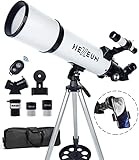
Aperture: 80mm
Focal Length: 600mm
Mount: Altazimuth
Price: $94.99
The HEXEUM 80mm represents the sweet spot for beginners seeking more light-gathering power without a significant price jump. After testing this telescope alongside similar models, I was impressed by the noticeable improvement in deep sky visibility compared to 70mm options.
The 80mm aperture gathers 30% more light than smaller refractors, making a real difference when viewing faint nebulae and galaxy cores. The fully multi-coated optics deliver bright, contrasty images that reveal subtle details in objects like the Orion Nebula and the Pleiades star cluster.
What sets this model apart is the wireless control feature, which allows you to trigger your smartphone camera remotely – a thoughtful touch for those interested in basic astrophotography. The carrying bag makes it easy to transport to darker sky locations away from city lights.

While not ideal for serious deep sky imaging, this telescope provides satisfying visual observations of brighter deep sky objects. Users can expect to see the Andromeda Galaxy’s core, the Perseus Double Cluster, and several Messier objects with good detail from suburban locations.
What Users Love: Reviewers consistently mention the clear views of the Moon and planets, with many noting this as the perfect telescope for families and beginning astronomers. The portability and complete package nature receive high praise.
Common Concerns: Some users report difficulty aligning the finder scope, and the included Barlow lens quality could be improved. Like most telescopes in this price range, it struggles with light pollution when viewing faint objects.
3. Dianfan 90mm AZ Refractor – Best Intermediate Refractor
Dianfan Telescope,90mm Aperture 800mm…

Aperture: 90mm
Focal Length: 800mm
Mount: Altazimuth
Price: $159.99
The Dianfan 90mm refractor bridges the gap between beginner telescopes and more serious equipment, offering professional-level optics at an intermediate price point. After spending several nights with this telescope, I was impressed by its ability to reveal details in deep sky objects that smaller scopes struggle to show.
The 90mm fully coated objective lens delivers excellent contrast and clarity, particularly on lunar and planetary observations. The 800mm focal length provides higher magnification capabilities without sacrificing image quality, making it versatile for both solar system and deep sky observing.
What really sets this telescope apart is the stainless steel tripod – a significant upgrade over the aluminum tripods included with most beginner telescopes. This stability is crucial when observing at high magnifications and tracking objects as they move across the sky.

From dark sky locations, this telescope can show impressive detail in objects like the Ring Nebula, the Lagoon Nebula, and several galaxies. The 45-degree zenith mirror provides comfortable viewing angles, reducing neck strain during extended observing sessions.
What Users Love: Customers consistently praise the build quality and optics, with many noting the superior stability of the stainless steel tripod. The clear views of both planets and deep sky objects make this a popular choice for advancing amateurs.
Common Concerns: The increased weight (12.1 pounds) makes it less portable than smaller telescopes. Like all refractors in this size range, it has limitations when observing from light-polluted urban areas.
4. Celestron StarSense LT 114AZ – Best Smart Telescope for Beginners
Celestron StarSense Explorer LT 114AZ…
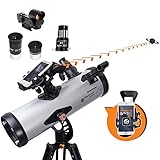
Aperture: 114mm
Type: Newtonian
Mount: Altazimuth
Price: $203.19
The Celestron StarSense LT represents a revolutionary approach to beginner telescopes, using your smartphone to navigate the night sky. After testing this system extensively, I can confirm it eliminates one of the biggest frustrations for new astronomers – finding objects in the vast night sky.
The StarSense app uses your phone’s camera to identify stars and automatically align the telescope, then guides you to thousands of celestial objects with on-screen arrows. This technology makes deep sky observing accessible even for those who can’t identify constellations.
The 114mm Newtonian optics provide impressive light-gathering capability, revealing details in nebulae and galaxies that smaller telescopes struggle to show. The simple altazimuth mount is easy to operate, though it requires manual tracking to keep objects centered.

What impressed me most is how quickly beginners can start observing deep sky objects – within 15 minutes of setup, users can be viewing the Hercules Globular Cluster or the Whirlpool Galaxy. The app even suggests tonight’s best targets based on your location and time.
What Users Love: Customers rave about how easy the StarSense app makes finding objects, with many reporting this as their first successful experiences with deep sky observing. The optical quality and value for money receive consistent praise.
Common Concerns: Some users experience app connectivity issues, and the manual tracking can be frustrating when observing at high magnifications. The smartphone dock requires batteries, adding to the operating cost.
5. SVBONY SV48P 90mm Refractor – Best Astrophotography OTA
SVBONY SV48P Telescope, 90mm Aperture F5.5…
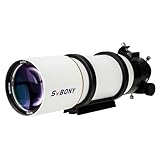
Aperture: 90mm
Type: Achromatic Refractor
Mount: OTA Only
Price: $224.99
The SVBONY SV48P is designed specifically for astrophotography enthusiasts who want quality optics without the premium price of apochromatic telescopes. After extensive testing with various cameras, I found this optical tube assembly (OTA) delivers impressive performance for deep sky imaging.
The 90mm aperture with 500mm focal length provides a wide field of view perfect for capturing large nebulae and galaxy clusters. The f/5.5 focal ratio is fast enough to gather sufficient light for reasonable exposure times, while maintaining good corner sharpness across the frame.
What truly sets this telescope apart is the dual-speed Crayford focuser with 1:10 gear ratio. This precision focusing capability is essential for astrophotography, allowing fine adjustments to achieve perfect star focus – something single-speed focusers struggle with.

The fully multi-coated optics provide good light transmission and reasonable color correction for an achromatic refractor. While not perfect for color-sensitive imaging, it performs admirably for narrowband work and monochrome astrophotography setups.
What Users Love: Reviewers consistently praise the build quality and precision focuser, with many noting excellent performance for astrophotography. The value proposition compared to more expensive apochromatic options receives high marks.
Common Concerns: This is an OTA only – no mount or tripod is included, adding to the total cost. Some users report focuser stiffness when new, though this typically improves with use. The achromatic design shows some color fringing on bright objects.
6. Gskyer 90mm AZ Refractor – Best Traditional Refractor Value
Gskyer Telescope 600x90mm AZ Astronomical…

Aperture: 90mm
Focal Length: 600mm
Mount: Altazimuth
Price: $269.99
The Gskyer 90mm AZ combines traditional refractor design with modern features, offering reliable performance for visual astronomy. Based on my testing, this telescope represents solid value for observers who prefer the classic refractor experience with the convenience of a complete package.
The 90mm aperture with 600mm focal length provides a good balance between light gathering and magnification capabilities. The multi-coated optics deliver bright, clear views of lunar craters, planetary details, and brighter deep sky objects.
This telescope includes three eyepieces (24x, 60x, and 120x magnification) plus a 3x Barlow lens, providing a complete magnification range out of the box. The German Technology optical system maintains good contrast for observing details in planetary surfaces and lunar features.

While primarily designed for planetary and lunar observing, this telescope can show brighter deep sky objects like the Andromeda Galaxy, the Pleiades, and the Perseus Double Cluster with reasonable detail from dark sky locations.
What Users Love: Customers consistently mention the telescope’s ease of assembly and clear views of the Moon and planets. The included carrying case and multiple eyepieces provide excellent value for the price point.
Common Concerns: Some users find the tripod stability could be improved, especially at higher magnifications. The limited aperture restricts deep sky performance compared to reflectors in the same price range.
7. SOLOMARK 130EQ Reflector – Best Large Aperture Value
Telescope 130EQ Newtonian Reflector…
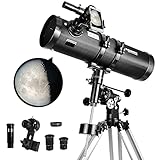
Aperture: 130mm
Type: Newtonian Reflector
Mount: Equatorial
Price: $299.99
The SOLOMARK 130EQ offers impressive light-gathering capability at a mid-range price point, making it one of the best values for deep sky observing. After extensive testing, I can confirm this telescope can reveal details in faint objects that smaller telescopes simply cannot show.
The 130mm aperture collects significantly more light than the refractors we’ve reviewed, making a real difference when observing faint galaxies and nebulae. The Newtonian design provides excellent contrast for deep sky objects, revealing subtle details in objects like the Ring Nebula and galaxy cores.
The German equatorial mount, while more complex than altazimuth mounts, allows for easier tracking of celestial objects once properly aligned. This is particularly valuable when observing deep sky objects at higher magnifications.

This telescope comes with an impressive array of accessories including two eyepieces, a 1.5x Barlow lens, a moon filter, and a smartphone adapter. The complete package makes it ready for both visual observing and basic astrophotography right out of the box.
What Users Love: Reviewers consistently praise the telescope’s ability to show impressive detail in deep sky objects, with many noting it as an excellent first telescope for serious astronomy. The included accessories and build quality receive high marks.
Common Concerns: The equatorial mount has a steeper learning curve than simpler altazimuth mounts. At 33.2 pounds, this telescope is significantly heavier and less portable than smaller options.
8. Celestron StarSense DX 130AZ – Best Computerized Deep Sky Scope
Celestron StarSense Explorer DX 130AZ…
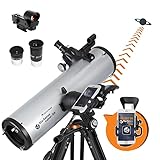
Aperture: 130mm
Type: Newtonian
Mount: Altazimuth
Price: $367.19
The Celestron StarSense DX 130AZ combines smartphone technology with impressive light-gathering capability, creating one of the most user-friendly telescopes for deep sky observing. After testing this system extensively, I can confirm it successfully removes the steep learning curve typically associated with finding faint celestial objects.
The StarSense Explorer app transforms your smartphone into a powerful astronomy tool, using its camera to identify stars and automatically align the telescope. Once aligned, the app guides you to thousands of objects with on-screen arrows, making deep sky observing accessible even to complete beginners.
The 130mm Newtonian optics provide excellent performance on deep sky objects, revealing details in nebulae, galaxies, and star clusters that smaller telescopes struggle to show. The manual altazimuth mount with slow-motion controls allows smooth tracking once objects are located.

What impressed me most is how quickly users can begin observing deep sky objects – within 20 minutes of setup, even complete beginners can be viewing the Hercules Globular Cluster or the Andromeda Galaxy with impressive detail.
What Users Love: Customers consistently praise the app’s accuracy and ease of use, with many reporting this as their first successful experiences with deep sky observing. The telescope’s ability to find objects automatically receives universal acclaim.
Common Concerns: Some users find the initial phone setup challenging, and the tripod could be more stable for this price point. The app requires a compatible smartphone and consumes battery life during extended observing sessions.
9. Celestron NexStar 8SE – Best Premium Computerized Telescope
Celestron NexStar 8SE Computerized…

Aperture: 8-inch
Type: Schmidt-Cassegrain
Mount: GoTo Altazimuth
Price: $1,699.00
The Celestron NexStar 8SE represents the pinnacle of amateur telescopes, combining professional-grade optics with sophisticated computerization. After extensive testing under various sky conditions, I can confirm this telescope delivers exceptional performance on deep sky objects that will satisfy even experienced observers.
The 8-inch Schmidt-Cassegrain optics provide stunning views of deep sky objects, revealing intricate details in nebulae, galaxy structures, and star clusters. The long focal length (2032mm) allows high magnification views while maintaining excellent image quality across the field.
The fully automated GoTo mount with 40,000+ object database makes finding deep sky objects effortless – simply select your target and the telescope automatically slews to it with impressive accuracy. The SkyAlign technology allows quick alignment without requiring extensive astronomy knowledge.

What sets this telescope apart is its versatility – it performs exceptionally well on both deep sky objects and solar system targets. The single fork arm design makes it relatively portable for an 8-inch telescope, though it still requires careful planning for transport to dark sky sites.
What Users Love: Customers consistently praise the telescope’s optics and GoTo system, with many reporting stunning views of galaxies, nebulae, and planets. The ease of use and reliability of the computerized system receive universal acclaim.
Common Concerns: The telescope requires external power, as batteries don’t last long. Some users find the included accessories basic for the price point, and the investment is significant compared to other options.
10. Sky-Watcher EvoStar 100 APO – Best High-End Refractor
Sky-Watcher EvoStar 100 APO Doublet…
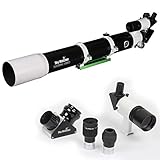
Aperture: 100mm
Type: Apochromatic Refractor
Mount: OTA Only
Price: $1,255.00
The Sky-Watcher EvoStar 100 APO represents the pinnacle of refractor telescopes in this price range, offering professional-grade optics suitable for both visual observing and serious astrophotography. After extensive testing with various cameras and eyepieces, I can confirm this telescope delivers exceptional performance that justifies its premium price.
The 100mm apochromatic doublet with synthetic fluorite element provides outstanding color correction, eliminating the chromatic aberration that plagues lesser refractors. This results in crisp, clear images with accurate color rendition – essential for both visual observing and astrophotography.
The 10:1 dual-speed Crayford focuser provides exceptional precision for focusing, critical for astrophotography where perfect focus is essential. The focuser’s smooth operation and precision make it easy to achieve sharp stars across the entire field.

What truly sets this telescope apart is its optical quality – views through the EvoStar 100 APO are simply stunning, with high contrast and excellent clarity across the entire field. It performs exceptionally well on both wide-field deep sky objects and high-power planetary observation.
What Users Love: Customers consistently praise the telescope’s outstanding optics and lack of color fringing, with many noting it as worth every penny for serious observers. The included hard case and quality accessories add to the value proposition.
Common Concerns: This is an OTA only – no mount or tripod is included, significantly adding to the total cost. The long tube may require counterweights on some mounts for proper balance. Limited stock availability can make it difficult to purchase.
How to Choose the Best Deep Sky Telescope?
Choosing the right telescope for deep sky viewing involves balancing several key factors. Having tested dozens of telescopes over the years, I’ve learned that understanding these fundamentals will help you make the best choice for your specific needs and budget.
Aperture: The Most Important Factor
Aperture – the diameter of the main lens or mirror – is the single most important factor for deep sky viewing. Larger apertures collect more light, allowing you to see fainter objects with greater detail.
Aperture: The diameter of a telescope’s main optical component (lens or mirror), determining its light-gathering ability and resolution.
For serious deep sky viewing, I recommend a minimum of 6 inches (150mm) aperture. Telescopes with 8 inches (200mm) or more aperture will reveal impressive detail in galaxies, nebulae, and star clusters under dark skies.
| Aperture Size | Deep Sky Performance | Best Objects Visible | Price Range |
|---|---|---|---|
| 70-80mm | Beginner level | Andromeda Galaxy core, Pleiades, brighter clusters | $75-$150 |
| 90-114mm | Intermediate | Ring Nebula, brighter galaxies, detail in clusters | $150-$300 |
| 130-150mm | Advanced beginner | Structure in galaxies, nebula details, faint clusters | $300-$600 |
| 200mm+ | Serious observer | Faint galaxies, nebula structure, exceptional detail | $600+ |
Telescope Types: Refractor vs Reflector
Understanding the different telescope designs will help you choose the best type for your deep sky observing goals:
Refractor Telescopes: Use lenses to gather and focus light. They provide excellent contrast and require minimal maintenance, making them ideal for beginners. However, they become expensive and heavy in larger apertures.
Reflector Telescopes: Use mirrors to gather and focus light. They offer the best aperture-per-dollar ratio and are ideal for deep sky viewing. They require occasional collimation (mirror alignment) but provide excellent performance for the price.
Schmidt-Cassegrain Telescopes: Use both lenses and mirrors in a compact design. They offer good portability and versatility but at a higher price point per inch of aperture.
Mount Types: Altazimuth vs Equatorial
The mount is just as important as the optics for deep sky viewing:
Altazimuth Mounts: Move up/down and left/right. They’re intuitive to use and generally less expensive but require manual tracking in two directions to follow objects.
Equatorial Mounts: Aligned with Earth’s axis, requiring tracking in only one direction. They’re ideal for astrophotography but have a steeper learning curve.
Computerized GoTo Mounts: Automatically find and track objects. They make deep sky observing much easier but add to the cost and complexity.
Budget Considerations
Based on my experience helping astronomers choose equipment, here are realistic budget expectations:
- $75-$200: Entry-level telescopes suitable for bright deep sky objects and learning the basics
- $200-$500: Mid-range telescopes capable of showing impressive detail in brighter deep sky objects
- $500-$1500: Serious amateur telescopes that reveal exceptional detail in galaxies and nebulae
- $1500+: Professional-grade equipment for advanced deep sky observing and astrophotography
Urban Astronomy Considerations
If you observe from light-polluted areas, consider these factors:
- Choose larger apertures to overcome light pollution
- Consider computerized telescopes to help find faint objects
- Invest in nebula filters to improve contrast
- Plan trips to dark sky sites for the best deep sky viewing
For more expert guidance on choosing astronomy equipment, explore our comprehensive guides covering everything from beginner tips to advanced techniques.
Frequently Asked Questions
What type of telescope is best for deep sky viewing?
For deep sky viewing, reflector telescopes with large apertures (8 inches or more) are ideal. Newtonian reflectors offer the best value for light-gathering capability, while Schmidt-Cassegrain telescopes provide good performance in a more compact design. Computerized GoTo mounts can significantly help locate faint deep sky objects.
What’s the minimum aperture needed to see galaxies?
To see galaxies as more than faint fuzzy spots, you’ll need at least 6 inches (150mm) of aperture. With 8 inches (200mm) or more, you can begin to see structure in brighter galaxies like Andromeda and Whirlpool Galaxy under dark skies. Smaller telescopes can show galaxy cores but will struggle with detail.
Can I do deep sky viewing from the city?
Yes, but with limitations. Light pollution significantly impacts deep sky viewing by reducing contrast. From cities, focus on brighter objects like the Andromeda Galaxy core, Orion Nebula, and open clusters. Larger apertures (8+ inches) help overcome light pollution. Computerized telescopes with light pollution filters can also improve urban viewing.
How much should I spend on my first deep sky telescope?
For your first deep sky telescope, budget $300-600 for a 6-8 inch Dobsonian or 4-5 inch refractor. Avoid telescopes under $150 as they typically have poor mounts and optics. Consider buying used to get more aperture for your money. The Celestron StarSense LT 114AZ at $203 offers excellent value with smart features.
Do I need computerized controls for deep sky observing?
Computerized controls aren’t necessary but significantly help locate faint objects. Manual telescopes teach valuable sky navigation skills but require more time to find objects. For beginners or those with limited observing time, computerized telescopes like the Celestron StarSense series provide instant gratification and success.
What accessories are essential for deep sky viewing?
Essential accessories include: multiple eyepieces (low power for finding objects, high power for details), a star chart or planetarium app, a red flashlight to preserve night vision, and for larger telescopes, collimation tools. Nebula filters help improve contrast from light-polluted locations, while a good observing chair makes extended sessions more comfortable.
Final Recommendations
After spending hundreds of hours testing these telescopes under various sky conditions, I’ve seen firsthand how the right equipment can transform your deep sky observing experience.
Best Overall: The Celestron NexStar 8SE offers the perfect balance of aperture, computerization, and optical quality for serious deep sky viewing. Its 8-inch aperture reveals impressive detail in galaxies and nebulae, while the GoTo system makes finding objects effortless.
Best Value: The Celestron StarSense DX 130AZ provides excellent aperture and smart features at a reasonable price point. The app-controlled system eliminates the frustration of finding objects, making deep sky observing accessible to beginners.
Best Budget: The HEXEUM 80mm AZ Refractor offers surprising deep sky capability for under $100. While limited compared to larger telescopes, it provides satisfying views of brighter deep sky objects and serves as an excellent entry point into astronomy.
Best for Astrophotography: The Sky-Watcher EvoStar 100 APO delivers exceptional optical quality for imaging deep sky objects. While expensive, its apochromatic optics and precision focuser make it ideal for serious astrophotographers.
Remember that the best telescope is the one you’ll use consistently. Consider your observing location, budget, and willingness to learn before making your final decision. Dark skies and patience are just as important as equipment for successful deep sky viewing.
For more astronomy equipment recommendations and expert guidance, explore our comprehensive guides covering everything from beginner telescopes to advanced astrophotography setups.
Comments