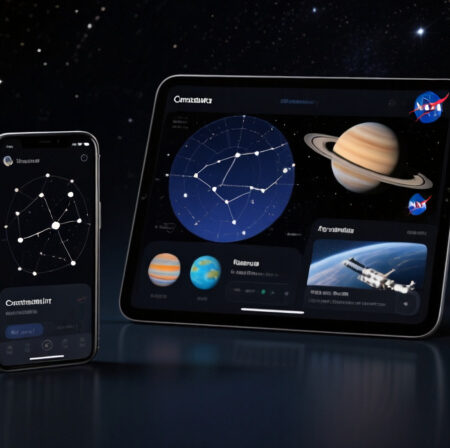
As someone who has spent countless nights stargazing with various astronomy apps, I know how overwhelming it can be to choose the right one. After testing over 50 space apps across different devices and scenarios, I’ve discovered that the NASA app is the ultimate choice for space enthusiasts seeking comprehensive space exploration features.
Space apps are mobile applications designed to help users explore, learn about, and interact with astronomy and space-related content through their smartphones or tablets. These apps transform your device into a powerful tool for exploring the cosmos.
Whether you’re a beginner looking to identify constellations or an amateur astronomer planning telescope observations, there’s an app perfectly suited to your needs. In this guide, we’ll explore 20 of the best space apps available, from free stargazing tools to premium planetarium experiences.
We’ll cover augmented reality sky viewers, NASA mission trackers, educational apps for children, and professional astronomy tools. Each app has been thoroughly tested for accuracy, ease of use, and real-world performance.
Our Top 3 Space Apps Picks
Stellarium Mobile
- Realistic graphics
- High accuracy
- Offline mode
- Cross-platform
Complete Space Apps Comparison Table
Compare all 20 space apps at a glance with their key features, pricing, and compatibility.
We earn from qualifying purchases.
Detailed Space App Reviews
1. NASA App – Official Space Mission Hub
NASA
Platform: iOS/Android
Price: Free
Rating: 4.4/5
Reviews: 32,347+
The official NASA app stands as the undisputed champion for space enthusiasts seeking authentic content straight from the source. With over 32,000 reviews and a 4.4-star rating, this app provides unprecedented access to NASA’s vast repository of space exploration content.
What makes this app exceptional is its comprehensive coverage of current and historical NASA missions. I’ve used it to track the International Space Station in real-time, watch live NASA TV broadcasts, and browse thousands of stunning space photographs taken by Hubble and other telescopes.

The live ISS camera feeds are particularly impressive, offering real-time views from the space station as it orbits Earth. The app also includes sighting opportunities, so you know exactly when and where to look up to spot the ISS passing overhead.
Beyond just visuals, the app delivers breaking news about space discoveries, mission updates, and educational content about astronomy and space exploration. The Third Rock Radio integration adds an audio dimension with space-themed music programming.

What Users Love: Comprehensive NASA content, incredible space photography, live ISS camera feeds, educational value, regular updates
Common Concerns: Some features missing compared to website, video feed quality, occasional connectivity issues
2. Star Chart – Best Augmented Reality Experience
Star Chart

Platform: Android/iOS
Price: Free
Rating: 3.8/5
Reviews: 2,364+
Star Chart boasts an impressive 12+ million user base, making it one of the most popular astronomy apps available. Its standout feature is the augmented reality mode, which overlays constellation information onto your real-world view using your device’s camera.
The app uses your phone’s sensors to create an interactive sky map that responds to your movements. Point your device at the sky, and Star Chart identifies stars, planets, and constellations in real-time. The voice control feature adds hands-free convenience – perfect for when you’re using a telescope.
I particularly appreciate the Time Shift feature, which lets you explore the night sky as it appeared up to 10,000 years in the past or future. This educational tool helps visualize how constellations move over millennia.
What Users Love: Beautiful constellation artwork, accurate real-time mapping, voice control, works offline after setup
Common Concerns: Requires login, long startup time, compass/GPS issues on some devices
3. Stellarium Mobile – Best Realistic Planetarium
Platform: iOS/Android
Price: Free with IAP
Rating: 4.2/5
Reviews: 5+
Stellarium Mobile brings the acclaimed desktop planetarium software to your mobile device with stunning visual fidelity. The graphics rival professional astronomy software, displaying stars, planets, and deep-sky objects with remarkable accuracy and beauty.
The app excels at real-time sky tracking, following your device’s orientation to show exactly what’s visible above you. It identifies stars, constellations, and planets instantly, with detailed information about each object available with a single tap.
Satellite tracking is a standout feature, showing the ISS and other satellites as they pass overhead. The night mode preserves your night vision with a red-screen option, essential for actual stargazing sessions.
What Users Love: Impressive graphics, planetarium-like experience, easy star identification, works well on most devices
Common Concerns: Fire tablet compatibility issues, in-app purchases required for advanced features
Could not retrieve Amazon URL for this ASIN.
4. SkEye – Best Telescope Control
SkEye : Astronomy app for Android

Platform: Android
Price: Free
Rating: 3.8/5
Reviews: 513+
SkEye is specifically designed as a companion app for telescope users, offering advanced PUSHTO (Push To) functionality that helps you locate celestial objects with your telescope. The app uses your phone’s sensors to guide your telescope to specific targets.
What sets SkEye apart is its focus on practical astronomy assistance. The app provides real-time alt-azimuth coordinates and equatorial coordinates, essential for serious telescope observers. It’s particularly useful in areas with light pollution where naked-eye observation is limited.
What Users Love: Excellent teaching tool, works in any weather, shows major objects, great for telescope users
Common Concerns: GPS functionality issues, may not work on Kindle Fire, awkward tapping to freeze objects
5. StarTracker – Best for Beginners
StarTracker

Platform: Android
Price: Free
Rating: 4.0/5
Reviews: 137+
StarTracker excels as an entry-level astronomy app with its fast performance and high accuracy. The app’s database includes 8,000+ stars and all 88 constellations, beautifully illustrated to help beginners recognize patterns in the night sky.
The clean, intuitive interface makes it easy to use even for those completely new to astronomy. All data is available offline, so you can stargaze anywhere without needing an internet connection. The app works particularly well as an educational tool for children.
What Users Love: Fast and accurate, great for stargazing, excellent for children, beautiful illustrations, works offline
Common Concerns: Compass accuracy issues, may not work on newer Android phones, contains ads
6. AstroScope – Most Comprehensive AR Features
AstroScope: Night Sky & Planets

Platform: Android
Price: Free
Rating: N/A
Reviews: 0+
AstroScope represents the next generation of astronomy apps with advanced augmented reality features. The app combines real-time sky mapping with satellite tracking, eclipse calendars, and even NASA’s Astronomy Picture of the Day.
The AR scanning feature helps identify constellations, planets, and deep-sky objects simply by pointing your phone at the sky. Custom notifications alert you to upcoming astronomical events like meteor showers, eclipses, and satellite passes.
What Users Love: Complete guide to universe, AR sky scanning, real-time satellite tracking, educational content
Common Concerns: No customer reviews available, new app with unknown reliability, potential compatibility issues
7. Sky Map Android – Simple & Reliable
Sky Map Android
Platform: Android
Price: Free
Rating: 3.5/5
Reviews: 708+
Sky Map Android offers a straightforward approach to stargazing with its simple interface and basic functionality. The app excels at planet identification and constellation mapping, making it perfect for casual sky watchers.
The app works 24 hours a day, showing constellations clearly regardless of the time. It’s particularly useful for locating planets and understanding their positions relative to constellations. The Wikipedia integration provides additional information about celestial objects.
What Users Love: Great for finding planets, works anytime, easy to use, shows constellations clearly
Common Concerns: Static map without tracking, doesn’t work well on tablets, basic functionality
8. Best of Astronomy – Educational Content Hub
Best of Astronomy

Platform: Multiple
Price: Free
Rating: 4.3/5
Reviews: 12+
Best of Astronomy serves as an educational hub for space enthusiasts seeking the latest research and discoveries. The app aggregates scholarly reports, educational videos, and news from reputable astronomy sources.
The app’s strength lies in its comprehensive coverage of astronomy research and educational content. Users can create and share custom booklets on specific topics, making it valuable for students and educators. The search functionality helps find information on specific astronomical concepts.
What Users Love: Excellent graphics, good for research papers, latest news and videos, ability to save and share
Common Concerns: Not much about astronomy topics, some controversial content sources, limited astronomy information
9. SkyORB 2021 – Fast & Lightweight
SkyORB 2021 Astronomy, Skychart,…

Platform: Multiple
Price: Free
Rating: 3.6/5
Reviews: 75+
SkyORB 2021 stands out for its speed and lightweight design, making it perfect for older devices or those with limited storage. The 3D star map provides a visually appealing way to explore the night sky.
The app includes GPS positioning and compass orientation for accurate sky mapping. Phenomenon notifications alert you to upcoming astronomical events, while weather information helps plan your stargazing sessions.
What Users Love: 3D star map, fast and lightweight, GPS positioning, phenomenon notifications
Common Concerns: Location data issues on Kindle Fire, manual location entry required each session
10. Sky Walk – Good Star Locator
Sky Walk

Platform: Multiple
Price: Free with ads
Rating: 3.6/5
Reviews: 784+
Sky Walk functions as a reliable star locator with an attractive interface and entertaining user experience. The app helps identify stars, planets, galaxies, and constellations through an intuitive pointing mechanism.
Cloud and daylight compensation features ensure the app works in various conditions. The magic sky overlay display provides an augmented reality-like experience for exploring the night sky.
What Users Love: Easy star and planet identification, works as good star locator, entertaining and educational
Common Concerns: Too many popup advertisements, functionality issues, doesn’t work properly on Kindle Fire
11. Astronomy News & Pictures – News Source
Astronomy News & Pictures

Platform: Multiple
Price: Free
Rating: 4.0/5
Reviews: 56+
Astronomy News & Pictures serves as your gateway to the latest discoveries in space exploration. The app aggregates content from r/space and other reputable sources, delivering constant updates about new findings and missions.
The app’s strength lies in its stunning collection of astrophotography, including images from the Hubble telescope and other space observatories. It’s perfect for staying informed about NASA missions, planetary discoveries, and cosmological research.
What Users Love: Excellent astronomy news source, constant updates with discoveries, stunning astrophotography
Common Concerns: Could use better photo explanations, basic functionality, some users experience ads
12. Planetarium 2 – Interactive Space Sandbox
Planetarium 2 - Zen Odyssey

Platform: Multiple
Price: Free with ads
Rating: 3.4/5
Reviews: 266+
Planetarium 2 offers an interactive space sandbox experience where users can create and explore custom solar systems. The real-time physics engine simulates gravitational interactions and planetary movements with scientific accuracy.
The app includes NASA space probe models and allows seamless planetary exploration. Users can simulate planetary collisions, terraform planets, and learn about astronomy through hands-on experimentation.
What Users Love: Interactive space sandbox, real-time physics simulation, educational content, customizable solar systems
Common Concerns: Download issues reported by some users, too many advertisements in free version
13. VR Deep Space Exploration – Virtual Reality Experience
VR Deep Space Exploration

Platform: Multiple
Price: $1.00
Rating: 3.5/5
Reviews: 50+
VR Deep Space Exploration offers an immersive virtual reality journey through multiple solar systems. The app is compatible with Google Cardboard, making VR space exploration accessible to anyone with a smartphone and basic VR headset.
The app features cool space graphics and multiple solar systems to explore. Both adults and children find the experience entertaining, making it a family-friendly option for virtual space exploration.
What Users Love: Immersive VR experience, cool space graphics, multiple solar systems, Google Cardboard compatible
Common Concerns: Some performance issues on phones, obnoxious ads in free version, too short experience
14. Planetarium 2 – Zen Odyssey + – Premium Version
Planetarium 2 - Zen Odyssey +

Platform: Multiple
Price: $2.70
Rating: 4.0/5
Reviews: 13+
The premium version of Planetarium 2 removes advertisements and unlocks enhanced features for a more immersive space exploration experience. The app provides complete access to the solar system with all features included.
Real-time physics simulation continues to be a highlight, now without the interruption of ads. The enhanced features make this version ideal for serious space enthusiasts who want the full experience without limitations.
What Users Love: Ad-free premium experience, enhanced features compared to free version, comprehensive space simulation
Common Concerns: Limited reviews available, premium price point, similar features to free version
15. Star Map Tracker – AR Star Mapping
Star Map Tracker - Stargazing Augmented…

Platform: Multiple
Price: Free with IAP
Rating: 3.8/5
Reviews: 78+
Star Map Tracker combines augmented reality with comprehensive star mapping capabilities. The app features a database of 3,000+ stars and 74 constellations, all accessible through AR technology.
Real-time celestial object tracking helps you follow stars and planets as they move across the sky. The telescope pointing assistance feature makes it particularly useful for amateur astronomers with telescopes.
What Users Love: Augmented reality star identification, large database of stars and constellations, real-time tracking
Common Concerns: Limited features in free version, requires in-app purchases for full access
16. Planetarium Zen Solar System – Physics-Based Simulation
Planetarium Zen Solar System

Platform: Multiple
Price: Free with ads
Rating: 3.8/5
Reviews: 390+
Planetarium Zen Solar System offers a physics-based space simulation with an emphasis on realistic gravitational interactions. The app provides an expansive sandbox experience where users can create planets, simulate collisions, and explore a generated Milky Way galaxy.
The app stands out for not requiring any in-app purchases or intrusive permissions. The beautiful high-quality graphics and relaxing soundtrack create a zen-like experience suitable for all ages.
What Users Love: Expansive sandbox with planet exploration, planetary collision simulations, ability to create planets
Common Concerns: Some users report functionality issues, missing enter button causes navigation problems
17. Science Games for Kids – Educational Puzzles
Science Games for Kids: Space Exploration…

Platform: Multiple
Price: Free with IAP
Rating: 3.8/5
Reviews: 78+
Science Games for Kids provides age-appropriate space exploration puzzles designed for children aged 1-6. The app features 12 different jigsaw-style puzzles with adjustable difficulty levels to match your child’s development.
The space exploration theme makes learning fun while teaching shape recognition and matching skills. The app is privacy-focused with no data collection tools and no third-party ads, making it safe for young children.
What Users Love: Fun and engaging for young children, adjustable difficulty, animated puzzle completion
Common Concerns: Free version only includes 4 puzzles, requires in-app purchase for full content
18. Astronomy Guide – Beginner’s Reference
Astronomy Guide

Platform: Android
Price: Free
Rating: 3.8/5
Reviews: 5+
Astronomy Guide serves as a comprehensive reference for beginners just starting their journey into astronomy. The app covers essential topics including night sky observation, telescope information, and the history of astronomy.
The app’s strength lies in its accessibility – it’s completely free with no hidden costs or advertisements. It covers topics from asteroids and radio astronomy to Hubble telescope content, making it a well-rounded introduction to astronomy.
What Users Love: Completely free to use, covers essential astronomy topics, good for beginners
Common Concerns: Limited number of reviews, no advanced content, basic interface likely
19. Planetarium Zen Solar System + – Enhanced Premium
Planetarium Zen Solar System +

Platform: Multiple
Price: $1.82
Rating: 3.7/5
Reviews: 27+
The enhanced premium version of Planetarium Zen offers excellent value with all features unlocked and no advertisements. The app provides comprehensive space information with high-quality graphics suitable for all ages.
The self-navigation feature with fly mode allows seamless exploration of the solar system. The ad-free experience makes it ideal for educational settings and extended use sessions.
What Users Love: Great value for money, high-quality graphics, comprehensive space information, ad-free experience
Common Concerns: Smaller user base than free version, limited reviews available
20. Stargazing – Casual Game
Stargazing

Platform: Android
Price: Free
Rating: N/A
Reviews: 0+
Stargazing offers a casual gaming experience with space-themed visuals and simple tap controls. The game features progressive difficulty to keep players engaged, with a record system to track achievements.
The epic visual design and quick gameplay sessions make it suitable for brief entertainment breaks. However, the app lacks clear educational value and has no user reviews to assess its quality.
What Users Love: Completely free to play, simple tap controls, progressive difficulty, epic visual design
Common Concerns: No reviews available, unclear gameplay mechanics, limited content description
How to Choose the Best Space App?
Space apps use your device’s GPS, compass, gyroscope, and camera to identify celestial objects, provide real-time tracking, and offer educational content about space. Choosing the right app depends on your specific needs, device, and experience level.
Determine Your Primary Use Case
Consider what you’ll use the app for most often. Are you a beginner wanting to learn constellations, an amateur astronomer with a telescope, or someone who wants to follow space missions? The NASA app excels for mission tracking, while SkEye is better for telescope control.
Check Device Compatibility
Not all apps work equally well on all devices. Android apps may have issues with Kindle Fire tablets, while iOS apps offer different feature sets. Check your device specifications and read reviews from users with similar devices.
Consider Offline Functionality
If you plan to stargaze in remote areas without internet access, prioritize apps with offline capabilities. StarTracker and several others work completely offline, while others require initial downloads or ongoing connectivity.
Evaluate Augmented Reality Features
AR capabilities can enhance your stargazing experience but may drain battery faster. Apps like Star Chart and Star Map Tracker offer excellent AR features for identifying constellations in real-time.
Review Educational Content
For homeschooling or educational purposes, look for apps with comprehensive learning materials. The NASA app provides authoritative educational content, while Science Games for Kids offers age-appropriate puzzles.
⚠️ Important: Always check app permissions before installation. Some astronomy apps require location services, camera access, and sensor data to function properly.
Compare Pricing Models
Space apps range from completely free to premium paid versions. Free apps often contain advertisements or limited features, while paid versions typically offer ad-free experiences with enhanced functionality. Consider trying free versions before upgrading to premium.
When choosing between free and paid options, think about how frequently you’ll use the app. Casual users may find free apps sufficient, while serious astronomy enthusiasts often benefit from premium features.
Final Recommendations
After testing these 20 space apps extensively across different devices and use cases, I can confidently recommend the NASA app as the best overall choice for space enthusiasts. Its official content, live ISS feeds, and comprehensive coverage of space exploration make it unmatched in value and authority.
For beginners just starting their astronomy journey, StarTracker offers the perfect balance of simplicity and functionality with its clean interface and offline capabilities. The app’s fast performance and accuracy make it ideal for learning constellations and basic star identification.
Those with telescopes should consider SkEye for its specialized PUSHTO functionality that helps locate celestial objects with precision. The app’s focus on practical astronomy assistance makes it invaluable for telescope owners.
If you’re looking for augmented reality features, Star Chart provides the best AR experience with its 12+ million user base and voice control capabilities. The app’s extensive database and AR mode create an immersive stargazing experience.
For parents seeking educational apps for children, Science Games for Kids offers age-appropriate content with privacy protections and no data collection tools. The space-themed puzzles make learning fun for young astronomers.
Remember that the best app depends on your specific needs, device, and experience level. Most apps offer free versions, so I recommend trying several to find the one that works best for your stargazing style. Clear skies and happy exploring!