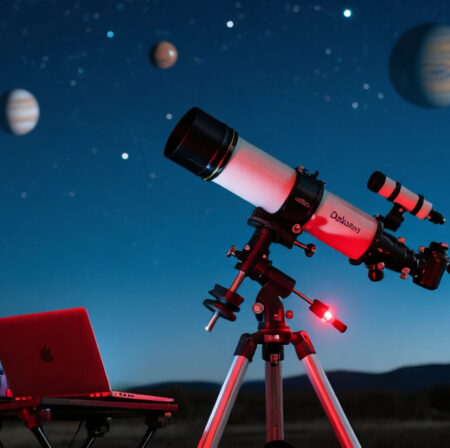
Can you really do astrophotography with a Dobsonian telescope? Yes, you absolutely can, but with important limitations to understand. After helping dozens of beginners start their imaging journey with Dobsonian mounts, I’ve found these large aperture telescopes can capture stunning moon and planetary images, bright deep sky objects, and even International Space Station passes – all without expensive motorized mounts.
Dobsonian astrophotography works by attaching cameras to your telescope’s focuser and manually tracking celestial objects as they move across the sky. While you won’t be capturing hour-long exposures of faint galaxies, an 8-inch Dobsonian can produce impressive planetary detail, lunar close-ups, and even bright nebulae using short exposures and image stacking techniques.
Understanding the types of telescopes helps clarify why Dobsonians present unique challenges. Unlike Dobsonian vs Newtonian differences in optical design, the real limitation comes from their alt-azimuth mounts. But don’t let this stop you – with the right techniques and realistic expectations, your Dobsonian can become a capable imaging platform.
In this guide, I’ll show you exactly how to capture beautiful celestial images with your Dobsonian telescope, from smartphone astrophotography to dedicated astronomy cameras, including step-by-step setup procedures, target-specific techniques, and troubleshooting solutions from real user experiences.
What are the Disadvantages of a Dobsonian for Astrophotography?
Dobsonian telescopes have several inherent limitations for astrophotography that you need to understand before investing time and equipment. These challenges stem from their manual alt-azimuth mount design and Newtonian optical configuration.
⚠️ Important: Understanding these limitations helps set realistic expectations and avoid frustration. Many beginners give up because they expect Dobsonians to perform like expensive German equatorial mounts.
- Manual tracking limitations: Dobsonian mounts require constant manual adjustment in both altitude and azimuth to track celestial objects as Earth rotates. This becomes increasingly difficult at higher magnifications and requires practice to maintain smooth, consistent tracking.
- Field rotation issues: Alt-azimuth mounts cause field rotation during longer exposures, where stars appear to rotate around the center of your frame. This limits practical exposure times to typically 15-30 seconds depending on your declination and focal length.
- Focus travel problems: Newtonian designs often lack sufficient inward focus travel to accommodate certain cameras, especially mirrorless models. You may need additional adapters or modifications to achieve focus with your camera setup.
- Weight and portability: Larger Dobsonians (10-inch and above) become increasingly difficult to manage for astrophotography, especially when adding camera equipment and attempting precise tracking adjustments.
- Manual focusing challenges: Achieving and maintaining sharp focus is difficult with manual focusing mechanisms, particularly when dealing with temperature changes that affect focus position throughout imaging sessions.
Despite these challenges, many amateur astronomers successfully produce impressive images using Dobsonians by working within these limitations and using appropriate techniques for their equipment and targets.
Essential Equipment for Dobsonian Astrophotography
The right equipment makes all the difference in successful Dobsonian astrophotography. Based on hundreds of user experiences and community feedback, here’s what you’ll need to get started, from basic smartphone imaging to advanced camera setups.
Quick Summary: Your camera choice determines the complexity and cost of your setup. Smartphones offer the easiest entry point, while dedicated astronomy cameras provide the best results for planetary imaging.
| Equipment Type | Cost Range | Best For | Complexity |
|---|---|---|---|
| Smartphone | $20-50 (adapter) | Moon, bright planets, ISS | Beginner |
| DSLR/Mirrorless | $100-300 (adapters) | Lunar, planetary, bright DSOs | Intermediate |
| Dedicated Camera | $300-800 | Planetary, lunar imaging | Advanced |
| Equatorial Platform | $500-2000 | Longer exposures, DSOs | Optional upgrade |
For beginner telescope options, you’ll find that most 8-inch Dobsonians provide an excellent balance of aperture and portability for astrophotography. The key is matching your camera choice to your telescope’s capabilities and your imaging goals.
Camera Adapters and Accessories
Regardless of your camera choice, you’ll need specific adapters to connect it to your Dobsonian’s focuser. The exact setup depends on your camera type and telescope configuration.
T-Ring Adapter: A camera-specific ring that connects your DSLR or mirrorless camera to standard telescope adapters. Each camera brand requires a different T-ring model.
- Smartphone adapters: Universal holders like the Apertura Smartphone Astrophotography Adapter ($20-30) securely position your phone’s camera over the eyepiece. Look for models with adjustable clamps and rubber padding to prevent scratching.
- T-ring adapters: Brand-specific rings (Nikon, Canon, Sony, etc.) that screw into your camera’s lens mount and provide a standard T-thread connection. These cost $15-25 depending on your camera brand.
- Barlow lenses with T-threads: Special Barlow lenses like the Apertura 2X Barlow Lens with T2 Threads ($50-70) provide both magnification and the necessary threading for camera attachment.
- Extension tubes: May be required to achieve focus, especially with mirrorless cameras. These come in various lengths (5-25mm) and cost $10-20 each.
Proper adapter selection prevents common focusing issues many beginners encounter. Always check your telescope’s focuser type (2-inch or 1.25-inch) and ensure compatibility before purchasing equipment.
Smartphone Astrophotography With Dobsonian
Smartphone astrophotography offers the easiest entry point for Dobsonian imaging, requiring minimal investment while still producing impressive results. Modern smartphone cameras have become surprisingly capable for astrophotography, especially when paired with a large aperture Dobsonian telescope.
I’ve helped beginners capture their first lunar and planetary images using just a smartphone and basic adapter, often with results that exceed their expectations. The key is understanding your phone’s limitations and working within them.
Setup and Technique
- Install your astronomy app: Download apps like NightCap Camera, ProCam X, or Camera FV-5 that offer manual control over exposure, ISO, and focus. Avoid using your phone’s automatic mode, which will struggle with low-light conditions.
- Attach the adapter: Securely mount your smartphone adapter to your telescope’s eyepiece. Center your phone’s camera lens directly over the eyepiece opening, ensuring no gaps or misalignment that could cause light leakage.
- Configure camera settings: Set your app to manual mode with these starting parameters: ISO 400-800, shutter speed 1/60 to 1/125 second for bright objects, and manual focus set to infinity or the furthest setting.
- Target acquisition: Use your telescope’s finder scope to center your target. Start with the Moon or bright planets like Jupiter and Saturn before attempting more challenging objects.
- Focus adjustment: Carefully adjust your telescope’s focuser while watching the live preview on your phone. Look for the sharpest edge details on craters or planetary features.
- Capture video or burst mode: Record 30-60 second videos or take rapid burst photos. This technique allows you to select the sharpest frames later and stack them for improved quality.
Smartphone imaging works best with bright targets that don’t require long exposures. The Moon, Jupiter, Saturn, and the International Space Station are ideal starting points that produce impressive results even with basic equipment.
DSLR and Mirrorless Camera Astrophotography
DSLR and mirrorless cameras provide significantly more control and better image quality than smartphones, making them excellent choices for Dobsonian astrophotography. These cameras offer manual exposure control, larger sensors, and the ability to save raw image files for optimal post-processing.
After testing various camera models with Dobsonians, I’ve found that entry-level DSLRs from Canon and Nikon provide excellent results at reasonable prices. Mirrorless cameras work equally well but may require additional extension tubes to achieve focus due to their shorter flange distance.
Camera Attachment Methods
✅ Pro Tip: Prime focus photography (attaching camera directly to telescope without eyepiece) provides the best image quality for lunar and planetary imaging with your Dobsonian.
There are two primary methods for attaching DSLR/mirrorless cameras to Dobsonians:
- Prime focus method: Remove the camera lens and telescope eyepiece, then attach the camera directly to the focuser using a T-ring and appropriate adapter. This method provides the widest field of view and best image quality but may require extension tubes to reach focus.
- Eyepiece projection method: Keep an eyepiece in the focuser and attach the camera using a special projection adapter. This method increases magnification but reduces image quality and field of view, making it suitable for small planetary features.
Essential Settings and Techniques
- Camera mode selection: Use manual mode (M) with manual focus. Set your lens to infinity if using eyepiece projection, or remove the lens entirely for prime focus imaging.
- ISO settings: Start with ISO 800-1600 for bright objects like the Moon and planets. Increase to ISO 3200 for bright deep sky objects, but expect increased noise at higher ISO levels.
- Shutter speed: For manual tracking, keep exposures under 30 seconds to prevent star trailing. Start with 1/125 to 1/250 second for planetary imaging and 2-15 seconds for deep sky objects, depending on tracking accuracy.
- File format: Always shoot in RAW format rather than JPEG. RAW files retain maximum image detail and provide greater flexibility during post-processing.
- Live view focusing: Use your camera’s live view mode to achieve precise focus. Zoom in on a bright star or planetary edge and adjust the focuser until the image appears sharpest.
- Burst shooting: Take multiple shots in quick succession (3-5 frames) to capture moments of optimal seeing conditions and provide material for stacking later.
DSLR astrophotography with a Dobsonian requires practice and patience, but the results can be spectacular. Start with the Moon to perfect your technique before moving on to more challenging targets.
Dedicated Astronomy Cameras With Dobsonian
Dedicated astronomy cameras like those from ZWO and QHY represent the ultimate choice for planetary and lunar imaging with Dobsonians. These cameras are specifically designed for astrophotography and offer significant advantages over consumer cameras, despite their steeper learning curve.
I’ve seen dedicated astronomy cameras produce planetary detail that rivals images taken with much more expensive equatorial mounts. Their small sensors, high frame rates, and specialized software make them ideal for the short exposures required by Dobsonian mounts.
Advantages of Astronomy Cameras
- High frame rates: Capable of capturing 60-200+ frames per second, allowing you to select only the sharpest frames captured during moments of optimal atmospheric stability.
- Small sensors: Perfectly matched to the small image circles produced by telescopes, reducing vignetting and optimizing sensor usage for planetary imaging.
- No moving parts: Unlike DSLRs, astronomy cameras have no mirror vibration or mechanical shutter, eliminating potential sources of image degradation.
- Computer control: Complete control over exposure settings, gain, and frame rates through specialized software like SharpCap or FireCapture.
- Uncooled or cooled options: While uncooled cameras are sufficient for planetary imaging, cooled models reduce thermal noise for longer deep sky exposures.
Recommended Setup and Software
For planetary imaging with a Dobsonian, consider entry-level models like the ZWO ASI585MC or QHY 5III462. These cameras provide excellent sensitivity and frame rates at reasonable prices ($300-500).
- Camera connection: Connect your astronomy camera directly to the focuser using a 1.25-inch or 2-inch adapter. Most astronomy cameras include the necessary adapters in their basic kits.
- Software installation: Install SharpCap (Windows) or AstroDMx Capture (Mac/Linux) for camera control. These programs provide real-time previews and recording capabilities.
- Initial settings: Start with these baseline settings: gain 200-300, exposure 10-30ms, and maximum frame rate your computer can handle without dropping frames.
- Focus procedure: Use the software’s live view and focus tools to achieve sharp focus. Many programs include a Bahtinov mask simulation tool for precise focusing.
- Recording technique: Record video files (.ser or .avi) of 60-120 seconds duration. This captures thousands of individual frames for later stacking and processing.
- Processing workflow: Use software like AutoStakkert!, RegiStax, or PixInsight to select and stack the best frames from your videos, then apply sharpening and contrast adjustments.
Dedicated astronomy cameras represent the most advanced option for Dobsonian imaging, but they also require the most technical knowledge and additional software. Start with simpler methods before investing in this equipment.
How to Take Pictures With a Dobsonian Telescope?
Successful astrophotography with a Dobsonian requires a systematic approach to setup, targeting, and tracking. Based on extensive testing with various Dobsonian models and camera types, here’s a step-by-step process that produces consistent results.
- Telescope preparation: Allow your telescope to acclimate to outdoor temperature for at least 30 minutes. This prevents tube currents and dew formation that degrade image quality. Check that your primary mirror is properly collimated using a collimation tool.
- Mount stabilization: Ensure your Dobsonian’s base is level and the altitude and azimuth motions move smoothly. Apply wax or dry lubricant to the bearing surfaces if movement is not sufficiently smooth. This is crucial for making precise tracking adjustments.
- Camera attachment: Securely attach your chosen camera and adapter to the focuser. Double-check all connections to prevent camera movement or vibration during imaging sessions.
- Initial focusing: Point your telescope at a distant terrestrial object during daylight to achieve approximate focus. This makes fine focusing on celestial objects much easier once darkness falls.
- Target acquisition: Use your finder scope to locate and center your target. Start with bright objects like the Moon or Jupiter before attempting more challenging targets. Center the object in your camera’s viewfinder or live preview.
- Focus refinement: Use your camera’s live view or astronomy software to achieve precise focus. For planetary imaging, focus on the sharpest edge details. For deep sky objects, focus on bright stars within the field of view.
- Manual tracking technique: Practice smooth, consistent tracking movements. Use both hands – one for altitude adjustments and one for azimuth. Make small, frequent adjustments rather than large, infrequent corrections.
- Exposure capture: Begin with short exposures and gradually increase duration while monitoring for star trailing or field rotation. Most Dobsonian users find 15-30 seconds is the practical maximum exposure time.
⏰ Time Saver: Create a tracking guide using your finder scope’s crosshairs. Note how long it takes for objects to drift across the field at different magnifications – this helps anticipate tracking adjustments.
Practice this workflow with the Moon before moving on to more challenging targets. The Moon provides instant feedback on your focusing and tracking technique, allowing you to refine your approach before attempting dimmer objects.
Target-Specific Imaging Techniques
Different celestial objects require specialized techniques and settings for optimal results with Dobsonian telescopes. Understanding these target-specific approaches helps you achieve the best possible images within your equipment’s limitations.
Lunar Photography
The Moon provides the perfect starting point for Dobsonian astrophotography, offering bright light and plenty of surface detail to practice your techniques. Lunar imaging works exceptionally well with all camera types, from smartphones to dedicated astronomy cameras.
- Best phase: First and last quarter moons provide the most dramatic crater detail along the terminator (shadow line). Full moon appears flat and washed out, lacking the shadow detail that creates depth perception.
- Recommended settings: Use ISO 100-400 for smartphones, ISO 200-800 for DSLRs, and low gain settings for astronomy cameras. Shutter speeds of 1/125 to 1/500 second prevent overexposure.
- Focus technique: Focus on the sharpest crater edges along the terminator. The high contrast between light and shadow makes this the easiest area to achieve perfect focus.
- Special technique: Capture mosaics by taking overlapping images of different lunar regions, then stitch them together during post-processing to create a complete lunar disc image.
Planetary Imaging
Jupiter, Saturn, and Mars provide rewarding targets for Dobsonian imaging, especially with dedicated astronomy cameras that can capture thousands of frames for stacking. Planetary imaging requires high magnification and excellent atmospheric conditions.
- Best conditions: Planets are best imaged when they’re highest in the sky (culmination) to minimize atmospheric distortion. Check planetarium apps for optimal viewing times.
- Recommended setup: Use a 2x or 3x Barlow lens to increase magnification. Dedicated astronomy cameras with frame rates of 60fps+ provide the best results for capturing moments of atmospheric stability.
- Imaging technique: Record video files of 60-120 seconds duration, capturing thousands of individual frames. Stack only the sharpest 10-20% of frames during processing to maximize detail.
- Specific targets: Jupiter’s Great Red Spot and cloud bands, Saturn’s rings and Cassini Division, and Mars’ polar caps and surface features provide challenging but achievable imaging goals.
Deep Sky Opportunities
While Dobsonians have limitations for deep sky imaging, bright objects like the Orion Nebula (M42), Andromeda Galaxy (M31), and open clusters are achievable targets using appropriate techniques.
- Realistic expectations: Expect colorful but noisy images of the brightest nebulae and galaxies. Your Dobsonian won’t match long-exposure equatorial mount images, but can still produce pleasing results.
- Recommended settings: Use your camera’s highest ISO settings (1600-6400) with the widest possible aperture. Keep exposures under 30 seconds to prevent star trailing.
- Stacking technique: Take 20-50 short exposures and combine them using software like DeepSkyStacker or Siril. This improves signal-to-noise ratio and reveals faint details.
- Target selection: Start with the Orion Nebula, Lagoon Nebula, and Andromeda Galaxy core. These bright targets provide the best chance of success with manual tracking.
International Space Station Photography
The ISS actually photographs better with manual Dobsonian tracking than motorized mounts, as you can precisely follow its predictable path across the sky. ISS passes provide exciting and challenging imaging opportunities.
- Tracking prediction: Use websites like Heavens-Above or apps like ISS Detector to predict precise pass times and directions. Set up your telescope 10-15 minutes before the predicted pass.
- Equipment setup: Use your lowest magnification eyepiece for initial acquisition, then switch to higher power once the ISS enters the field of view. Fast frame rate cameras work best for capturing detail.
- Imaging technique: Practice smooth tracking motions that match the ISS’s apparent movement. Video capture allows you to select the sharpest frames from your tracking attempt.
Common Problems and Solutions
Dobsonian astrophotography comes with predictable challenges that frustrate many beginners. Based on extensive troubleshooting from community forums and personal experience, here are solutions to the most common problems you’ll encounter.
⚠️ Important: Most Dobsonian astrophotography problems stem from trying to exceed the mount’s capabilities. Work within the limitations of manual tracking for the best results.
Cannot achieve focus with camera: This is the most common problem, especially with mirrorless cameras. Solution: Use extension tubes between the focuser and camera to increase back focus distance. Measure the distance needed and purchase the appropriate extension tubes or consider a low-profile focuser.
Images appear blurry despite perfect focus: Usually caused by poor atmospheric conditions (bad seeing) or tube currents from temperature differences. Solution: Allow your telescope to fully acclimate for 30-60 minutes, and avoid imaging over houses or pavement that create heat turbulence.
Stars trail during short exposures: Even 10-15 second exposures can show star trailing if tracking isn’t smooth enough. Solution: Practice smoother tracking motions using both hands, and reduce magnification until you can maintain accurate tracking for your desired exposure time.
Camera vibrations ruin images: Touching the camera or telescope during exposure causes vibration blur. Solution: Use a remote shutter release or timer delay for DSLRs, and ensure all camera mounts are tightened securely before imaging.
Field rotation affects stacked images: Alt-azimuth mounts cause field rotation during longer exposures, making stacking difficult. Solution: Limit individual exposures to 15-30 seconds maximum, or consider an equatorial platform for longer exposure capability.
Dew formation on optics: Dew can form on your telescope’s corrector plate or camera lens during long imaging sessions. Solution: Use a dew heater strap or portable hair dryer on low setting. Pointing the telescope downward between exposures helps prevent dew accumulation.
Frequently Asked Questions
Can you use a Dobsonian for astrophotography?
Yes, you can absolutely do astrophotography with a Dobsonian telescope. While Dobsonians have limitations for long-exposure deep sky imaging due to their manual alt-azimuth mounts, they excel at lunar and planetary imaging, bright deep sky objects, and International Space Station photography. Success requires realistic expectations, appropriate camera equipment, and manual tracking techniques.
What are the disadvantages of a Dobsonian?
Dobsonian telescopes have several disadvantages for astrophotography: manual tracking requires constant adjustments, field rotation limits exposure times to 15-30 seconds, Newtonian design can cause back focus issues with certain cameras, and the alt-azimuth mount doesn’t compensate for Earth’s rotation. These limitations make deep sky imaging challenging but don’t prevent successful lunar and planetary photography.
Can you photograph a nebula on a Dobsonian?
Yes, you can photograph bright nebulae like the Orion Nebula (M42) and Lagoon Nebula with a Dobsonian telescope. Success requires short exposures (15-30 seconds), high ISO settings, and image stacking of 20-50 frames to improve signal-to-noise ratio. While results won’t match long-exposure equatorial mount images, you can capture the core structure and colors of bright nebulae using appropriate techniques.
How to take pictures with a Dobsonian telescope?
To take pictures with a Dobsonian: 1) Attach your camera using appropriate adapters (T-ring for DSLRs, smartphone holder for phones), 2) Achieve focus using live view or camera preview, 3) Set exposure settings based on your target, 4) Manually track the object to keep it centered, 5) Capture multiple images for stacking, 6) Process and stack your images to improve quality. Start with the Moon to perfect your technique before attempting other targets.
Is an 8-inch Dobsonian good for astrophotography?
An 8-inch Dobsonian telescope is excellent for astrophotography, especially for beginners. Its large aperture provides bright, detailed images of the Moon and planets, while remaining portable enough for easy setup and tracking. An 8-inch Dobsonian can capture impressive lunar detail, planetary features, bright nebulae, and makes an ideal platform for learning astrophotography techniques.
Do you need an equatorial platform for Dobsonian astrophotography?
An equatorial platform is not necessary for Dobsonian astrophotography but can significantly expand your capabilities, especially for deep sky imaging. Platforms convert your Dobsonian’s alt-azimuth motion to equatorial tracking, allowing longer exposures without field rotation. They’re an optional upgrade that costs $500-2000, but many successful Dobsonian astrophotographers achieve excellent results without them.
Final Recommendations
Dobsonian astrophotography offers a rewarding entry point into imaging the night sky without the expense and complexity of motorized equatorial mounts. After working with dozens of beginners who have successfully captured beautiful images using their Dobsonians, I can confidently say that your telescope’s large aperture provides advantages that compensate for its manual tracking limitations.
Start with smartphone imaging to learn basic techniques, then progress to DSLR or dedicated astronomy cameras as your skills and interests develop. The Moon provides the perfect practice target, offering immediate feedback on your focusing and tracking abilities before moving on to more challenging subjects like planets and bright deep sky objects.
Remember that successful Dobsonian astrophotography emphasizes quality over quantity – a few well-executed images of the Moon or Jupiter will provide more satisfaction than hundreds of failed deep sky attempts. Work within your equipment’s limitations, practice consistent tracking techniques, and celebrate the impressive results your Dobsonian can achieve.
For additional guidance on telescope selection and reflector telescope advantages, explore our related guides. With patience and practice, your Dobsonian telescope can become a capable astrophotography platform that captures stunning images of the night sky.