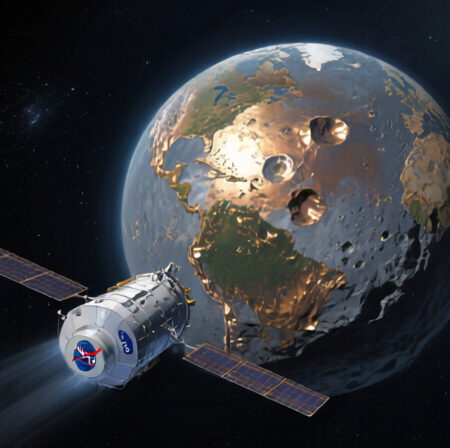
Asteroid 16 Psyche represents one of the most fascinating objects in our solar system. This massive metal-rich asteroid has captured the attention of scientists and space enthusiasts worldwide. NASA’s ambitious Psyche mission aims to explore this unique world, potentially revealing secrets about how planets like Earth formed.
What is Asteroid 16 Psyche?
Asteroid 16 Psyche is a large metallic asteroid in the main asteroid belt between Mars and Jupiter, discovered in 1852. It’s approximately 220 kilometers in diameter and is one of the most massive M-type asteroids, potentially representing the exposed core of an early protoplanet. This asteroid contains roughly 1% of the total mass of the entire asteroid belt, making it a truly remarkable object for scientific study.
What makes Psyche particularly special is its composition. Unlike most asteroids composed of rock and ice, Psyche appears to be primarily made of metal, similar to Earth’s core. This unique characteristic offers scientists an unprecedented opportunity to study a planetary core-like object that cannot be observed directly on our own planet.
I’ve followed the Psyche mission since its announcement, and the scientific community’s excitement is palpable. We’ve never had the chance to examine a planetary core up close, and Psyche might be giving us exactly that opportunity.
Discovery and Basic Facts
Asteroid 16 Psyche was discovered on March 17, 1852, by Italian astronomer Annibale de Gasparis at the Naples Observatory. It was the 16th asteroid discovered, hence its numerical designation. The asteroid was named after Psyche, the Greek goddess of the soul, from the myth of Psyche and Eros (Cupid in Roman mythology).
The asteroid follows an elliptical orbit between Mars and Jupiter, completing one revolution around the Sun every 4.99 years. Its distance from the Sun varies between 2.51 and 3.29 astronomical units (AU), where one AU equals the average distance from Earth to the Sun. This places Psyche firmly in the main asteroid belt, though slightly closer to Mars than Jupiter.
M-type Asteroid: A classification of asteroids showing metallic composition, characterized by high radar reflectivity and spectral features similar to iron-nickel meteorites. Psyche is the largest and most massive of all M-type asteroids discovered.
Physical Characteristics of 16 Psyche
Asteroid 16 Psyche is massive by asteroid standards. Its mean diameter measures approximately 220 kilometers (136 miles), making it larger than many countries. The asteroid has an irregular, potato-like shape with dimensions estimated at 278 × 238 × 171 kilometers, forming what scientists call a Jacobi ellipsoid.
The mass of Psyche is equally impressive. With an estimated mass of 2.72 × 10^19 kilograms, it accounts for about 0.7% of the total mass of the asteroid belt. The asteroid’s bulk density has been measured at approximately 3.977 ± 0.253 grams per cubic centimeter, which is significantly higher than typical rocky asteroids but lower than pure iron-nickel.
Psyche rotates on its axis once every 4.2 hours, which is relatively fast for such a large object. This rapid rotation has flattened the asteroid slightly at the poles and caused it to bulge at the equator, contributing to its distinctive ellipsoid shape.
| Physical Property | Measurement | Context |
|---|---|---|
| Mean Diameter | 220 km (136 miles) | About the size of West Virginia |
| Mass | 2.72 × 10^19 kg | 1% of asteroid belt mass |
| Orbital Period | 4.99 Earth years | Between Mars and Jupiter |
| Rotation Period | 4.2 hours | Day length on Psyche |
| Surface Gravity | 0.0042 m/s² | 0.04% of Earth’s gravity |
What is Asteroid 16 Psyche Made Of?
Asteroid 16 Psyche’s metallic composition sets it apart from most other asteroids. Based on spectral analysis and radar observations, scientists believe Psyche is composed primarily of iron and nickel, similar to Earth’s core. The asteroid’s high radar albedo (reflectivity) of up to 0.52 in bright regions strongly indicates a metallic surface, far exceeding the reflectivity of typical rocky asteroids.
While popular media often sensationalizes Psyche’s potential precious metal content, including gold and platinum, the scientific reality is more nuanced. The asteroid’s composition is likely dominated by iron (90-95%) with smaller amounts of nickel (5-10%) and trace amounts of other metals. The idea that Psyche is a solid chunk of gold is pure misconception.
Recent observations have added complexity to our understanding. The NASA Infrared Telescope Facility detected the presence of hydroxyl ions on Psyche’s surface in 2023, suggesting the presence of water-bearing materials. This finding challenges the purely metallic model and indicates Psyche might have a more complex composition than previously thought.
⚠️ Important: Despite sensational headlines about Psyche’s “value” reaching $10,000 quadrillion, this theoretical calculation assumes all metals are accessible and can be economically transported to Earth—neither of which is currently feasible.
NASA’s Psyche Mission: Journey to a Metal World
NASA’s Psyche mission, launched on October 13, 2023, represents humanity’s first dedicated exploration of a metallic asteroid. This ambitious $1.2 billion mission will travel approximately 3.6 billion kilometers over 6 years to reach and orbit 16 Psyche, beginning in August 2029.
The Psyche spacecraft, built by NASA’s Jet Propulsion Laboratory and managed by Arizona State University, carries a suite of sophisticated scientific instruments designed to study this unique world. The spacecraft uses solar-electric propulsion, with four Hall-effect thrusters powered by large solar arrays that will extend the size of a tennis court.
Upon arrival, the spacecraft will enter orbit around Psyche for a 21-month science mission, gradually lowering its orbit to bring instruments closer to the asteroid’s surface. This methodical approach allows for increasingly detailed observations and measurements throughout the mission duration.
Mission Scientific Instruments
- Multispectral Imager: Captures high-resolution images in various wavelengths to map surface features and composition variations
- Gamma-Ray and Neutron Spectrometer: Detects and measures gamma rays and neutrons emitted from Psyche to determine elemental composition
- Magnetometer: Searches for evidence of an ancient magnetic field, which would indicate Psyche was once part of a larger planetary body
- Radio Science Instrument: Uses spacecraft communications to measure Psyche’s gravity field and internal structure
✅ Pro Tip: The Psyche mission also includes a technology demonstration of deep space optical communications, testing laser-based communication systems that could revolutionize future space missions.
Why Studying Psyche Matters?
The scientific importance of studying 16 Psyche cannot be overstated. This unique asteroid offers a rare glimpse into processes that shaped our solar system billions of years ago. Earth’s core lies thousands of kilometers beneath our feet, completely inaccessible to direct study. Psyche might represent a natural laboratory where we can examine a planetary core-like object up close.
The mission will help answer fundamental questions about planet formation. How do planets differentiate into layers of core, mantle, and crust? What processes create metallic cores like Earth’s? By studying Psyche, scientists hope to understand the building blocks of terrestrial planets and the processes that led to Earth’s formation.
The insights gained could also revolutionize our understanding of exoplanets. Many distant worlds discovered around other stars appear to be super-Earths or planets with unusual densities. Understanding how metallic bodies form and evolve in our solar system will help interpret observations of distant planetary systems.
Having studied planetary science for years, I’m particularly excited about what Psyche might reveal about the early solar system. This mission isn’t just about visiting an asteroid—it’s about understanding our own planet’s deep history.
Common Misconceptions About 16 Psyche
Several misconceptions about asteroid 16 Psyche have circulated in popular media, causing confusion about the mission’s purpose and the asteroid’s nature. Let’s address these directly:
Myth: Psyche is made of gold and will make everyone rich. Reality: While Psyche contains valuable metals, it’s primarily iron and nickel with trace amounts of precious metals. The astronomical value calculations ignore extraction, transportation, and market realities that make asteroid mining economically unfeasible with current technology.
Myth: NASA plans to mine Psyche. Reality: The Psyche mission is purely scientific. NASA has no plans or technology to extract resources from Psyche. The mission’s goal is to understand planetary formation, not resource extraction.
Myth: Psyche could hit Earth. Reality: Psyche’s orbit is stable and poses no threat to Earth. It remains safely in the main asteroid belt between Mars and Jupiter, with no chance of collision with our planet.
Myth: We could bring Psyche’s metals to Earth. Reality: The energy and technology required to move even a small portion of Psyche’s mass to Earth would be astronomical. The asteroid’s mass is equivalent to trillions of metric tons—far beyond any conceivable transport capability.
Myth: Mining Psyche would solve resource scarcity. Reality: Even if asteroid mining were feasible, flooding markets with massive quantities of metals would crash global economies. The solution to resource challenges lies in sustainable practices and recycling, not asteroid extraction.
Frequently Asked Questions
Why is 16 Psyche worth so much?
The theoretical value of asteroid 16 Psyche is calculated based on its estimated metal content multiplied by current market prices, reaching figures like $10,000 quadrillion. However, this value is purely theoretical and doesn’t account for the enormous challenges of extraction, transportation, or market impact. No current technology can economically mine asteroids or transport materials from the asteroid belt to Earth.
Will asteroid Psyche 16 hit Earth?
No, asteroid 16 Psyche poses no threat to Earth. Its stable orbit remains in the main asteroid belt between Mars and Jupiter, at distances between 370-497 million kilometers from Earth. The asteroid’s orbital path is well-understood and shows no possibility of collision with our planet. Psyche is one of the most securely positioned objects in the solar system.
Is 16 Psyche made of gold?
No, 16 Psyche is not made of gold. While it contains trace amounts of precious metals, the asteroid is composed primarily of iron (90-95%) and nickel (5-10%). The misconception about gold content comes from sensational media reports. Spectral analysis and radar observations clearly indicate a composition similar to iron meteorites, not a solid gold asteroid.
When will NASA reach Psyche?
NASA’s Psyche spacecraft launched on October 13, 2023, and will reach asteroid 16 Psyche in August 2029. The journey takes approximately 6 years due to the vast distances involved—over 3.6 billion kilometers. The spacecraft will then orbit the asteroid for 21 months, from August 2029 through mid-2031, conducting detailed scientific observations.
How big is asteroid 16 Psyche?
Asteroid 16 Psyche has a mean diameter of 220 kilometers (136 miles), making it one of the largest objects in the asteroid belt. Its irregular shape measures approximately 278 × 238 × 171 kilometers. For comparison, if Psyche were placed on Earth, it would cover an area larger than most U.S. states, though its irregular shape makes direct comparison challenging.
Can we mine asteroid Psyche?
No, we cannot currently mine asteroid Psyche. The technical challenges are enormous: extreme distances, lack of infrastructure, energy requirements, and unknown extraction difficulties. Even if mining were possible, the economic viability is questionable due to transportation costs and potential market impacts. NASA’s mission focuses purely on scientific understanding, not resource extraction.
Why is NASA studying Psyche?
NASA is studying Psyche because it offers a unique opportunity to examine a metal-rich body that may be the exposed core of an early protoplanet. Since Earth’s core lies thousands of kilometers beneath our surface, Psyche provides an unprecedented chance to understand planetary formation, core composition, and the processes that created terrestrial planets like Earth.
What will we learn from the Psyche mission?
The Psyche mission will teach us about planetary differentiation, core formation processes, and the early solar system. Scientists hope to determine whether Psyche is indeed a planetary core, understand its composition and structure, map its surface features, and potentially discover evidence of ancient magnetic fields. This knowledge will help us understand how Earth and other rocky planets formed billions of years ago.
The Future of Psyche Research
The Psyche mission marks just the beginning of our exploration of metallic asteroids. As data begins returning in 2029, scientists will gain unprecedented insights into planetary formation processes. These discoveries could reshape our understanding of Earth’s formation and the development of terrestrial planets throughout the universe.
The mission also represents a significant step in humanity’s solar system exploration capabilities. The technologies developed for Psyche—including advanced solar-electric propulsion and deep space optical communications—will enable future missions to even more distant and challenging destinations.
For educators and students, Psyche offers an exciting real-world example of ongoing scientific discovery. Many classrooms are already following the mission’s progress, using it to teach concepts in astronomy, geology, physics, and engineering. You can enhance your learning experience with space tracking apps that follow the mission’s journey.
As we await the spacecraft’s arrival in 2029, the scientific community continues studying Psyche from Earth using advanced telescopes and instruments. Each observation adds to our understanding before the close-up examination begins, building anticipation for one of the most exciting space exploration missions of this decade.
“The Psyche mission will be the first to explore a world of metal rather than rock or ice. This mission is truly a journey to the center of the Earth—to understand how terrestrial planets like our own formed.”
– Lindy Elkins-Tanton, Psyche Mission Director, Arizona State University
Conclusion
Asteroid 16 Psyche stands as a unique window into our solar system’s formation history. This metal-rich world offers scientists an unprecedented opportunity to study processes that created planets like Earth billions of years ago. NASA’s ongoing Psyche mission represents not just an exploration of an asteroid, but a journey into the fundamental processes that shaped our world.
While sensational claims about Psyche’s economic value capture public imagination, the true value lies in the knowledge we’ll gain. Understanding planetary core formation, differentiation processes, and the building blocks of terrestrial planets will advance science in ways that cannot be measured in dollars.
As the spacecraft continues its journey through the solar system, we can look forward to August 2029 when humanity finally gets its close-up view of this metallic world. The discoveries that await will help answer fundamental questions about our planet’s origins and our place in the cosmos. For those interested in exploring more planetary phenomena, Psyche represents just one of many exciting frontiers in space exploration.
The mission reminds us that there are still wonders to discover in our own solar system, and that understanding our cosmic neighborhood helps us better understand ourselves and our home planet.
Comments