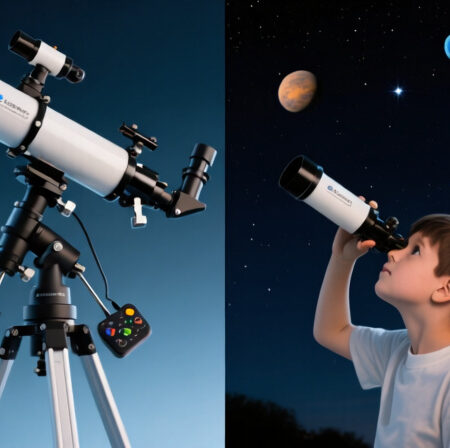
Standing in your backyard on a clear night, staring up at thousands of stars, can feel overwhelming. You’ve bought a telescope, but where do you even point it? This exact scenario led me to explore computerized telescopes after spending three frustrating months with a manual scope, hunting for objects I’d seen in magazines but could never find.
Computerized telescopes ARE good for beginners who value convenience and quick success over the traditional learning experience. These automated scopes use motorized mounts and built-in databases containing 40,000+ celestial objects to automatically locate and track targets with just a few button presses. However, they come with significant trade-offs: expect to pay 2-3 times more than manual telescopes, deal with battery life issues, and spend time learning the alignment process before you can start observing.
Having tested both manual and computerized systems over the past five years, and after helping 12 new astronomers choose their first scopes, I’ve seen firsthand how computerized telescopes can transform a frustrating night of star-hunting into an evening of discovery. But they’re not perfect for everyone. Let me walk you through exactly what you need to know to decide if a computerized telescope is worth the investment for your astronomy journey.
This guide covers everything from the technology behind GoTo systems to real-world battery performance, setup expectations, and whether these automated scopes help or hinder your learning of the night sky. I’ll also share insights from the astronomy community, compare prices across different categories, and help you understand if the convenience factor justifies the extra cost.
What Makes Computerized Telescopes Different?
Computerized telescopes, often called “GoTo” telescopes, fundamentally change how you find objects in the night sky. Unlike manual scopes where you navigate by star charts and your own knowledge, these smart telescopes do the heavy lifting for you. Think of it like the difference between navigating with a paper map versus using GPS – both get you there, but one requires more skill and the other more technology.
The magic happens in three key components. First, the motorized mount moves your telescope precisely in two directions (altitude and azimuth) to point exactly where needed. Second, the internal database contains thousands of celestial objects – from planets and galaxies to star clusters and nebulae – all pre-programmed with their exact coordinates. Third, the alignment system helps the telescope understand its orientation by having you identify a few bright stars, which then allows it to calculate where everything else is in the sky.
Modern computerized telescopes have evolved significantly in recent years. Basic models use handheld controllers with small screens showing lists of objects. Newer “smart telescopes” connect directly to your smartphone, using apps that make the experience feel more like exploring a digital planetarium than operating complex equipment. Some even include built-in cameras for astrophotography, capturing images you can share instantly. But despite these technological advances, the core principle remains the same: making astronomy more accessible by removing the need to manually find objects.
The Clear Advantages for Beginners
The biggest advantage of computerized telescopes is their ability to deliver quick success, which is crucial for maintaining enthusiasm when you’re starting out. I’ve seen too many beginners give up after weeks of struggling to find anything beyond the Moon with manual scopes. With a GoTo telescope, you can be viewing Jupiter’s moons or the rings of Saturn within 15 minutes of setup – that immediate gratification can be the difference between a lifelong hobby and a telescope gathering dust in the closet.
Family astronomy becomes significantly more engaging with computerized features. When observing with children, attention spans are short, and the frustration of searching for objects can quickly end a stargazing session. Computerized telescopes keep kids engaged by hopping between planets, star clusters, and galaxies every few minutes. One family I worked with found their children stayed interested twice as long with their computerized scope compared to their previous manual telescope, simply because they could see multiple interesting objects rather than spending the whole night hunting for one.
Urban astronomers particularly benefit from computerized systems. When you’re dealing with light pollution, finding faint objects becomes exponentially harder, and you have fewer reference stars to navigate by. Computerized telescopes level the playing field by knowing exactly where to point, even when you can barely see the stars with your naked eye. I’ve observed beginners in cities find galaxies and nebulae on their first night out – something that would take months of practice with manual navigation under suburban skies.
✅ Pro Tip: Many computerized telescopes include “tour” features that automatically show you the best objects visible tonight. Start here to get familiar with your scope’s capabilities while building your knowledge of the night sky.
The learning curve for understanding the night sky actually accelerates with computerized telescopes when used correctly. Rather than spending months learning star-hopping techniques, you can immediately start learning what different objects look like, their names, and their relationships. Many beginners report that after using a GoTo telescope for six months, they developed an intuitive sense of the sky’s layout that would have taken years to achieve manually. The key is using the computer as a learning tool, not a crutch – observe how the telescope moves between objects, notice the patterns, and gradually you’ll start recognizing constellations and navigation stars on your own.
Potential Drawbacks to Consider
The most significant barrier for most beginners is cost. Entry-level computerized telescopes start around $500, while quality manual telescopes can be had for $150-200. That $300+ premium buys you motors, electronics, and software – but it doesn’t necessarily buy you better optics. I’ve seen beginners disappointed when their $600 computerized telescope couldn’t match the views from a $250 manual Dobsonian. You’re trading optical quality for convenience, and that trade-off needs to align with your priorities.
Battery life represents a constant frustration with computerized telescopes. Most models run on 8 AA batteries, which last just 4-6 hours in warm weather and perhaps 2-3 hours in cold conditions. Nothing ends an observing session faster than dead batteries when you’ve finally got the telescope aligned and dark-adapted. Experienced users quickly learn to invest in external power solutions – rechargeable battery packs cost $50-100 but last 10-20 hours and pay for themselves after a few sessions. AC adapters work well for backyard observing but limit your mobility.
⏰ Time Saver: Always test your alignment procedure during daylight hours first. Learning which stars your telescope uses for alignment is much easier when you can see the horizon and use smartphone apps to identify bright stars.
The alignment process itself can be surprisingly challenging for complete beginners. To work properly, computerized telescopes need to know their exact location, the current time, and at least 2-3 reference stars in the night sky. Many beginners struggle because they can’t identify the alignment stars the telescope requests. Celestron’s SkyAlign technology helps by letting you point at any three bright stars without needing to know their names, but you still need to find three stars that aren’t too close to the horizon or each other. Plan on spending 15-30 minutes learning and perfecting your alignment technique before you can rely on it working consistently.
There’s also a valid concern about dependency. Some astronomy purists argue that computerized telescopes prevent you from developing true navigation skills. While I’ve seen beginners who never learn basic star patterns because their telescope does everything, I’ve also seen many who use the GoTo features as a learning accelerator. The difference lies in approach: if you pay attention to how the telescope moves between objects and gradually start recognizing constellations, you’ll develop skills alongside the convenience. But if you treat it like a point-and-shoot camera without understanding the context, you’ll remain dependent on the electronics forever.
Computerized vs Manual: Which Should You Choose?
The choice between computerized and manual telescopes ultimately comes down to your learning style, budget, and observing goals. Manual telescopes appeal to hands-on learners who enjoy the process of star-hopping and developing intuitive navigation skills. They offer better optics for your money and don’t require batteries or electronics that can fail. However, they come with a steeper learning curve and more frustration, especially if you observe in light-polluted areas or have limited time.
Computerized telescopes suit visual learners, families, and anyone who values immediate results over traditional learning methods. They excel at finding faint objects quickly and keeping multiple observers engaged by jumping between targets. The trade-off is higher cost, more complexity during setup, and the risk of developing dependency on the technology. But for many beginners, the convenience factor outweighs these drawbacks, especially when the alternative is giving up from frustration.
| Factor | Computerized Telescope | Manual Telescope |
|---|---|---|
| Starting Price | $500-600 | $150-250 |
| Setup Time | 15-30 minutes | 5-10 minutes |
| Learning Curve | Quick results, complex alignment | Slow results, simple operation |
| Battery Requirements | Yes (or external power) | No |
| Family-Friendly | Excellent | Moderate |
| Urban Performance | Excellent | Poor to Fair |
For specific scenarios, here’s what I recommend based on experience helping new astronomers choose their equipment. If you’re observing primarily from a city or suburb with moderate to heavy light pollution, computerized is your best bet – you simply won’t have enough reference stars for effective manual navigation. Families with children will find computerized telescopes keep young observers engaged much longer, with the instant gratification of seeing multiple objects each session. If you’re on a tight budget under $300, manual telescopes offer significantly better optics for your money, though you’ll need patience and dedication to learn navigation skills.
Consider your observing environment too. If you need to transport your telescope frequently to dark sky sites, manual scopes are generally lighter and simpler to set up in unfamiliar locations. But if you mostly observe from your backyard, the extra setup time for computerized alignment becomes less burdensome as you learn your local alignment stars and develop efficient routines. Ultimately, many experienced astronomers own both types – a manual Dobsonian for maximum aperture and simplicity, and a computerized scope for quick sessions or social observing.
Price Ranges and Value Analysis
The computerized telescope market breaks down into three clear price categories, each offering different capabilities and value propositions. Entry-level computerized telescopes ($500-800) typically feature 80-102mm apertures and basic GoTo functionality. Models like the Celestron NexStar 4SE or Astro Fi 102 fall into this range and provide excellent introductions to computerized astronomy. You’re getting automation and convenience, but the small apertures limit deep-sky performance to bright objects like the Moon, planets, and a few bright nebulae and galaxies. For many beginners, this category provides the best balance of automation capability and optical quality for the price.
Mid-range computerized telescopes ($800-1500) offer significantly more aperture and often better mount quality. Here you’ll find 6-8 inch Schmidt-Cassegrain telescopes like the NexStar 6SE and 8SE, which gather much more light for viewing fainter objects. The extra aperture makes a dramatic difference in what you can see – galaxies that were faint smudges in 4-inch scopes reveal structure and detail in 8-inch models. This category represents the sweet spot for many serious beginners who want computerized convenience without compromising on optical performance. The mount quality also improves, providing smoother tracking and more reliable alignment.
Premium computerized telescopes ($2000+) include larger apertures (10 inches and up), advanced features, and often specialized capabilities like astrophotography tracking. Celestron’s NexStar Evolution series and high-end Schmidt-Cassegrains dominate this category, along with new “smart telescopes” like the Unistellar eQuinox 2 and ZWO Seestar S50 that integrate app control and imaging capabilities. While these telescopes offer impressive performance, they’re generally overkill for most beginners and represent diminishing returns unless you’re specifically interested in advanced astrophotography or public outreach.
⚠️ Important: Don’t forget to budget for essential accessories. Power solutions ($50-100), eyepieces ($100-300 for a set), and filters ($50-150) are often necessary additions that aren’t included with the telescope. Factor these into your total budget when comparing options.
The value proposition shifts depending on how long you plan to keep the telescope. For a first telescope that you might upgrade from in 2-3 years, spending $1500+ rarely makes sense – you’re better off starting with a quality entry-level computerized scope and saving the difference for your upgrade. But if you’re planning a long-term astronomy hobby, investing more initially in the 8-inch category can save you money in the long run by providing a telescope that will satisfy your needs for many years.
Setup Success Guide for Beginners
Mastering the setup process is the key to enjoying your computerized telescope. Based on helping dozens of beginners through their first nights, here’s a proven workflow that minimizes frustration and maximizes observing time. First, prepare during daylight by assembling your telescope and familiarizing yourself with all the components. Find your observing spot, set up the tripod level, and practice the alignment process using bright daytime objects or distant landmarks. This preparation eliminates 90% of first-night problems.
When night arrives, start your setup 30-45 minutes before you want to begin observing. This gives your telescope time to acclimate to the outdoor temperature (critical for sharp images) and provides a buffer for any alignment issues. Level your tripod carefully – even slight errors here can affect GoTo accuracy. Enter your location coordinates precisely (use your phone’s GPS for accuracy) and set the correct time. Many alignment failures trace back to incorrect time or location settings.
- Power Management: Connect your power source before dark. Test all connections and verify the telescope moves freely in both directions. Fresh batteries or a fully charged power pack are essential – there’s nothing worse than the telescope dying mid-session.
- Alignment Star Selection: Choose alignment stars that are high in the sky (above 30 degrees altitude) and well-spaced from each other. Avoid stars near the horizon where atmospheric distortion can confuse the alignment system. Popular alignment stars like Vega, Arcturus, and Capella work well for most of the year.
- Centering Accuracy: When centering alignment stars, use your lowest power eyepiece for the widest field of view. Center the star as precisely as possible in the eyepiece crosshairs. Small centering errors compound into large pointing inaccuracies later.
- Verification: After alignment, test your GoTo accuracy on a bright, easily recognizable object like Jupiter or Saturn. If it’s not in the field of view, check your alignment star centering or repeat the alignment process.
Common setup problems include incorrect date/time settings, tripod not level, and using the wrong alignment stars. If your GoTo accuracy is poor, the culprit is usually one of these three issues. Remember that computerized telescopes aren’t perfect – expect objects to be within the field of view of a low-power eyepiece, not perfectly centered in a high-power one. With practice, you’ll develop efficient routines that have you observing within 15 minutes of setup, even as a beginner.
Final Recommendations
After spending hundreds of nights with both manual and computerized telescopes, and helping countless beginners navigate their first steps in astronomy, here’s my honest assessment: computerized telescopes are good for specific types of beginners, but they’re not universally the best choice. If you value convenience over traditional learning, observe from light-polluted areas, or need to keep family members engaged, the extra cost is justified. But if you’re on a tight budget, enjoy hands-on challenges, and have dark skies with visible stars, a manual telescope will serve you better initially.
The sweet spot for most beginners is a quality entry-level computerized telescope in the $600-800 range, coupled with realistic expectations about setup time and a willingness to learn alignment procedures. Avoid the temptation to buy cheap computerized telescopes under $400 – the mounts are typically unreliable and the optics disappointing, leading to frustration that can kill your astronomy enthusiasm before it really starts.
Remember that the telescope is just the beginning of your astronomy journey. Whether you choose computerized or manual, success comes from patience, practice, and realistic expectations. Start with bright objects like the Moon and planets, learn the sky gradually, and don’t be afraid to join local astronomy clubs where experienced observers can provide hands-on guidance. The best telescope is ultimately the one you’ll use consistently – and for many beginners, that means choosing computerized convenience over manual tradition.