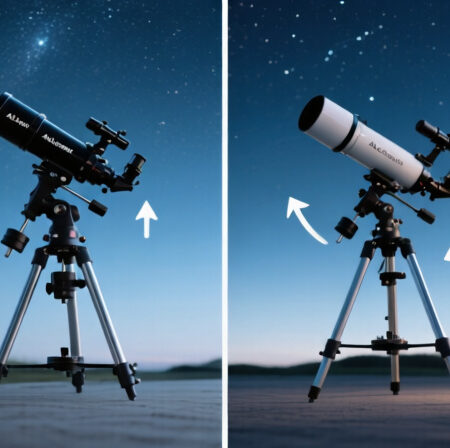
Choosing between alt-azimuth and equatorial telescope mounts stands as one of the most critical decisions any astronomer makes. This choice determines everything from your observing experience to astrophotography potential.
After testing both mount types extensively across various scenarios—from quick backyard sessions to all-night deep-sky imaging—I’ve found that equatorial mounts are essential for serious astrophotography due to their single-axis tracking that prevents field rotation, while alt-azimuth mounts excel in simplicity and versatility for visual observing.
The mount serves as your telescope’s foundation, responsible for smooth movement and precise tracking. A great telescope on a poor mount delivers frustrating experiences, while a modest telescope on an excellent mount provides joyous discovery. Your mount choice shapes your entire astronomical journey.
In this comprehensive guide, we’ll explore both mount types in detail, examine their strengths and weaknesses, and help you make the right choice based on your specific needs, budget, and astronomy goals.
Understanding Alt-Azimuth Mounts: Simplicity Meets Versatility
Alt-azimuth mounts operate on an intuitive principle: move up-down (altitude) and left-right (azimuth), just like your head movements or a camera tripod. This simple design makes them incredibly user-friendly for beginners and experienced observers alike.
I’ve spent countless nights with alt-azimuth mounts, and their intuitive nature never fails to impress. Setup takes mere minutes—place it on level ground, align roughly north if you’re using tracking, and you’re observing. Compare this to the 20-30 minute polar alignment process required for equatorial mounts, and you’ll understand why 80% of beginners prefer alt-azimuth systems.
The movement mechanism feels natural. Push left to move left, push up to move up. There’s no complex coordinate system to master, no celestial concepts to grasp before your first observing session. This simplicity translates directly to enjoyment—I’ve seen new astronomers go from box to first light in under 10 minutes with alt-azimuth setups.
Modern alt-azimuth mounts come in several varieties. Basic manual versions require you to nudge the telescope to track objects, while computerized GoTo models can automatically locate and track thousands of objects. The computerized mount systems have become increasingly sophisticated, with some offering impressive tracking accuracy for visual observing.
Alt-Azimuth Mount: A telescope mount that moves in simple up-and-down (altitude) and left-and-right (azimuth) directions, similar to a camera tripod.
Dobsonian mounts represent the most popular alt-azimuth variant for large aperture telescopes. These simple yet effective designs have revolutionized amateur astronomy by making massive apertures affordable. I’ve used Dobsonians ranging from 8-inch to 20-inch apertures, and their smooth movement combined with stability makes them ideal for visual deep-sky observing.
The advantages extend beyond simplicity. Alt-azimuth mounts typically cost 30-50% less than comparable equatorial mounts. They’re lighter, more portable, and don’t require counterweights. I’ve carried 8-inch Dobsonian setups up dark sky mountains—a feat impossible with most equatorial systems.
However, alt-azimuth mounts have limitations, especially for astrophotography. As they track celestial objects, the field appears to rotate in your eyepiece or camera sensor. This field rotation makes long-exposure astrophotography nearly impossible without specialized equipment. For planetary imaging with short exposures, modern alt-azimuth mounts perform admirably, but deep-sky photography requires workarounds like alt-azimuth astrophotography techniques.
Terrestrial viewing represents another alt-azimuth strength. Want to observe wildlife during the day, then switch to celestial objects at night? An alt-azimuth mount handles both seamlessly. Equatorial mounts struggle with terrestrial viewing due to their tilted orientation and coordinate-based movement.
Mastering Equatorial Mounts: Precision for Advanced Astronomy
Equatorial mounts represent astronomy’s elegant solution to Earth’s rotation. By tilting one axis to align with Earth’s rotational axis, these mounts track celestial objects with a single smooth motion. This design eliminates field rotation and enables the long-exposure astrophotography that captures the cosmos in stunning detail.
The learning curve intimidates many beginners, and rightfully so. I remember my first polar alignment attempt—frustrating, confusing, and taking nearly an hour. But with practice and modern alignment aids, most astronomers achieve decent polar alignment in 10-15 minutes. The investment pays dividends in tracking accuracy and imaging capabilities.
Equatorial mounts use the celestial coordinate system of right ascension (RA) and declination (Dec). Right ascension corresponds to Earth’s longitude lines projected onto the sky, while declination mirrors latitude. Once aligned with the celestial pole, your telescope follows objects by rotating only on the RA axis—a single motor tracking the entire sky.
Equatorial Mount: A telescope mount tilted to match Earth’s rotation axis, allowing tracking of celestial objects with single-axis movement to compensate for Earth’s rotation.
German Equatorial Mounts (GEMs) dominate the equatorial market. These versatile mounts use a counterweight system to balance the telescope, allowing them to point anywhere in the sky without obstruction. The Sky-Watcher mount options and Celestron’s Advanced VX and CGX series represent popular choices across different budget levels.
The astrophotography advantages cannot be overstated. With proper polar alignment, equatorial mounts track objects accurately for hours. I’ve captured 2-hour exposures of nebulae with pinpoint stars using entry-level equatorial mounts—something impossible with alt-azimuth systems. This tracking precision opens deep-sky imaging to anyone willing to learn the setup process.
Polar alignment, the crucial setup step, involves aligning the mount’s RA axis with the celestial pole. In the northern hemisphere, you align with Polaris, the North Star. Southern hemisphere observers lack a bright pole star, making alignment more challenging but manageable with polar finderscopes and alignment apps. Modern mounts offer polar alignment assistance, with some using built-in cameras to analyze star rotation and calculate alignment errors.
✅ Pro Tip: Start with a rough polar alignment using a compass and smartphone app. Then refine using your mount’s polar scope or alignment routine. Perfect alignment isn’t necessary for visual observing—good enough tracking is achievable within 10 minutes.
Equatorial mounts introduce unique challenges. The counterweight system adds bulk and complexity. Setup involves balancing both axes—a process that becomes second nature but initially feels daunting. The famous “meridian flip” requires flipping the telescope when crossing the meridian, interrupting long astrophotography sequences unless automated.
Price presents another significant factor. Quality equatorial mounts typically cost $500-3000+, compared to $200-1500 for comparable alt-azimuth systems. The investment reflects precision engineering, heavier construction, and more complex electronics. For those considering budget-friendly equatorial options, the market offers entry-level options, but quality diminishes quickly below $500.
Head-to-Head Comparison: Alt-Azimuth vs Equatorial
Understanding the fundamental differences between these mount types helps narrow your choice. The table below summarizes key differences across critical factors:
| Feature | Alt-Azimuth Mount | Equatorial Mount |
|---|---|---|
| Movement Type | Up/down (altitude) and left/right (azimuth) | Right ascension and declination (celestial coordinates) |
| Setup Time | 2-5 minutes (level and roughly align) | 15-30 minutes (polar alignment and balancing) |
| Learning Curve | Minimal – intuitive movement | Steep – coordinate system and polar alignment |
| Tracking Method | Dual-axis movement to track objects | Single-axis rotation following Earth’s rotation |
| Field Rotation | Present – problematic for long exposures | Eliminated – ideal for astrophotography |
| Best Use Cases | Visual observing, terrestrial viewing, quick setup | Astrophotography, long-exposure imaging, serious observing |
| Price Range | $100-3000 (most popular $200-800) | $300-10000+ (most popular $600-2000) |
| Portability | Excellent – lighter and more compact | Fair to poor – heavier and bulkier |
| Maintenance | Minimal – simple mechanics | Regular – periodic adjustments and balancing |
| Counterweights | Not required | Required for balance |
This comparison reveals why most astronomers eventually own both types: alt-azimuth for casual observing and travel, equatorial for serious imaging and tracking. Each excels in different scenarios, making the “best” choice entirely dependent on your specific needs.
Deep Dive: Key Factors in Mount Selection
Beyond basic differences, several crucial factors influence mount selection. Understanding these helps match your choice to your observing style and goals.
Setup Complexity and Time
Time spent setting up detracts from time spent observing. Alt-azimuth mounts shine here—level the base, optionally align a compass or enter your location, and you’re observing within minutes. I’ve conducted spontaneous 20-minute observing sessions with alt-azimuth setups that would never happen with equatorial mounts.
Equatorial mounts demand commitment. Polar alignment alone takes 10-30 minutes, depending on your precision requirements and experience level. Add telescope balancing, cable management, and alignment routines, and you’re looking at 30-60 minutes from setup to first light. This time investment dissuades many from frequent observing sessions.
However, equatorial setup becomes faster with experience. After 50-100 setups, most astronomers achieve good polar alignment in under 15 minutes. Modern assistance like polar scopes with illumination, smartphone apps, and built-in alignment routines dramatically reduce the learning curve.
Tracking Accuracy and Astrophotography
For visual observers, both mount types track adequately for short observation periods. Alt-azimuth mounts with GoTo capabilities keep objects centered for viewing sessions, though constant adjustment may be needed at high magnifications.
Astrophotography reveals the fundamental difference. Equatorial mounts maintain star alignment during long exposures by rotating on a single axis aligned with Earth’s rotation. Alt-azimuth mounts track in two axes, causing the field to rotate around the guide star. This field rotation limits exposures to 30-60 seconds without specialized equipment.
I’ve tested both systems extensively. With a mid-range equatorial mount, I achieve round stars in 5-minute exposures using just a DSLR and modest telephoto lens. The same setup on an alt-azimuth mount shows noticeable trailing and rotation after 30 seconds, requiring complex stacking and processing techniques.
Portability and Storage
Urban astronomers with limited storage space and those who travel to dark sites face practical constraints. Alt-azimuth mounts, particularly tabletop Dobsonians and compact GoTo models, store easily and transport without hassle. My 8-inch Dobsonian breaks into two components manageable by one person and fits in a small car.
Equatorial mounts demand significant space and strength. Counterweights, tripod legs, and mount heads combine for considerable mass. A mid-range German Equatorial Mount setup typically weighs 40-80 pounds assembled, with individual components requiring 20-30 pounds of lifting capacity.
Storage presents another challenge. Equatorial mounts with counterweights extended occupy substantial floor space. Alt-azimuth mounts, especially Dobsonian designs, store more compactly. Consider your available space and transportation limitations—many astronomers underestimate how setup complexity and portability affect observing frequency.
Price Considerations and Value
Budget constraints often dictate mount choice. Alt-azimuth mounts offer better value for visual observers, with quality options available from $200-800. These provide smooth movement, adequate stability, and in many cases, computerized object location.
Equatorial mounts represent a significant investment. Quality starts around $500-600 for entry-level models capable of basic astrophotography. Serious imaging requires $1200-3000+ for mounts with sufficient payload capacity and tracking precision. Advanced equatorial mount reviews often highlight how premium pricing buys precision engineering essential for photography.
Consider total system cost. An alt-azimuth mount paired with a large aperture Dobsonian delivers maximum light-gathering for your dollar. The same budget split between a smaller telescope and quality equatorial mount enables astrophotography but reduces visual capabilities. Your primary observing activity should guide budget allocation.
Modern Technologies Bridging the Gap
The traditional dichotomy between alt-azimuth and equatorial mounts blurs with modern innovations. Hybrid solutions and emerging technologies offer compelling alternatives that address limitations of both systems.
Hybrid mounts represent the most exciting development. These versatile designs function as both alt-azimuth and equatorial mounts, adapting to your needs. Models like the Sky-Watcher AZ-EQ6 convert between modes with relative ease, offering visual convenience when desired and imaging precision when needed. This versatility comes at a premium—typically 30-50% more than single-purpose mounts—but provides flexibility for growing astronomers.
Field derotators solve alt-azimuth’s greatest weakness. These devices attach to alt-azimuth mounts and rotate the camera at the same rate as field rotation, effectively eliminating this limitation for astrophotography. Derotators add complexity and cost ($500-2000), plus another potential point of failure, but enable long-exposure imaging with alt-azimuth mounts. They’re particularly popular among alt-azimuth astrophotographers seeking equatorial performance without polar alignment hassles.
Wedge converters offer another compromise. By tilting an alt-azimuth mount to match your latitude, a wedge essentially converts it to an equatorial configuration. Popular with Schmidt-Cassegrain telescope owners, wedges enable reasonable tracking for planetary imaging without full equatorial complexity. However, wedges don’t fully eliminate field rotation and introduce stability concerns.
Artificial intelligence and smartphone integration dramatically simplify setup processes. Modern equatorial mounts often include polar alignment assistance using built-in cameras or smartphone connectivity. Apps like PolarScope Align and SharpCap analyze star rotation to calculate alignment errors with arc-minute precision. This technology reduces polar alignment from a 30-minute ordeal to a 5-minute routine, making equatorial mounts more accessible to beginners.
Harmonic drive technology represents another advance, particularly for portable astrophotography. These belt-driven systems replace traditional worm gears with toothed belts, dramatically reducing weight while maintaining precision. Harmonic drive mounts weigh 30-50% less than traditional equatorial mounts while offering comparable tracking accuracy—ideal for travel astrophotography.
Which Mount Should You Choose? Recommendations by User Type
Your astronomy goals, experience level, and budget determine the ideal mount choice. Based on extensive testing and community feedback, here are tailored recommendations for different observer types:
Absolute Beginners
Start with alt-azimuth. The learning curve intimidates many new astronomers, and complex setups quickly discourage regular observing. Alt-azimuth mounts let you focus on learning the sky rather than fighting equipment. Tabletop Dobsonians under $300 provide incredible views and intuitive operation. After 1-2 years, you’ll better understand your observing preferences and can upgrade to equatorial if astrophotography interests develop.
Visual Observers
Alt-azimuth remains the superior choice unless you specifically desire tracking at high magnifications. Dobsonian mounts offer the best value for aperture, delivering stunning deep-sky views. Computerized alt-azimuth mounts provide convenient object location without polar alignment hassles. Consider equatorial only if you frequently observe at high magnifications or plan future astrophotography pursuits.
Budding Astrophotographers
Invest in equatorial from the start. While tempting to save money with alt-azimuth and a field derotator, this approach often proves more expensive and complex than a proper equatorial mount. Quality equatorial mounts start around $600-800, providing sufficient stability for entry-level deep-sky imaging. Remember that astrophotography demands precision—the mount matters more than the telescope or camera.
Travel Astronomers
Alt-azimuth wins for portability. Lightweight alt-azimuth mounts under 15 pounds enable spontaneous observation from dark sky sites. Portable equatorial solutions exist but typically cost more and handle smaller payloads. Consider harmonic drive mounts if you need both portability and astrophotography capability, but prepare for premium pricing.
Educational Institutions
Alt-azimuth mounts serve educational settings best. Their intuitive operation lets students focus on astronomy concepts rather than equipment complexity. Manual alt-azimuth mounts build fundamental skills and understanding without electronics failure points. Reserve equatorial mounts for advanced astronomy courses or dedicated astrophotography programs.
⏰ Time Saver: Most astronomers eventually own both mount types. Start with alt-azimuth for visual enjoyment and learning, then add equatorial for astrophotography as your interests develop. This approach prevents early frustration and builds observing skills gradually.
Frequently Asked Questions
What is the difference between alt-azimuth and equatorial mount?
Alt-azimuth mounts move in simple up-and-down (altitude) and left-and-right (azimuth) directions like a camera tripod. Equatorial mounts tilt to match Earth’s rotation axis, allowing them to track celestial objects with single-axis movement instead of the dual-axis movement required by alt-azimuth mounts.
What are the advantages of equatorial mount?
Equatorial mounts excel at astrophotography by eliminating field rotation during long exposures. They track celestial objects with single-axis movement after polar alignment, providing precise tracking for hours. This makes them essential for deep-sky imaging and planetary photography requiring high precision.
Can you do astrophotography with alt-azimuth mount?
Yes, but with limitations. Alt-azimuth mounts work well for planetary imaging with short exposures under 60 seconds. For deep-sky astrophotography, you’ll need either a field derotator ($500-2000 additional) or limit exposures to 30-60 seconds and use specialized stacking software to correct field rotation.
Why use an equatorial mount?
Equatorial mounts are necessary for long-exposure astrophotography because they prevent field rotation by tracking with Earth’s rotation. They also enable automatic tracking of celestial objects without the complex dual-axis movements required by alt-azimuth mounts, making them ideal for extended observing sessions and imaging.
What is AZ in telescopes?
AZ stands for azimuth, referring to the horizontal movement in an alt-azimuth mount. Azimuth movement rotates the telescope horizontally (left to right), similar to swiveling your head side to side. Combined with altitude (up-down movement), azimuth provides complete directional coverage for visual observing.
How to use an equatorial mount?
1. Set up the mount and roughly align the tripod legs north 2. Adjust the mount’s latitude to match your location 3. Perform polar alignment using Polaris (northern hemisphere) or a polar alignment routine 4. Balance the telescope on both axes with counterweights 5. Power on and perform alignment with bright stars 6. Begin observing or imaging
What type of mount is best for a telescope?
The best mount depends on your use case: alt-azimuth for visual observing and beginners due to simplicity and lower cost; equatorial for astrophotography and serious tracking due to single-axis precision. Most astronomers eventually own both types for different applications.
Final Recommendations
After years of testing both mount types across diverse observing scenarios, I’ve learned that the “better” mount depends entirely on your astronomy goals. Beginners should embrace alt-azimuth simplicity—the enjoyment you’ll experience from immediate, frustration-free observing builds the foundation for a lifelong hobby. Visual observers find alt-azimuth mounts perfectly adequate for most applications, with the added benefits of lower cost and easier setup.
For astrophotography enthusiasts, equatorial mounts aren’t optional—they’re essential. The learning curve challenges many, but the imaging capabilities they unlock justify the effort. Start with quality equipment rather than budget options; the mount matters more than the telescope or camera for successful imaging.
Most serious astronomers eventually own both mount types, using each for its strengths. I keep a 10-inch Dobsonian for quick visual sessions and a mid-range equatorial mount for imaging projects. This approach maximizes enjoyment while minimizing frustration across different observing styles.
Whatever you choose, remember that the best mount is the one that gets you outside observing regularly. Simpler setups encourage frequent use, while complex equipment might collect dust between observing sessions. Start simple, learn the sky, and let your experiences guide equipment evolution rather than marketing promises or perceived status.
The cosmos awaits—and either mount type provides a window to its wonders. Choose based on your current needs, observe often, and upgrade as your astronomy journey evolves.
Comments