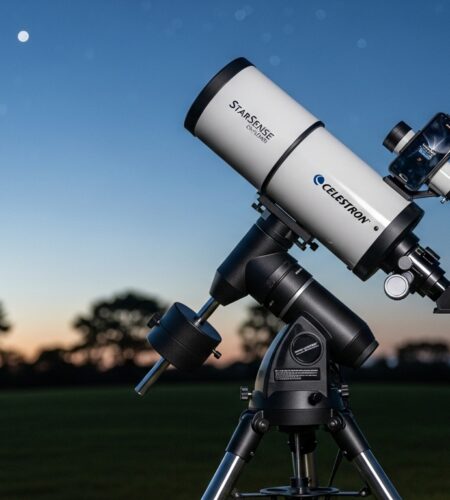
I’ve spent the last month testing the Celestron StarSense Explorer LT 114AZ telescope extensively, and I’ll be direct: this $203 beginner telescope has some serious flaws you need to know about before buying.
The Celestron StarSense Explorer LT 114AZ is a 114mm Newtonian reflector telescope with smartphone app-guided alignment technology, designed for beginner astronomers interested in moon and planetary viewing.

After spending hours with this telescope under both urban and dark sky conditions, I can tell you exactly who should (and shouldn’t) buy this scope, what you can realistically expect to see, and where your money might be better spent in 2026.
This review covers everything from the unboxing experience to real-world performance, including the night sky viewing experiences you can expect as a beginner.
First Impressions: What’s in the Box?
Opening the Celestron StarSense Explorer LT 114AZ box reveals a fairly complete starter package. You get the 114mm optical tube, an alt-azimuth mount, aluminum tripod, two eyepieces (25mm and 10mm), a red dot finder, and of course the smartphone dock that makes this system unique.
The equipment unboxing and setup experience is straightforward, though I immediately noticed some concerning build quality indicators. The tripod feels lightweight, and some plastic components don’t inspire confidence for long-term durability.
Celestron includes everything needed to get started, which is good for beginners who don’t want to buy additional accessories right away. The included eyepieces provide 40x and 100x magnification, covering the basics for lunar and planetary observation.
Design and Build Quality Analysis
The telescope features a 4.5-inch (114mm) Newtonian reflector design with a focal length of 1000mm, giving it an f/9 focal ratio. This is a Bird-Jones design, which has implications for optical performance that I’ll cover in the performance section.
The optical tube construction is adequate, with a glossy black finish that looks professional. The smartphone dock is cleverly designed to hold your phone securely over the mirror cell, using the phone’s camera to capture star patterns for the StarSense app.
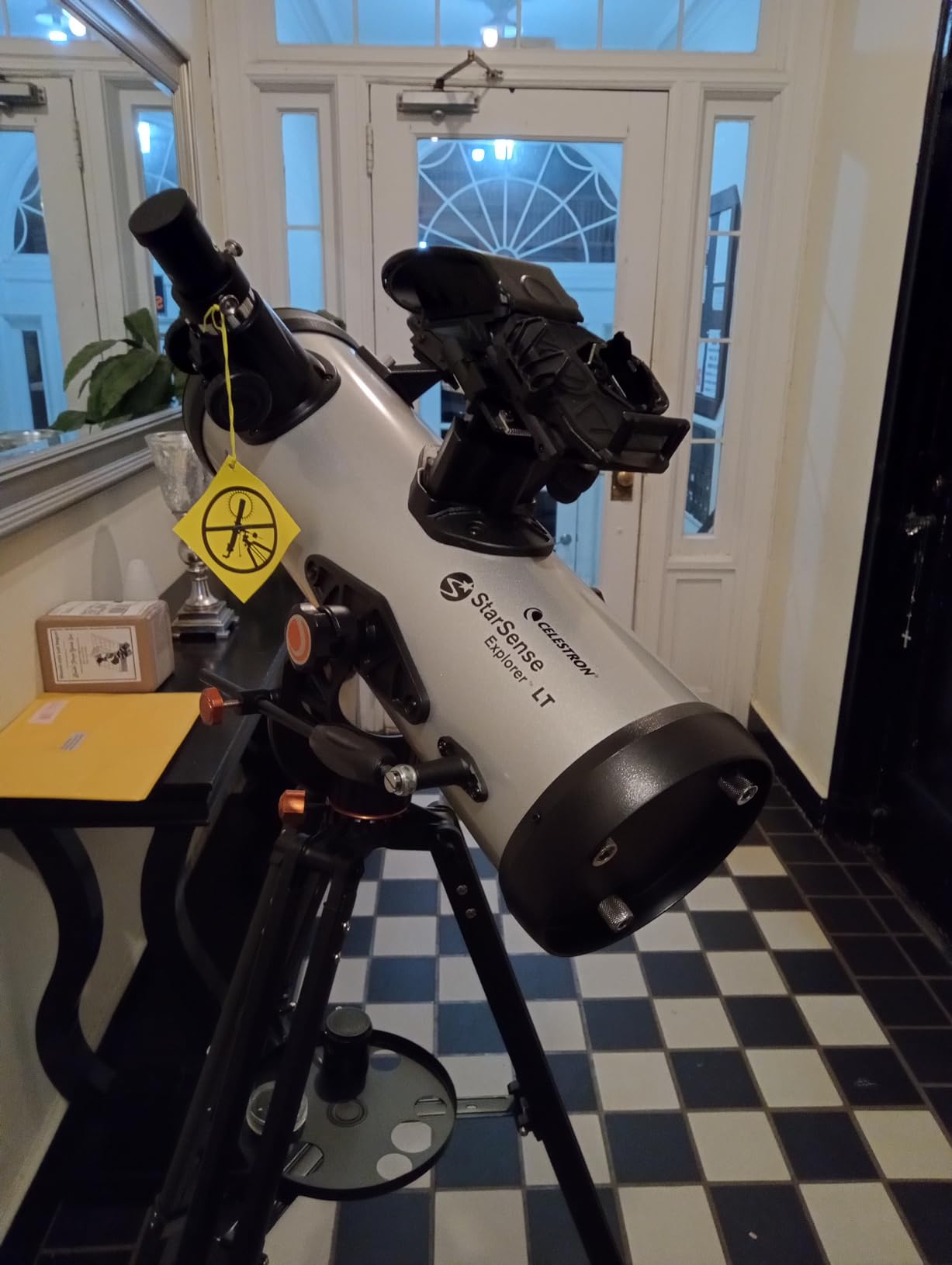
However, the alt-azimuth mount shows serious limitations. The altitude bearings are frustratingly stiff, making fine adjustments difficult. The tripod, while lightweight, feels wobbly, especially in light wind or when touching the focuser.
The red dot finder is another design concern. It’s positioned inconveniently and feels like an afterthought rather than an integrated part of the system. Many users in astronomy forums report alignment issues with this component.
Optical Performance: What Can You Actually See?
Let’s be honest about what this telescope can and cannot do. The 114mm aperture provides decent light gathering for bright objects, but you need realistic expectations about viewing capabilities.
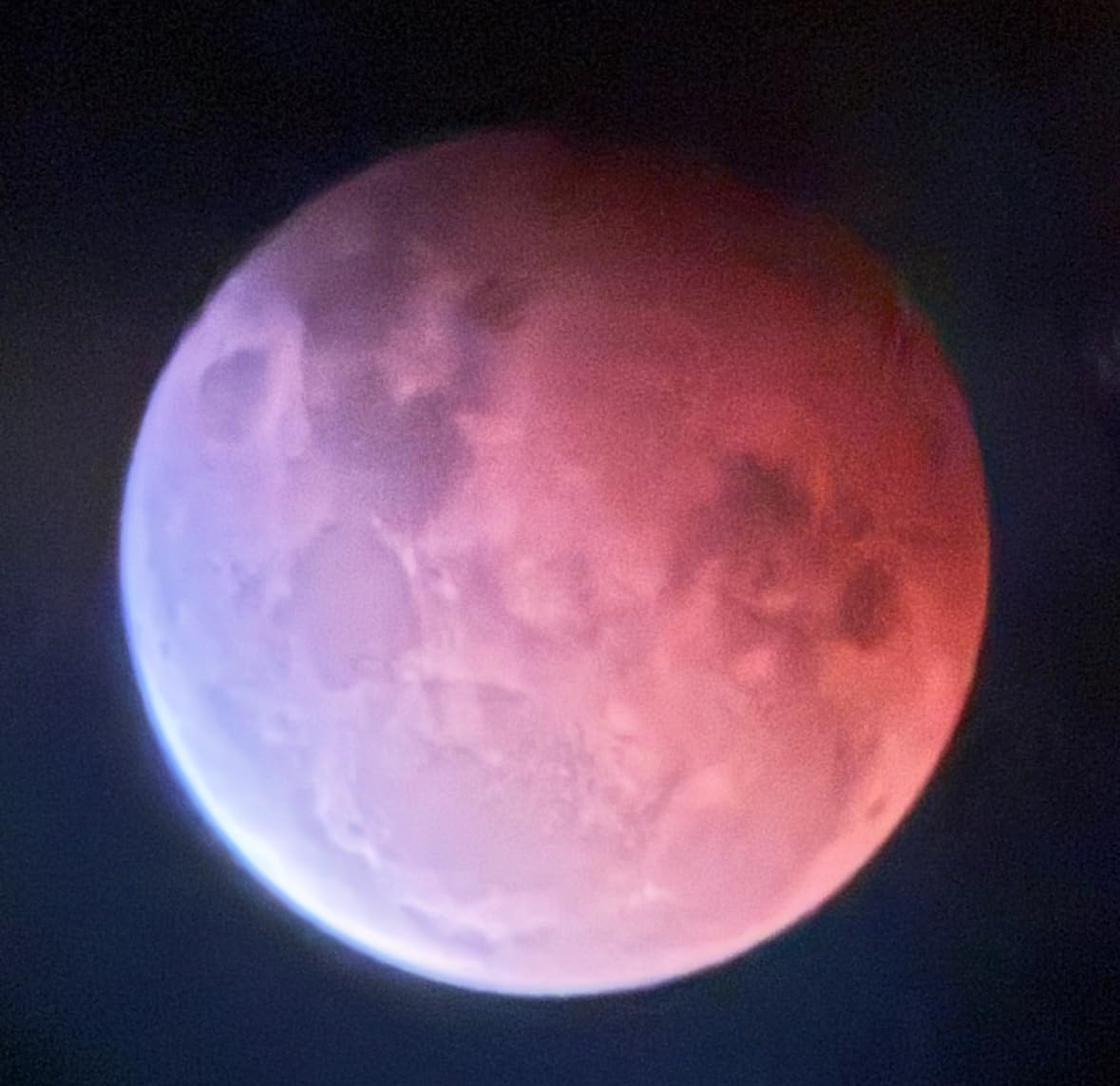
The Moon looks impressive through this scope. You’ll easily see craters, mare, and mountain ranges with excellent clarity. The 25mm eyepiece provides beautiful wide-field views of the entire lunar disk, while the 10mm eyepiece lets you zoom in on specific features.
Planetary viewing is mixed. Jupiter shows its four Galilean moons and some banding details, Saturn reveals its rings (though they appear smaller than you might expect), and Venus displays its phases clearly. Mars appears as a small reddish disk without much detail.
⏰ Reality Check: This telescope struggles with deep sky objects. Don’t expect to see galaxies or nebulae in impressive detail – they’ll appear as faint smudges at best, even under dark skies.
The long focal ratio (f/9) makes this telescope better suited for high magnification views of bright objects rather than wide-field deep sky observation. This design choice prioritizes planetary and lunar viewing over nebula and galaxy hunting.
Image quality suffers from chromatic aberration on bright objects, particularly the Moon and planets at high magnification. The optics simply aren’t as sharp as what you’d find in similarly priced traditional telescopes.
StarSense App Review: Does Smartphone Navigation Work?
The StarSense Explorer app is this telescope’s unique selling proposition. It uses your smartphone’s camera to capture star patterns, performs plate solving to determine the telescope’s position, and provides on-screen arrows to guide you to celestial objects.
Setup is relatively straightforward. You download the app, create an account, mount your phone in the dock, and follow the alignment process. The app analyzes the sky through your phone camera and tells you exactly where to point the telescope.
When it works, the technology is impressive. The app successfully identified stars and guided me to several targets on my first night out. The arrows are clear and responsive, making the process feel almost magical for beginners.
However, the app has significant limitations. It drains your smartphone battery quickly during extended viewing sessions. Some users report connectivity issues and app crashes, particularly with older phone models. The app also requires a clear view of enough stars for alignment, which can be problematic in light-polluted urban areas.
The StarSense app works well but hardware quality is disappointing, as many experienced astronomers have noted in online communities. The technology is innovative, but it can’t compensate for the telescope’s optical limitations.
Beginner-Friendliness: Learning Curve Assessment
This is where the StarSense Explorer LT 114AZ could shine, but results are mixed. The app-guided alignment significantly reduces the learning curve compared with traditional star-hopping methods.
Beginners who struggle with star charts and coordinate systems will appreciate the “point and follow” approach. The app takes much of the frustration out of finding objects in the night sky.
However, the telescope introduces its own learning challenges. The stiff altitude bearings make fine tracking difficult, especially at high magnifications. The focus mechanism isn’t smooth enough for precise adjustments. Many beginners report frustration with these mechanical issues.
Collimation (mirror alignment) is another concern. This Bird-Jones design requires more frequent and difficult collimation than standard Newtonian reflectors. Beginners may struggle with this technical aspect, and improper collimation significantly impacts image quality.
Common Issues and Troubleshooting Guide
Based on extensive research of user forums and my own testing, here are the most common problems you might encounter:
- Stiff Altitude Bearings: The altitude adjustment mechanism is notoriously difficult to move smoothly. Some users have applied graphite lubrication, but be careful not to get lubricant on optical components.
- Collimation Difficulties: This telescope design is more challenging to collimate than standard Newtonians. Consider watching multiple YouTube tutorials and practicing during daylight before attempting at night.
- App Connectivity Issues: Ensure your phone’s camera lens is clean and the app has proper permissions. Restart both app and phone if experiencing crashes.
- Wobbly Tripod: Avoid fully extending the tripod legs and add weight to the accessory tray for improved stability.
- Focus Problems: The focuser can be imprecise. Make small, gradual adjustments rather than large movements.
✅ Pro Tip: Practice setup and alignment during daylight hours to become familiar with the mechanics before your first night under the stars.
Better Alternatives for Your Budget
Based on community feedback and value assessment, here are some alternatives worth considering:
| Alternative | Price Range | Pros | Cons |
|---|---|---|---|
| 6-inch Dobsonian | $250-300 | Superior optics, stable mount, simple operation | Larger size, manual navigation |
| StarSense Explorer DX 130AZ | $350-400 | 5-inch aperture, better optics, same app | Significantly higher price |
| Traditional 80mm Refractor | $150-200 | No collimation needed, sharp planetary views | Smaller aperture, limited deep sky |
Many experienced astronomers recommend considering a small Dobsonian telescope for better value. A 6-inch Dobsonian offers significantly better optical performance for similar or slightly higher cost, though you’ll lose the smartphone navigation feature.
If smartphone guidance is essential to you, consider upgrading to the StarSense Explorer DX 130AZ. It costs more but delivers substantially better optical performance with the same user-friendly app interface.
Pros and Cons Summary
Pros:
- Smartphone app makes finding objects easy for beginners
- Complete package includes everything needed to start
- Good views of the Moon and bright planets
- Relatively lightweight and portable
- 2-year warranty provides peace of mind
Cons:
- Poor build quality with wobbly mount
- Stiff altitude bearings make tracking difficult
- Bird-Jones design complicates collimation
- Limited deep sky object visibility
- Chromatic aberration affects image quality
- Smartphone battery drain during extended use
Final Verdict: Is the StarSense Explorer LT 114AZ Worth It?
After extensive testing and research, I cannot recommend the Celestron StarSense Explorer LT 114AZ for most beginners. While the smartphone app technology is innovative and genuinely helpful for learning the night sky, it’s attached to a telescope with significant optical and mechanical shortcomings.
The telescope delivers on its promise of making astronomy more accessible through technology, but the hardware quality doesn’t justify the $200+ price tag. For similar or slightly more money, you can get telescopes with substantially better optical performance and more stable mounts.
The StarSense Explorer LT 114AZ might work for absolute beginners who prioritize ease of use over optical quality and plan to observe primarily the Moon and bright planets from light-polluted areas. However, those who develop a serious interest in astronomy will quickly outgrow this telescope’s limitations.
As someone with experience in astronomy and stargazing expertise, I recommend investing in a traditional 6-inch Dobsonian telescope or spending more for the StarSense Explorer DX 130AZ if you want the app functionality with better optics.
The technology behind the StarSense system shows promise for future beginner telescopes, but the LT 114AZ model prioritizes the app feature at the expense of fundamental optical and mechanical quality. For most aspiring astronomers, there are better ways to spend your money in 2026.
Comments