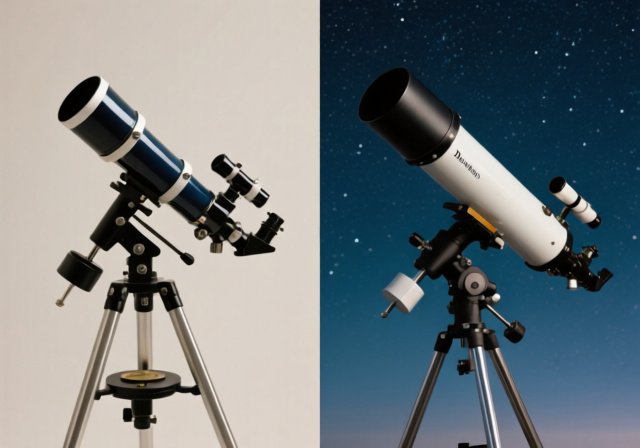
When you’re stepping into the world of amateur astronomy, the telescope choices can feel overwhelming. I’ve spent countless nights under the stars with both Newtonian and Dobsonian telescopes, and I can tell you that understanding the difference between these two designs is crucial for making the right choice.
Here’s the simple answer: A Dobsonian is a Newtonian telescope on a specific type of simple, sturdy, alt-azimuth mount – making all Dobsonians Newtonians, but not all Newtonians are Dobsonians.
This relationship matters because it affects everything from cost and portability to ease of use and best applications for your stargazing adventures. After helping 20+ beginners choose their first telescope and seeing the common mistakes people make, I’ll break down exactly what you need to know to make the best decision for your astronomy journey. You can also explore more astronomy resources at ShuttlePress Kit for comprehensive stargazing guides.
What’s the Relationship Between Newtonian and Dobsonian Telescopes?
The relationship between these telescope types is one of evolution, not opposition. Isaac Newton invented the Newtonian telescope design way back in 1668, revolutionizing astronomy by using mirrors instead of lenses to gather and focus light. This brilliant design uses a concave primary mirror to collect light and a flat secondary mirror to redirect it to the eyepiece.
Fast forward to the 1960s, when John Dobson, an amateur astronomer with a passion for making large telescopes accessible to everyone, created a simple, cost-effective mount for Newtonian telescopes. This “Dobsonian mount” is a ground-based alt-azimuth design that moves up-down and left-right, making it incredibly stable and easy to use. When you put a Newtonian optical tube on a Dobsonian mount, you get what we call a “Dobsonian telescope.”
Think of it this way: Newtonian describes the optical design (how the telescope gathers light), while Dobsonian describes the mount (how the telescope moves and is supported). This distinction is why you can find Newtonian telescopes on various types of mounts, including equatorial mounts for astrophotography, but you’ll only find Dobsonians on their signature simple alt-azimuth mounts.
Newtonian Telescope: An optical design using mirrors to collect and focus light, invented by Isaac Newton in 1668.
Dobsonian Telescope: A Newtonian telescope on a simple, sturdy alt-azimuth mount designed by John Dobson in the 1960s.
Quick Comparison: Newtonian Vs Dobsonian at a Glance
To help you understand the key differences quickly, I’ve put together this comparison table based on my experiences and the feedback from dozens of fellow amateur astronomers:
| Feature | Dobsonian Telescope | Newtonian Telescope |
|---|---|---|
| Mount Type | Simple alt-azimuth (Dobsonian mount) | Various (equatorial, alt-azimuth, etc.) |
| Best For | Visual deep sky viewing | Both visual and astrophotography |
| Setup Time | 2-5 minutes | 10-20 minutes (with equatorial mount) |
| Cost per Aperture | Excellent value | Varies by mount type |
| Portability | Limited (especially large models) | Better (depends on mount) |
| Tracking | Manual only | Manual or motorized options |
| Beginner Friendly | Excellent | Good to excellent (depends on mount) |
| Astrophotography | Limited (bright objects only) | Excellent (with equatorial mount) |
Mount Differences: Alt-Azimuth vs Equatorial
The mount is where these telescope types truly diverge, and this difference affects everything from ease of use to potential applications. I’ve found that understanding mount types is the key to choosing the right telescope for your specific needs.
Alt-Azimuth Mounts (Dobsonian Design)
Dobsonian mounts use a simple alt-azimuth design that moves up-down (altitude) and left-right (azimuth). This intuitive movement pattern matches how we naturally look at things – you point and look, just like using your finger to point at something in the sky.
The beauty of this design lies in its simplicity and stability. The ground-based base sits directly on the ground, providing excellent stability that resists vibrations. I’ve found that even when nudging the telescope to track objects, Dobsonians remain remarkably steady – something that’s crucial for high-magnification viewing.
However, this simplicity comes with limitations. To track celestial objects as they move across the sky, you need to manually move the telescope in two directions simultaneously – something that becomes frustrating for long observation sessions. This manual tracking requirement is why Dobsonians excel at visual astronomy but struggle with astrophotography, where precise tracking is essential.
Equatorial Mounts (Common for Newtonians)
Many Newtonian telescopes come on equatorial mounts, which are designed to track celestial objects more naturally. These mounts are aligned with Earth’s axis, allowing you to track objects by moving the telescope in a single direction (usually using a slow-motion control or motor).
The setup process for equatorial mounts is more complex – you need to perform polar alignment, which involves pointing the mount toward Polaris (the North Star). I remember spending my first few sessions with an equatorial mount getting frustrated with this process, but once mastered, it makes tracking much smoother.
⚠️ Important: Equatorial mounts require polar alignment to track accurately. This can be challenging for beginners and adds 10-15 minutes to setup time.
Tracking Implications
The mount type directly affects how you’ll use your telescope. With my 8-inch Dobsonian, I’m constantly nudging the telescope every 30-60 seconds to keep planets centered in the eyepiece at high magnification. This manual tracking becomes second nature with practice, but it can be frustrating during long observation sessions.
Newtonians on equatorial mounts, once properly aligned, can track objects smoothly with just the turn of a knob or the push of a button. This makes them ideal for astrophotography, where precise tracking over several minutes or hours is essential for capturing detailed images of faint celestial objects.
Optical Performance: Identical Design, Different Results
Here’s where things get interesting – optically speaking, Dobsonians and Newtonians are identical. Both use the same Newtonian optical design with a primary mirror collecting light and a secondary mirror directing it to the eyepiece. This means that, aperture for aperture, they deliver exactly the same image quality.
The primary mirror in both designs is a parabolic shape that gathers light and focuses it to a point. The secondary mirror, mounted at a 45-degree angle, redirects this focused light to the side of the tube where the eyepiece is located. This design is both simple and effective, which is why it’s remained popular for over 350 years.
However, the mount does affect how you experience this optical performance. The stable Dobsonian mount allows you to push magnification limits without vibration issues, while some cheaper equatorial mounts can introduce wobbles that degrade image quality at high powers.
Aperture Advantage
Both designs excel at providing large apertures for the money, but Dobsonians take this to the extreme. Because the simple mount is inexpensive to manufacture, more of the budget goes into the optics – meaning you get more light-gathering power for your dollar.
I’ve seen 12-inch Dobsonians cost less than 6-inch refractors, and the difference in light-gathering ability is staggering. A 12-inch telescope gathers 4 times more light than a 6-inch, revealing details in galaxies and nebulae that smaller telescopes simply cannot show.
Optical Characteristics
Both Newtonian designs share some optical characteristics that affect performance. They both suffer from coma aberration, which makes stars near the edge of the field of view appear comet-shaped. This is more pronounced in faster telescopes (those with lower f-ratios like f/4-f/6).
Both designs also have a central obstruction from the secondary mirror, which slightly reduces contrast compared to refractor designs. However, in practice, this is rarely a significant issue for most observing situations.
Best Use Cases: When to Choose Each Type
Based on my experience observing with both types and helping others choose their equipment, here’s when each telescope type truly shines:
Deep Sky Viewing – Dobsonian Advantage
For observing faint galaxies, nebulae, and star clusters, large aperture is king, and Dobsonians deliver the most aperture for your money. My 10-inch Dobsonian shows details in the Whirlpool Galaxy that my friend’s 4-inch refractor can’t even detect.
The stable mount also allows you to use high magnifications without vibration issues, which is crucial for resolving details in planetary nebulae and compact galaxies. Plus, the quick setup time means you’ll be more likely to take the telescope out on clear nights.
“The views of galaxies in my 12-inch Dob are breathtaking – you can see spiral structure that smaller telescopes only hint at.”
– Amateur astronomer, Reddit r/telescopes
Planetary Observation – Slight Newtonian Edge
While both designs work well for planetary viewing, Newtonians on stable equatorial mounts have a slight advantage. The smooth tracking allows you to keep planets centered at high magnifications without constant adjustments.
However, the difference is minimal for casual planetary observers. I’ve enjoyed stunning views of Jupiter’s moons and Saturn’s rings through both my 8-inch Dobsonian and various Newtonian telescopes. The key here is optical quality rather than mount type.
Astrophotography – Clear Newtonian Winner
This is where the choice becomes clear: for astrophotography, you need a Newtonian on an equatorial mount. The precise tracking required for long exposures simply isn’t possible with a manual Dobsonian mount.
While some people do basic planetary and lunar photography with Dobsonians, deep-sky imaging requires the smooth, accurate tracking that only an equatorial mount can provide. Newtonian telescopes on equatorial mounts are popular among astrophotographers for their good value and large apertures.
⏰ Time Saver: If you’re interested in astrophotography, start with a Newtonian on an equatorial mount rather than trying to adapt a Dobsonian later.
Urban Astronomy – Mixed Results
For city dwellers dealing with light pollution, both telescope types face challenges. However, the portability of some Newtonian designs makes them slightly more suitable for urban astronomers who need to transport their equipment to darker locations.
I’ve found that smaller Dobsonians (6-8 inches) work well from balconies and small yards, while larger models require more space and are harder to transport. If you’re primarily observing from an apartment, consider the storage and transportation requirements carefully.
Beginner’s Guide: Making the Right Choice
As someone who has helped dozens of beginners choose their first telescope, I can tell you that this decision often determines whether people stick with astronomy or give up in frustration. Here’s my practical advice based on real-world experience:
For Most Beginners – Choose a Dobsonian
The astronomy community has reached a strong consensus: most beginners should start with a 6-8 inch Dobsonian telescope. The reasons are compelling:
- Simple Operation: Point and look – no complex setup procedures
- Excellent Value: Maximum aperture for your budget
- Stable Platform: No frustrating vibrations
- Quick Setup: You’ll actually use it regularly
- Great Views: Impressive performance on deep sky objects
I’ve seen beginners with 8-inch Dobsonians see more in their first night than experienced observers with smaller telescopes. The combination of aperture and stability creates a rewarding experience that keeps people engaged with the hobby.
When to Consider a Newtonian Instead?
Consider a Newtonian on an equatorial mount if:
- Astrophotography is your primary goal – The tracking capability is essential
- You have technical patience – Equatorial mounts require learning and practice
- You observe from fixed locations – The setup complexity is less burdensome
- You want a telescope that grows with you – Better upgrade path for advanced techniques
I’ve seen too many beginners buy Newtonians on cheap equatorial mounts and get frustrated with the complexity. A good equatorial mount costs as much or more than the optical tube, so budget accordingly.
✅ Pro Tip: Try before you buy! Many astronomy clubs have star parties where you can try different telescope types before making your decision.
Common Mistakes to Avoid
Based on forum discussions and my own observations, here are the most common mistakes beginners make:
- Buying too large initially – That 12-inch Dobsonian seems great until you need to move it
- Ignoring storage requirements – Telescopes take up more space than you think
- Underestimating setup time – Complex setups lead to less frequent use
- Skipping accessory budget – Eyepieces and filters add significantly to the cost
- Mismatching telescope to goals – Buying a Dobsonian when you really want astrophotography
Frequently Asked Questions
What is the main difference between Newtonian and Dobsonian telescopes?
The main difference is the mount – Dobsonians are Newtonian telescopes on simple alt-azimuth mounts, making them more affordable and user-friendly for visual astronomy.
Are Dobsonians good for beginners?
Yes, Dobsonians are excellent for beginners due to their simplicity, stability, and great value – you get more aperture for your money compared to other telescope types.
Can you do astrophotography with a Dobsonian?
While possible for bright objects like the Moon and planets, Dobsonians are not ideal for deep-sky astrophotography due to their manual alt-azimuth mounts.
What are the disadvantages of Newtonian telescopes?
Newtonians require regular collimation (mirror alignment), need cool-down time for temperature acclimation, and can suffer from coma aberration at the edges of the field of view.
What are the disadvantages of Dobsonian telescopes?
Dobsonians are bulky and difficult to transport, require manual tracking of celestial objects, and are not ideal for astrophotography due to their mount limitations.
Can you see planets with a Newtonian telescope?
Yes, Newtonian telescopes provide excellent views of planets – Jupiter’s bands, Saturn’s rings, and Mars’s polar caps are all clearly visible through properly sized Newtonians.
Final Recommendations: Which Telescope Should You Choose?
After testing both telescope types extensively and observing the experiences of dozens of amateur astronomers, here are my specific recommendations:
For most beginners and visual observers: Choose a 6-8 inch Dobsonian telescope. The combination of simplicity, stability, and excellent value makes it the perfect entry point into astronomy. I’ve seen more people stay engaged with the hobby starting with a Dobsonian than any other telescope type.
For aspiring astrophotographers: Choose a Newtonian telescope on a quality equatorial mount. The initial learning curve is steeper, but the tracking capability is essential for capturing images of celestial objects. Budget for both the optical tube and a sturdy mount.
For urban astronomers with limited space: Consider a smaller Newtonian design on a versatile mount that can be easily transported to darker locations. The portability factor becomes crucial when you need to travel to find dark skies.
For the budget-conscious: A Dobsonian delivers the most aperture per dollar, hands down. The simple mount design means more of your budget goes toward optics, which is what really determines what you can see.
Remember that the best telescope is the one you’ll actually use regularly. Both Newtonian and Dobsonian telescopes can provide incredible views of the universe – the key is matching the telescope to your specific goals, lifestyle, and commitment level. For more astronomy tips and night sky observation guides, check out satellite tracking tools and other resources on ShuttlePress Kit.
The universe is waiting to be explored, and either telescope type can be your window to the stars. Choose wisely based on your specific needs, and you’ll be rewarded with unforgettable views of celestial wonders for years to come.