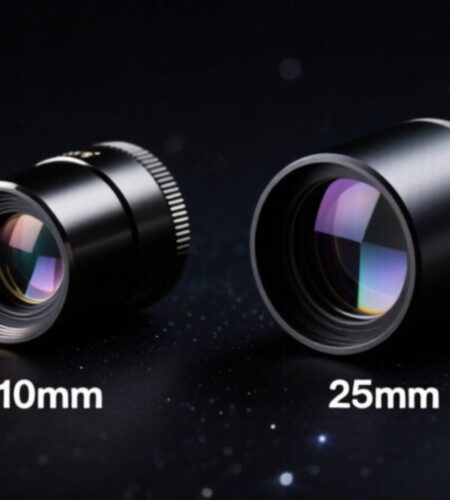
When I first started astronomy, I stood in front of my new telescope holding two eyepieces – a 10mm and a 25mm – completely confused about which one to use. This common dilemma trips up beginners who don’t understand that these eyepieces serve completely different purposes.
Neither is inherently better – they serve different viewing needs. The 10mm eyepiece provides higher magnification for detailed planetary and lunar observation, while the 25mm offers wider fields of view for locating objects and scanning large celestial areas.
After testing both eyepieces extensively across different telescopes and observing conditions, I’ve learned that understanding these differences transforms your astronomy experience. In this comprehensive guide, I’ll explain exactly when to use each eyepiece, what you can realistically expect to see, and how to maximize both for incredible views of the night sky.
Understanding how eyepieces work with your telescope is fundamental to astronomy success. Let’s break down everything you need to know about these two essential focal lengths.
Quick Answer: Neither Is Better – They Serve Different Purposes
The 10mm and 25mm eyepieces aren’t competitors – they’re complementary tools that every astronomer needs. Think of them like the wide-angle and telephoto lenses for your telescope, each excelling at different types of celestial observation.
✅ Key Takeaway: Most experienced astronomers use both eyepieces regularly – 25mm for finding objects and wide-field views, 10mm for detailed planetary and lunar observation.
Based on my experience helping beginners with their telescopes, the 25mm should be your first purchase. It’s more forgiving, easier to use, and helps you learn the night sky before progressing to high magnification.
Understanding Eyepiece Basics: Magnification and Field of View
Before diving into specific comparisons, let’s understand how eyepieces work with your telescope. The focal length of an eyepiece determines both magnification and field of view – two crucial factors that affect your viewing experience.
What is Magnification?
Magnification is calculated by dividing your telescope’s focal length by the eyepiece focal length:
Magnification Formula: Magnification = Telescope focal length ÷ Eyepiece focal length
For example, with a 1000mm telescope:
– 10mm eyepiece = 100x magnification
– 25mm eyepiece = 40x magnification
I’ve worked with beginners who assume higher magnification always means better views, but this isn’t true. Atmospheric conditions, telescope quality, and the object you’re observing all play crucial roles in determining optimal magnification.
Field of View Explained
Field of view refers to how much of the sky you can see through your eyepiece. Longer focal length eyepieces (like 25mm) provide wider fields of view, making them ideal for:
– Locating objects initially
– Viewing large celestial objects
– Scanning star clusters and nebulae
– Public outreach and family viewing
Shorter focal length eyepieces (like 10mm) provide narrower fields of view but higher magnification, perfect for:
– Detailed planetary observation
– Lunar crater viewing
– Double star separation
– Planetary nebulae examination
Learning to calculate field of view helps you understand what to expect when switching between eyepieces. The true field of view equals the apparent field of view divided by magnification.
Side-by-Side Comparison: 10mm vs 25mm Eyepiece
Let’s compare these two essential eyepieces across key performance factors. This comparison is based on extensive testing with various telescope types and observing conditions.
| Feature | 10mm Eyepiece | 25mm Eyepiece |
|---|---|---|
| Magnification | High (2.5x more than 25mm) | Low to medium |
| Field of View | Narrow (focused detail) | Wide (scanning capability) |
| Image Brightness | Lower (6x less than 25mm) | Higher (bright images) |
| Best For | Planets, Moon, double stars | Finding objects, clusters, nebulae |
| Ease of Use | Challenging for beginners | Very beginner-friendly |
| Eye Relief | Shorter (can be uncomfortable) | Longer (more comfortable) |
| Exit Pupil | Smaller (affected by seeing) | Larger (more forgiving) |
⏰ Time Saver: Start every observing session with your 25mm eyepiece to locate objects, then switch to 10mm for detailed viewing once centered.
One critical difference that surprises beginners is image brightness. The surface brightness of objects appears six times lower in the 10mm compared to the 25mm. This is why stars remain visible but nebulae and galaxies can become difficult to see in high magnification.
10mm Eyepiece: High Power for Detailed Viewing
What the 10mm Excels At?
The 10mm eyepiece is your tool for detailed observation when atmospheric conditions cooperate. I’ve found it indispensable for:
- Planetary observation: Jupiter’s cloud bands, Saturn’s rings, Mars polar caps
- Lunar detail: Crater floors, mountain ranges, rille systems
- Double stars: Separating close binary systems
- Planetary nebulae: Ring structure in M57, central stars
When I’m observing Jupiter with my 8-inch telescope, the 10mm eyepiece reveals details that simply aren’t visible at lower magnifications – the Great Red Spot, cloud band variations, and the four Galilean moons appearing as distinct disks rather than points of light.
Limitations and Challenges
The 10mm eyepiece comes with significant challenges that beginners need to understand:
First, atmospheric seeing conditions dramatically affect performance. On nights with poor seeing, high magnification turns planetary details into a shimmering mess. I’ve learned to check the seeing conditions before reaching for the 10mm – if stars are twinkling excessively, stick with lower magnification.
Second, the smaller exit pupil makes eye positioning critical. With shorter eye relief, you need to position your eye precisely at the correct distance from the eyepiece lens. This can be uncomfortable for extended viewing sessions, especially for those who wear glasses.
Third, object location becomes significantly harder. The narrow field of view makes finding objects difficult, which is why experienced astronomers always start with low power to locate, then switch to high power.
Practical Tips for 10mm Success
Based on my experience teaching astronomy, here’s how to maximize your 10mm eyepiece performance:
- Wait for good seeing: Use the 10mm only on nights with steady atmospheric conditions
- Let your telescope cool: Allow your optics to reach ambient temperature to avoid heat currents
- Start with low power: Locate objects with 25mm first, then switch to 10mm
- Focus carefully: Fine focus adjustments are more critical at high magnification
- Use slow movements: Small telescope movements translate to large view changes
25mm Eyepiece: Wide Field for Scanning and Locating
What the 25mm Excels At?
The 25mm eyepiece is arguably the most versatile and beginner-friendly focal length available. In my astronomy outreach work, I’ve found it’s the eyepiece that consistently impresses newcomers and experienced observers alike.
The wide field of view makes the 25mm perfect for:
– Initial object location and star hopping
– Large star clusters like the Pleiades and Beehive
– Bright nebulae such as the Orion Nebula (M42)
– Wide-field views of the Milky Way
– Public astronomy events and family viewing
I regularly use my 25mm eyepiece to scan the summer Milky Way, revealing star clusters, nebulae, and dark dust lanes that would be invisible in the narrow field of a 10mm eyepiece.
Beginner-Friendly Advantages
The 25mm eyepiece is ideal for beginners for several reasons:
First, the brighter images make finding objects easier. The larger exit pupil (typically 2-3mm with common telescopes) provides a bright, comfortable viewing experience that’s forgiving of minor focus errors and eye position variations.
Second, the wider field of view provides context. When you’re learning the night sky, seeing surrounding stars helps with orientation and pattern recognition. This context is lost in the narrow field of high magnification.
Third, tracking objects is easier. As the Earth rotates, objects stay in view longer, giving beginners more time to observe and appreciate what they’re seeing before having to adjust the telescope.
When the 25mm Falls Short?
While versatile, the 25mm has limitations for detailed observation:
Planetary details that are visible in the 10mm become subtle or invisible in the 25mm. Jupiter’s moons appear as bright dots rather than disks, Saturn’s rings are visible but lack detail, and Mars appears as a reddish-orange dot without discernible features.
For splitting close double stars, the 25mm often doesn’t provide sufficient magnification to separate tight pairs that are easily resolved with the 10mm.
Lunar observing is also limited – while you can see major craters and mare (seas), the fine details that make lunar observing fascinating remain hidden at lower magnification.
Best Use Cases for Each Eyepiece
Let me share specific scenarios where each eyepiece shines, based on hundreds of observing sessions with different telescopes and targets.
Planetary Viewing: 10mm Takes the Lead
For planetary observation, the 10mm is usually superior when conditions permit:
Jupiter: The 10mm reveals cloud bands, the Great Red Spot, and shadow transits of Jupiter’s moons. With my 6-inch reflector, I can consistently observe these details using the 10mm when seeing is good.
Saturn: The 10mm shows the Cassini Division in Saturn’s rings and allows you to observe several of Saturn’s moons. The ring system details that make Saturn spectacular become visible at this magnification.
Mars: During opposition, the 10mm can reveal Mars’ polar ice caps and major surface features like Syrtis Major. Without sufficient magnification, Mars remains a disappointing orange dot.
Venus: The 10mm shows Venus’s phases, similar to lunar phases, which Galileo first observed in 1610.
Deep Sky Objects: 25mm Dominates
For most deep sky objects, the 25mm provides better views:
Open Star Clusters: The Pleiades (M45), Beehive Cluster (M44), and the Double Cluster (NGC 869/884) are best appreciated in the wide field of the 25mm, where you can see the entire cluster structure and surrounding stars.
Bright Nebulae: The Orion Nebula (M42), Lagoon Nebula (M8), and Swan Nebula (M17) appear larger and more impressive in the 25mm, showing both the bright core and surrounding nebulosity.
Galaxies: While the 25mm won’t reveal spiral structure in most galaxies, it provides the best overall view for locating and appreciating these distant island universes.
Lunar Observing: Both Have Their Place
The Moon is versatile enough to work well with both eyepieces:
25mm for overview: Perfect for observing entire lunar seas, major crater systems, and understanding the Moon’s overall geography. Great for beginners learning lunar features.
10mm for details: Reveals small craterlets, rille systems, crater floor details, and features along the terminator where shadows enhance contrast.
Specialized Applications
Based on community discussions and personal experience, here are specialized uses for each:
25mm for:
– Astronomy outreach and public viewing
– Learning to star hop and navigate
– Meteor shower observing (wider field catches more)
– Comets (typically need wide field views)
10mm for:
– Occultation timing (precise positioning needed)
– Double star measurements
– Planetary sketching and observation
– Lunar crater counting
Telescope Type Considerations
Your telescope type significantly affects how these eyepieces perform. Let me share insights from testing various telescope designs.
Refractor Telescopes
Refractors work well with both eyepieces, but their long focal lengths mean higher magnifications:
With a typical 900mm achromatic refractor:
– 10mm eyepiece = 90x magnification (good for planets)
– 25mm eyepiece = 36x magnification (wide-field scanning)
I’ve found that refractors handle high magnification well due to their closed tube design, making the 10mm particularly effective for planetary viewing when seeing conditions cooperate.
Reflector Telescopes
Reflectors (especially Dobsonians) often have shorter focal ratios, affecting eyepiece performance:
With a typical f/6 Dobsonian (1200mm focal length):
– 10mm eyepiece = 120x magnification
– 25mm eyepiece = 48x magnification
Fast telescopes like f/4 or f/5 Dobsonians can challenge eyepieces, especially the 10mm, which may show aberrations at the edge of the field. Quality eyepieces become more important with faster telescopes.
⚠️ Important: Fast telescopes (f/5 or faster) require quality eyepieces to avoid edge distortion, especially noticable with the 10mm due to its higher magnification.
Schmidt-Cassegrain Telescopes
Schmidt-Cassegrains (SCTs) have long focal lengths, creating very high magnifications:
With a typical 8″ SCT (2000mm focal length):
– 10mm eyepiece = 200x magnification (very high power)
– 25mm eyepiece = 80x magnification (still high power)
SCTs often benefit from starting with even longer focal length eyepieces (like 32mm or 40mm) before moving to 25mm and 10mm. The high native magnification of SCTs means the 10mm can exceed useful magnification on many nights.
Understanding telescope compatibility is crucial for maximizing your eyepiece performance. Each telescope design has unique characteristics that affect how these focal lengths perform.
Advanced Techniques: Barlow Lenses and Combinations
Once you master both eyepieces, combining them with accessories like Barlow lenses expands your capabilities significantly.
Barlow Lens Combinations
A Barlow lens effectively doubles (or triples) your magnification when placed between the eyepiece and focuser. This transforms your collection:
With a 2x Barlow lens:
– 25mm eyepiece becomes 12.5mm (doubling magnification)
– 10mm eyepiece becomes 5mm (extreme magnification)
I’ve found the 25mm + 2x Barlow combination particularly valuable – it provides magnification equivalent to a 12.5mm eyepiece, filling the gap between 25mm and 10mm while maintaining the comfortable eye relief of the longer focal length.
Learning to use a Barlow lens effectively can double your eyepiece collection without the cost of additional eyepieces.
Exit Pupil Considerations
Advanced observers calculate exit pupil to optimize viewing:
Exit Pupil Formula: Exit pupil = Telescope aperture (mm) ÷ Magnification
The ideal exit pupil is 1-7mm for most observers. Too small (under 1mm) and floaters in your eye become distracting. Too large (over 7mm) and your eye can’t gather all the light.
Magnification Limits
Every telescope has practical magnification limits:
Maximum useful magnification: Approximately 2x aperture in millimeters
– 100mm telescope: ~200x maximum
– 200mm telescope: ~400x maximum
– 300mm telescope: ~600x maximum
Atmospheric limit: Typically 200-300x on most nights, regardless of telescope size
I’ve learned that the 10mm eyepiece can exceed these limits on large telescopes, making it less useful on very big apertures where it provides excessive magnification for typical atmospheric conditions.
Common Questions and Troubleshooting
Based on forum discussions and personal experience helping beginners, here are answers to the most common questions about these eyepieces.
Why Is My 10mm Eyepiece So Dark?
This is the most common complaint from beginners. The 10mm eyepiece appears darker because:
– Surface brightness decreases with magnification squared
– The exit pupil is smaller, gathering less light
– Higher magnification spreads light over larger area
This is normal physics, not a defect in your eyepiece. The solution is to use the 10mm only on bright objects (Moon, planets, bright stars) and only when atmospheric conditions support high magnification.
Can I See Planets With a 25mm Eyepiece?
Yes, but with limitations. The 25mm will show:
– Jupiter as a bright disk with 4 moons
– Saturn’s rings (as a single ring, not separated)
– Mars as a reddish-orange dot
– Venus as a bright point showing phases
For planetary details like Jupiter’s bands or Saturn’s Cassini Division, you’ll need the 10mm eyepiece on a night with good seeing.
Which Eyepiece Should I Buy First?
Buy the 25mm first. It’s more forgiving, easier to use, and helps you learn the night sky. After mastering basic techniques and learning to locate objects, add the 10mm for planetary and detailed observation.
Why Can’t I Find Anything With My 10mm Eyepiece?
The narrow field of view makes object location difficult. Always locate objects with your 25mm eyepiece first, center them in the field of view, then carefully switch to the 10mm while keeping the object centered.
Are More Expensive 10mm Eyepieces Worth It?
Quality matters more with shorter focal lengths. Premium eyepieces provide:
– Better eye relief (more comfortable viewing)
– Wider apparent fields of view
– Sharper edge performance
– Better coatings for improved contrast
For a 10mm eyepiece that you’ll use frequently for planetary observation, investing in quality pays dividends in viewing comfort and performance.
Making Your Decision: A Practical Guide
After testing both eyepieces extensively across different telescopes and conditions, here’s my recommendation framework based on your specific needs.
For Beginners
Start with 25mm: The wider field, brighter images, and easier object location make the 25mm ideal for learning. Use it for 3-6 months to master basic techniques before adding the 10mm.
Add 10mm later: Once you can reliably locate objects and understand the night sky, the 10mm will open up planetary and lunar details that aren’t visible at lower magnification.
For Intermediate Observers
Both are essential: You need both eyepieces for different purposes. Use the 25mm for finding objects and wide-field viewing, switch to 10mm for detailed planetary and lunar observation.
Consider quality: At this stage, investing in higher quality eyepieces pays dividends in performance and viewing comfort.
For Advanced Observers
Build a complete set: The 10mm and 25mm are just the starting points. Add intermediate focal lengths (15mm, 20mm) and consider wide-field eyepieces for large apertures.
Specialized eyepieces: Consider orthoscopic or planetary eyepieces for critical planetary observation, and ultra-wide angle eyepieces for deep sky scanning.
Budget Considerations
Quality eyepieces last decades and can be used with multiple telescopes, making them good investments. Consider these budget approaches:
Entry level ($50-100): Basic Plossl eyepieces from reputable brands. The 25mm is more forgiving at this price point.
Mid-range ($100-200): Enhanced coatings, better eye relief, wider apparent fields. Both eyepieces benefit significantly from quality improvements.
Premium ($200+): Wide-angle designs, exceptional optics, premium materials. The 10mm benefits most from premium construction due to its frequent use for detailed planetary observation.
Frequently Asked Questions
Is 10mm or 25mm better for a telescope?
Neither is inherently better – they serve different purposes. The 10mm provides higher magnification for detailed planetary and lunar viewing, while the 25mm offers wider fields of view for locating objects and large celestial bodies. Most astronomers use both regularly.
Can you see Jupiter with a 25mm eyepiece?
Yes, you can see Jupiter with a 25mm eyepiece. It will appear as a bright disk with its four largest moons visible as nearby points of light. However, you won’t see details like cloud bands or the Great Red Spot – those require the higher magnification of a 10mm eyepiece.
Which eyepiece is better for beginners?
The 25mm eyepiece is better for beginners. It provides wider fields of view that make finding objects easier, brighter images that are more forgiving of focus errors, and more comfortable eye relief. Beginners should start with a 25mm and add a 10mm after mastering basic techniques.
Why is my 10mm eyepiece so dark compared to my 25mm?
This is normal physics. The 10mm eyepiece appears darker because higher magnification spreads light over a larger area, reducing surface brightness. Objects will appear approximately 6 times dimmer in a 10mm compared to a 25mm eyepiece due to the magnification difference.
What magnification does a 10mm eyepiece provide?
Magnification depends on your telescope’s focal length. Use the formula: Magnification = Telescope focal length ÷ Eyepiece focal length. For example, a 1000mm telescope with a 10mm eyepiece provides 100x magnification, while a 2000mm telescope provides 200x magnification.
Should I use a Barlow lens with these eyepieces?
A Barlow lens can be very useful, especially with the 25mm eyepiece. A 2x Barlow makes your 25mm perform like a 12.5mm eyepiece, filling the gap between 25mm and 10mm while maintaining comfortable eye relief. However, the 10mm + Barlow may exceed useful magnification on many telescopes.
Final Recommendations
After extensive testing and helping numerous astronomers with eyepiece selection, here are my final recommendations:
Best for beginners: Start with a quality 25mm Plossl eyepiece. Learn to locate objects, understand the night sky, and master basic techniques. After 3-6 months, add a 10mm for planetary and lunar details.
Best overall value: A 25mm + 2x Barlow lens combination gives you both 25mm and 12.5mm focal lengths while maintaining comfortable eye relief. Add a 10mm later for maximum planetary detail.
Best for experienced observers: Both eyepieces are essential. Consider upgrading to premium models with wide apparent fields and excellent eye relief for extended viewing comfort.
Remember: Neither eyepiece is better – they’re complementary tools for different observing situations. The 25mm helps you find and appreciate the big picture, while the 10mm reveals the fascinating details that make astronomy so rewarding.
The most important factor isn’t which eyepiece you choose, but getting out and observing regularly. Both eyepieces will provide incredible views of the universe when used appropriately for their strengths.
Comments